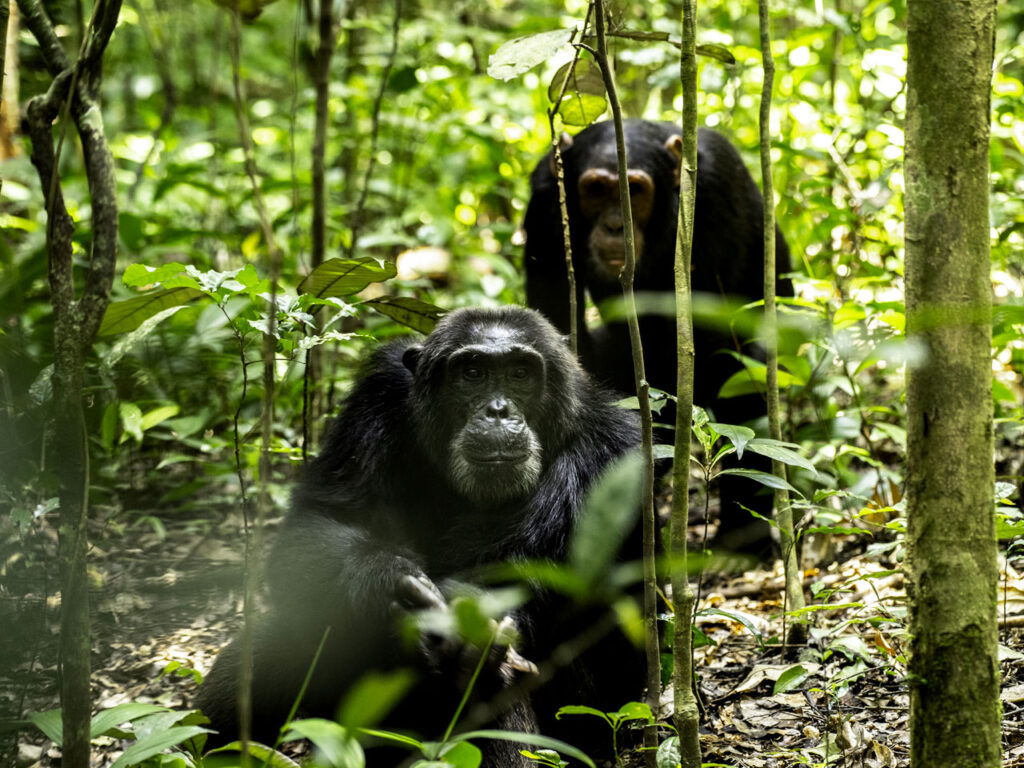
A standard chimpanzee tracking session in Budongo Forest takes about 3 to 4 hours in total. This includes a mandatory 30-minute pre-trek briefing, 1 to 3 hours of walking through the forest trails to locate the chimpanzees, and a strict 1 hour of direct observation once the chimpanzees are found.
4-days-birding-safari-in-murchison-falls-budongo-forest-and-ziwa-rhinos
2-days-chimpanzee-tracking-sleeping-at-budongo-eco-lodge
2-days-best-chimpanzee-tracking-in-kibale-forest-park-tour-package
3-days-trips-to-queen-elizabeth-national-park-for-chimpanzee-tracking-in-kyambura-gorge
3-days-chimpanzee-tracking-to-kibale-forest-national-park
4-days-queen-elizabeth-national-park-and-kyambura-gorge-chimpanzee-tracking
4-days-kibale-forest-chimpanzee-tracking-and-queen-elizabeth-national-park
4-days-chimpanzee-tracking-in-lake-mburo-national-park-and-lake-mburo-safari
4-days-kibale-forest-chimpanzee-tracking-and-queen-elizabeth-national-park
4-days-murchison-falls-and-chimpanzee-tracking-in-budongo-forest
5-days-uganda-big-five-safari-and-chimpanzee-tracking-in-kibale-forest-park
6-days-jinja-white-water-rafting-gorilla-trekking-and-chimpanzee-tracking-adventure
6-days-budget-uganda-safari-and-gorilla-trekking
7-days-perfect-uganda-primate-safari-itinerary
The Pre-Trek Briefing
Your adventure begins at the Kaniyo Pabidi eco-tourism site with a warm welcome from local rangers. This 30-minute briefing is not just a standard safety lecture; it is an essential introduction to a delicate rainforest ecosystem. Rangers share fascinating insights into the history of the habituated chimpanzee communities living within Budongo Forest. They explain chimp social hierarchies, communication methods like vocalizations, and the subtle behaviors you might witness while out on the trail.
You will also learn crucial behavioral guidelines designed to protect both you and the primates. These rules include keeping a strict eight-meter distance, lowering your voice, and avoiding direct eye contact with dominant males, which can be interpreted as a direct challenge. The rangers also outline exactly what to do if a curious chimpanzee decides to approach you on the path. This time allows you to double-check your gear, lace up your hiking boots, adjust your camera settings, and ensure your insect repellent is properly applied. It sets a respectful, highly anticipatory tone for the journey ahead, transforming you from a regular tourist into a conscious, prepared observer.
The Searching and Trekking
Once the briefing concludes, you step directly into the dense, ancient mahogany canopy of the forest. This phase is an active, unpredictable trek that typically lasts between one and three hours. You are not just going for a walk; you are actively tracking wild animals alongside an expert guide. The guides use tracking skills to look for fresh footprints in the mud, discarded fruit peels, and nests built high in the trees the previous night.
The forest around you is alive with the sounds of rustling leaves, birds, and distant monkey calls. The duration of your search depends entirely on where the chimpanzees moved to find food. During fruiting seasons, they might be close to the eco-lodge, making for a quick walk. In dry periods, they move deeper into the forest, requiring a more challenging hike across uneven terrain and thick undergrowth. It is a fully immersive sensory experience where every crack of a twig builds immense anticipation. Your guide will frequently pause to interpret forest signs, making the search an educational journey until the sudden, thrilling sound of a distant chimp pant-hoot signals success.
The Viewing Time
The moment you finally catch up with the chimpanzees, the atmosphere shifts completely, and your strict sixty-minute observation window begins. Watching wild chimpanzees in their natural habitat is a profound, deeply moving experience. For one full hour, you get a front-row seat to their daily lives. You might see them grooming each other to strengthen social bonds, playing in the undergrowth, or swinging effortlessly through the high branches.
If you are lucky, you will witness the raw power of an alpha male drumming on buttress roots to assert dominance. The forest fills with their incredibly loud pant-hoot calls, a sound that literally vibrates through your chest. Your guide will help identify individual chimps by their facial features and explain the specific interactions happening right in front of you. This hour passes incredibly fast as you quietly take photographs and absorb their human-like expressions and gestures. It is a rare privilege to sit quietly in their living room, observing the striking similarities we share with our closest living relatives before quietly slipping away back down the trail.
What is the total length of a standard chimpanzee tracking session?
A standard chimpanzee tracking excursion in Budongo Forest typically takes between 3 to 4 hours from start to finish. This timeframe covers three main phases: the initial park briefing, the active forest search, and the habituated viewing period. The exact duration depends largely on the movements of the chimpanzee troops on any given day. If the primates are foraging near the Kaniyo Pabidi center, the entire outing can wrap up in roughly two and a half hours. Conversely, if the group moves deep into the mahogany canopy seeking ripe fruits, the search phase stretches out, pushing the experience toward the full four-hour mark. Regardless of how quickly or slowly you locate the group, the structure of the session ensures that time spent walking is balanced with proper instruction and safe observation. Planning for a four-hour window gives you a comfortable buffer for your daily itinerary without feeling rushed during the walk.
How long does the pre-trek briefing actually take?
The pre-trek briefing at the Kaniyo Pabidi eco-tourism site runs for precisely 30 minutes. Rangers use this structured block of time to prepare visitors for the terrain and the wild nature of the primates. Rather than a quick sign-in, it serves as an operational walkthrough of park rules, safety protocols, and forest conservation facts. During these 30 minutes, rangers explain how to maintain the mandatory eight-meter distance, how to manage noise levels, and what steps to take if an alpha male moves across the trail. It also gives trackers time to adjust backpacks, tie boot laces, check camera settings, and finish applying insect repellent. Skipping or shortening this half-hour segment is not permitted, as proper preparation ensures both human safety and the protection of Budongo’s habituated chimpanzee communities.
How much time is spent searching for the chimpanzees in the forest?
The search phase generally lasts anywhere from 1 to 3 hours. Because the chimpanzees roam freely through their natural habitat, there is no set trail or fixed location for finding them. Rangers and expert guides rely on visual cues like fresh knuckle prints in the soil, fallen fruit pieces, and vocalizations to map out the route. During months when food is abundant near the main paths, finding a troop can take as little as 45 minutes. When food is scarce, the chimps move further into dense, off-trail sections, extending the walk to three hours. This variability makes the trekking time dynamic, requiring moderate physical endurance as you navigate uneven ground, dangling vines, and thick forest floor undergrowth.
Why is direct observation limited to strictly one hour?
Once your guide locates the chimpanzees, a strict 60-minute countdown begins for direct observation. This precise time limit is a mandatory conservation standard implemented across protected areas in Uganda. Restricting human contact to one hour prevents excessive stress on the animals, allowing them to carry on with their natural feeding, resting, and grooming routines without prolonged disruption. Furthermore, limiting exposure time significantly lowers the risk of disease transmission between humans and primates, who share roughly 98.8% of their DNA. Even if the chimpanzees remain seated near the path when your hour ends, the guide will instruct the group to step back and begin the return journey to keep the interaction safe and sustainable.
What start times are available for tracking sessions?
Budongo Forest operates two main tracking shifts each day: a morning session starting at 8:00 AM and an afternoon session starting at 2:00 PM. The morning slot requires arriving at the Kaniyo Pabidi visitor site by 7:30 AM for registration and the briefing. This shift is widely favored because chimpanzees are highly active in the cooler early hours, feeding and calling to one another. The afternoon shift requires checking in by 1:30 PM. During this later window, the primates often rest or groom under the thick canopy to escape the midday heat before their late-afternoon feeding cycle begins. Choosing between the two options depends on your overall travel schedule across the Murchison Falls conservation region.
How early should visitors arrive before their scheduled tracking shift?
Visitors should plan to arrive at the Kaniyo Pabidi eco-tourism center at least 30 minutes before the official start time—meaning 7:30 AM for the morning trek or 1:30 PM for the afternoon trek. Arriving early allows sufficient time to complete mandatory administrative steps, including permit verification and signing the park visitor registry. It also provides a relaxed environment to use the restroom facilities, meet your designated ranger guide, and hire a local porter if needed. Running late can disrupt the group dynamic or result in missing the mandatory briefing, which can compromise your ability to join the morning or afternoon entry into the forest.
Does the time of year affect how long tracking takes?
Yes, seasonal weather patterns directly influence the time required to locate chimpanzee troops. During the wet seasons (March to May and September to November), fruit is abundant throughout the forest, so chimpanzees do not need to travel long distances to feed. Consequently, search times are often shorter during these wet months. During dry seasons (December to February and June to August), fruit becomes scarce, prompting the chimps to disperse into smaller sub-groups and cover wider territories deep within the forest. As a result, tracking sessions during dry periods often stretch toward the upper limit of three hours of walking before making contact.
Is full-day chimpanzee habituation available, and how long does it last?
Yes, Budongo Forest offers a Chimpanzee Habituation Experience (CHAE), which lasts a full day, typically around 10 to 12 hours. Unlike the standard tracking session—which caps viewing at one hour—the habituation process begins before sunrise at around 6:00 AM and concludes at dusk near 6:30 PM. Participants accompany researchers and habituation rangers into the forest to find the chimps where they built their nests the previous night. Visitors spend the entire day observing the troop as they wake, forage, groom, and construct new nests for the evening. This option provides an extended look at primate behavior for those seeking a longer immersion than the standard tour.
How far in advance should permits be booked to guarantee a time slot?
Chimpanzee tracking permits for Budongo Forest should ideally be secured 2 to 4 months in advance, particularly if traveling during peak safari months (June through September and December through February). Because daily permit numbers are restricted to protect the forest environment and prevent overcrowding around the troops, space on both the 8:00 AM and 2:00 PM shifts fills up quickly. Booking well ahead of your travel dates ensures you secure your preferred morning or afternoon time slot and allows your ground operator to structure the surrounding road transfers smoothly. Last-minute bookings are sometimes possible during the low season, but availability cannot be guaranteed.
How does tracking fit into a transfer day from Kampala or Entebbe?
Driving directly from Kampala or Entebbe to Budongo Forest takes roughly 5 to 6 hours depending on traffic conditions and road stops. Because of this transit duration, joining the 8:00 AM morning tracking session on the same day you leave Kampala is generally not feasible unless you depart during the early hours of the night. A more practical schedule involves driving up to the Masindi or Budongo area on day one, overnighting nearby, and doing the morning trek on day two. Alternatively, travelers leaving Kampala very early in the morning can reach the park in time for the 2:00 PM afternoon tracking session.
How much time is spent driving inside the reserve to reach the trailhead?
The Kaniyo Pabidi visitor center serves as the primary base for chimpanzee tracking in Budongo, located directly along the main road that runs through the Budongo Forest Reserve toward Murchison Falls National Park. Depending on where your lodge is located within the park or surrounding areas, driving time to the visitor center ranges from 15 to 45 minutes. The trek itself starts on foot right from or near the eco-center base, meaning there are no long, secondary off-road drives required inside the forest once you have arrived and registered at the main post.
What happens to the schedule if it rains heavily during the trek?
Tropical rainfall is common in rainforest environments, and tracking sessions proceed as scheduled in light to moderate rain. If a heavy downpour begins right before the briefing, rangers may pause the start for 15 to 30 minutes to let the worst of the storm pass. Rain does not cancel the trek, but it can extend the searching time. Chimpanzees often take shelter high in the tree canopy or under thick foliage during rain, making them quieter and harder to locate. Visitors should pack waterproof jackets and rain covers for cameras so the schedule can continue smoothly regardless of sudden weather changes.
How is time allocated between walking on established trails vs. off-trail terrain?
During a typical tracking session, about 60% of your walking time takes place on established forest paths and old logging tracks, while the remaining 40% involves navigating off-trail through raw forest floor. Guides initially lead groups along well-maintained trails to cover ground quickly while listening for calls. Once fresh tracks or distant pant-hoots are detected, the guide will lead the group off the main path directly into the undergrowth to reach the exact position of the chimps. Pushing through thick vegetation slows the walking pace, which is factored into the overall 1 to 3-hour search duration.
What time of day offers the best photography light in the forest?
Light conditions within the Budongo mahogany canopy vary significantly depending on your session time. The morning session (8:00 AM to 12:00 PM) generally offers softer, cooler light as the sun rises, though the thick canopy can make the forest floor dark. The afternoon session (2:00 PM to 5:00 PM) provides stronger overall light, but contrast can be harsh when sunbeams break through the trees, creating strong highlights and deep shadows. The 60-minute viewing window requires quick adjustments to camera settings, particularly boosting ISO levels to account for shaded environments under the dense forest ceiling.
How much time do chimpanzees spend on the ground versus up in the trees?
Chimpanzee behavior varies throughout the day, affecting where you spend your 60 minutes of viewing time. In the early morning hours, chimps often descend to the forest floor to travel between feeding sites, forage for fallen seeds, or socialise in open clearings, giving trackers clear ground-level views. As the sun rises and temperatures warm up toward midday, they tend to move high up into the trees to feed on fruit or rest in shady branches. Consequently, morning tracking sessions often offer more ground-level observation, while afternoon sessions involve looking up into the high branches.
What is the cancellation policy regarding missed arrival times?
Permits for chimpanzee tracking are tied to specific dates and times. If you arrive late and miss both the 8:00 AM briefing and the group departure, your permit for that shift becomes invalid and is non-refundable. Because group sizes are limited to ensure conservation compliance, late arrivals cannot simply join a group that has already entered the forest. If space permits, park authorities may allow you to reschedule to the 2:00 PM afternoon slot on the same day, but this depends entirely on permit availability. Maintaining strict adherence to your travel schedule is essential to avoid forfeiting your permit.
How long should you plan to rest after the trek before driving to your next destination?
After completing the 3 to 4-hour tracking session, planning a 45 to 60-minute recovery window at the visitor center or your lodge is recommended. This time allows you to change out of damp trekking gear, enjoy a hot meal or cold drink, use the restrooms, and debrief with your guide. If your itinerary involves driving to northern Murchison Falls, Paraa, or back toward Kampala, factoring in this short break prevents driver fatigue and ensures you leave Budongo rested and prepared for the next leg of your journey.
How much time is allocated for hiring a porter before the trek starts?
Hiring a local porter at Kaniyo Pabidi takes less than 10 minutes and happens during the pre-trek arrival window before the official briefing begins. Porters are local community members available at the visitor site to carry daypacks, camera bags, and assist over slippery sections of the trail. Engaging a porter not only lightens your physical load during the 1 to 3-hour hike but also directly supports local families living adjacent to the forest reserve. The small fee is arranged on-site prior to stepping onto the forest trail.
How long is the lunch break between the morning and afternoon tracking sessions?
For travelers spending the day around the Budongo Forest area, there is a clear two-hour window between the end of the morning shift (around 11:30 AM or 12:00 PM) and the start of the afternoon check-in (1:30 PM). This interval provides sufficient time to return to nearby accommodations like Budongo Eco Lodge for a cooked lunch, rest in the lounge areas, recharge camera batteries, and prepare gear if participating in afternoon game drives or secondary forest walks within the reserve.
Can a Budongo tracking session be combined with a Murchison Falls boat cruise on the same day?
Combining morning chimpanzee tracking in Budongo with an afternoon boat cruise to the base of Murchison Falls is logistically possible, but timing must be managed carefully. The morning tracking session finishes by 11:30 AM at the latest. From Kaniyo Pabidi, driving north to the Paraa river crossing takes roughly 1.5 to 2 hours. Since afternoon boat cruises along the Nile typically depart Paraa at 2:00 PM or 2:30 PM, you must clear the forest prompt at 11:30 AM and drive directly to the river point without extended stops, leaving a tight buffer for lunch along the way.
Booking chimpanzee tracking in Budongo forest with us Roads f Adventure safaris
Booking chimpanzee tracking in Budongo Forest via Roads Of Adventure Safaris involves coordinating 4×4 transport from Kampala, securing permits through the Uganda Wildlife Authority, and organizing stays at Kaniyo Pabidi. Standard permits cost $130 for foreign non-residents ($120 for foreign residents)
