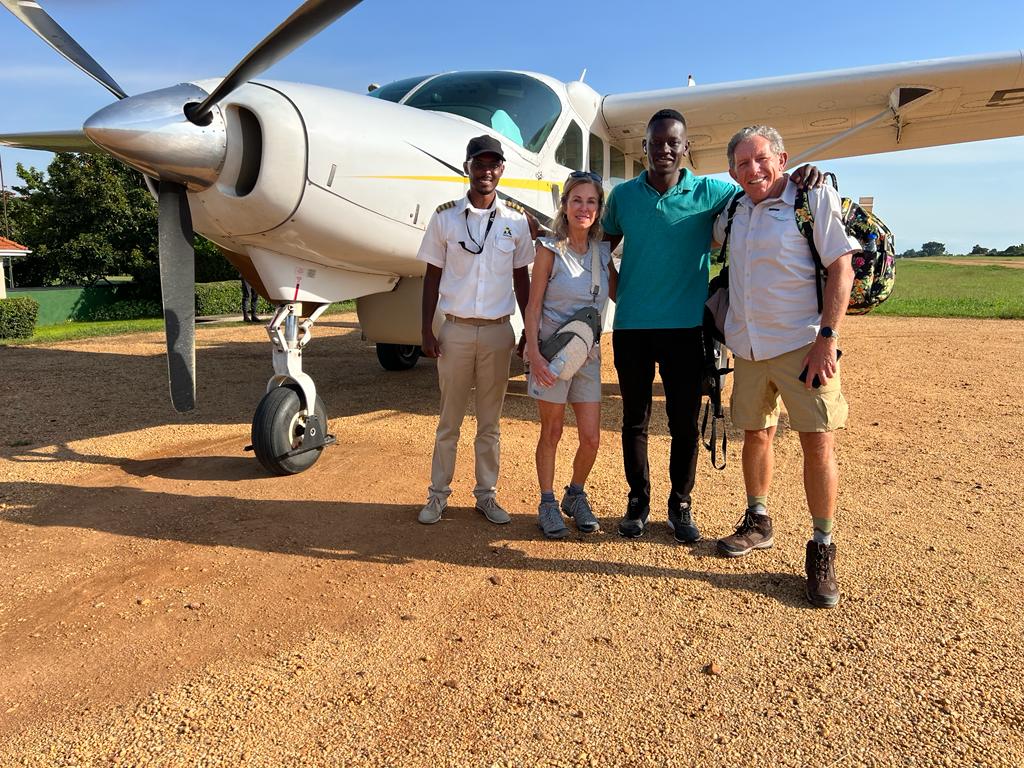
Neither airstrip is universally "better"; the best choice depends entirely on which of Bwindi's four gorilla trekking sectors (Buhoma, Ruhija, Rushaga, or Nkuringo) your gorilla permit is booked for
4-days-luxury-gorilla-trekking-safari-in-bwindi-fly-in-all-inclusive-tour
1. Kihihi Airstrip (Northern Bwindi)
Conveniently positioned in the low-lying valleys of southwestern Uganda, Kihihi Airstrip serves as the primary and most reliable northern gateway into Bwindi Impenetrable National Park. This unpaved bush runway is highly favored by domestic airlines due to its lower elevation, which generally translates to stable weather patterns, minimal fog interference, and fewer flight cancellations or delays compared to higher-altitude alternatives. For travelers holding gorilla tracking permits for the Buhoma or Ruhija sectors, landing at Kihihi is the most logistically sound decision you can make for your itinerary.
Upon touchdown, you will find yourself surrounded by a relatively flat, rural landscape that quickly transitions into rolling agricultural countryside. The subsequent ground transfer to the Buhoma sector—the historic headquarters of the national park—is a manageable and scenic 1 to 1.5-hour drive in a 4x4 safari vehicle. If you are tracking in Ruhija, the drive takes roughly 2 hours, climbing gradually into the cooler mountain heights. The road infrastructure heading south from Kihihi has seen steady improvements, meaning the overall transfer is noticeably smoother, less jarring, and less physically exhausting than the rugged tracks found in the deep south.
The overall vibe of arriving via Kihihi is one of seamless transition. You trace a beautiful path through rural Ugandan villages, vast tea plantations, and local banana shambas, watching the countryside gradually rise to meet the massive, dark green wall of the ancient rainforest. Because Buhoma is home to some of the oldest and most established luxury lodges in the region, flying into Kihihi offers a highly polished, effortless luxury safari experience that maximizes your comfort and keeps transit friction to an absolute minimum.
2. Kisoro Airstrip (Southern Bwindi)
Tucked deep into the dramatic southwestern corner of Uganda, right at the base of the towering Virunga Massifs, Kisoro Airstrip is the thrilling aviation gateway to Southern Bwindi. This airstrip is explicitly designed to service the Rushaga and Nkuringo tracking sectors of Bwindi, as well as nearby Mgahinga Gorilla National Park. For adventurous travelers looking to experience the steep, mist-shrouded ridges of the southern forest or tackle the challenging volcanic peaks of Mgahinga, Kisoro is the indispensable point of arrival.
The approach into Kisoro is a visual masterpiece, offering jaw-dropping aerial views of the terraced hills of Kigezi, Lake Mutanda, and the iconic silhouettes of the Muhabura, Gahinga, and Sabyinyo volcanoes. However, because the airstrip sits at a high altitude surrounded by mountainous terrain, flights here are highly weather-dependent. Morning fog and heavy cloud cover are common, meaning pilots require excellent visibility to land safely, occasionally leading to flight delays. Once on the ground, the vibe is raw, dramatic, and breathtakingly beautiful. The crisp mountain air immediately signals that you have arrived in Africa’s true highlands.
The ground transfer from Kisoro to the Rushaga and Nkuringo park gates takes about 1.5 to 2 hours, but it is a journey defined by intense, rugged, and steep mountain terrain. You will navigate winding dirt roads that hug the edges of deep valleys, requiring a sturdy 4x4 vehicle and an experienced safari guide. While the drive is bumpy and physically demanding, it rewards you with unparalleled vistas of rural African mountain life and panoramic views of the volcanoes. It is the perfect entryway for trackers seeking a rugged, immersive, and visually spectacular gorilla expedition.
Which airstrip protects my $800 permit investment from becoming an operational loss?
A gorilla permit is strictly non-refundable and tied to a specific sector.
- Kihihi (North) directly serves Buhoma and Ruhija.
- Kisoro (South) directly serves Rushaga and Nkuringo.
If you book a client to land at Kihihi but their tracking permit is for Rushaga, you face a 4-hour rough overland transfer crossing the mountains. This misalignment often forces high-end operators to pay emergency 4x4 transfer rates (~$250+) or risk the client arriving late, forfeiting the $800 permit completely with zero recourse from the Uganda Wildlife Authority (UWA).
What is the financial exposure regarding seasonal flight cancellations between the two runways?
Kisoro Airstrip sits at a higher altitude surrounded by the Virunga Volcanoes, making it highly susceptible to heavy morning fog and low cloud cover. Airlines like Aerolink and Bar Aviation will ground or divert flights if visibility drops below safety minimums. Kihihi sits lower in a valley and has vastly superior operational uptime.
From a transactional standpoint, booking Kisoro during the wet shoulder seasons (March–May, October–November) introduces a higher probability of flight cancellation. This can trigger expensive contractual penalties with luxury lodges for "no-shows" and force you to buy last-minute road evacuations.
How do the airline arrival/departure windows impact my overall itinerary yield?
Airlines heavily restrict Kisoro flights due to afternoon winds and cloud buildup over the highlands.
- Kisoro Airstrip: Only operates morning scheduled flights (typically departing Entebbe at 07:00 AM).
- Kihihi Airstrip: Benefits from up to three scheduled frequencies daily (Morning, Mid-morning, and Afternoon).
Transactionally, Kihihi allows you to upsell same-day international arrivals onto a afternoon bush flight, maximizing the client's vacation days and increasing your package pricing efficiency. Kisoro forces an automatic overnight stay in Entebbe if the client arrives past 06:00 AM.
What are the vehicle and fuel cost differences after touchdown?
Landing is only half the journey; you must calculate the "last mile" cost.
- From Kihihi to Buhoma: ~1 hour on relatively gentle, improving dirt roads. Wear-and-tear on your 4x4 fleet is lower, and fuel consumption is predictable.
- From Kisoro to Nkuringo/Rushaga: 1.5 to 2 hours over punishing, steep volcanic switchbacks.
The steep gradients of the south demand high-grade, meticulously maintained 4x4 Land Cruisers, which command a higher daily rental yield (~$200–$250/day) and burn more fuel per kilometer.
Which airstrip delivers a better ROI when building a multi-destination safari?
If your goal is to upsell a multi-park itinerary to increase total booking value, Kihihi is a superior financial hub. It seamlessly links into the Western Tourism Circuit. A client can trek gorillas in Buhoma, take a 1.5-hour road transfer to Queen Elizabeth National Park for tree-climbing lions, or catch a short hop flight to Kasese (for Kibale chimpanzees) or Murchison Falls. Kisoro is tucked into a geographic dead-end; it links perfectly to Mgahinga (Golden Monkeys) but adds severe transit time if you try to route clients northward by road afterward.
How does airstrip selection affect my margins with tier-one lodging partners?
The highest-yielding luxury lodges are split between the sectors. Buhoma (via Kihihi) holds legacy properties like Sanctuary Gorilla Forest Camp and Volcanoes Bwindi Lodge. The South (via Kisoro) boasts ultra-luxury gems like Clouds Mountain Gorilla Lodge. Because access to Clouds requires navigating Kisoro infrastructure, you must price the ground handling tightly. However, because southern transfers are more intense, these ultra-luxury properties often offer higher built-in operator commissions (up to 20-25%) to incentivize agents to push through the southern logistical friction.
When does switching from scheduled seats to a private charter optimize group profitability?
A scheduled return ticket to either airstrip averages ~$540 per person. If you are booking a family or a small corporate group of 4 to 6 passengers, booking individual seats costs between $2,160 and $3,240. At this price point, transactionally switching to a private charter via Fly Uganda or Bar Aviation becomes highly viable. Private charters eliminate luggage restrictions, allow custom departure times, and protect your profit margin by locking in a flat aircraft rate rather than paying per-seat variable costs.
How do strict weight limits affect client spend?
Both airstrips utilize Cessna Grand Caravans with a strict 15kg to 20kg soft-bag weight limit. If a luxury client arrives with oversized, rigid luggage, the airline will reject it. As an operator, this means you must either maintain an expensive luggage storage/freight delivery service in Entebbe or buy an extra "freight seat" on the aircraft (costing an additional ~$280 one-way) to accommodate their gear. Factoring this into your initial transactional quote for photography-heavy clients is vital.
Which airstrip protects my market share against Rwanda's luxury corridor?
Rwanda positions Volcanoes National Park as a frictionless, 3-hour smooth tarmac drive from Kigali. To compete commercially, Uganda operators must offer an equally seamless premium experience. Kihihi to Buhoma is the closest match to this level of comfort. Landing at Kisoro and subjecting high-net-worth clients to 2 hours of violent mountain switchbacks can generate negative feedback, reducing your referral rates and lifetime customer value.
Which runway maximizes the conversion rate for high-ticket $1,500 experiences?
The exclusive Gorilla Habituation Experience—where clients spend 4 hours with wild gorillas instead of 1—is only run in the southern Rushaga sector. The permit costs $1,500 (nearly double the standard $800 permit). Commercially, Kisoro Airstrip is the exclusive gateway to this high-margin add-on. When pitching a premium itinerary, routing via Kisoro allows you to position the Habituation Experience as the centerpiece, significantly increasing your overall package revenue per passenger
Booking fly gorilla trekking with us Roads of Adventure safaris
To book a fly-in gorilla trekking safari with Roads of Adventure Safaris, you can easily customize a 3- to 4-day all-inclusive package that replaces the 9-hour drive with a 1.5-hour scenic flight from Entebbe to Bwindi Impenetrable National Park
