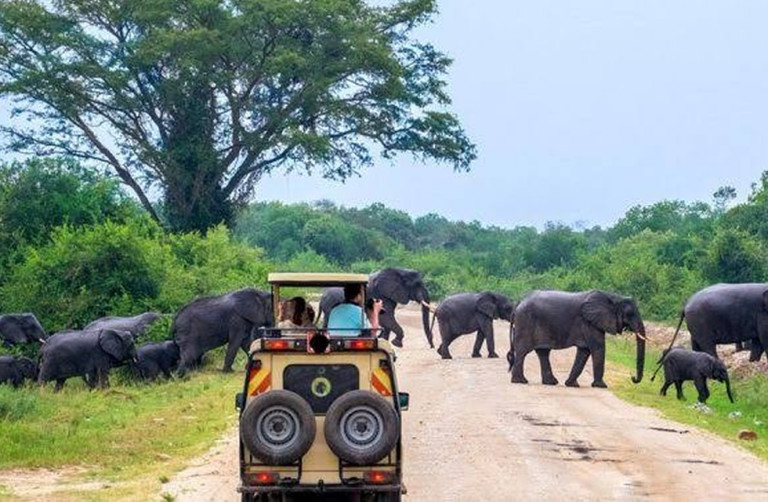
Budget Uganda safaris cost between $150–$300 per person, per day. You can experience the Pearl of Africa affordably by booking group tours, traveling during the low seasons (March–May, October–November), choosing basic campsites or Bandas, and renting 4WD safari vans instead of Land Cruisers
2-days-all-inclusive-uganda-gorilla-trekking-from-kigali-rwanda
2-days-budget-uganda-safari-to-murchison-falls-park
3-days-affordable-uganda-budget-gorilla-trekking-via-kigali
6-days-budget-uganda-wildlife-safari-holiday-vacation
7-days-budget-uganda-safari-tour-package
1. Timing Your Trip with Low Season Variations
One of the easiest ways to slash the cost of your budget Uganda safari is to book during the low or rainy seasons. Uganda has two distinct wet windows: March to May and October to November. During these months, the country receives tropical rainfall, but the showers usually clear up within a few hours, leaving the rest of the day wide open for exploration.
Because tourist numbers drop during these months, most safari lodges, camp facilities, and transport operators slash their prices by 20% to 40% to attract clients. This provides a brilliant opportunity for budget travelers to secure comfortable mid-range accommodations at basic budget prices. Furthermore, the national parks are much quieter, meaning you can enjoy your game drives without a long line of tourist vehicles blocking your view of a leopard or a lion pride.
An additional benefit of a wet-season budget Uganda safari is the landscape itself. The savannas turn a beautiful, lush green, the dust is swept away, and the air is crisp, which makes for spectacular wildlife photography. Migratory birds also arrive in huge numbers, making it the absolute peak time for birdwatching. If you pack a good rain jacket, sturdy waterproof boots, and an open mind, traveling off-peak offers an incredibly intimate, pocket-friendly adventure.
2. Navigating the Fixed Costs of Gorilla Permits
When planning a budget Uganda safari, it is crucial to understand that primate tracking permits are fixed costs set by the Uganda Wildlife Authority (UWA). Unlike lodging or transportation, permit prices cannot be discounted or negotiated by local tour operators. A mountain gorilla trekking permit for a foreign non-resident costs $800, which gives you one unforgettable hour with a habituated gorilla family in either Bwindi Impenetrable National Park or Mgahinga Gorilla National Park.
While $800 is a significant investment for a budget traveler, it is actually a massive saving when compared to neighboring Rwanda, where a single gorilla permit costs $1,500. Choosing a budget Uganda safari instantly saves you $700 on the permit alone. To balance this heavy fixed cost, smart travelers minimize their spending on the surrounding variable factors—such as choosing basic, community-owned camps and using shared transport.
Because Bwindi has four distinct trekking sectors (Buhoma, Ruhija, Rushaga, and Nkuringo), you should ensure your permit matches the exact region where your affordable lodge is located. Booking a permit in Rushaga but reserving a budget room near Buhoma will force you into an exhausting, expensive 4-hour mountain drive before sunrise. Securing your permits three to six months in advance guarantees your spot and allows your operator to align your cheap accommodation perfectly, avoiding unnecessary transit fees.
3. Opting for Shared Group Joining Safaris
Transportation and fuel often make up the second-largest portion of a travel budget. Renting a private 4x4 safari vehicle with a professional driver-guide typically costs between $150 and $250 per day. For a solo traveler or a couple, bearing this entire cost independently will quickly push a budget Uganda safari out of financial reach.
The most effective solution is to book a scheduled group joining safari. By sharing a rugged 4x4 safari land cruiser or a customized safari van with fellow travelers, you split the daily vehicle hire, fuel costs, and guide fees across multiple people. This single choice dramatically lowers your individual daily expenditure while still giving you a seamless, professionally guided wildlife experience.
Group safaris also bring a fun, social element to your budget Uganda safari. You get to share the excitement of spotting a tree-climbing lion or an elephant herd with like-minded travelers from all over the world. These itineraries are highly organized and follow set routes through top destinations like Queen Elizabeth National Park and Murchison Falls National Park, ensuring you hit all the major highlights without paying premium private rates.
4. Prioritizing Locally Owned Budget Accommodations
Accommodation options in Uganda span a vast range, from ultra-luxury eco-lodges costing over $1,000 a night to simple, comfortable community camps. To keep your trip firmly within a budget Uganda safari framework, you should target locally owned guesthouses, bed-and-breakfasts, and budget eco-lodges located just outside the national park boundaries.
Lodges situated inside the park gates usually face high concession fees, which drives up their booking rates. In contrast, properties situated a few kilometers outside the gates bypass these fees, allowing them to offer clean rooms, hot running water, mosquito nets, and delicious hot meals at a fraction of the cost. Many of these budget properties are run by local communities, meaning your stay directly supports conservation and local families.
For the ultra-thrifty traveler, UWA operates basic, self-contained guest houses called "bandas" directly inside several major parks. These thatched cabins provide simple beds and basic amenities under 24-hour ranger security. Alternatively, if you are willing to pack a lightweight travel tent, almost all budget camps will allow you to pitch it on their green lawns for a nominal fee of $5 to $8 per night, granting you full access to their shared hot showers and common dining areas.
5. Maximizing Park Fees with 24-Hour Planning
National park entry fees are another essential factor to manage closely during a budget Uganda safari. For most of Uganda's premium savanna parks—including Murchison Falls, Queen Elizabeth, and Kidepo Valley—the standard park entry fee for foreign non-residents is $45 per person. The critical detail to remember is that this fee operates strictly on a 24-hour ticket cycle, not a calendar day.
Smart itinerary planning can save you a significant amount of money. For example, if you enter Murchison Falls National Park at 2:00 PM on a Tuesday, your entry ticket remains completely valid until 2:00 PM on Wednesday. A well-constructed budget Uganda safari will utilize this window by scheduling an afternoon boat cruise on the Nile upon arrival, followed by an early morning game drive the next day, exiting the park before the 24 hours expire.
If your itinerary is loose and unoptimized, dragging an activity past that 24-hour mark by even thirty minutes will force you to pay for an entire second day's entry fee. When working with a local operator, always ensure they design your entry and exit times tightly. Maximizing every single hour on your park ticket keeps your funds free for other memorable activities along the route.
6. Discovering Affordable Chimpanzee Tracking Alternatives
Chimpanzee tracking is an absolute highlight of any trip to Uganda, but the costs vary wildly depending on where you choose to go. Kibale Forest National Park is globally recognized as the prime destination for seeing chimps, boasting the highest density of primates in East Africa. However, a standard chimpanzee tracking permit in Kibale costs $250 per person, which can heavily strain a tight budget Uganda safari financial plan.
Fortunately, Uganda offers several fantastic, low-cost alternative locations for tracking our closest genetic relatives. Budongo Forest, located right on the boundary of Murchison Falls National Park, offers an incredible chimp tracking experience under a lush mahogany canopy for roughly $130 to $140. Another excellent budget choice is the Kalinzu Forest Reserve, located close to Queen Elizabeth National Park, where chimp tracking permits cost around $50.
Kalinzu Forest features a remarkably high tracking success rate, and because it is managed by the National Forestry Authority rather than UWA, it remains an affordable hidden gem. Choosing Kalinzu or Budongo for your budget Uganda safari delivers a thrilling, authentic jungle trek alongside expert local guides while instantly saving you over $100 compared to premium park locations.
7. Emphasizing High-Value, Low-Cost Destinations
Not all national parks and tourist sites in Uganda cost the same to explore. A brilliant strategy for building a low-cost itinerary is to focus on destinations that offer immense natural beauty and rich wildlife experiences without charging heavy commercial park fees. Including these spots allows you to extend your budget Uganda safari without blowing your budget.
A prime example is Lake Mburo National Park, located along the western highway. Because Lake Mburo lacks large predators like elephants and lions, it is one of the few places where you can take a guided walking safari alongside zebras, giraffes, and impalas for a tiny community fee of $15 to $20. This completely eliminates the need for expensive vehicle rentals and heavy fuel consumption, allowing you to explore the African bush entirely on foot.
Other incredible, high-value destinations include Lake Bunyonyi and Sipi Falls. Lake Bunyonyi is a stunning, bilharzia-free lake framed by terraced hills where dugout canoe hires and island hikes cost next to nothing. Sipi Falls, located on the slopes of Mount Elgon, offers breathtaking multi-tiered waterfall treks and local coffee-making tours for a small local guide fee. These destinations keep your daily expenses very low while providing unforgettable cultural and natural encounters.
8. Opting for Overland Travel Over Domestic Flights
Uganda's top national parks are scattered across the western and northern corners of the country, far from the international airport in Entebbe. While domestic fly-in safaris are available, a single one-way flight to an airstrip near Bwindi or Murchison Falls can easily cost $300 to $400. To preserve your funds, a budget Uganda safari must rely entirely on overland road travel.
Driving through Uganda is not just a cost-saving measure; it is a fundamental part of the authentic African safari experience. The long drives take you through bustling roadside markets, endless terraced tea plantations, and beautiful rural villages. Watching the landscape shift from the dense urban energy of Kampala to the rolling savannahs of the west gives you a deep, genuine appreciation for the country’s geography and daily life.
To make overland travel highly efficient, a good budget Uganda safari itinerary will avoid long, exhausting 10-hour single-day drives. Instead, it breaks up the journey by stopping at intermediate attractions—such as visiting the Ziwa Rhino Sanctuary on the way north to Murchison Falls, or stopping at the Equator crossing for photos and a quick lunch. This keeps the journey comfortable, engaging, and highly budget-friendly.
9. Budgeting Smartly for Tipping and Gratuities
A common mistake made by many first-time travelers is forgetting to account for tipping when calculating their total safari costs. In Uganda's tourism industry, tipping is a deeply ingrained cultural practice that supplements the income of the hard-working rangers, trackers, drivers, and lodge staff who ensure your safety and comfort. Even on a strict budget Uganda safari, tipping should be treated as a non-negotiable expense.
Knowing the standard local tipping rates allows you to budget accurately without overspending. For your main professional driver-guide, a standard tip of $10 to $15 per day from the entire travel group is highly appreciated. When tracking gorillas or chimpanzees, it is customary to tip the lead ranger guide around $10 per person, and an additional $5 per person for the armed support rangers and wildlife trackers who locate the primate groups.
If you choose to hire a local porter at the trailhead to carry your backpack through steep terrain—which is highly recommended—their standard hiring fee is $15 to $20, and adding a small $5 tip for their hard work is standard practice. For budget lodge staff, dropping $5 to $10 into the communal staff tip box at checkout covers the entire team. Budgeting an extra $20 to $30 per day for general tipping ensures you show respect to local professionals without facing any unexpected financial surprises.
10. Booking Directly with a Local Tour Operator like Roads of Adventure safaris
The single most effective way to ensure you receive a true budget Uganda safari price is to book your trip directly with a licensed local tour operator based in Uganda rather than an international travel agency overseas. International agencies rarely own vehicles or employ guides locally; instead, they simply sub-contract your itinerary to local operators while adding a massive commission markup to the final price.
By cutting out the international middleman and working directly with a local destination management company (DMC), you save hundreds of dollars. Local operators possess up-to-the-minute knowledge of road conditions, park logistics, and the best affordable community lodges. They are also highly skilled at matching your specific interests with the most cost-effective routes, helping you skip overpriced tourist traps.
When choosing a local partner, look for operators registered with the Association of Uganda Tour Operators (AUTO) and licensed by the Uganda Tourism Board (UTB). This ensures your funds are fully secure, your vehicle is properly maintained, and your guide is a trained professional. Booking locally keeps your safari costs low, guarantees that your money directly boosts the local economy, and connects you with passionate local experts who can craft the ultimate budget adventure.
When Is the Best Time for Budget Uganda Safaris
The rainy low seasons running from March to May and October to November provide the absolute best window for budget travelers. During these wetter months, visitor numbers drop across the country. To fill empty rooms, standard mid-range and budget safari lodges drop their nightly prices significantly, often giving discounts between 30 and 40 percent.
While heavy showers do occur, they rarely last all day, leaving plenty of clear time for daily activities. Savannah landscapes in Murchison Falls and Queen Elizabeth National Park turn incredibly green, and newborn animals appear everywhere, which makes for spectacular photography. Furthermore, primate tracking trails in Bwindi Impenetrable National Park feel empty, offering a peaceful experience with fewer vehicles blocking the tracks. Availability for highly sought-after gorilla and chimpanzee tracking permits becomes much easier to secure, allowing budget travelers to plan their trips without the stress of booking over a year in advance.
Where to Stay on Budget Uganda Safaris
Uganda offers a wide range of affordable accommodation options that provide clean facilities, safety, and excellent access to national parks. Around Bwindi Impenetrable National Park, budget travelers can book comfortable eco-camps and community-run rest camps like Buhoma Community Rest Camp or Broadbill Forest Camp. These properties offer basic wooden cabins, self-contained safari tents, and secure camping grounds right near the tracking trailheads.
In the savannah parks, properties like Bush Lodge in Queen Elizabeth National Park or Red Chilli Rest Camp in Murchison Falls National Park present great budget value. They feature comfortable permanent tents under thatched roofs, shared or private bathroom facilities, and outdoor dining areas overlooking the parks. These locations let you hear the nocturnal sounds of hippos and hyenas without paying luxury prices. For chimpanzee tracking in Kibale Forest, budget travelers stay at cozy forest camps or local guesthouses inside the nearby Bigodi village area.
Booking Budget Uganda Safaris with Us Roads of Adventure Safaris
Booking with Roads of Adventure Safaris Ltd ensures you get maximum value out of your travel budget. As a registered Destination Management Company based in Kampala, we know how to cut unnecessary logistics costs while maintaining complete comfort. We design custom budget itineraries that prioritize affordable overland road travel instead of expensive internal flights. Our close partnerships with local lodge managers allow us to secure the best possible low-season room rates for our guests.
We operate a fleet of reliable, well-maintained 4x4 safari vehicles featuring pop-up roofs for optimal wildlife viewing. Our experienced local guides understand the terrain perfectly, ensuring smooth and safe road travel between destinations. We focus heavily on transparent pricing with no hidden fees, carefully covering park entries, vehicle fuel, and clean accommodation. Contact our Kampala office today to plan a highly authentic, cost-effective, and memorable journey through the Pearl of Africa.
