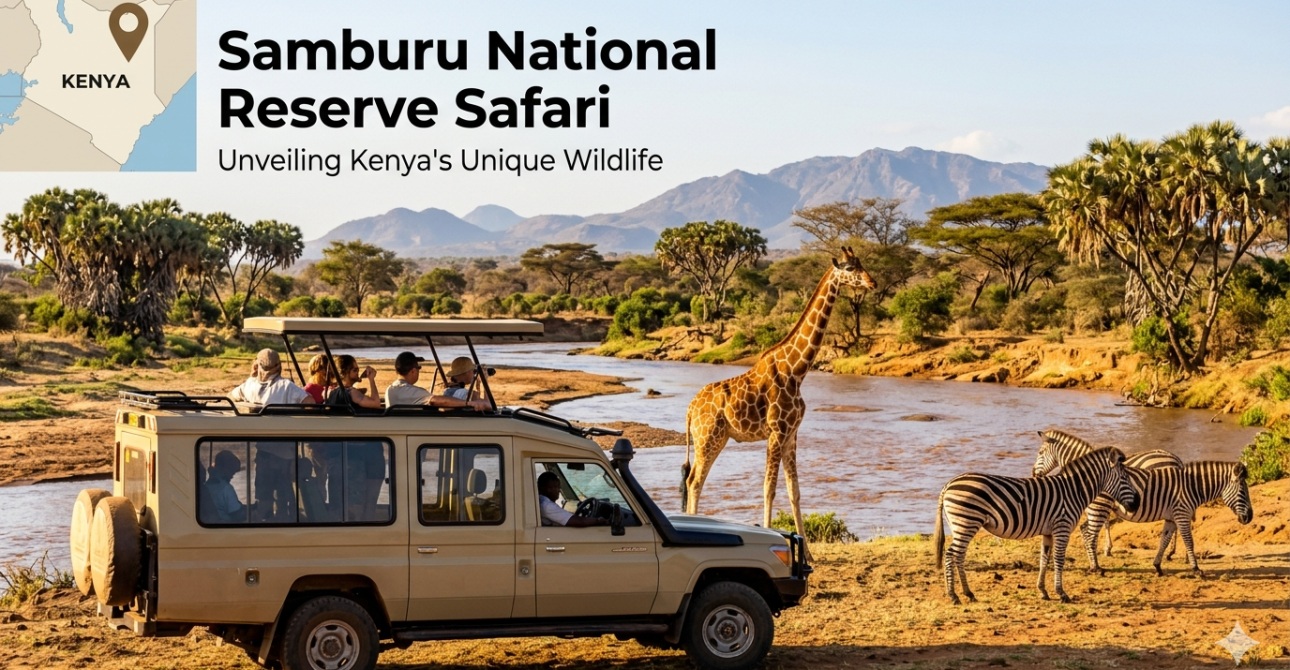
Heading north to Samburu National Reserve is a breathtaking journey of transformation. Located about 355 kilometers from Nairobi, the 5-to-6-hour drive along the A2 highway sweeps you through the lush, green central highlands—where you will cross the equator right at Nanyuki town—before plunging into the dramatic, semi-arid landscapes of northern Kenya. A rugged 4x4 vehicle is an absolute must to handle the rough, unpaved tracks near the reserve.
If you prefer to skip the bumps, a quick 50-minute domestic flight from Wilson Airport via Safari link or Air Kenya lands you directly on the local red-earth airstrips. Once you arrive, you will be in a completely different world, famous for the "Samburu Special Five": the beautiful reticulated giraffe, Grevy's zebra, Beisa oryx, Somali ostrich, and the long-necked gerenuk. Ready to explore this untamed northern frontier?
3-days-compelling-samburu-national-park-kenya-wildlife-safari-tour-package
4-days-kenya-wildlife-safar-to-samburu-and-lake-naivasha
10-days-samburu-amboseli-nakuru-naivasha-maasai-mara-safari-tour
What is the road distance from Nairobi to Samburu?
The road distance from Nairobi to Samburu National Reserve is approximately 355 kilometers (about 220 miles). Starting your journey from Kenya’s bustling capital, you will head north along the well-paved A2 highway. This scenic drive typically takes between 5 to 6 hours, depending on traffic leaving Nairobi and the number of stops you make along the way.
As you leave the city, the urban chaos quickly gives way to the agricultural heartland of the central highlands. You will pass through thriving towns like Thika—famous for its vast pineapple plantations—and Karatina, home to one of the largest open-air markets in East Africa. The road hugs the slopes of Mount Kenya, offering spectacular views of its jagged, snow-capped peaks on a clear morning.
The transition in geography is nothing short of dramatic. You will watch the landscape transform from lush, cool banana and coffee plantations into the golden, acacia-dotted plains of the northern frontier. While the highway itself is smooth tarmac, the final stretch leading into the reserve’s main gates (such as Archer’s Gate) turns into rough, corrugated dirt tracks where a sturdy vehicle is essential.
Is a four-wheel-drive vehicle necessary for this safari trip?
Yes, a robust 4x4 vehicle is highly recommended—and practically essential—for a safari in Samburu. While the main A2 highway from Nairobi to the turn-off near Archer’s Post is smooth tarmac, the roads inside the reserve itself consist of unpaved, rugged dirt tracks. These paths are prone to deep ruts, loose gravel, and thick sand, especially near the Ewaso Nyiro River.
During the dry season, a standard two-wheel-drive vehicle will struggle with traction and low ground clearance, risk scraping its undercarriage on rocks, or get stuck in soft riverbed sand. In the wet season (typically April to May and November), the clay-rich soils turn into slick, sticky mud that can easily trap anything less than a four-wheel-drive.
An ideal safari vehicle is a custom-built 4x4 Toyota Land Cruiser or a 4x4 safari minivan featuring a pop-up roof for unobstructed wildlife viewing. These vehicles offer high ground clearance, heavy-duty suspension to absorb the relentless corrugation, and low-range gears to crawl through tough terrain. Relying on a 4x4 ensures you can safely track a leopard through a donga without getting stranded in the wild.
Which airlines fly directly from Nairobi to Samburu airstrips?
If you prefer to bypass the six-hour road journey, you can book a direct domestic flight from Nairobi’s Wilson Airport (WIL). The two premier bush airlines operating daily scheduled flights to this northern region are Safarilink and Airkenya.
These airlines typically fly rugged, highly reliable turboprop aircraft such as the De Havilland Canada Dash 8 or the Cessna Grand Caravan, which are perfectly suited for landing on short, unpaved bush airstrips. The flight takes a mere 50 to 60 minutes, saving you a full day of travel and sparing you the dusty, bumpy roads.
Flights usually depart Wilson Airport in the morning, around 08:00 AM, and touch down on one of Samburu's red-clay runways—such as Buffalo Springs Airstrip or Samburu Oryx Airstrip—just in time for a mid-morning game drive and lunch at your lodge. Booking these flights in advance is crucial, especially during the peak tourist seasons from July to October, as these smaller aircraft have limited seating capacity (typically 12 to 37 passengers) and strict luggage limits of 15 kilograms (33 pounds) in soft-sided bags.
Where exactly do you cross the equator on this drive?
On the drive from Nairobi to Samburu, you will cross the equator right in the heart of Nanyuki town, located approximately 200 kilometers north of Nairobi. This geographic milestone sits at an elevation of 1,950 meters (6,398 feet) above sea level, nestled right at the foothills of Mount Kenya.
The crossing is marked by large, bright yellow road signs that proudly proclaim, "You Are Now Crossing The Equator." It is a mandatory pitstop for almost every traveler heading north. Local residents run clever, highly entertaining demonstrations using a bowl of water, a funnel, and a couple of matchsticks to showcase the Coriolis effect.
They will place a matchstick in water just north of the line to show it spinning clockwise, move it a few meters south to show it spinning counter-clockwise, and place it directly on the line where the water drains straight down without spinning. While the scientific accuracy of these quick, small-scale demonstrations is often debated by physicists, the experience is incredibly fun. It is the perfect place to stretch your legs, buy a hand-carved wooden souvenir, and take a classic photo.
What unique wildlife species make up the Samburu Special Five?
Samburu is world-famous for hosting five rare, highly adapted northern species collectively known as the "Samburu Special Five." These animals have evolved unique physical traits and behaviors to thrive in the harsh, semi-arid environment of northern Kenya, and you will rarely find them in southern parks like the Maasai Mara.
First is the Reticulated Giraffe, easily recognized by its striking, large, rust-colored patches outlined by sharp white lines, resembling a beautiful mosaic. Second is the Grevy’s Zebra, which is much larger than the common plains zebra, featuring narrower, tightly packed stripes and large, rounded mule-like ears. Third is the Beisa Oryx, an elegant antelope with straight, rapier-like horns and distinct black-and-white face markings.
Fourth is the Somali Ostrich, where the males display dramatic, bright blue skin on their necks and thighs during mating season, unlike the pinkish skin of common ostriches. Finally, there is the extraordinary Gerenuk (or giraffe-gazelle), an antelope with an incredibly long, slender neck that habitually stands flat on its hind legs to nibble tender leaves from thorny acacia branches high off the ground.
How long does the flight from Wilson Airport take?
The flight from Wilson Airport in Nairobi to the airstrips of Samburu is incredibly fast, taking just 50 to 60 minutes. This short flight time makes flying an incredibly popular option for travelers who want to maximize their safari time and avoid the physical fatigue of a six-hour road journey.
Your flight path takes you north, climbing quickly over the sprawling suburbs of Nairobi. On a clear day, the aerial views are spectacular. You will fly past the jagged, glacier-draped peaks of Mount Kenya (rising to 5,199 meters) and look down upon the neat, green checkerboard patterns of the Aberdare tea and coffee estates before descending into the vast, arid, ochre-colored plains of the northern frontier.
The descent is a thrilling experience in itself. The aircraft lines up with a rustic, red-earth airstrip—like Buffalo Springs—where pilots occasionally have to do a quick flyover first to clear wandering giraffes or impalas off the runway. From the moment you take off in the cool air of Nairobi to the moment you step out into the warm, dry breeze of Samburu, less than an hour has passed.
What is the landscape like in northern Kenya's reserve?
The landscape of Samburu National Reserve is a stark, dramatic, and hauntingly beautiful contrast to the lush green savannahs found in the south of the country. Classified as a semi-arid desert, it is characterized by vast, dusty plains of red earth, rugged volcanic kopjes (rocky hills), and dry, thorny scrubland.
The lifeblood of this harsh wilderness is the Ewaso Nyiro River, which cuts a brown, muddy path right through the reserve. The riverbanks are lined with a dense, oasis-like fringe of magnificent doum palms, acacia trees, and wild fig trees. This narrow green ribbon provides vital shade, water, and food, drawing in high concentrations of wildlife from the surrounding parched plains.
Dominating the horizon to the south is the imposing silhouette of Ol Olokwe (Sabache), a massive, flat-topped sacred mountain that rises sharply out of the dry plains. The play of light across this arid landscape is spectacular; sunrise and sunset paint the dusty air in rich shades of deep orange, dusty pink, and fiery red, creating a dreamlike backdrop that is a favorite for professional wildlife photographers worldwide.
Can you describe the behavior of the long-necked gerenuk?
The gerenuk (Litocranius walleri), also known as the "giraffe-gazelle," is one of the most physically adapted and fascinating antelopes you will ever encounter on safari. Its name translates to "giraffe-necked" in the Somali language, a fitting description for a creature with an elongated, pencil-thin neck and incredibly long, slender legs.
To survive in a dry habitat where ground-level grass is scarce, the gerenuk has developed a highly specialized feeding behavior. Unlike other antelopes that graze on the ground, the gerenuk is a high-browser. It routinely stands upright on its spindly hind legs, stretching its body vertically to its full height of up to 2 meters (over 6 feet) to reach the tender, moisture-rich leaves of thorny acacia bushes.
To do this, it uses its strong hip joints and wedges its forefeet into the branches for balance. It then uses its pointed muzzle and prehensile lips to selectively pluck leaves while ignoring the sharp thorns. Remarkably, gerenuks do not need to drink standing water; they obtain all the hydration they need from the sap and moisture of the green leaves they consume.
What are the main entry gates to the reserve?
Samburu National Reserve is highly accessible through a few well-established entry gates, each managed by the local county council. The most frequently used and famous entrance is Archer’s Gate, located on the eastern side of the reserve. It is situated just off the main A2 highway, near the lively dusty trading outpost of Archer's Post.
If you are arriving from the south after driving from Nairobi, Archer's Gate is the most direct entry point. For those staying in the neighboring Buffalo Springs National Reserve (which sits just across the Ewaso Nyiro River), the Buffalo Springs Gate is the primary point of access. Further to the west lies Uaso Gate, which connects Samburu to the neighboring Shaba National Reserve and offers a quieter, less-traveled entry route.
At these gates, you will stop to pay the mandatory park conservation fees—which currently sit at $70 USD per adult per day for non-residents. The gates feature basic visitor facilities, clean restrooms, and small offices where rangers inspect permits and safari vehicles before clearing you to enter the dusty, game-rich tracks of the reserve.
How does the Ewaso Nyiro River support local wildlife?
The Ewaso Nyiro River is the absolute lifeline of Samburu National Reserve; without it, this wildlife sanctuary simply could not exist. The river's name translates to "river of brown or muddy water" in the local Maa language, referring to the heavy silt it carries from its source on the slopes of the Aberdare Range and Mount Kenya.
As the river snakes its way through the hot, dry plains of Samburu, it creates a lush, green riverine forest corridor packed with doum palms and acacias. This narrow strip of vegetation serves as an essential refuge for wildlife during the heat of the day. Thousands of animals flock to the riverbanks to quench their thirst.
You can regularly watch large herds of elephants—sometimes numbering over 50 individuals—bathing, splashing, and playing in the shallow waters to cool down. Large Nile crocodiles, some stretching over 4 meters (13 feet) long, bask openly on the muddy banks, while leopards use the thick, overhanging branches of the riverine trees as perfect ambush platforms. During severe droughts, elephants will use their feet and tusks to dig deep wells into the dry sandy riverbed, uncovering clean water.
What is the best time of year to visit?
The absolute best time of year to visit Samburu National Reserve is during the dry seasons, which run from June to October and again from January to February. During these months, the weather is consistently warm, dry, and sunny, making for ideal safari conditions.
The dry weather has a dramatic effect on wildlife behavior, which works heavily in favor of tourists. Because water sources dry up across the wider region, animals are forced to migrate inward and congregate in high densities around the permanent waters of the Ewaso Nyiro River. Furthermore, the thick scrubland and dry grasses wither away, drastically improving visibility through the bush. This makes it much easier to spot elusive predators like leopards and lions.
If you visit during the wet seasons—specifically the "long rains" of April to May—the landscape turns beautifully green and lush, and birdwatching is spectacular. However, wildlife disperses far away from the river into the interior wilderness because water is abundant everywhere. This makes finding animals much more challenging, and some of the unpaved black-cotton soil tracks can become impassable, even for the sturdiest 4x4 vehicles.
Are there opportunities to interact with the local Samburu?
Yes, a safari to Samburu National Reserve offers incredible, deeply enriching opportunities to interact with the local Samburu people. The Samburu are a semi-nomadic pastoralist community closely related to the Maasai, known for keeping large herds of cattle, goats, and camels, and wearing vibrant, red shúkàs (traditional blankets).
Most lodges and safari guides can easily arrange a respectful, educational visit to a traditional Samburu village, known locally as a Manyatta. A typical Manyatta is a circular settlement enclosed by a thick barrier of thorny acacia branches designed to keep predators like lions and hyenas out at night.
During a visit, which usually costs a village entry fee of around $20 to $30 USD per person (which goes directly to supporting the local community), elders will welcome you with traditional songs and high-jumping dances. You can step inside their mud-and-cow-dung huts, learn how they start fires using dry wood and elephant dung, and discover their deep cultural connection to their livestock. It is an incredibly eye-opening cultural experience that perfectly complements the wildlife-focused aspect of your Kenyan safari.
What predators are commonly sighted in the Samburu reserve?
Despite its arid, harsh environment, Samburu National Reserve boasts an exceptionally healthy and thriving population of large African predators. It is one of the premier locations in East Africa for spotting the elusive Leopard (Panthera pardus). These majestic cats thrive in the dense riverine forests lining the Ewaso Nyiro River, where they often drag their prey high into the branches of acacia trees to keep it safe from scavengers.
You are also highly likely to spot Lions, which travel in highly adapted desert prides. These lions have slightly shorter manes to cope with the intense heat and are expert hunters of Beisa oryx and zebras. Cheetahs love the open, flat plains of neighboring Buffalo Springs, where they can use their explosive, 100 km/h speed to chase down impalas and Thomson's gazelles.
Additionally, Samburu is home to both spotted and striped hyenas, as well as the endangered African Wild Dog (painted wolf). While wild dogs are highly nomadic and require a bit of luck to spot, packs of them are regularly sighted running through the rocky valleys, coordinating incredibly efficient team hunts.
How hot does it typically get in Samburu National?
Samburu National Reserve is situated just north of the equator at a relatively low altitude of around 800 to 1,200 meters (2,600 to 3,900 feet) above sea level. Because of this geographic position, the climate is consistently hot, dry, and arid throughout the entire year.
During the hottest months of the year, which run from January to March, daytime temperatures regularly soar to a scorching 32°C to 35°C (90°F to 95°F). The midday sun is incredibly intense, which is why almost all safari lodges schedule their activities around it; you will go on early morning game drives when it is cool, rest by the pool during the blistering midday heat, and head out again in the late afternoon.
Fortunately, because the air is very dry rather than humid, the heat is generally comfortable if you stay well-hydrated. Evenings bring a welcome relief as the temperature cools down to a very pleasant 18°C to 20°C (64°F to 68°F), accompanied by gentle, refreshing breezes sweeping off the northern highlands—perfect for enjoying dinner under a star-filled African sky.
What accommodation options are available within the Samburu reserve?
Samburu National Reserve offers a spectacular range of accommodation options, catering to every budget and travel style—ranging from rustic, unfenced public campsites to ultra-luxury eco-lodges.
For travelers seeking high-end luxury, places like Sasaab Lodge or Elephant Bedroom Camp are exceptional. These properties feature lavish, elevated canvas tents mounted on wooden decks, private plunge pools overlooking the river, and personal butler services. Here, you can watch elephants drink from the river directly from your private veranda. Mid-range options, such as the historic Samburu Game Lodge or Ashnil Samburu Camp, offer comfortable, permanent rooms, excellent swimming pools, buffet dining, and secure, fenced grounds.
If you are an adventurous, budget-conscious traveler, you can opt to camp at designated public campsites managed by the Kenya Wildlife Service. These campsites are basic—often containing only a simple pit latrine and a cold shower—but they offer an incredibly raw, immersive experience where you fall asleep to the distant roaring of lions and wake up to the morning calls of the bush.
Booking Kenya safari to Samburu national reserve with us Roads of Adventure safaris
When you book a Samburu safari with Roads of Adventure Safaris, the planning stress melts away. You get custom-tailored itineraries designed to put you face-to-face with the rare "Samburu Special Five," like the elegant gerenuk and striking reticulated giraffe. Everything is fully sorted—from your rugged private 4x4 and park fees to delicious meals and cozy lodge stays.
For the perfect trip, we recommend a seamless three-to-four-day adventure, starting with a scenic six-hour drive from Nairobi or a quick 80-minute flight. Head over to our website to find your perfect itinerary and start packing!
