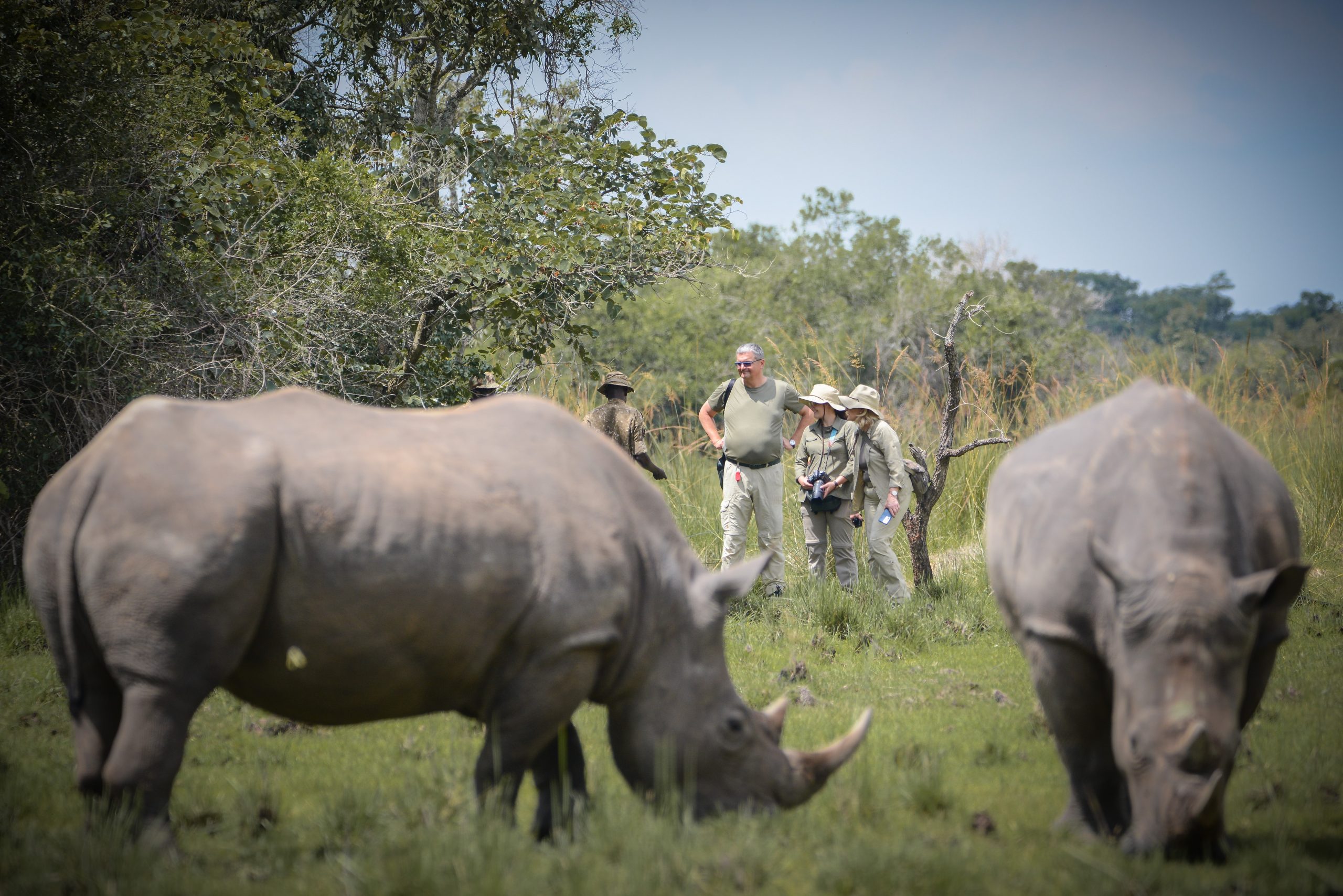
Yes, you can see rhinos very easily during the Lake Nakuru National Park portion of your safari. The park is a fenced, dedicated rhino sanctuary with a large population of both black and white rhinos, making sightings far more reliable here than in the open plains of the Masai Mara
4-days-masai-mara-and-lake-nakuru-kenya-safari-tour-package
5-days-best-of-kenya-wildlife-safari-to-masai-mara-lake-nakuru-and-amboseli-national-park
5-days-masai-mara-safari-lake-nakuru-and-hells-gate-national-park-kenya-tour
6-days-circuit-kenya-safari-to-masai-mara-lake-nakuru-and-amboseli-park
7-days-incredible-africa-big-five-kenya-tanzania-combined-tour
Why Rhino Viewing is Excellent Here
Compact and Fenced
Lake Nakuru National Park operates as a fully enclosed, electric-fenced sanctuary specifically designed to safeguard vulnerable wildlife populations from human encroachment and illegal poaching. Spanning roughly 188 square kilometers around the lake, the park's total geographical footprint is exceptionally compact when contrasted with the vast, open expanses of ecosystem giants like the Masai Mara or Serengeti. This physical boundary creates a defined, managed habitat where wide-ranging megafauna remain within predictable geographic limits. For safari visitors, this restricted space dramatically increases the statistical probability of wildlife encounters. Instead of searching across thousands of square kilometers of trackless savannah where animals can easily disperse beyond reach, guide drivers operate within a well-mapped network of access tracks. The physical barrier restricts long-distance migration, concentrating both black and white rhinoceros populations within reachable distance of main driving routes. Consequently, tracking these prehistoric giants becomes significantly less time-consuming. Safari vehicles can efficiently cover primary grazing sectors and lakefront tracks in a single morning or afternoon drive, consistently locating rhinos in a fraction of the time required in larger, unfenced game reserves where animals wander freely across international borders and expansive wilderness corridors.
Habituated Animals
The rhinoceros population in Lake Nakuru benefits from decades of continuous, intensive conservation management and round-the-clock protection by dedicated ranger patrols. Because the park has served as an established sanctuary since the late 20th century, successive generations of rhinos have grown up with a constant, non-threatening presence of safari vehicles and park wardens. This prolonged exposure has resulted in high habituation, meaning the animals view customized four-wheel-drive vehicles as neutral, non-disruptive components of their natural environment rather than potential predators or threats. As a result, when a safari vehicle approaches, these magnificent creatures rarely exhibit skittish behavior, retreat into dense acacia thickets, or display aggressive defensive postures. Instead, they frequently continue their vital daily routines uninterrupted—grazing peacefully along open shorelines, wallowing in cooling mud pools, or nursing calves within mere meters of established dirt roads. This remarkable tolerance grants visitors extraordinary, front-row opportunities to observe authentic, natural behaviors up close. Wildlife photographers and safari guests can capture crisp, detailed photographs without causing physiological stress to the animals or prompting sudden flight responses, making viewing sessions exceptionally serene, prolonged, and educationally rewarding for everyone on board.
Both Species Present
Lake Nakuru National Park stands out as one of the few premier conservation strongholds in East Africa where visitors have an outstanding statistical chance of sighting both the southern white rhinoceros (Ceratotherium simum) and the critically endangered eastern black rhinoceros (Diceros bicornis michaeli) within the exact same reserve. While both species share similar gray hide tones, they occupy completely different ecological niches and display distinct physical adaptations that make side-by-side comparison fascinating. White rhinos are heavy-bodied grazers that prefer open grasslands along the lake floodplain; their wide, flat, square lips are anatomically specialized for cropping short grasses close to the soil line. They are naturally social and frequently seen grazing in small family groups or crashes. Conversely, black rhinos are elusive, solitary browsers that inhabit the park's dense acacia woodlands and rocky scrublands; their prehensile, pointed upper lips are designed to hook and pluck leaves, twigs, and thorns off woody bushes. Having both species thriving side-by-side in one compact ecosystem allows safari guides to clearly point out these contrasting physical traits, feeding mechanisms, and behavioral dynamics, delivering a comprehensive and deeply educational double-rhino sighting experience in a single safari destination.
Tips for Spotting Rhinos
Best Locations
To maximize your chances of locating rhinos, focus your game drives on specific habitat zones across the park. The open southern grasslands and lakefront floodplains provide ideal grazing grounds for white rhinos, who favor the nutrient-rich grasses along the water's edge. Meanwhile, the dense yellow fever tree forests and thick acacia woodlands offer prime browsing conditions and natural shade for the more secretive black rhino. Additionally, the bushy terrain and rocky contours near Makalia Waterfalls serve as a frequent haven for rhinos seeking water and cover. Scouting these contrasting ecosystems ensures you cover the favored haunts of both species.
Morning Drives
Embarking on early morning game drives immediately after sunrise yields the highest success rate for rhino sightings. During these cooler hours, rhinos are actively moving, grazing, and wallowing before intense mid-day equatorial heat forces them to seek shelter under deep, inaccessible bush cover. Early light also creates superior conditions for wildlife photography, casting warm tones across the landscape and highlighting animal silhouettes against the open terrain. As temperatures rise past mid-morning, rhinos become far less mobile, making them significantly harder to spot amidst dense vegetation. Setting out at first light ensures you catch them at their most active and visible.
Use Your Guide
Relying on the expertise of a professional driver-guide is your single greatest asset when searching for rhinos. Local safari guides possess intimate knowledge of individual rhino territories, daily movement patterns, and seasonal waterhole preferences built over years in the field. Furthermore, drivers maintain real-time contact with fellow guides across open radio networks, sharing immediate updates on recent sightings, tracking directions, and road conditions. While self-guided visitors often pass right by well-camouflaged animals tucked into thick foliage, an experienced guide's trained eye can spot a distant horn or ear twitch through dense cover, dramatically raising your odds of a successful encounter.
How easy is it to spot rhinos in Lake Nakuru National Park compared to the Masai Mara?
Spotting rhinos in Lake Nakuru is exponentially easier than in the Masai Mara. Lake Nakuru National Park covers a compact 188 square kilometers enclosed by a electric perimeter fence, concentrating a thriving population of around 150 rhinos within defined boundaries. In contrast, the Masai Mara spans over 1,500 square kilometers of open, unfenced wilderness where a much smaller, highly mobile black rhino population can easily hide across vast distances. While a Mara game drive requires substantial luck and tracking to locate a single black rhino, a single game drive in Lake Nakuru almost guarantees multiple rhino sightings—often within minutes of passing through the entry gates. The high density of animals per square kilometer makes Nakuru Kenya’s premier rhino viewing destination.
What makes Lake Nakuru a dedicated rhino sanctuary?
Lake Nakuru was established as Kenya’s very first national rhino sanctuary in 1987 in response to the poaching crisis of the 1970s and 1980s. The Kenya Wildlife Service, alongside international conservation organizations, erected a multi-strand electric fence surrounding the park to create an impenetrable barrier against poachers. Combined with 24-hour armed ranger patrols and intensive biological monitoring, this sanctuary environment allowed relocated founder rhinos from Solio Ranch and other areas to breed safely. Today, the park serves as a vital breeding reservoir for both eastern black and southern white rhinos, frequently translocating surplus animals to restock other reserves across Kenya.
Can I see both black and white rhinos in Lake Nakuru?
Yes, Lake Nakuru is one of the rare places in Africa where you can comfortably spot both species in a single morning. The park supports roughly 80% white rhinos and 20% black rhinos. White rhinos (Ceratotherium simum) are grazers with square, wide lips designed for eating short grass on the lake's open floodplains. Black rhinos (Diceros bicornis) are browsers equipped with hooked, prehensile lips meant for stripping leaves from bushes in dense acacia woodlands. Seeing both species side-by-side allows visitors to observe these clear evolutionary and behavioral differences firsthand.
How do white rhinos and black rhinos differ in their feeding habits and locations within the park?
White rhinos prefer open, flat terrain such as the southern grasslands and lakefront plains where short grasses grow abundantly. Because they feed on low vegetation, they stay out in the open and are naturally more social, often seen in family groups called "crashes". Black rhinos are solitary, timid browsers that thrive in the dense yellow fever tree forests, acacia thickets, and rocky escarpments around Baboon Cliff and Makalia Falls. While white rhinos graze calmly near safari vehicles in plain view, black rhinos require slower tracking through wooded areas where they pluck leaves and woody stems.
What is the success rate for spotting rhinos during a typical game drive in Lake Nakuru?
The success rate for spotting white rhinos during a standard three-hour game drive in Lake Nakuru is close to 95% to 100%. White rhinos graze continuously in open fields along main circuit roads, making them nearly impossible to miss. For the more reclusive black rhino, the sighting success rate is roughly 60% to 70% per drive, depending on time of day and thicket density. Combining a late-afternoon and early-morning drive brings your overall chance of seeing both species to virtually 100%.
Why are rhino sightings harder in the Masai Mara than in Lake Nakuru?
The Masai Mara is an unfenced, continuous ecosystem connected to Tanzania's Serengeti. Its massive scale means animals move freely over hundreds of miles following water and food. The Mara holds an estimated population of only 30 to 50 black rhinos spread across 1,500 square kilometers, mostly concentrated in remote sectors like the Mara Triangle or near the Sand River border. Finding a rhino in the Mara requires dedicated searching, luck, and radio coordination among guides. In Nakuru, 150 rhinos are concentrated in just 188 square kilometers, drastically increasing sighting density.
What is the ideal itinerary length for Lake Nakuru to ensure a rhino sighting?
A 1-night, 2-day stay or a full-day stopover in Lake Nakuru is all you need to guarantee incredible rhino encounters. A popular itinerary involves driving from Nairobi or the Masai Mara, arriving in Nakuru by noon for lunch, taking a late-afternoon game drive (3:30 PM to 6:30 PM), staying overnight at a lodge inside or near the park, and finishing with a 3-hour morning drive (6:30 AM to 9:30 AM). This timing gives you two distinct opportunities during peak animal activity hours to view both species under optimal lighting conditions.
What time of day offers the best chance to spot rhinos active in Lake Nakuru?
Early morning between 6:30 AM and 9:00 AM is the absolute best time for rhino action. During these cooler hours, rhinos actively walk, graze, and drink near waterholes before equatorial heat sets in. By mid-afternoon (12:00 PM to 3:00 PM), rhinos seek shade under dense bush canopies or cool off in mud wallows, making them much harder to see. A secondary prime window occurs in the late afternoon from 4:00 PM until sunset, when temperatures drop and rhinos emerge back into open glades to resume feeding.
How does the park’s perimeter fence affect rhino viewing opportunities?
The electric perimeter fence surrounding Lake Nakuru keeps the park's wildlife from wandering out into surrounding human settlements like Nakuru town. For safari enthusiasts, this barrier acts as a natural funnel that keeps rhinos contained within accessibility ranges of established dirt tracks. Because the animals cannot migrate out of the park during dry seasons, seasonal variations do not reduce rhino numbers. You are guaranteed the same density of rhinos whether you visit in January, July, or October.
Where in Lake Nakuru are white rhinos most commonly seen?
White rhinos are most frequently spotted along the southern shorelines of Lake Nakuru, the open Naishi airstrip grasslands, and the flat plains stretching toward the southern park gates. These open habitats allow white rhinos to move in small family herds consisting of females and calves, alongside dominant bulls. It is common to see five to ten white rhinos grazing peacefully together alongside herds of Rothschild's giraffes, zebras, and Cape buffaloes.
Where in the park are black rhinos typically found hiding?
Black rhinos are usually encountered in the denser, wooded sectors of the park. Key areas include the fever tree woodland groves along the eastern and western shores, the thick bush around Lion Hill, and the rocky terrain leading toward Makalia Falls. Because black rhinos feed on woody twigs and shrub leaves, driver-guides slow down along narrow bush tracks in these forested zones, searching for rounded dark shapes amidst the underbrush.
How close can safari vehicles safely get to rhinos in Lake Nakuru?
Because rhinos in Lake Nakuru have been protected for decades, they are habituated to pop-top safari Land Cruisers and vans. Vehicles frequently stop within 10 to 20 meters of grazing white rhinos without causing distress or defensive behavior. Drivers must remain on designated tracks, keep engines quiet, and avoid sudden loud movements. White rhinos will often walk calmly right past a stopped vehicle, offering close-up viewings and photography.
Are rhinos in Lake Nakuru habituated to safari vehicles?
Yes, the resident rhinos are exceptionally well-habituated. Living in a heavily visited national park with daily vehicular traffic means these animals view safari vehicles as non-threatening background objects. White rhinos in particular show almost zero fear, continuing to graze, nap, or nurse calves as pop-top safari vehicles idle nearby. Black rhinos remain naturally more cautious and alert due to their solitary nature, but even they rarely bolt unless startled by sudden noises.
How many rhinos currently live in Lake Nakuru National Park?
Lake Nakuru National Park supports a healthy, dense population of around 150 rhinos. This includes roughly 90 to 100 white rhinos and 50 to 60 black rhinos. The population has done so well under Kenya Wildlife Service management that Nakuru is officially considered over capacity for black rhinos, periodically requiring conservationists to translocate selected individuals to other sanctuaries like Tsavo or Loisaba to maintain habitat balance.
What role do driver-guides play in locating rhinos in Lake Nakuru?
Professional driver-guides are critical for a seamless rhino experience. Local Kenyan guides possess trained eyes capable of spotting a black rhino’s horn poking out of dense foliage hundreds of yards away. Furthermore, safari drivers communicate via two-way CB radios. If a guide spots a elusive black rhino near Makalia Falls, they immediately relay the coordinates to fellow drivers, ensuring visitors across the park get a chance to share the sighting before the animal moves deeper into the woods.
Can you see rhinos and flamingos in the same view near the lake shoreline?
Yes, this iconic dual sighting is a hallmark of Lake Nakuru. While rising water levels in recent years have shifted flamingo concentrations around various Rift Valley lakes, thousands of lesser and greater flamingos still feed along Nakuru's alkaline shores. White rhinos frequently graze along the green grass lining the mudflats, allowing photographers to frame a massive 2-ton white rhino with a vibrant pink ribbon of flamingos and pelicans in the background.
How does the rainy season impact rhino visibility in Lake Nakuru?
During the rainy seasons (April–May and November), grass grows long and bush vegetation becomes thick, giving black rhinos extra cover to hide in. Rain also creates scattered water puddles deep inside woodland sectors, meaning rhinos do not need to travel to main lakefront water points to drink. However, because white rhinos still prefer open grazing tracks and park roads dry out quickly, overall rhino visibility remains remarkably high year-round compared to other parks.
Is a full-day or half-day game drive better for finding rhinos in Lake Nakuru?
A half-day game drive (around 3 to 4 hours) in the early morning or late afternoon is generally sufficient to spot multiple white rhinos and usually at least one black rhino. However, a full-day game drive with a packed picnic lunch allows you to explore remote corners like the Makalia Falls loop, Baboon Cliff lookout, and the southern bush tracks without rushing, significantly improving your chances of finding more elusive black rhinos.
What other Big Five animals can I pair with rhino sightings in Lake Nakuru?
Lake Nakuru is home to four of the traditional "Big Five": rhinos, lions, leopards, and Cape buffaloes (elephants are absent due to the park's perimeter fence). Buffaloes are ubiquitous, often grazing alongside rhinos. Tree-climbing lions are frequently spotted resting in yellow fever acacia trees, while Lake Nakuru boasts one of Kenya's highest densities of leopards, often seen lounging on rocky outcrops near Baboon Cliff.
How does Lake Nakuru protect its rhino population from armed poachers?
Protection in Lake Nakuru is managed by the Kenya Wildlife Service (KWS) through a multi-layered security strategy. The entire park is surrounded by a heavy-duty electric fence equipped with alarm sensors. Armed KWS ranger units patrol the perimeter and interior 24/7 on foot and in 4x4 vehicles. Every single rhino in the park is individually cataloged, microchipped, and tracked by dedicated monitoring teams, resulting in an extraordinary anti-poaching safety record over the last decade.
What should I pack specifically for rhino photography in Lake Nakuru?
For optimal rhino photography, bring a DSLR or mirrorless camera paired with a telephoto zoom lens (such as 100–400mm or 150–600mm). While white rhinos often graze close enough for standard phone photos, skittish black rhinos resting under acacia trees require telephoto reach. A dust cover or beanbag support for your vehicle’s window frame is invaluable for stabilizing heavy lenses during low-light morning drives.
Is it possible to do a walking safari to track rhinos in Lake Nakuru?
No, walking safaris inside Lake Nakuru National Park are strictly prohibited due to the high density of dangerous megafauna, including wild black rhinos, buffaloes, lions, and leopards. All wildlife viewing must take place from inside an enclosed safari land cruiser or pop-top van. Visitors may only step out of their vehicles at designated, safe fenced viewpoints like Baboon Cliff, Out of Africa Lookout, and the Makalia Falls picnic site.
How far is Lake Nakuru from the Masai Mara, and how do they fit together in a safari route?
Lake Nakuru is located approximately 220 kilometers north of the Masai Mara. The overland drive between Nakuru and the Mara takes about 5 to 6 hours, passing through the town of Narok along paved highways and dirt safari roads. Standard itineraries route travelers from Nairobi to Lake Nakuru for a 1-night rhino safari, followed by a scenic drive south to the Masai Mara for 2 to 3 nights of big cat and migration viewing.
Are baby rhinos or nursing mothers common to see in Lake Nakuru?
Yes, baby rhinos are seen frequently. Because Lake Nakuru is a protected sanctuary with minimal predator pressure on calves, rhino breeding rates are very high. Female white rhinos give birth every 2.5 to 3 years, keeping their young calves close for protection. It is common to spot mothers grazing alongside small, playful calves on the open floodplains.
Lake Nakuru National Park
How do rising lake water levels affect rhino habitats around Lake Nakuru?
In recent years, eco-system changes across the Great Rift Valley have caused Lake Nakuru's water levels to expand, submerging some shorelines and acacia trees. While this flooding reduced some shoreline grass patches, rhinos easily adapted by shifting their grazing grounds further inland into the southern acacia woodlands and higher grasslands, keeping rhino viewing opportunities stable.
Should I choose a Lake Nakuru lodge inside or outside the park gate for early rhino drives?
Staying at a lodge inside the park (such as Lake Nakuru Lodge or Sarova Lion Hill Game Lodge) gives you a distinct advantage. Being inside the park gates allows you to start your game drive at the crack of dawn (6:00 AM) before outside vehicles arrive, catching rhinos while they are most active in morning light.
How does Lake Nakuru compare to Ol Pejeta for seeing rhinos in Kenya?
Both parks are world-class rhino sanctuaries, but they offer slightly different experiences. Ol Pejeta Conservancy in Laikipia is larger and home to the last two surviving Northern White Rhinos (kept under 24/7 guard in an enclosure). Lake Nakuru, however, fits more seamlessly into a classic Southern Rift Valley safari circuit alongside the Masai Mara and Lake Naivasha, making it easier to include without extra internal flight costs.
Are rhinos aggressive toward safari land cruisers during game drives?
White rhinos are placid grazers and rarely pay attention to vehicles. Black rhinos are naturally more territorial and unpredictable, but aggressive charges at safari vehicles in Lake Nakuru are rare because the animals are well-habituated. As long as your driver maintains a respectful distance (at least 15 to 20 meters) and never cuts off a rhino's path or separates a mother from her calf, encounters remain completely safe.
What is the cost and permit structure for visiting Lake Nakuru's rhino sanctuary?
Entry to the rhino sanctuary is included in the standard Lake Nakuru National Park conservation fee charged by the Kenya Wildlife Service. As of recent rates, international adult park entry fees range from $60 to $80 USD per person per 24-hour period (depending on high vs. low season). There are no extra internal fees or special permits required specifically to view the rhinos inside the park.
Why is combining Masai Mara and Lake Nakuru the ultimate Big Five safari strategy?
Combining these two destinations guarantees a complete Big Five experience. The Masai Mara delivers vast savannah landscapes, massive lion prides, cheetahs, leopards, thousands of elephants, and the Great Migration, but finding a rare black rhino there can be difficult. Adding Lake Nakuru solves the "rhino puzzle," guaranteeing up-close sightings of both black and white rhinos in a single stop. Together, they form East Africa’s most reliable safari pairing.
Booking Masai Mara safari and lake Nakuru with us Roads of Adventure safaris
Booking a combined safari to Masai Mara and Lake Nakuru with Roads of Adventure Safaris typically spans 4 to 6 days. Packages include private 4x4 transport, park entrance fees, professional guide services, and full-board accommodation in scenic lodges or tented camps
