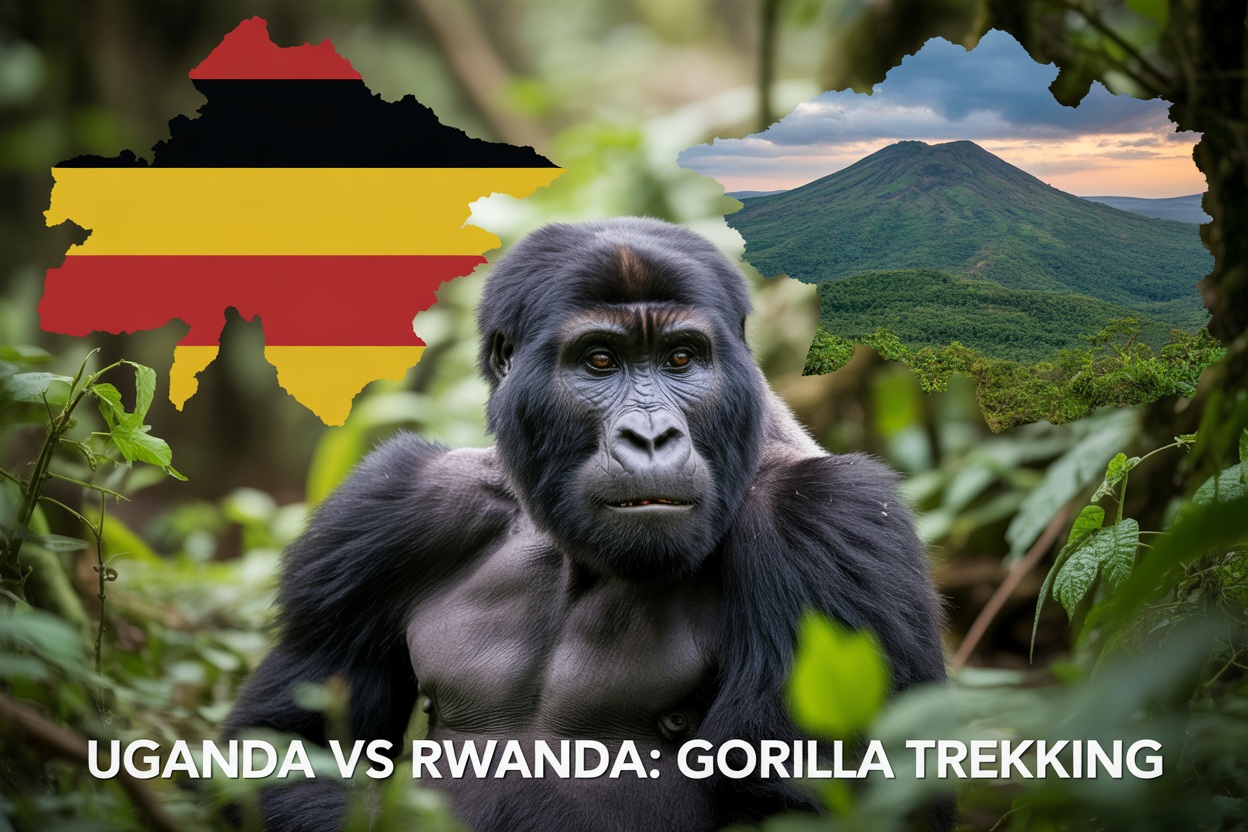
Choosing between Uganda and Rwanda boils down to budget, time, and trekking style. Uganda offers budget-friendly permits ($800) and immersive, wild treks, making it ideal for longer wildlife trips. Rwanda costs more ($1,500) but provides luxury lodges, seamless logistics, and shorter, easier hikes starting just two hours from the airport
2-days-luxury-rwanda-gorilla-trekking-safari-from-kigali-city
4-days-gorilla-trekking-in-volcanoes-park-combined-with-lake-kivu-trip
4-days-best-rwanda-gorilla-trekking-and-bisoke-hike
5-days-rwanda-uganda-safari-combined-volcanoes-to-queen-elizabeth-national-park
6-days-best-gorilla-and-rwanda-safari-tour-package
7-days-family-rwanda-safari-holiday-vacation
8-days-best-of-rwanda-safari-tour-uganda-and-ending-in-kigali
10-days-rwanda-uganda-safari-tour-double-gorilla-trekking-itinerary
1. Gorilla Permits & Cost
Uganda
A standard gorilla trekking permit costs $800 per person for foreign non-residents. This investment grants you access to the forest, the support of armed rangers, and exactly one hour with a habituated mountain gorilla family. For those seeking an entirely immersive encounter, Uganda also offers an exclusive Gorilla Habituation Experience for $1,500. This specialized permit allows you to accompany researchers and trackers as they accustom a wild group to human presence, extending your time with the gorillas to four hours. Uganda also offers a seasonal discount, dropping standard permits to $600 during April, May, and November, making it an incredibly flexible, budget-friendly choice.
Rwanda
The Rwanda Development Board sets its standard gorilla trekking permit at $1,500 per person, making it one of the most premium wildlife experiences on earth. This permit provides a strict one-hour encounter with a habituated gorilla family in Volcanoes National Park. Rwanda deliberately models its tourism industry around a high-end, low-impact ecotourism strategy. This approach guarantees smaller, more intimate trekking groups and funnels substantial revenue directly back into intensive conservation efforts and local community infrastructure. While the upfront cost is higher, international visitors can qualify for a 30% discount ($1,050) during the low-season months of November and May if they add a multi-day stay at Akagera or Nyungwe National Parks.
2. Trekking Difficulty & Terrain
Uganda
Gorilla trekking in Uganda is a raw, physical adventure defined by the dense, untamed landscapes of Bwindi Impenetrable Forest and the dramatic, steep slopes of Mgahinga Gorilla National Park. Bwindi lives up to its name; the terrain is a labyrinth of thick tangled undergrowth, hanging vines, slippery mud tracks, and steep ridges. Treks can last anywhere from two to eight hours as you navigate varying elevations and dense canopy cover. This environment demands a solid level of physical fitness, sturdy hiking boots, and a true sense of adventure. The reward is an authentic, wild rainforest experience where the thrill of discovering a hidden gorilla family amidst the deep jungle foliage is unmatched.
Rwanda
Trekking in Rwanda takes place across the spectacular, open slopes of the Virunga Volcanoes within Volcanoes National Park. While the altitude can be challenging—often ranging between 2,500 and 3,000 meters above sea level—the undergrowth and vegetation are significantly less dense than in Uganda’s rainforests. The paths mostly wind through expansive bamboo forests and clear mountain meadows, offering clearer visibility and a more predictable footing. Because the terrain is generally more open and manageable, the physical strain is less intense. This makes Rwanda the preferred destination for older travelers, photographers seeking clear sightlines, or individuals with limited mobility who still want to experience a magical silverback encounter.
3. Convenience & Drive Times
Uganda
The primary challenge of a Ugandan gorilla safari is its remote geography. Bwindi and Mgahinga sit in the far southwestern corner of the country, requiring a long, bumpy 8-to-10-hour drive from Entebbe International Airport. While the journey is scenic, it takes up a full day of travel on both ends of the safari. To bypass the roads, travelers can book expensive domestic scheduled flights from Entebbe to local airstrips like Kihihi or Kisoro, followed by a short drive. Because of these long transit times, Uganda is best suited for travelers who have a flexible schedule and want to build a comprehensive, multi-week itinerary across various parks.
Rwanda
Rwanda is celebrated globally for its seamless logistics and unmatched accessibility. From Kigali International Airport, it takes a smooth, scenic 2-to-3-hour drive on fully paved, well-maintained roads to reach the Volcanoes National Park headquarters in Kinigi. The proximity of the park to the capital makes it entirely feasible to land in Kigali, transfer to a luxury lodge, trek the mountain gorillas the next morning, and head back to the airport that same evening. This unmatched convenience makes Rwanda the ultimate choice for business travelers, luxury seekers, or anyone operating on a tight schedule who wants to experience a world-class safari.
4. Additional Wildlife & Activities
Uganda (Chimpanzee Trekking)
Uganda is a primate lover's paradise, easily allowing you to pair your gorilla trek with world-class chimpanzee tracking in Kibale National Park. Kibale is home to the highest density and diversity of primates in East Africa, hosting roughly 1,500 chimpanzees. Walking through this lush forest provides a thrilling contrast to the quiet focus of a gorilla trek. Chimpanzees are loud, highly vocal, and incredibly active, moving rapidly through the high canopy and across the forest floor. Watching a community interact, scream, and hunt offers a fascinating window into the complex social structures of our closest living evolutionary relatives.
Uganda (Safari Game Drives)
Beyond primates, Uganda offers classic African savannah safaris that can be effortlessly woven into a gorilla itinerary. Queen Elizabeth National Park sits just a few hours north of Bwindi, famous for its unique tree-climbing lions in the Ishasha sector, massive herds of elephants, and abundant hippos along the Kazinga Channel. Further north, Murchison Falls National Park offers dramatic views of the Nile squeezing through a narrow gorge, alongside giraffes, leopards, and lions. This incredible ecological diversity allows travelers to transition seamlessly from a deep-jungle foot trek to a traditional 4x4 game drive, creating a complete and diverse holiday experience.
Uganda (Bird Watching)
Uganda is globally renowned as one of Africa’s premier birding destinations, boasting an incredible record of over 1,000 recorded bird species. The Albertine Rift valley ecosystem provides a sanctuary for rare, colorful, and localized birds that cannot be found anywhere else on earth. Bwindi Impenetrable Forest itself is a legendary birding hotspot, famously home to the elusive African Green Broadbill and Grauer's Rush Warbler. From the majestic, prehistoric Shoebill Stork found in the marshy wetlands to the vibrant Great Blue Turaco flying through the rainforest canopies, bird enthusiasts will find an endless variety of avian life to observe.
Rwanda (Golden Monkey Tracking)
Located in the lower bamboo zones of Volcanoes National Park, golden monkey tracking offers a vibrant, fast-paced contrast to a gorilla trek. The golden monkey is an endangered species characterized by its striking, bright orange-gold coat and playful disposition. Because they inhabit the lower slopes, the trek is physically easy and highly accessible. Once the habituated troop is located, guests spend an hour watching them leap effortlessly across the bamboo canopy, forage for shoots, and chase one another. The experience is a photographer's dream, providing an intimate look at one of Africa’s rarest and most energetic primates.
Rwanda (Kigali Genocide Memorial)
Located in the capital, the Kigali Genocide Memorial stands as a deeply moving, vital site of remembrance, education, and healing. It serves as the final resting place for more than 250,000 victims of the 1994 tragedy. Through a sobering collection of historical photographs, video testimonies from survivors, original artifacts, and archival documents, the museum provides an unvarnished account of the nation's past. While the experience is undeniably emotional, the exhibition ultimately transitions into a powerful narrative of hope, forgiveness, and national unity, highlighting Rwanda's monumental efforts to successfully rebuild itself from the ashes of tragedy.
To help you pinpoint the ideal destination for your trip, here is how each of those structural questions shapes your final travel decision.
Can I do gorilla trekking in both Uganda and Rwanda (doble gorilla trekking)
Combining a gorilla trek across both Rwanda and Uganda is one of the most rewarding ways to experience these primates, giving you the chance to compare two completely different worlds. Most travelers fly into Kigali, start with a trek through Rwanda’s open, misty bamboo forests in Volcanoes National Park, and then take a scenic drive across the border to tackle Uganda’s dense, rugged, and untamed jungles in Bwindi or Mgahinga. It’s an seamless cross-border journey, made incredibly easy by the $100 East African Tourist Visa, which covers entry into both countries without any paperwork headaches. Logistically, you’ll just need to factor in the price difference between Rwanda’s $1,500 premium permit and Uganda’s $800 option, alongside a roughly 4-to-5-hour road trip from Kigali through the Cyanika or Katuna border posts to reach your Ugandan trekking sector.
Is $800 or $1,500 the better permit budget for you?
Your baseline permit budget is the single biggest deciding factor between these two nations. If you are tracking as a couple or a family, choosing Uganda’s $800 standard permit keeps entry fees manageable, allowing you to allocate more money toward extended travel or flights. Conversely, if a $1,500 permit fits comfortably into your budget, Rwanda’s premium model is highly compelling. Rwanda's higher fee directly supports exclusive, low-impact ecotourism, ensuring smaller groups and highly protected environments. If money is no object, Rwanda offers maximum exclusivity; if you want exceptional value, Uganda wins.
Does an 8-hour drive bother you compared to two?
This comes down to how much you value transit comfort versus the journey itself. Driving from Entebbe to Uganda's southwest parks takes 8 to 10 hours over bumpy, winding roads. While beautiful, it consumes two full travel days unless you buy costly internal flights. In stark contrast, Rwanda boasts a seamless, fully paved 2-to-3-hour drive from Kigali to the park gates. If long road trips exhaust you or eat into limited vacation time, Rwanda’s breezy transit is unmatched. Choose Uganda only if you view the long drive as an adventurous road trip.
Do you prefer luxury lodges over rustic mid-range options?
Your preference in accommodation will dramatically dictate your destination choice. Rwanda has positioned itself as the "Switzerland of Africa," deliberately attracting ultra-luxury hospitality brands like One&Only, Bisate Lodge, and Singita. These properties offer world-class, premium amenities but come with high-end price tags to match. Uganda offers an entirely different hospitality landscape. While it does possess beautiful luxury properties, its true strength lies in its diverse, character-filled mid-range and rustic eco-lodges. If you want high-end pampering, pick Rwanda; if you prefer cozy, authentic mid-range comfort, pick Uganda.
Is trekking at higher elevations safer for your health?
Health considerations regarding altitude require careful evaluation. Both destinations feature high-elevation trekking, but the physical environment alters the cardio strain. Rwanda’s Volcanoes National Park sits at a consistently higher altitude—often between 2,500 and 3,000 meters—which can trigger acute altitude sickness if you aren't acclimated. However, the paths are more uniform. Uganda's Bwindi sits slightly lower but features constant, grueling up-and-down climbs through humid jungle. If respiratory issues flare at high altitudes, Uganda is slightly lower, but if steep, relentless climbing threatens your knees or cardio health, Rwanda’s slopes are more forgiving.
Does thick jungle or open bamboo forest sound better?
The backdrop of your trek alters everything from hiking difficulty to photography. Uganda’s Bwindi Impenetrable Forest is a dense, ancient, raw rainforest characterized by tangled vines, thick undergrowth, and a closed canopy. It feels like a true jungle expedition, though photographing gorillas through the brush can be challenging. Rwanda’s Volcanoes National Park features wide, open bamboo forests and clear alpine meadows. This open layout offers fantastic light, clear fields of view for photography, and a significantly less claustrophobic hiking experience. Your choice hinges on whether you want an untamed jungle adventure or open mountain vistas.
Would you like a four-hour gorilla habituation experience instead?
If standard wildlife viewing feels too rushed, this exclusive option will instantly make your decision for you. Only Uganda offers the official Gorilla Habituation Experience in the southern sector of Bwindi. For $1,500, you spend four full hours with a gorilla family alongside researchers, helping them get used to human presence. Rwanda does not offer this; their standard $1,500 permit buys exactly one hour with a fully habituated group. If your primary goal is maximizing time on the ground to watch complex social behaviors, Uganda’s habituation experience is an unbeatable opportunity.
Do you have time for other wildlife safaris afterwards?
If you want a diverse, multi-species African safari, Uganda is the superior choice. Its geographic layout allows you to easily chain your gorilla trek with chimpanzee tracking in Kibale, tree-climbing lions in Queen Elizabeth National Park, and boat safaris along the Nile. Rwanda offers Akagera National Park for big-game viewing, but its safari circuit is smaller and more compact. Uganda functions as a complete, all-in-one safari destination where you can see primates, savannah wildlife, and unique birds over two weeks, whereas Rwanda is best optimized for shorter, primate-focused itineraries.
Is it easier to secure last-minute permits in Uganda?
If you are planning a spontaneous trip, permit availability is a crucial logistics bottleneck. Because Rwanda has fewer habituated gorilla groups and a shorter, highly accessible transit route, its permits sell out months in advance, especially during peak seasons. Uganda tracks gorillas across multiple distinct sectors in Bwindi as well as Mgahinga, offering a higher total volume of daily permits. While booking early is always recommended, Uganda's decentralized system and larger gorilla population make it statistically much easier to secure a last-minute tracking permit during unexpected travel windows.
Does a country's overall safety and stability matter most?
Both nations are highly stable and incredibly safe for international tourists, but they project different civic environments. Rwanda is globally lauded for its immaculate cleanliness, low crime rates, orderly traffic, and highly efficient infrastructure, making it exceptionally comforting for first-time African travelers. Uganda is equally welcoming, famous for having some of the friendliest, most hospitable people on the continent, though its cities and roads are more chaotic and vibrant. If you crave military-grade order and pristine public safety, choose Rwanda; if you enjoy bustling, authentic African energy, choose Uganda.
Which destination best matches your total vacation time limit?
Your calendar is the ultimate deciding factor. If you only have a 3-to-4-day window over a long weekend, Rwanda is the clear winner; you can land in Kigali, trek the next morning, and fly out that night. Uganda simply cannot be done quickly due to the immense driving distances required to reach the western forests. A proper Ugandan safari requires a minimum of 5 to 7 days just to cover the transits and tracking comfortably. Match Rwanda to short, time-crunched luxury getaways, and save Uganda for extended, immersive vacations.
Booking Gorilla trekking either in Uganda or Rwanda with us Roads of Adventure safaris
Securing a non-refundable permit early is the essential first step for any gorilla safari, as spots sell out months in advance. Your choice comes down to your personal travel style: Uganda offers an adventurous, budget-friendly journey with $800 permits and longer treks through raw jungle, while Rwanda provides ultimate convenience with $1,500 permits and a quick two-hour drive from the airport to high-end luxury lodges. To make planning completely seamless, local operators like Roads of Adventure Safaris tailor everything for you, offering curated packages from quick 3-day treks to comprehensive 6-day double-country itineraries directly on their website.
