8 Days Safari in Rwanda 3 National Parks & 15 Primate Species. Rwanda stands as one of Africa's premier primate trekking destinations, harboring 15 distinct primate species across three diverse national parks. This 8-day itinerary guides you through Akagera National Park, Nyungwe National Park, and Volcanoes National Park. Discover savanna-dwelling baboons, high-canopy chimpanzees, rare golden monkeys, and the famous mountain gorillas. Traveling across scenic landscapes, you experience dense rainforests, papyrus swamps, and volcanic slopes. Detailed drive times, accurate lodge options, and key wildlife sightings ensure a seamless adventure through the heart of the country.
8-day-rwanda-birding-safari-odyssey
8-days-best-luxury-rwanda-gorilla-trekking-safari-and-wildlife
8-days-best-africa-big-five-rwanda-safari-and-gorilla-trekking
8-days-best-of-rwanda-safari-tour-uganda-and-ending-in-kigali
8-days-best-of-rwanda-uganda-safari-volcanoes-to-best-uganda-safari-parks
8-day-safari-to-rwanda-and-kenya-safari-tour
8-days-luxury-honeymoon-rwanda-primate-safari
8-days-ultimate-gorilla-and-uganda-safari-tour-from-kigali-rwanda
8-days-7-nights-midrange-rwanda-wildlife-safari-trip
Day 1: Arrival in Kigali and Transfer to Akagera National Park
Upon arrival at Kigali International Airport, meet your driver guide and start your journey east toward Akagera National Park. The drive covers approximately 135 kilometers and takes about 2.5 to 3 hours along paved roads. Akagera is Rwanda’s only savanna park, featuring rolling hills, open plains, and interconnected lakes. Check in at your accommodation and enjoy a relaxing afternoon overlooking the park landscapes. In the late afternoon, venture out for your first game drive along the southern network of tracks. Keep your eyes open for Olive Baboons and Vervet Monkeys along the wooded fringes, alongside zebras, topis, and impalas. Return to the lodge for dinner and rest.
- Attractions & Wildlife: Olive Baboons, Vervet Monkeys, zebras, topis, impalas, Lake Ihema views.
- Drive Distance & Time: 135 km (2.5 to 3 hours).
- Lodge Options: Ruzizi Tented Lodge (Luxury) or Akagera Game Lodge (Mid-range).
Day 2: Morning Boat Safari and Northbound Game Drive in Akagera
Begin the day with an early morning boat safari on Lake Ihema, Rwanda's second-largest lake. The boat trip lasts roughly 2 hours, offering close sightings of hippos, Nile crocodiles, and wetland bird species like the African Fish Eagle. Along the shores, look out for Vervet Monkeys and Olive Baboons foraging near the water line. Afterwards, embark on a north-bound game drive through the park's varied ecosystems. The northern plains present optimal chances to spot broad-headed Blue Monkeys in riverine woodlands, as well as giraffes, buffaloes, lions, and rhinos. Exit the park in the late afternoon and check in at your northern lodge.
- Attractions & Wildlife: Blue Monkeys, Olive Baboons, Vervet Monkeys, hippos, Nile crocodiles, lions, rhinos, giraffes.
- Drive Distance & Time: Full day game viewing across 100 km within the park.
- Lodge Options: Magashi Camp (Luxury) or Karenge Bush Camp (Mid-range).
Day 3: Transfer from Akagera to Nyungwe National Park via Huye
Depart Akagera early in the morning for the long transit southwest to Nyungwe National Park. The journey spans around 320 kilometers and takes approximately 6.5 to 7.5 hours. Route highlights include rolling tea plantations and historical towns. Stop in Huye (formerly Butare) to visit the Ethnographic Museum of Rwanda, home to traditional artifacts and historical exhibits. Enjoy lunch before continuing through the southern highlands to the rainforest boundaries of Nyungwe. This ancient montane forest is home to 13 primate species. Arrive at your lodge in the late afternoon, unwind, and prepare for early morning forest treks.
- Attractions & Wildlife: Scenic highland tea estates, Ethnographic Museum, edge-of-forest birdlife.
- Drive Distance & Time: 320 km (6.5 to 7.5 hours).
- Lodge Options: One&Only Nyungwe House (Luxury) or Nyungwe Top View Hill Hotel (Mid-range).
Day 4: Chimpanzee Tracking and Canopy Walkway in Nyungwe
Wake early for a 5:00 AM transfer to Cyamudongo Forest or the Uwinka Visitor Center for chimpanzee tracking. Accompanied by park rangers, trek through the dense rainforest to locate habituated chimpanzee troops. Along the trail, watch for L’Hoest’s Monkeys, Red-Tailed Monkeys, and Dent’s Mona Monkeys. After spending an hour observing chimpanzees feeding and socializing, return for lunch. In the afternoon, head to Uwinka for the suspended Canopy Walkway. Walking 70 meters above the forest floor along a 160-meter bridge provides aerial views of the canopy, where you may spot Ruwenzori Colobus, Mona Monkeys, and Grey-Cheeked Mangabeys moving through the treetop branches.
- Attractions & Wildlife: Chimpanzees, L’Hoest’s Monkeys, Red-Tailed Monkeys, Dent’s Mona Monkeys, Grey-Cheeked Mangabeys, Canopy Walk.
- Drive Distance & Time: 30 to 45 km local transfers (1 hour total).
- Lodge Options: One&Only Nyungwe House (Luxury) or Nyungwe Top View Hill Hotel (Mid-range).
Day 5: Ruwenzori Colobus Monkey Trekking and Transfer to Lake Kivu (Karongi)
Start the morning with a guided trek to track large troops of Ruwenzori Colobus Monkeys at Gisakura. These striking black-and-white primates often gather in super-groups exceeding 200 individuals. During the trek, look out for Owl-Faced Monkeys and Silver Monkeys in the bamboo and hardwood zones. Following the trek, check out of your lodge and travel north toward Karongi along the shores of Lake Kivu. This scenic coastal drive covers about 95 kilometers and takes approximately 2.5 to 3 hours over winding roads. Check in at your lakeside hotel, relax by the water, and take an evening boat cruise to Napoleon Island to view fruit bat colonies.
- Attractions & Wildlife: Ruwenzori Colobus Monkeys, Owl-Faced Monkeys, Silver Monkeys, Lake Kivu, Napoleon Island fruit bats.
- Drive Distance & Time: 95 km (2.5 to 3 hours).
- Lodge Options: Cormoran Lodge (Luxury/Mid-range) or Cleo Lake Kivu Hotel (Luxury).
Day 6: Transfer to Volcanoes National Park and Iby’Iwacu Cultural Village
Enjoy a leisurely breakfast overlooking Lake Kivu before departing for Volcanoes National Park in the Virunga Mountains region. The drive spans 140 kilometers along the Kivu Belt road, taking roughly 3.5 to 4 hours. Upon arriving in Musanze, check in at your lodge with views of the Virunga volcanoes. In the afternoon, visit the Iby’Iwacu Cultural Village (Gorilla Guardians Village) located near the park boundaries. Learn about traditional Rwandan culture, drumming, royal history, and community conservation initiatives that support local primate preservation. Return to your lodge early to rest ahead of the gorilla trek.
- Attractions & Wildlife: Lake Kivu scenery, Virunga Volcanoes range, traditional cultural performances, community conservation stories.
- Drive Distance & Time: 140 km (3.5 to 4 hours).
- Lodge Options: Bisate Lodge (Luxury), Five Volcanoes Boutique Hotel (Mid-range), or Le Bambou Gorilla Lodge (Mid-range).
Day 7: Mountain Gorilla Trekking in Volcanoes National Park
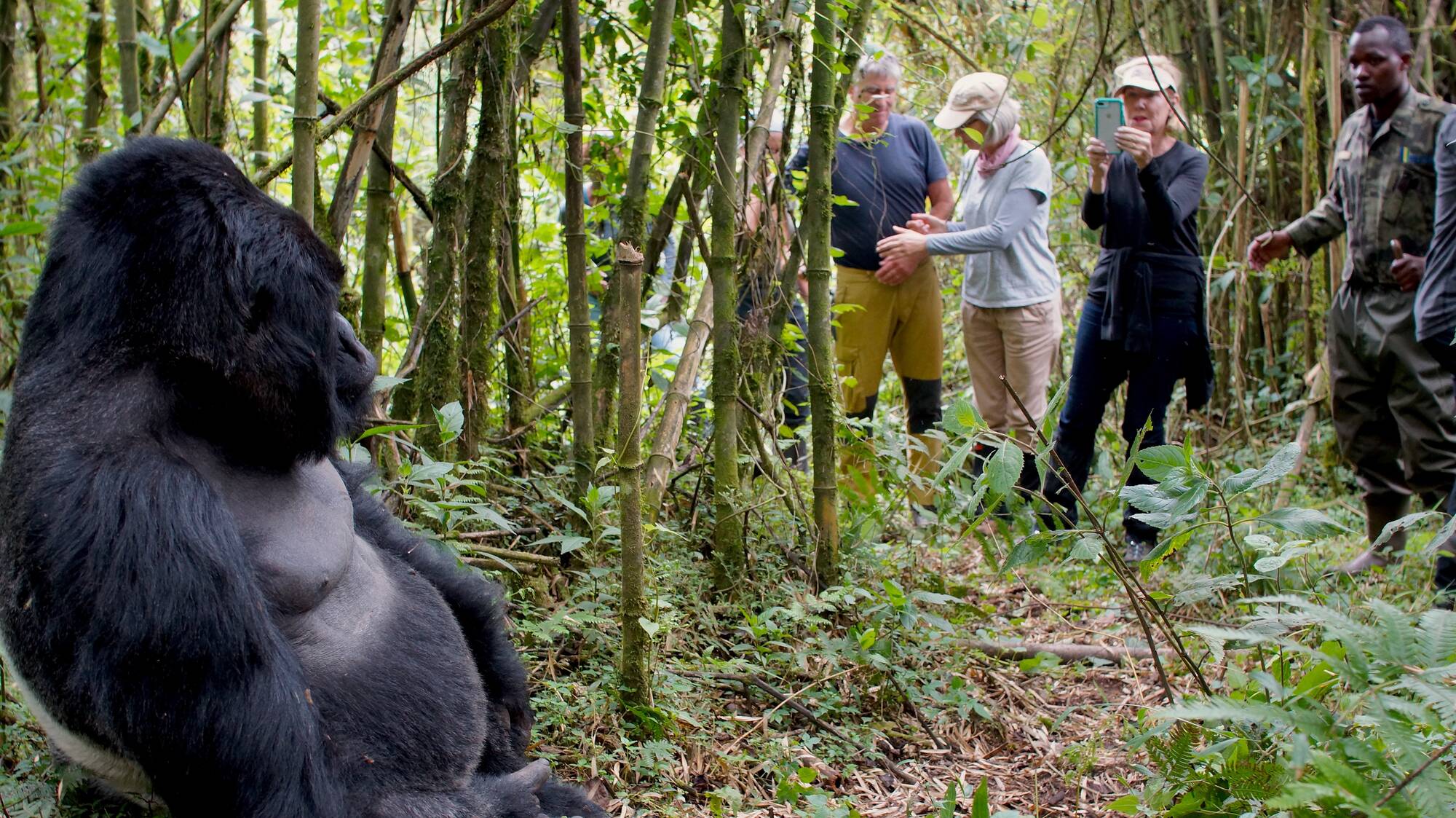
Report to the Kinigi park headquarters at 7:00 AM for a safety briefing and allocation to a habituated mountain gorilla family. Guided by rangers and trackers, venture into the bamboo and montane forest slopes. The trek duration ranges from 1 to 5 hours depending on where the family group moved overnight. Once located, spend one full hour observing these magnificent primates as they feed, groom, and play in their natural habitat. During the forest walk, keep watch for elusive Golden Monkeys and Bushbabies in the lower canopy. Return to the park base for your trekking certificate, then transfer back to the lodge for relaxation.
- Attractions & Wildlife: Mountain Gorillas, bamboo forest habitats, views of Mount Sabyinyo and Mount Gahinga.
- Drive Distance & Time: 15 to 20 km local park transfers (30 to 45 minutes).
- Lodge Options: Bisate Lodge (Luxury), Five Volcanoes Boutique Hotel (Mid-range), or Sabyinyo Silverback Lodge (Luxury).
Day 8: Golden Monkey Tracking and Transfer to Kigali
Head back to Kinigi headquarters early for a briefing on Golden Monkey tracking. Endemic to the Virunga volcanic arc, these active primates inhabit the bamboo zones at the base of the mountains. Follow your guide into the bamboo forest to observe them jumping between stalks and feeding on shoots. You may also catch glimpses of Vervet Monkeys and various highland bird species. After the 2- to 3-hour excursion, return to the lodge to check out. Drive back to Kigali, covering 115 kilometers over approximately 2.5 to 3 hours. Visit the Kigali Genocide Memorial before your transfer to Kigali International Airport for your departure flight.
- Attractions & Wildlife: Golden Monkeys, bamboo zone birdlife, Kigali Genocide Memorial.
- Drive Distance & Time: 115 km (2.5 to 3 hours).
- Day Use / Departure: Transfer directly to Kigali International Airport.
Summary of the 15 Primate Species Covered:
- Mountain Gorilla
- Chimpanzee
- Golden Monkey
- Ruwenzori Colobus Monkey
- L’Hoest’s Monkey
- Owl-Faced Monkey
- Blue Monkey
- Silver Monkey
- Red-Tailed Monkey
- Dent’s Mona Monkey
- Mona Monkey
- Grey-Cheeked Mangabey
- Olive Baboon
- Vervet Monkey
- Bushbaby (Galago)
What makes Akagera National Park unique among Rwanda’s national parks, and what primate and wildlife species can visitors expect to encounter during the first two days of the itinerary?
Akagera National Park holds a distinct place in Rwanda’s tourism landscape as the country’s only savanna national park. Unlike the dense montane rainforests of Nyungwe or the volcanic, high-altitude slopes of Volcanoes National Park, Akagera features rolling grassland hills, open savannah plains, woodland fringes, and a vast network of interconnected wetlands surrounding Lake Ihema. This ecosystem allows travelers to experience classic East African big-game safari viewing alongside specialized primate sightings.
During the first two days, visitors encounter savanna-dwelling primates such as Olive Baboons and Vervet Monkeys along the wooded shores and track fringes. In the riverine woodlands of the northern plains, broad-headed Blue Monkeys can also be spotted. Beyond primates, Akagera is home to the classic "Big Five." Game drives and a morning boat cruise on Lake Ihema yield sightings of hippos, Nile crocodiles, zebras, topis, impalas, giraffes, buffaloes, lions, and black rhinos. The aquatic environment supports diverse birdlife, including the African Fish Eagle. Combining savanna game viewing with primate tracking makes Akagera an essential starting point for an all-encompassing 8-day Rwandan wilderness adventure.
How does the journey from Akagera National Park to Nyungwe National Park incorporate cultural heritage and historical learning on Day 3?
The 320-kilometer transfer from Akagera to Nyungwe National Park is the longest drive of the itinerary, taking approximately 6.5 to 7.5 hours. Rather than serving purely as transit time, Day 3 strategically breaks up the journey by incorporating cultural enrichment and historical depth through a stop in Huye (formerly known as Butare). Huye is widely recognized as the intellectual and cultural heart of traditional Rwanda.
During this stopover, travelers visit the Ethnographic Museum of Rwanda, one of Africa’s finest cultural institutions. The museum houses extensive collections of traditional artifacts, royal paraphernalia, indigenous hunting tools, ancient agricultural gear, and authentic woven crafts. Guided exhibits offer visitors a comprehensive understanding of pre-colonial social structures, royal traditions, indigenous beliefs, and artistic heritage. Beyond the museum, the scenic drive passes through high-altitude tea plantations and terraced hillsides, providing authentic insight into daily rural life. Integrating this cultural stop enriches the overall travel experience, ensuring guests connect not only with Rwanda's world-class biodiversity and wildlife but also with the deep history, resilience, and rich traditions of the Rwandan people.
What high-canopy primate species and structural features make the Day 4 excursions in Nyungwe National Park a highlight for adventure travelers?
Day 4 in Nyungwe National Park highlights the high-canopy biodiversity of one of Africa’s oldest montane rainforests, featuring 13 resident primate species. The morning begins at 5:00 AM with an immersive chimpanzee tracking trek in Cyamudongo Forest or Uwinka. Accompanied by experienced park rangers, visitors venture into dense vegetation to observe habituated chimpanzee troops for one hour as they feed, groom, and vocalize. Along the forest floor and lower canopy, trackers often spot L’Hoest’s Monkeys, Red-Tailed Monkeys, and Dent’s Mona Monkeys.
In the afternoon, the adventure shifts to the canopy level at the Uwinka Visitor Center with the famous Canopy Walkway. Suspended 70 meters above the forest floor, this 160-meter-long canopy bridge offers an exhilarating eye-level perspective of the ancient rainforest treetops. From this elevated viewpoint, travelers enjoy dramatic aerial vistas while scanning the upper canopy for arboreal primates, including Ruwenzori Colobus monkeys, Mona Monkeys, and Grey-Cheeked Mangabeys. The combination of ground-level tracking and elevated aerial canopy exploration makes Day 4 an unparalleled experience for wildlife enthusiasts seeking to observe rare high-canopy primates in their natural, undisturbed habitat.
What unique social behaviors characterize the Ruwenzori Colobus Monkeys at Gisakura, and what additional primate sightings are possible on Day 5?
Day 5 highlights the remarkable social structure of the Ruwenzori Colobus Monkey (Colobus angolensis ruwenzorii) during a morning trek in the Gisakura section of Nyungwe National Park. Unlike many primate species that live in small family units, Ruwenzori Colobus monkeys are famous for forming super-groups that can exceed 200 to 300 individuals. Observing these large, striking black-and-white primates move collectively through the forest canopy is a breathtaking wildlife spectacle. Their long white tails, dramatic shoulder capes, and acrobatic leaps between tree branches create unforgettable photographic opportunities.
While tracking these massive colobus troops in the bamboo and hardwood zones, sharp-eyed trackers can also spot other elusive forest primates. Key species to look for include the distinctively marked Owl-Faced Monkey (Cercopithecus hamlyni), known for its vertical facial stripe, and the Silver Monkey (Cercopithecus doggetti). Following the forest trek, the itinerary shifts scenery as travelers journey 95 kilometers north along the Kivu Belt road to Karongi on Lake Kivu. In the evening, a boat cruise to Napoleon Island offers a unique non-primate wildlife bonus: observing massive roosting colonies of fruit bats.
How does visiting the Iby’Iwacu Cultural Village on Day 6 complement the primate conservation goals of Volcanoes National Park?
Visiting the Iby’Iwacu Cultural Village (also known as the Gorilla Guardians Village) on Day 6 provides vital context regarding the crucial relationship between local communities and wildlife conservation around Volcanoes National Park. Situated near Musanze, this community-led initiative was established to transform former poachers into active conservation stewards by providing alternative, sustainable livelihoods through cultural tourism.
The cultural experience introduces travelers to traditional Rwandan life through authentic drumming performances, traditional Intore dancing, archery demonstrations, medicinal herb talks, and re-enactments of ancient royal ceremonies. More importantly, it demonstrates how community-based tourism directly protects endangered primates. A significant portion of revenue generated from tourism at the village directly funds local infrastructure, healthcare, clean water access, and school construction. By offering local residents a stable income stream derived from preserving rather than exploiting the forest, the village effectively eliminates poaching threats facing mountain gorillas and golden monkeys. Engaging with the community on Day 6 emphasizes that the long-term survival of Rwanda’s world-famous primate species depends on empowering and supporting the indigenous communities who share their surrounding landscapes.
What should travelers expect regarding logistics, terrain, and duration during the Day 7 Mountain Gorilla trek in Volcanoes National Park?
Day 7 delivers the premier highlight of the 8-day safari: tracking endangered mountain gorillas in Volcanoes National Park. The day begins at 7:00 AM at the Kinigi park headquarters for a mandatory safety briefing, where rangers assign guests to a specific habituated gorilla family based on fitness levels and preference. Accompanied by official park rangers and trackers, guests enter the park’s dense bamboo zones and montane rainforest slopes.
Trek difficulty and duration vary significantly, lasting anywhere from 1 to 5 hours depending on where the gorilla family moved overnight. The terrain involves steep climbs, muddy trails, dense vegetation, and high altitudes ranging between 2,500 and 3,000 meters above sea level. Sturdy hiking boots, gaiters, and garden gloves are highly recommended. Once trackers locate the gorilla family, guests spend exactly one magical hour observing them from a respectful distance as they feed, groom, interact, and care for infants. During the forest walk, trekkers may also glimpse Golden Monkeys or Bushbabies. Upon returning to Kinigi headquarters, trekkers receive a official trekking certificate commemorating their conservation journey.
What makes the Golden Monkey tracking experience on Day 8 distinct from gorilla trekking, and how does the day conclude?
On Day 8, travelers return to Kinigi headquarters for a morning Golden Monkey tracking excursion, offering a dynamic contrast to the previous day's gorilla trek. Endemic strictly to the Virunga Volcanic Arc, Golden Monkeys (Cercopithecus kandti) are striking, fast-moving primates recognized by their bright golden-orange fur and energetic personalities.
Unlike mountain gorilla trekking, which can involve long, strenuous climbs up steep mountain slopes, Golden Monkey tracking takes place in the lower bamboo zones at the base of the volcanoes. The terrain is gentler, making the trek shorter and physically less demanding, usually lasting 2 to 3 hours total. Because these monkeys remain highly active—leaping between bamboo stalks, foraging for fresh shoots, and tumbling playfully through the foliage—the encounter is lively, fast-paced, and ideal for photography.
Following the trek, guests return to their lodge to check out before taking a 2.5 to 3-hour drive (115 km) back to Kigali. Before heading to Kigali International Airport for departure flights, travelers visit the Kigali Genocide Memorial. This poignant, educational visit provides essential historical context, highlighting Rwanda’s inspiring journey of peace, unity, and modern rebirth.
How do the landscape and habitat transitions across Akagera, Nyungwe, and Volcanoes National Parks influence primate distribution across Rwanda?
The distribution of Rwanda’s 15 primate species is directly shaped by the dramatic geographical and ecological shifts across its three main national parks. Akagera National Park in the east represents a low-altitude savanna landscape characterized by acacia woodlands, broad wetlands, and open plains. Consequently, it supports savanna-adapted primates like Olive Baboons and Vervet Monkeys, which rely on open terrain and riverine trees, alongside tree-dwelling Blue Monkeys.
In contrast, Nyungwe National Park in the southwest is a vast, ancient montane rainforest located at mid-to-high elevations (1,600 to 2,950 meters). Its dense, multi-layered canopy and rich floral diversity provide an ideal habitat for 13 distinct primate species, including high-canopy frugivores like Chimpanzees, Grey-Cheeked Mangabeys, Mona Monkeys, Dent’s Mona Monkeys, L’Hoest’s Monkeys, and massive troops of Ruwenzori Colobus.
Finally, Volcanoes National Park in the northwest features extreme high-altitude volcanic slopes (2,300 to over 4,000 meters) dominated by bamboo forests and sub-alpine vegetation. This specialized environment supports high-altitude specialists tailored to cool mountain climates, most notably Mountain Gorillas and Virunga-endemic Golden Monkeys. Understanding these distinct habitat zones explains how Rwanda packs 15 diverse primate species into one compact country.
What accommodation options are available across the three national parks, catering to both luxury and mid-range travelers?
This 8-day itinerary offers carefully selected luxury and mid-range accommodation options across all three national parks, ensuring comfort, exceptional service, and prime access to park gates. In Akagera National Park, luxury guests stay at Magashi Camp, an exclusive tented camp situated in the wildlife-rich northern sector, or Ruzizi Tented Lodge along Lake Ihema. Mid-range options include Akagera Game Lodge in the south or Karenge Bush Camp, a seasonal eco-friendly bush camp in the north.
In Nyungwe National Park, luxury travelers experience world-class hospitality at One&Only Nyungwe House, set amid a working tea plantation on the forest edge. Mid-range travelers enjoy panoramic ridge-top views and comfortable amenities at Nyungwe Top View Hill Hotel. Along Lake Kivu, accommodations range from the boutique luxury of Cleo Lake Kivu Hotel to the charming wooden chalets of Cormoran Lodge.
Finally, in Volcanoes National Park, luxury travelers can stay at the iconic Bisate Lodge or Sabyinyo Silverback Lodge, both offering breathtaking volcano views. Excellent mid-range alternatives include Five Volcanoes Boutique Hotel and Le Bambou Gorilla Lodge. These diverse options allow travelers to customize their safari experience according to their preferred budget and style.
Why should travelers book this complete 8-day Rwanda primate safari with U Roads of Adventure Safaris, and what value does the company provide?
Booking your 8-day Rwanda primate safari with U Roads of Adventure Safaris guarantees a seamlessly organized, stress-free, and deeply authentic African adventure. Navigating Rwanda's primate tracking logistics—such as securing highly competitive mountain gorilla permits ($1,500 each), chimpanzee tracking passes, and golden monkey permits—requires expert regional knowledge and advance coordination. U Roads of Adventure Safaris manages all permit acquisitions, park fees, activity bookings, and lodge reservations effortlessly on your behalf.
Furthermore, U Roads of Adventure Safaris provides dedicated, highly trained local driver-guides and customized 4x4 safari vehicles equipped for long transit routes like the Kivu Belt road. Their expert guides offer deep insights into local primate behavior, regional ecology, Rwandan history, and hidden cultural spots along the way. By choosing U Roads of Adventure Safaris, you support sustainable tourism practices that directly benefit local community conservation funds and park protection initiatives. From the moment you land at Kigali International Airport until your final departure, U Roads of Adventure Safaris ensures personalized care, transparent communication, optimal drive timings, and superior lodge selection, turning this ambitious 15-primate species itinerary into a unforgettable journey of a lifetime.