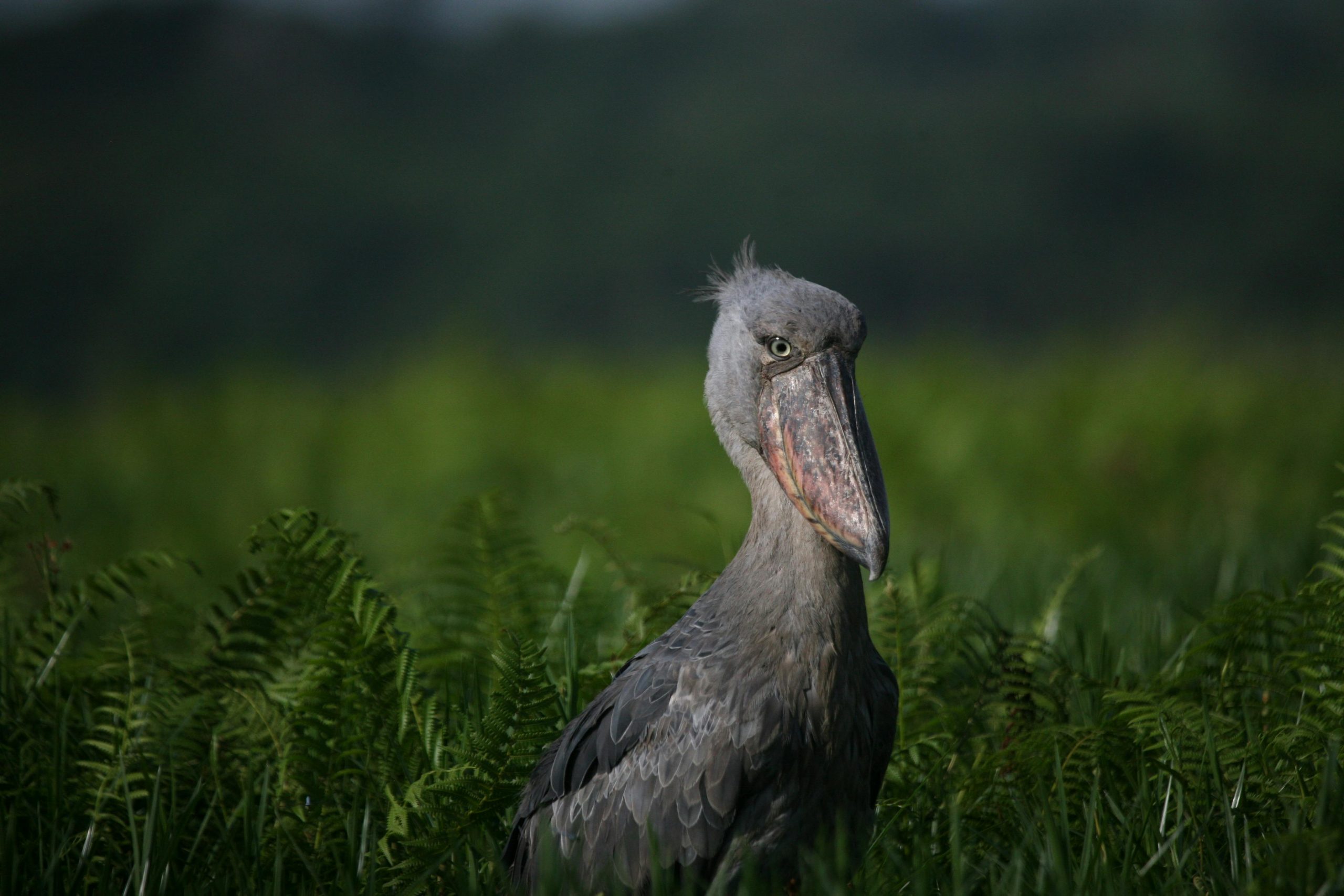
This 20-day birding and Uganda photography safari itinerary provides a detailed roadmap through the diverse ecosystems of Uganda, crafted specifically for avian enthusiasts and wildlife photographers. You will navigate habitats ranging from lowland swamps to dense equatorial rainforests, targeting a notable portion of the region's 1,000+ recorded bird species. Key targets include the prehistoric-looking Shoebill, the secretive Green-breasted Pitta, and numerous Albertine Rift endemics. Beyond the diverse birdlife, the route provides clear opportunities to document primates, large mammals, and varied geological features. This guide outlines the daily routes, specific avian and mammalian targets, and logistical details—such as travel distances and driving times—to ensure a productive and well-paced expedition across the country's premier wildlife destinations.
Tour highlights for 20 Days Birding and Uganda Photography Safari
Mabamba Shoebill Stork
Entebbe Botanical Birds
Ziwa Rhino Tracking
Budongo Royal Mile
Murchison Falls Cruise
Nile Delta Waterbirds
Bugoma Forest Primates
Kibale Forest Pitta
Kibale Chimpanzee Trekking
Bigodi Swamp Walk
Semuliki Congo Endemics
Sempaya Hot Springs
Kasenyi Savannah Drive
Kazinga Channel Boat
Kyambura Gorge Primates
Ishasha Tree-Climbing Lions
Bwindi Gorilla Tracking
Mubwindi Swamp Endemics
Sabinyo Gorge Birds
Mburo African Finfoot
Day By day 20 Days Birding and Uganda Photography Safari
Day 1: Arrival in Entebbe
Your journey begins at Entebbe International Airport ( ) on the shores of Lake Victoria. After clearing customs, a short 5-kilometer drive brings you to your hotel in Entebbe town, taking roughly 15 minutes. This day is reserved for logistical preparation, gear assembly, and rest after long-haul flights. Use this evening to calibrate your camera settings for low-light forest environments and high-glare wetland conditions. Test your telephoto lenses, organize your memory cards, and ensure your backup battery systems are fully charged. Your guide will conduct a brief orientation meeting to review the upcoming route, weather expectations, and specific safety protocols for photographing wildlife.
Day 2: Mabamba Swamp & Botanical Gardens
Leave your hotel at 06:00 to drive 40 kilometers to the Mabamba Wetland, a journey of roughly 1.5 hours via the Nakiwogo ferry route. You will board a traditional wooden motorized canoe to navigate the narrow papyrus channels. The primary target here is the Shoebill (Balaeniceps rex), locally known as 'Bulwe'. You will also target the Lesser Jacana and Malachite Kingfisher. In the afternoon, travel back to Entebbe to visit the Botanical Gardens, established in 1898. Here, you spend three hours walking three kilometers to document the Great Blue Turaco (Kamunye) and the Black-and-white-casqued Hornbill in the tall canopy.
Day 3: Drive to Murchison Falls via Ziwa Rhino Sanctuary
Depart Entebbe early for a 305-kilometer drive north to Murchison Falls National Park. The first leg covers 175 kilometers over 3.5 hours to reach the Ziwa Rhino Sanctuary in Nakasongola. At Ziwa, you will walk two kilometers over two hours to photograph southern white rhinos on foot. Look out for the White-crested Turaco in the acacia woodlands. After lunch, drive another 130 kilometers over three hours to enter the park, checking into your lodge near the top of the falls. Capture the sunset over the Nile River where the water forces through a seven-meter canyon wall.
Day 4: Budongo Forest (Royal Mile)
Depart your lodge at 05:30 for a 45-kilometer drive lasting one hour to the Royal Mile in the Budongo Forest Reserve. This historic forestry track provides an open canopy ideal for understory photography. You will walk a flat six-kilometer stretch over eight hours. The main avian targets are the rare Nahan’s Francolin, Chocolate-backed Kingfisher, and the Dwarf Kingfisher. You will also look for the Chestnut-capped Flycatcher. Local guides will assist in locating these species by their distinct calls. Pack ample lens cleaning supplies, as the humidity inside this dense mahogany forest regularly exceeds 80 percent.
Day 5: Murchison Falls Game Drive & Boat Cruise
Cross the River Nile at 06:30 for a four-hour, 40-kilometer game drive across the northern savannah track. Look for the Abyssinian Ground Hornbill, Northern Carmine Bee-eater, and Denham's Bustard, alongside Rothschild's giraffes and lions. At 14:00, board a three-hour launch cruise heading three kilometers upstream to the base of Murchison Falls. This water safari brings you within 20 meters of massed hippopotamus pods and Nile crocodiles. Photograph Pied Kingfishers hovering above the water and Rock Pratincoles nesting on the spray-hit boulders near the thunderous base of the falls.
Day 6: Nile Delta to Hoima
Board a boat at 06:00 for a 25-kilometer cruise downriver toward the Nile Delta, where the river empties into Lake Albert. This four-hour boat trip focuses on wetland specialists, including the Saddle-billed Stork, Goliath Heron, and the African Skimmer skimming the calm water surfaces. After returning to dock, pack your gear for a 140-kilometer drive south to Hoima town. This road journey takes approximately 3.5 hours along the Albertine rift escarpment, providing views of rural farming communities. You will arrive in Hoima by late afternoon for an evening editing session and overnight rest.
Day 7: Bugoma to Kibale Forest
Depart Hoima at 06:30 and drive 30 kilometers to Bugoma Forest, taking roughly one hour. Spend three hours walking a three-kilometer trail inside this tropical forest to look for the endemic Uganda Mangabey and the localized Nahan's Francolin. At 11:00, begin a 170-kilometer drive south toward Fort Portal and Kibale National Park, a journey of four hours. The route passes through extensive green tea plantations blanketing the hillsides. Arrive at your lodge on the edge of the Kibale forest canopy by late afternoon, allowing time to prep your high-ISO camera gear.
Day 8: Green-breasted Pitta & Chimpanzees
Arrive at the Kanyanchu tourism center at 05:00. Enter the dark forest on a three-kilometer trek to search for the Green-breasted Pitta (Pitta reichenowi). You will sit quietly on the forest floor before dawn, listening for its brief display call. At 14:00, join the chimpanzee tracking excursion. You will walk four kilometers over three hours to find a habituated community of chimpanzees (Enshonju). Photographing these primates in the dense undergrowth requires fast prime lenses, wide apertures like f/2.8, and ISO settings ranging from 3200 to 6400 due to the thick forest shade.
Day 9: Bigodi Wetland to Semuliki
At 07:00, walk a four-kilometer boardwalk loop through the Bigodi Wetland Sanctuary over three hours. This community-run swamp is home to eight primate species and specialty birds like the Papyrus Gonolek and the Great Blue Turaco. After the walk, undertake a 75-kilometer drive to Semuliki National Park, taking 2.5 hours. The road winds down the steep Bundibugyo escarpment, dropping into the remote Congo basin ecosystem. Check into your lodge and spend the late afternoon photographing the distinct hot springs at Sempaya, where boiling water bubbles up from the tectonic fault lines.
Day 10: Semuliki National Park
Spend a full eight-hour day exploring the Kirumia trail inside Semuliki National Park, walking roughly eight kilometers through lowland tropical rainforest. This park contains Central African biome species found nowhere else in the country. Your camera targets include the massive Piping Hornbill, Red-billed Dwarf Hornbill, Ross's Turaco, and the elusive Nkulengu Rail. The humid environment requires protective weather sealing for your camera bodies. Local park rangers will clear paths through the dense vegetation, helping you position your tripods for stable shots of vocal birds moving through the high canopy layers.
Day 11: Drive to Queen Elizabeth National Park
Depart Semuliki at 07:30 for a 130-kilometer drive to Queen Elizabeth National Park, taking three hours. The route passes through Fort Portal town and runs parallel to the Rwenzori mountain range. As you cross the equator line, the vegetation shifts from mountain forest to open savannah. Enter the park through the northern gate, tracking birds of prey along the road. Keep your camera ready for the Martial Eagle, Bateleur, and Long-crested Eagle perched on dead euphorbia trees. Arrive at your lodge overlooking the savannah plains by early afternoon.
Day 12: Kasenyi Plains & Kazinga Channel
Start a 35-kilometer game drive through the Kasenyi savannah tracks at 06:30. Photograph lions, African bush elephants, and Ugandan kob (Enjobe). Look for grassland birds like the Rufous-naped Lark and Temminck's Courser. At 14:00, head to the Mweya peninsula for a two-hour boat cruise along the 32-kilometer Kazinga Channel. This boat trip puts you within ten meters of the muddy banks, providing clear angles for photographing African Skimmers, Yellow-billed Storks, Pink-backed Pelicans, and wallowing buffaloes without the vibration of a moving land vehicle.
Day 13: Kyambura Gorge & Maramagambo Forest
Drive 30 kilometers to the Kyambura Gorge at 06:30, a 45-minute trip. This sunken rainforest drops 100 meters below the savannah floor. Descend the steep trails on a four-kilometer trek lasting three hours to find resident chimpanzees and riverine birds like the Shining-blue Kingfisher. In the afternoon, drive 40 kilometers to Maramagambo Forest. Walk a flat two-kilometer path around the volcanic crater lakes to photograph the Black-bee-eater and thousands of Egyptian fruit bats inside a deep volcanic cave, alongside their natural predators, central African rock pythons.
Day 14: Ishasha Tree-Climbing Lions to Bwindi
Depart the northern sector at 06:30 and drive 80 kilometers south to the Ishasha sector, a two-hour journey on gravel roads. Spend three hours scanning the branches of large fig trees for the famous tree-climbing lions. Look out for the Broad-billed Roller and Compact Weaver in this wooded savannah. After lunch, drive another 65 kilometers up into the Kigezi highlands to the Buhoma sector of Bwindi Impenetrable National Park. This two-hour drive climbs to an altitude of 1,500 meters, where the temperature drops and misty conditions prevail.
Day 15: Gorilla Trekking Photography
Report to the Buhoma park headquarters at 07:45 for a safety briefing. You will join a group to trek into the ancient rainforest to locate a family of mountain gorillas (Engagi). The trek involves walking between three to eight kilometers across steep ridges, taking anywhere from two to six hours. Once located, you have exactly one hour to photograph the gorillas from a distance of ten meters. Use mid-range zoom lenses like a 70-200mm to frame the silverback male, juveniles playing in vines, and mothers nursing their young in the filtered jungle light.
Day 16: Mubwindi Swamp Birding
Drive 50 kilometers from Buhoma to the Ruhija sector of Bwindi, taking 1.5 hours along mountain roads. From Ruhija, hike down the steep four-kilometer trail to the Mubwindi Swamp, sitting at 2,300 meters elevation. This eight-hour round-trip hike is physically demanding but targets rare Albertine Rift endemics. Your primary targets are the African Green Broadbill, Grauer's Broadbill, and the Rwenzori Batis. You will also look out for the Archer's Robin-Chat. Keep your camera set to a high shutter speed to capture these small, fast-moving birds within the dense bamboo and swamp thickets.
Day 17: Scenic Drive to Mgahinga Gorilla National Park
Depart Ruhija at 08:00 for a 120-kilometer drive to Mgahinga Gorilla National Park, located in the far southwestern corner of the country. This drive takes four hours, winding through the terraced Kigezi hills and past Lake Bunyonyi. The road approaches three extinct Virunga volcanoes: Muhabura, Gahinga, and Sabinyo. Arrive at your lodge at an altitude of 2,400 meters by early afternoon. The cooler alpine air requires warm clothing layers. Spend the evening photographing sunbirds, such as the Regal Sunbird, visiting the flowers around the lodge gardens.
Day 18: Mgahinga Endemics
At 07:00, enter the Mgahinga park trail system to walk the six-kilometer Sabinyo Gorge trail over seven hours. This trail cuts through bamboo zones and afro-alpine moorlands. Your primary photographic objective is the colorful Rwenzori Turaco, which is active in the high bamboo canopy. You will also target the Dusky Turtle Dove, Cape Robin-Chat, and Kivu Ground Thrush. The steep mountain terrain requires a sturdy monopod or lightweight tripod. Keep a lookout for the endangered Golden Monkey (Enshunju), which can be seen moving through the bamboo stalks.
Day 19: Lake Mburo National Park
Depart Mgahinga at 06:30 for a 260-kilometer drive northeast to Lake Mburo National Park, taking roughly five hours. The route passes through Mbarara town before entering the acacia-dotted savannah of Mburo. At 15:00, take a two-hour boat trip on Lake Mburo. This quiet water safari focuses on the African Finfoot, an elusive water bird that stays close to the overhanging root systems. You will also photograph the Giant Kingfisher, White-backed Night-Heron, and hippos. Return to the lodge for a night game drive to photograph nocturnal species like nightjars.
Day 20: Departure
At 06:30, take a two-hour, three-kilometer morning walking safari accompanied by an armed park ranger. This walk allows you to get close to plains zebras (Entuha), impalas, and common elands on foot, providing low-angle photography options. Return to the lodge for breakfast, then pack your gear for the final 240-kilometer drive back to Entebbe, taking five hours. Stop briefly at the Kayabwe Equator line crossing for lunch and documentary photos. Arrive at Entebbe International Airport by late afternoon to check in for your evening international flight home.
How do I pay the thirty percent trip deposit?
Roads of Adventure Safaris processes your initial thirty percent deposit in US dollars through two main channels: international bank wire transfers or secure online credit card systems. Once you agree on your custom itinerary, you receive a digital invoice containing complete swift codes and routing details for their corporate bank account in Kampala. Wire transfers are highly reliable but generally require three to five business days to clear internationally. If your travel dates are fast approaching and tracking permits are running low, using the online credit card payment link is highly recommended. This method grants instant verification, allowing the reservation team to purchase your permits from the Uganda Wildlife Authority immediately. Be aware that online credit card transactions, including Visa and Mastercard, incur an automated processing fee of roughly 3.5 to 5 percent charged by the merchant bank. For the remaining seventy percent balance due sixty days prior to your arrival, most travellers opt for a bank wire to avoid these card surcharges. The team issues a formal receipt and booking confirmation voucher within twenty-four hours of funds clearing.
Can I choose which gorilla family I want to track?
You cannot officially select a specific gorilla family at the time of booking your permits. Your initial $800 permit secures your entry into a particular sector of Bwindi Impenetrable National Park—such as Buhoma, Ruhija, Rushaga, or Nkuringo—rather than a specific group of primates. The actual allocation of individual gorilla families happens on the morning of your trek at the Uganda Wildlife Authority park headquarters. During the 7:30 AM briefing, park rangers group trekkers into teams of eight based on physical fitness, age, and personal preferences. If you are an experienced hiker seeking a challenging mountain climb, you can request a family known to range deep into the valleys. Conversely, if you have mobility concerns or prefer a shorter walk, your guide will negotiate with the wardens to assign you a family currently nesting closer to the park boundaries. While rangers do their best to accommodate these requests, tracking wild animals remains unpredictable, and families move freely across borders. Entrusting this process to your Roads of Adventure Safaris guide ensures your physical capabilities are clearly communicated to the park authorities during the morning assembly.
What happens if permits sell out for my dates?
If gorilla permits sell out for your preferred dates, Roads of Adventure Safaris deploys several logistical alternatives to salvage your trip. Because the Uganda Wildlife Authority limits permit availability to eight people per habituated family daily, slots during peak dry months vanish quickly. First, the team checks for cancellations or looks into alternative sectors of Bwindi. The park has four distinct tracking trailheads; if Buhoma is completely full, slots might still remain open in Ruhija or Rushaga, requiring a simple adjustment to your lodge bookings. Second, they can check permit availability in Mgahinga Gorilla National Park, which protects the Nyakagezi gorilla family on the slopes of the Virunga volcanoes. If Uganda is entirely booked, they can look at adjusting the sequence of your twenty-day circuit, reversing the route so you visit the primates at the start or end of your journey instead. If a date shift is impossible, they can explore tracking options across the border in Rwanda's Volcanoes National Park, though this requires a separate permit fee. Booking three to six months in advance remains the best way to avoid these complications entirely.
Are there any seasonal discounts for Uganda gorilla permits?
The Uganda Wildlife Authority maintains a flat, year-round permit tariff of $800 for foreign non-residents, meaning there are no official seasonal discounts during the traditional low-revenue months. Previously, discounted permits were available during the rainy seasons of April, May, and November to encourage travel, but this multi-tiered pricing system was permanently retired to standardize conservation funding. Roads of Adventure Safaris confirms that regardless of when you travel, the permit cost remains fixed. However, traveling during the wetter months still delivers significant financial advantages for your overall vacation. Many luxury and mid-range safari lodges reduce their nightly room rates by twenty to forty percent during these off-peak periods to fill empty beds. Additionally, because fewer travellers visit the parks in rainy seasons, you enjoy an exclusive wilderness experience with uncrowded game drives and smaller tracking groups. You might find yourself tracking chimpanzees or gorillas in a group of four instead of the maximum limit of eight. The money saved on premium accommodation makes off-peak travel highly attractive, even though the core permit cost stays standard.
Is a luxury lodge worth the extra safari cost?
Investing in a luxury lodge significantly changes your safari experience, particularly regarding comfort, amenities, and location. While mid-range properties provide clean, comfortable accommodation with private bathrooms and reliable meals, luxury properties provide secluded settings, superior service, and premium positions directly bordering the parks. In regions like Bwindi or Kibale, luxury properties place you minutes from the tracking trailheads, saving you from exhausting pre-dawn drives on bumpy gravel roads. These high-end properties feature spacious, hand-crafted cottages with private viewing decks, open fireplaces to take away the evening mountain chill, and inclusive laundry services, which are essential after muddy rainforest treks. Furthermore, luxury lodges include all premium meals, drinks, and soft beverages in their rates, along with personalized hospitality like private butler service and tailored dining times that adapt to your daily wildlife schedule. If your budget permits, upgrading to a luxury tier ensures top-tier relaxation after physically demanding days in the field. Roads of Adventure Safaris customizes these selections, allowing you to mix mid-range stays on transit days with luxury properties at key tracking locations to optimize your overall expenditure.
Do I need to send a physical passport copy?
You do not need to mail your physical passport to Uganda to secure your tracking permits. Roads of Adventure Safaris only requires a clear, high-resolution digital scan or photograph of your passport's information page. You can easily upload this file via email or a secure messaging application during the inquiry phase. The reservation team uses these digital details to verify your full name, nationality, passport number, and date of birth, which are mandatory requirements for the Uganda Wildlife Authority registration database. This data is printed directly onto your official gorilla and chimpanzee tracking cards to prevent illegal permit transfers or reselling on the secondary market. Ensure your passport remains valid for at least six months beyond your intended departure date and contains at least two blank pages for entry stamps. When arriving at Entebbe International Airport and at individual park check-in points, you must present the original physical passport matching the digital copy used for booking. The digital process takes minutes, keeping your physical document safely in your possession throughout the entire pre-travel planning stage.
What is the best time of year to visit?
The ideal months for this comprehensive twenty-day circuit are the dry seasons running from June to August and December to February. During these periods, rainfall is minimal, making the dirt roads leading to remote parks like Kidepo Valley and Bwindi far more reliable for navigation. In the savannah parks of Murchison Falls and Queen Elizabeth, the dry weather forces wildlife to gather around permanent water sources like the Narus Valley and the Kazinga Channel, resulting in exceptional game viewing. Furthermore, forest trails in Kibale and Bwindi are less muddy and slippery, making the physical tracking of chimpanzees and mountain gorillas considerably easier. However, because this is the peak travel window, permits and premium lodges sell out months in advance. The shoulder months of March, September, and October are also excellent alternatives, featuring minor afternoon showers but lush, green scenery and fewer tourists on the tracks. Avoid April, May, and November if you dislike heavy downpours, as intense seasonal rains can wash out secondary roads and make rainforest hikes significantly more demanding.
Can the itinerary be modified after paying a deposit?
Modifying your twenty-day itinerary after paying the thirty percent deposit is possible, but it depends strictly on permit availability and individual lodge cancellation policies. Once Roads of Adventure Safaris receives your deposit, they immediately purchase your $800 gorilla and $250 chimpanzee permits from the Uganda Wildlife Authority for the specific dates requested. These primate tracking permits are strictly non-refundable and tied to fixed dates; changing them requires a formal rescheduling process through park headquarters, which incurs administrative fees and relies entirely on open slots existing on your new dates. General route logistics, safari drive sequences, and hotel bookings are much easier to adjust. If you wish to upgrade a specific property, add an extra night at Lake Bunyonyi, or alter a cultural activity, the team can amend the details, provided the changes are requested at least sixty days before arrival. Any adjustments made close to your departure date may trigger penalties from safari properties or transport operators. Clear communication with your consultant during the initial planning phase keeps modifications minimal.
What vehicle does Roads of Adventure Safaris provide?
Roads of Adventure Safaris conducts this entire twenty-day circuit in a customized, heavy-duty 4x4 Toyota Land Cruiser, specifically engineered for rugged road conditions. These robust vehicles feature uprated heavy-duty suspension systems to cushion the impact of unpaved gravel tracks, ensuring your comfort during long transit days. The interior layout is configured to carry a maximum of six passengers, guarantees an individual window seat for every traveller, and provides ample legroom and dedicated storage space for your luggage. A key feature of the vehicle is the extended pop-up roof, which elevates during game drives in Kidepo, Murchison, and Queen Elizabeth to provide unobstructed, three-hundred-and-sixty-degree views for photography and wildlife viewing. The cabin is equipped with an integrated refrigerator or cooler box stocked with complimentary bottled mineral water, an inverter charging system with universal sockets to keep your camera batteries powered, and a dual-frequency two-way radio for guide communication. Your professional driver-guide handles all vehicle maintenance, ensuring a reliable journey across changing terrains.
Is tipping compulsory for drivers and park rangers?
Tipping is not legally compulsory in Uganda, but it is an internationally established custom within the safari industry that forms a vital part of the local tourism economy. The field staff, including your dedicated driver-guide, site rangers, boat captains, and lodge hospitality teams, work long hours to ensure your safety and comfort. Exceptional service is traditionally acknowledged with a cash gratuity at the end of an activity or stay. For your personal Roads of Adventure Safaris driver-guide, a tip of $10 to $15 per day from the group is standard practice. When tracking primates or taking walking safaris, a tip of $5 to $10 per participant is customary for the lead Uganda Wildlife Authority ranger. For accommodation, most properties feature a communal staff tip box located at the reception desk; contributing $10 per room per night covers the behind-the-scenes team, including chefs, room attendants, and security guards. Always tip in clean, unmarred US dollar bills or the equivalent in Uganda Shillings to ensure the local staff can easily exchange or use the gratuity.
Booking 20 Days Birding and Uganda photography safari with us Roads of Adventure safaris
To customize your 20 Days Birding and Uganda photography safari with Roads of Adventure Safaris, we need to finalize a few logistics so the reservations team can secure your specialized 4x4 vehicle, expert guides, and permits. Please let me know your preferred travel months to align with seasonal bird migrations, your choice between mid-range and luxury lodging, and your total group size for vehicle coordination. Once we have these details, we can build a precise quote and lock in your permits for critical hotspots like Mabamba and Bwindi well in advance.
