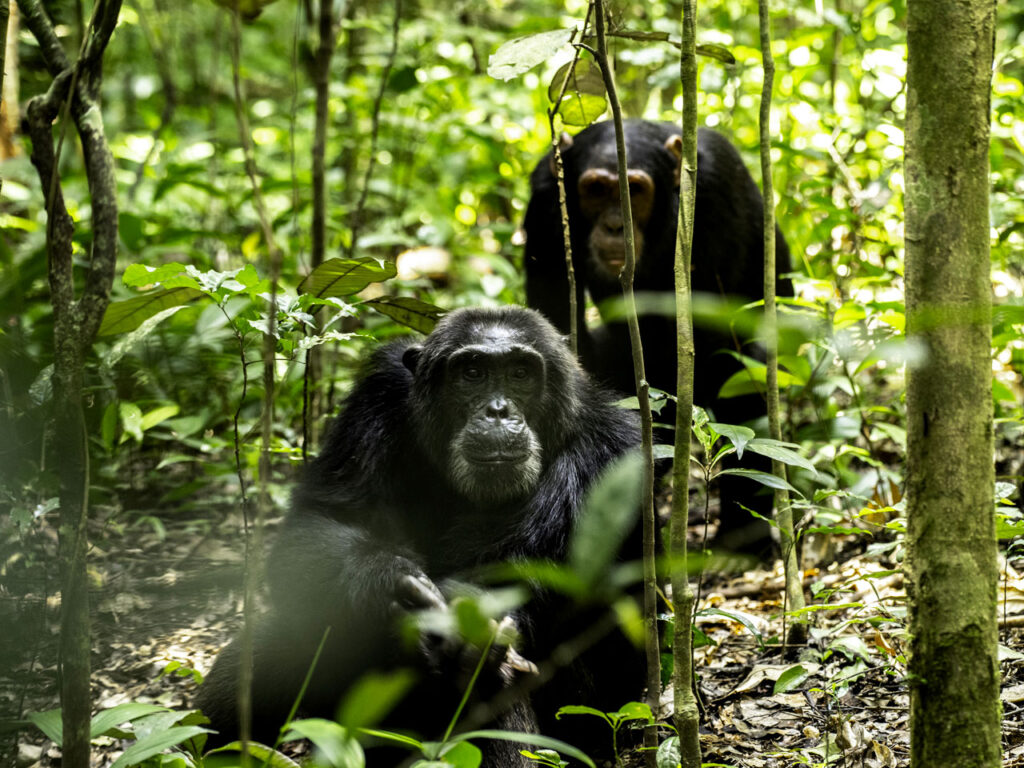
You can combine a 2-Day Nyungwe Chimpanzee trek with a 3-Day Namibia Safari by flying between Kigali and Windhoek. This action-packed combo offers an intense contrast of dense rainforest primates and the arid, sweeping desert landscapes of southern Africa.
2-days-nyungwe-luxury-fly-in-to-trek-with-chimpanzee
2-days-nyungwe-chimpanzee-tracking-and-canopy-walk
3-days-luxury-honeymoon-chimpanzee-tracking-and-canopy-walk-in-nyungweb
3-days-budget-chimpanzee-tracking-in-nyungwe-forest-park
3-days-nyungwe-chimpanzee-tracking-and-lake-kivu-relaxation
3-days-best-rwanda-canopy-walk-and-nyungwe-chimpanzee-tracking-adventure
3-day-chimpanzee-trekking-tour-package-canopy-and-lake-kivu
4-days-nyungwe-chimpanzee-trekking-canopy-walk-and-lake-kivu-relaxation
The 2 Days Nyungwe Chimpanzee Tracking & Canopy Walk package is a high-octane expedition designed for travelers who want to dive straight into one of Africa’s oldest and most biodiverse environments. Spanning over 390 square miles in southwestern Rwanda, Nyungwe National Park is a massive montane rainforest that survived the last ice age, making it an ecological goldmine. This dense forest is home to 1,068 recorded plant species, 322 bird species, and 13 distinct primate species, including a population of roughly 500 chimpanzees. Booking through a platform like SafariBookings bundles your entire experience—covering your private 4x4 transport, specialized park rangers, and tracking permits—into a single, streamlined operation. For those looking to maximize a weekend or a brief window in Rwanda, this trip delivers an unmatched blend of adrenaline-pumping canopy views and raw, deep-forest wildlife tracking.
Day 1: Arrival & Canopy Walk
Your expedition begins at 6:00 AM with a private 4x4 pickup from your hotel in Kigali. You will head southwest on a 140-mile journey, winding through terraced hillsides along the RN1 highway for 5 to 6 hours. After passing through Huye, you will enter the park boundaries and head straight to the Uwinka Visitor Centre. By 2:00 PM, you will step onto the famous Canopy Walkway. This engineering marvel features three suspension bridges stretching a total of 525 feet, hanging a dizzying 160 feet above the forest floor. Walking across these narrow slats for 2 hours puts you eye-level with the rainforest canopy, offering spectacular views of the valley and a chance to spot rare Rwenzori turacos. Afterward, you will check into a nearby lodge for an early dinner.
Day 2: Chimpanzee Tracking & Return
The day kicks off with a 4:30 AM wake-up call. By 5:00 AM, you are at the Cyamudongo or Uwinka briefing center, sipping local tea while park rangers check your permits and explain chimpanzee etiquette. You will enter the dense forest by 6:00 AM, embarking on a rugged, unpredictable trek that lasts between 2 and 5 hours. Navigating steep, muddy terrain requires solid boots, but tracking the loud hoots and pant-hoots of the chimpanzees is thrilling. Once you locate the habituated community of about 30 individuals, your strict 60-minute observation window starts. You will watch them swing through the mahogany branches, groom each other, and forage for fruit. By noon, you will hike out, grab lunch, and jump back into the 4x4 for the 6-hour drive back to Kigali.
3 Days Namibia Desert & Wildlife Safari Namibia is a land of staggering geographic extremes, home to some of the most dramatic and photogenic wilderness areas on the planet. Spanning across southwest Africa along the Atlantic coast, it is a country defined by its vast open spaces, ultra-low population density, and ancient geological formations. For travelers working within a tight 3-day itinerary, Namibia presents two distinct, world-class safari experiences that cannot be combined in a single weekend. You must choose between the iconic, iron-oxide sand crests of the Namib Desert or the wildlife-packed salt crusts of the north. Whether you choose to climb the world’s oldest dunes in Sossusvlei or track rare black rhinos around the massive salt flats of Etosha National Park, this short expedition delivers an intense, visually spectacular introduction to the raw beauty of the southwest.
Day 1: Arrival & Afternoon Game Drive Your wildlife safari begins with an 8:00 AM departure from Windhoek, heading due north along the smooth, paved B1 highway. This 260-mile drive takes about 4.5 hours, passing through the towns of Otjiwarongo and Outjo. By 12:30 PM, you will enter Etosha National Park through the Andersson Gate and check into Okaukuejo Resort or a nearby lodge. At 3:00 PM, you will set off on a 3-hour afternoon game drive. Etosha’s flat, open plains make wildlife spotting incredibly easy. You will return to camp by the 6:30 PM sunset gate closure. The highlight of the evening is sitting at Okaukuejo’s floodlit waterhole, where you can watch black rhinos and breeding herds of elephants drink just meters away well into the night.
Day 2: Full-Day Game Drives Today follows a classic safari schedule, starting with a 6:00 AM departure as the camp gates unlock. You will spend 4 hours exploring the loops around the western edge of the Etosha Pan, a colossal 1,900-square-mile salt desert so massive it can be seen from space. Because the landscape is exceptionally dry, wildlife gathers in huge numbers around permanent waterholes like Olifantsrus and Okondeka. You can park your vehicle and watch hundreds of springbok, zebras, and blue wildebeest line up to drink while lions wait in the tall grass. After a mid-day lunch and rest back at camp to avoid the midday heat, you will head out for another 3-hour afternoon drive at 3:30 PM, targeting cheetahs hunting on the open savanna.
Day 3: Final Wildlife Viewing & Departure Your final day kicks off with a shorter 2-hour sunrise game drive at 6:00 AM, focusing on waterholes close to camp to spot nocturnal predators like leopards or spotted hyenas before they retreat from the sun. You will head back to the resort by 8:15 AM for a full buffet breakfast and to pack your vehicle. At 9:30 AM, you will officially exit the park and begin the 260-mile overland drive back south to Windhoek. The return journey takes roughly 4.5 hours on the paved B1 highway, bringing you into the city center by 2:00 PM. This gives you plenty of time to drop off your rental car and transfer out to the airport for your international departure.
What are the main entry requirements for entering Namibia?
Traveling to Namibia requires a bit of straightforward administrative preparation to ensure a smooth arrival at Hosea Kutako International Airport. First, your passport must be valid for at least six months beyond your planned date of departure from the country. Bureaucratically, immigration officers are exceptionally strict about passport pages; you must have at least three completely blank pages available for entry and entry stamps, or airlines will deny you boarding at your point of origin.
Fortunately, citizens from over 50 countries, including the United States, the United Kingdom, Canada, Germany, and Australia, do not require a tourist visa in advance.
You will be granted a free tourist stamp upon arrival, valid for up to 90 days per calendar year. If you are traveling with minors under the age of 18, Namibia enforces strict regulations to combat child trafficking. You must carry certified, unabridged birth certificates for each child, which explicitly list the full names and details of both parents. From a medical standpoint, no routine vaccinations are mandatory for entry, though a yellow fever vaccination certificate is legally required if you are traveling from an endemic country.
How much does a Namibian safari package typically cost?
The financial investment required for a three-day Namibian safari depends entirely on whether you prefer a rugged, independent self-drive adventure or an all-inclusive luxury guided tour. Namibia is famous for being a premier self-drive destination. Renting a standard 4x4 vehicle equipped with a rooftop tent, camping gear, and paying your own park entrance fees averages roughly $150 to $250 per day for two people, making it highly accessible for independent travelers on a budget.
If you prefer mid-range comfort, staying in established safari lodges outside the park gates while driving yourself will scale costs to around $350 to $500 per night for a double room.
For high-end luxury, checking into exclusive, fully inclusive private concessions inside Sossusvlei or private game reserves adjacent to Etosha—such as Ongava or Little Kulala—costs anywhere from $900 to $2,500 per person, per night. These premium rates cover top-tier fine dining, vintage wines, custom open-safari vehicles, and the expertise of master local guides who know the tracks intimately, ensuring an exclusive experience far away from the busier public routes.
When is the absolute best time to visit Namibia?
The premier window to experience Namibia's desert and wildlife landscapes is during the dry winter months, which run from May to September. This period offers the most comfortable weather for travel, with cloudless blue skies and pleasant daytime temperatures averaging around 25°C. However, winter in the desert brings intense temperature drops at night, frequently plummeting to 0°C or below, which means heavy thermal layers, beanies, and gloves are mandatory for early morning departures.
The dry season is particularly vital if you choose the Etosha National Park safari option.
Because it has not rained for months, natural bush pools evaporate completely, forcing thousands of animals to congregate predictably around permanent, spring-fed waterholes along the edges of the pan. You can simply park your vehicle at a single waterhole and watch an endless procession of elephants, giraffes, lions, and rhinos come down to drink. Conversely, the hot summer months from November to April bring intense afternoon thunderstorms and temperatures pushing past 40°C, which fills the pan with water and scatters wildlife across vast, inaccessible areas.
What is the difference between Sossusvlei and Etosha?
Choosing between Sossusvlei and Etosha National Park requires deciding whether you want to prioritize dramatic, ancient landscapes or classic African big game viewing. Sossusvlei, located in the southern Namib Desert, is an aesthetic wonderland defined by giant, shifting sand dunes that are widely considered the oldest on Earth. The experience here is highly visual and physical, centered around climbing towering ridges of burnt-orange sand at sunrise, exploring stark clay pans, and photographing the sharp contrast between white earth, black trees, and deep red sands.
Wildlife does exist here—such as desert-adapted oryx and springbok—but it is sparse and solitary.
Etosha National Park, located in the far north, is the polar opposite. It is a massive, flat wildlife sanctuary dominated by a stark, white salt pan that spans nearly 1,900 square miles. The focus here is entirely on dense wildlife viewing. Etosha is home to 114 mammal species, including four of the Big Five, large lion prides, and the world’s healthiest population of endangered black rhinos. If you want dramatic scenery, choose Sossusvlei; if you want heavy wildlife encounters, Etosha is the clear winner.
Do I need a 4x4 vehicle for Namibia?
While Namibia boasts an exceptional, well-mapped network of primary roads, renting a high-clearance 4x4 vehicle is strongly recommended for a safe and stress-free safari. The country’s main highways connecting major towns are flawlessly tarred, but once you exit these arteries to head toward Sossusvlei or Etosha, you will immediately encounter gravel, dirt, and sand roads. These secondary tracks can be notoriously unpredictable, frequently developing deep corrugations, sharp rocks, and loose gravel accumulation that can cause standard sedans to slide.
A high-clearance 4x4 vehicle provides better physical visibility over the bush, vastly improves passenger comfort on bumpy roads, and offers superior structural durability against tire punctures.
Crucially, if you choose the Sossusvlei itinerary, the final 3-mile stretch of road leading directly to the Deadvlei parking area consists entirely of deep, soft, unpaved sand. Standard two-wheel-drive cars will become instantly bogged down here, forcing unprepared travelers to park and pay for an expensive shuttle service. Having a true 4x4 with low-range capabilities allows you to deflate your tires and drive effortlessly through the desert sand right to the trailheads.
Is Namibia a safe destination for self-drive?
Namibia is widely recognized as one of the safest, most stable, and welcoming countries in Africa for international self-drive tourists. The nation enjoys a peaceful democratic political climate, low crime rates, and an economy that highly values and protects its tourism industry. Navigating the country is incredibly straightforward; roads are explicitly signposted, maps are highly accurate, and locals are famously friendly, fluent in English, and always willing to help a traveler change a tire or find a route.
The primary safety hazards in Namibia are actually environmental rather than human, centered around vast distances and wildlife.
Because towns are separated by hundreds of miles of uninhabited terrain, running out of fuel or water is a real danger if you fail to plan ahead. The golden rule of Namibian travel is to never let your fuel tank drop below half, and to always carry at least 10 liters of emergency drinking water in your trunk. Furthermore, driving at night is strictly discouraged across the country. Roads are entirely unlit, and wild animals like massive kudus, zebras, and desert elephants frequently wander onto the warm gravel and tarmac after dark, creating a severe collision risk.
What clothing should I pack for this safari?
Packing for Namibia requires a strategic approach that accounts for extreme, rapid temperature swings within a single 24-hour cycle. If you are heading out on a pre-dawn desert climb or an early morning game drive, temperatures can be freezing. You will need a heavy windproof jacket, a thick fleece, a warm beanie, a scarf, and gloves to stay comfortable while the vehicle is moving. However, by 11:00 AM, the harsh African sun climbs high, and temperatures regularly soar past 30°C, requiring you to shed your outer layers.
Your base clothing should consist of lightweight, breathable cotton or linen fabrics, including shorts, t-shirts, and long-sleeved safari shirts that offer UV sun protection.
Stick to neutral, earth-toned colors like khaki, tan, brown, and olive green to blend into the environment and avoid attracting dust. For footwear, pack sturdy, broken-in trail shoes or lightweight hiking boots with thick soles to protect your feet from hot desert sand and sharp thorns in the bush. Do not forget a wide-brimmed sun hat, high-quality sunglasses, and heavy-duty moisturizing lotion and lip balm to combat the intensely dry desert air.
What is the significance of Deadvlei's trees?
Deadvlei is one of the most surreal, hauntingly beautiful, and photographed locations on earth, carrying immense geological and historical significance. Located inside Namib-Naukluft National Park, Deadvlei is a stark, white clay pan surrounded by some of the highest sand dunes in the world. Approximately 900 years ago, an intense period of rainfall caused the nearby Tsauchab River to flood, creating a temporary marshland that allowed camel thorn trees to grow and flourish in the desert.
However, as the climate shifted and massive sand dunes slowly migrated across the landscape, the dunes blocked the river's path, cutting off the water supply completely.
The climate became so intensely dry that the trees did not decompose or rot; instead, they were slowly scorched black by the relentless sun, effectively becoming mummified skeletons. Today, these ancient, black wooden statues stand frozen in time against a brilliant white clay floor and a backdrop of vibrant, iron-oxide orange dunes. Visiting Deadvlei requires a 1.1-mile walk from the 4x4 parking area, and arriving early in the morning allows you to witness the dramatic shadows cast by these centuries-old trees.
What unique wildlife can I see in Etosha?
Etosha National Park offers a highly unique wildlife viewing experience shaped entirely by its stark, arid, and open geography. Because the landscape is dominated by a massive salt flat with minimal thick vegetation, wildlife visibility is exceptional compared to the dense bush environments of East or South Africa. Etosha is a vital stronghold for several rare and endangered species, most notably the desert-adapted black rhinoceros.
While rhinos are notoriously elusive elsewhere, you can reliably see multiple individuals drinking together at night at floodlit resort waterholes like Okaukuejo.
The park is also home to massive herds of elephants, lions, leopards, cheetahs, and uniquely adapted desert antelopes. You will see thousands of elegant gemsbok (oryx) with their long, rapier-like horns, alongside springbok, blue wildebeest, and Hartmann’s mountain zebras. The birdlife is equally spectacular, with over 340 recorded species ranging from the massive, flightless common ostrich to the tiny, colorful lilac-breasted roller. The sheer volume of animals gathering peacefully side-by-side at the waterholes creates a dramatic, theater-like wildlife experience that is entirely unique to this northern Namibian oasis.
Is malaria a significant risk in Namibia's parks?
Malaria risk in Namibia is highly localized and seasonal, meaning your level of concern depends entirely on where you travel and the time of year. The southern and central regions of the country, including the capital city of Windhoek and the entire Sossusvlei desert region, are completely malaria-free year-round due to the intensely dry, arid environment where mosquitoes cannot breed. However, as you travel further north toward Etosha National Park, the environment transitions into a low-to-medium risk zone.
The risk is lowest during the dry winter months from May to September, when mosquito populations die back significantly due to cold nighttime temperatures.
If you are traveling during the rainy summer season from November to April, the risk increases as standing water accumulates. It is highly recommended to consult a travel clinic before departure regarding malaria prophylactics if you plan to visit Etosha during the wet months. Regardless of the season, basic physical prevention is highly effective. Ensure you apply an insect repellent containing at least 30% DEET to exposed skin during the peak mosquito hours of dawn and dusk, and wear long sleeves and trousers when sitting around evening campfires.
Booking Nyungwe chimpanzee tracking with us Roads of Adventure safaris
Locking in a 3-day or 4-day primate itinerary with Roads of Adventure Safaris completely streamlines your trip to Nyungwe National Park. Their tailored packages smoothly handle the 140-mile, 5-to-6-hour road transfer from Kigali, getting you to the park stress-free.
They take care of the upfront logistics, securing your $90 chimpanzee tracking permit and booking your pass for the 160-foot-high forest canopy walk. You can customize your entire itinerary or lock down a package directly by emailing their Kampala-based office at info@roadsodadventuresafaris.com or messaging them via WhatsApp at +256 773 796644.
