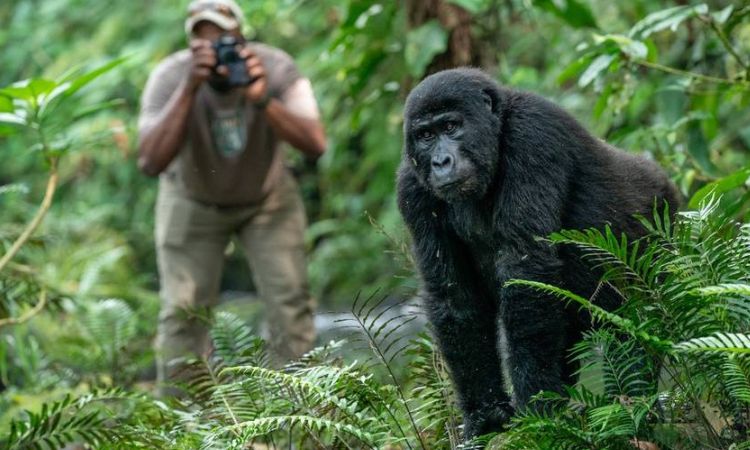
Experience gorillas in Uganda, golden monkeys in Rwanda, and vast wildlife in Tanzania. This 10-day itinerary features gorilla trekking in Bwindi, golden monkey tracking in Rwanda, and a 4-night stay in the Serengeti before departing directly via a local airstrip flight
Day 1: Arrival in Kigali, Rwanda
Your 10-day Uganda Rwanda Tanzania safari begins at Kigali International Airport (KGL), where your private driver-guide meets you at the arrivals terminal. You will transfer 12 kilometers to your city hotel in a closed 4x4 safari vehicle. Depending on your landing time, you can schedule a 2-hour visit to the Kigali Genocide Memorial in Gisozi. This historic site provides critical context on Rwanda’s past, marking the final resting place of over 250,000 victims. Afterward, you will check into your hotel to rest before your early morning departure north. Dinner is at your leisure in the city, where you can sample local Rwandan coffee.
Day 2: Transfer to Volcanoes National Park
At 8:00 AM, you leave Kigali for a 115-kilometer drive north to Volcanoes National Park. The journey takes approximately 2.5 hours along paved, winding roads that rise into the Virunga Mountains. You will arrive at your lodge near Musanze in time for lunch. At 2:00 PM, you can visit the Iby’Iwacu Cultural Village, a community-led initiative where former poachers demonstrate traditional drumming, archery, and historical medicine practices. This 2-hour cultural exchange directly funds local conservation. You return to your lodge by 5:00 PM for dinner and your mandatory trekking briefing.
Day 3: Golden Monkey Tracking & Uganda Border Cross
Your day starts at 7:00 AM at the Kinigi park headquarters for a briefing on golden monkey tracking. At 8:00 AM, you enter the bamboo forests at the base of the volcanoes to track a habituated troop of up to 100 monkeys. You have exactly 1 hour to photograph them feeding on bamboo shoots. By 11:30 AM, you return to the vehicle and drive 40 kilometers to the Cyanika border post. After completing Rwanda and Uganda immigration formalities, you continue another 60 kilometers to Bwindi Impenetrable National Park, arriving at your lodge by late afternoon.
Day 4: Gorilla Trekking in Bwindi
Breakfast is served at 6:00 AM, followed by a transfer to the Uganda Wildlife Authority station at 7:30 AM. Park rangers divide trekkers into groups of eight, assigning each group to one of Bwindi's 21 habituated gorilla families. You enter the dense jungle at 8:30 AM. The trek involves navigating steep ridges and thick undergrowth at elevations between 1,160 and 2,600 meters. The search takes anywhere from 2 to 6 hours. Once your group locates the family, you spend 60 minutes observing the silverback and juveniles before returning to camp.
Day 5: Fly to Serengeti National Park, Tanzania
You depart Bwindi at 6:30 AM for a 2-hour drive to the Kihihi Airstrip. At 8:45 AM, you board a domestic flight to Entebbe International Airport (EBB), arriving at 11:20 AM. Here, you clear customs and board a regional flight to Kilimanjaro International Airport (JRO) in Tanzania. After processing your Tanzanian visa, you board a coastal bush flight directly into the Seronera Airstrip in the Central Serengeti. Your Tanzanian guide meets you at the airstrip at 4:30 PM for a 90-minute evening game drive en route to your tented camp.
Day 6: Central Serengeti Game Drive
Your morning game drive starts at 6:00 AM to catch predators like lions and leopards while temperatures are cool. You explore the Seronera River Valley, a year-round water source that supports a high density of resident wildlife, including herds of elephants, buffaloes, and giraffes. You return to camp at 11:30 AM for lunch and a midday rest. At 3:30 PM, you head back out into the savannah to track large prides of lions that frequent the local granite kopjes. You return to camp by 6:30 PM for dinner.
Day 7: Central Serengeti to Northern/Western Serengeti
After a 7:00 AM breakfast, you pack your bags and begin a game-filled transfer toward your next camp. Depending on the month of your safari, you will head north toward the Mara River or west toward the Western Corridor to shadow the moving herds of the Great Migration. This 80-kilometer drive serves as an extended game drive, allowing you to observe changing terrains and specialized wildlife like Nile crocodiles and colobus monkeys. You reach your new seasonal camp by 1:00 PM, followed by a 4:00 PM afternoon drive.
Day 8: Full Day in the Serengeti
This day is dedicated to a deep-plains safari. You can choose to pack a picnic breakfast and depart at 6:00 AM for an 8-hour drive into remote sectors of the park, tracking large cheetah coalitions and migratory wildebeest herds. Alternatively, you can book a dawn hot air balloon safari, which lifts off at 5:30 AM for a 1-hour flight over the plains, concluding with a bush breakfast at 8:00 AM. The remainder of the day is spent analyzing wildlife patterns and tracking nocturnal predators returning from their hunts.
Day 9: Serengeti to Ngorongoro Conservation Area
You maximize your final morning in the Serengeti with a 6:00 AM game drive. After a 10:00 AM brunch at camp, you pack up and drive 140 kilometers southeast toward the Ngorongoro Conservation Area. The route takes you through the shifting desert sands of the Olduvai Gorge region. You enter the conservation area gates by mid-afternoon and drive up the outer slopes of the volcanic caldera. You check into your lodge, situated at 2,200 meters on the crater rim, where temperatures drop significantly by sunset.
Day 10: Crater Tour and Fly Out
At 6:00 AM, you descend 600 meters down the steep access road into the 260-square-kilometer Ngorongoro Crater floor. This enclosed ecosystem allows you to view resident black rhinos, hippos in the Ngoitokitok Springs, and dense populations of spotted hyenas and lions. After a 5-hour game drive, you ascend the crater rim at 11:30 AM and drive 45 kilometers to the Lake Manyara Airstrip. You board a 1:45 PM regional flight to Kilimanjaro International Airport, arriving in time for your evening international flight home.
What packing essentials are required for gorilla trekking?
You need thick gardening gloves, sturdy hiking boots, and long trousers to protect your legs from stinging nettles. A lightweight waterproof jacket is mandatory because weather changes instantly in the rainforest. Pack high-energy snacks like nuts and dried fruit, along with two liters of water, because the trek can last up to six hours. Do not forget a insect repellent with high DEET content to ward off bugs. Bring a dry bag to protect your camera gear from sudden downpours. A wide-brimmed hat and sunglasses protect against the intense high-altitude sun when the canopy opens up.
Avoid wearing bright colors like blue or black, as they attract tsetse flies; choose neutral khaki, green, or brown tones instead. Gaiters are highly useful for preventing safari ants from crawling up your legs. You do not need to bring a walking stick from home, as rangers provide wooden ones at the briefing station. Remember to carry your passport, as park authorities check it against your permit before you enter the forest. Finally, include a small first-aid kit with blister pads, bandages, and antiseptic cream, because walking through thick undergrowth often causes minor scrapes.
How long does the border crossing process take?
The border crossing between Rwanda and Uganda at Cyanika or Katuna takes between forty-five and ninety minutes. The exact duration depends on the volume of tourist vehicles arriving at the customs counters simultaneously. You must physically exit your safari vehicle and enter the immigration hall to present your documents. If you have the East Africa Tourist Visa, the process is streamlined because it covers both nations under a single fee. The border agents will check your passport validity, scan your fingerprints, and take a digital photograph.
You must also show your yellow fever vaccination certificate, which officials inspect thoroughly before granting entry. While you handle paperwork, your driver-guide takes the vehicle through separate commercial clearing lanes to pay cross-border road tolls. Do not bring plastic bags into Rwanda, as they are illegal and customs agents search luggage for them. Once both you and the vehicle clear the respective counters, you re-board and continue the journey. Midday crossings are usually faster than early morning hours when regional commercial trucks crowd the border posts, so timing your arrival helps reduce delays.
What is the best month for this safari?
The best months for this combined itinerary are from June to September or January to February. During these dry seasons, forest trails in Bwindi and Volcanoes National Park are less muddy, making the steep climbs much safer. In Tanzania, the dry weather forces wildlife to gather around permanent water sources like the Seronera River, which simplifies wildlife tracking. If you travel between June and July, you stand a high chance of witnessing the Great Migration herds crossing the Grumeti or Mara rivers in the northern Serengeti.
Choosing January or February allows you to see the wildebeest calving season in the southern plains, where thousands of calves are born daily. The wet months of April, May, and November bring heavy rains that make forest paths slippery and cause safari vehicles to get stuck in deep mud. However, the rainy season offers lower lodge rates and fewer tourists around the gorilla groups. If your primary goal is comfortable trekking conditions combined with classic Serengeti game viewing, targeting the dry July window gives you the most predictable weather across all three nations.
Are domestic bush flights safe in East Africa?
Yes, domestic bush flights are safe and strictly regulated by national civil aviation authorities. The airlines operating these routes use modern, well-maintained turboprop aircraft like the Cessna Caravan or Twin Otter, which are engineered for short, unpaved runways. Pilots flying these routes possess extensive experience navigating local weather patterns and high-altitude terrains. Flights operate strictly during daylight hours under visual flight rules, meaning planes do not fly if heavy storms or dense fog compromise visibility.
Because these are light aircraft, they fly at lower altitudes than commercial jets, which occasionally causes mild turbulence over the hot savannah plains. The luggage allowance is strictly limited to fifteen kilograms per passenger, and bags must be soft-sided duffels to fit into the small cargo pods. Every aircraft undergoes routine maintenance checks after a set number of flight hours, adhering to international safety standards. Using these flights saves you from twenty hours of bumpy driving over rough dirt roads, preserving your energy for safaris. The planes land on clear dirt tracks where park rangers keep animals off the runway before descent.
What wildlife lives inside the Ngorongoro Crater?
The Ngorongoro Crater floor hosts roughly twenty-five thousand large mammals within its enclosed walls. It is one of the best locations in Africa to spot the endangered black rhino, as the open plains allow clear visibility from a distance. Large prides of lions live here year-round, utilizing the high concentration of prey to hunt without migrating. You will see large herds of blue wildebeests, plains zebras, and Cape buffaloes grazing across the short grass.
Elands, gazelles, and warthogs move through the landscape, while hippos spend their days submerged in the Ngoitokitok Springs. The Lerai Forest sector provides cover for massive bull elephants with giant tusks, though breeding herds of elephants generally stay on the crater rim. Spotted hyenas are highly active here, often competing directly with lions for kills. You will not find giraffes or impalas inside the crater because the steep, sixty-meter walls deter them, and the lack of specific acacia trees limits their food source. Cheetahs are present but hide in the taller grasses near the crater walls to avoid larger predators.
Can I photograph primates using a flash?
No, you cannot use a camera flash under any circumstances when photographing gorillas or golden monkeys. The sudden, intense burst of light easily startles these wild animals, potentially triggering an aggressive charge from a defensive silverback. Flash photography can also cause permanent eye damage to young primates whose vision is still developing. Park rangers enforce this rule strictly; if your flash accidentally fires, they will issue a firm warning or terminate your trek immediately.
To capture clear images in the dark forest canopy, you must manually adjust your camera settings before entering the woods. Increase your ISO setting to 1600 or 3200 to compensate for the dim light beneath the thick trees. Use a lens with a wide aperture, such as f/2.8 or f/4, to allow maximum light into the camera sensor. Keep your shutter speed above 1/250th of a second to prevent motion blur from moving animals or shaking hands. Bring a clean microfiber cloth to wipe moisture off your lens, as the jungle humidity condenses on glass quickly, ruining your photos.
How physically demanding is the gorilla trek?
Gorilla trekking is physically demanding and requires a moderate level of physical fitness from participants. You will hike through dense vegetation with no clear paths, navigating steep mud slopes and slippery tree roots. The elevation in Bwindi ranges from 1,160 to 2,600 meters above sea level, meaning the thin mountain air makes breathing noticeably harder. The length of the trek is highly unpredictable; you might locate a family within two hours, or you could spend six hours walking uphill before finding them.
The park rangers adjust the walking pace to match the slowest member of the group, ensuring no one gets left behind. You can hire a local porter at the trailhead for twenty dollars to carry your backpack and provide physical support on steep inclines. Preparing for the trip by doing regular cardio exercises and hill walking two months prior greatly improves your experience. If you have severe mobility issues, you can hire a traditional sedan chair service, where eight porters carry you through the forest. Ultimately, your determination and sturdy footwear matter more than peak athletic ability.
Is tipping expected on an African safari?
Yes, tipping is an established custom on African safaris and forms an important part of the staff's income. For your private driver-guide, a standard tip ranges from twenty to thirty dollars per day per vehicle, usually presented at the end of the trip. When trekking gorillas or golden monkeys, you should tip the head park ranger twenty dollars per group, and the individual track trackers ten dollars each. If you hire a personal porter to assist with your daypack, a fifteen-dollar tip on top of their base fee is customary.
For safari lodges and tented camps, most properties place a communal tip box at the reception desk. Dropping fifteen to twenty dollars per day into this box covers the behind-the-scenes staff, including chefs, room stewards, and security guards. It is best to tip using crisp, clean US dollar bills printed after 2013, as local banks reject older, torn, or wrinkled currency. Alternatively, you can tip using local currency like Tanzanian Shillings or Ugandan Shillings, which helps staff avoid foreign exchange fees when purchasing daily goods.
What accommodation style can I expect here?
You will stay in a mix of luxury eco-lodges and permanent canvas tented camps designed to blend into nature. In Rwanda and Uganda, the accommodations are solid stone or timber chalets perched on hillsides, offering panoramic views of the volcanic peaks or forest canopy. These rooms feature private en-suite bathrooms, flush toilets, hot showers, and mosquito netting over the beds. Many forest lodges include fireplaces to warm the rooms during the chilly mountain nights.
In the Serengeti, you will stay in luxury tented camps built on raised wooden platforms under large canvas structures. These tents offer the amenities of a hotel room, including king-sized beds, running water, and solar-powered lighting, while keeping you close to the sounds of the African bush. The camps move twice a year to follow the Great Migration, ensuring you remain close to the wildlife action. Most properties provide laundry services, though they often exclude undergarments due to local cultural traditions. Every camp features a central dining mess tent where group meals are served, along with an evening campfire area.
Do I need a yellow fever certificate?
Yes, you need an international certificate of vaccination against yellow fever for this specific multi-country itinerary. Because you are crossing land borders between Rwanda and Uganda, and subsequently flying into Tanzania, immigration officials will demand to see the physical yellow paper document. Tanzania enforces this rule strictly for any traveler arriving from countries where yellow fever is endemic, which includes both Uganda and Rwanda. You must receive the vaccine injection at least ten days before entering East Africa for the certificate to become legally valid.
If a medical condition prevents you from receiving the vaccine, you must carry an official signed waiver letter from a licensed physician, which border health officials will review before granting entry. Keep this certificate inside your passport jacket so it is easily accessible at every airport check-in desk and border crossing station. Failing to present a valid certificate can result in border authorities denying you entry or forcing you to receive the vaccine injection directly at the border station for an extra fee, which delays your travel schedule significantly.
Booking 10 Days Uganda Rwanda and Tanzania safari with us Roads of Adventure safaris
Booking a 10-day multi-country safari with Roads of Adventure Safaris covers an expertly managed cross-border expedition across East Africa. Our custom mid-range tours typically range from $300 to $1,000 per person per day, depending heavily on your selected accommodations, group size, and specific activities
