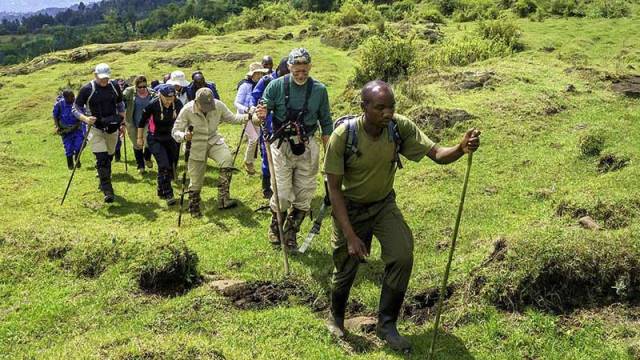
The Mount Sabinyo hike stands out as one of East Africa’s most thrilling, high-altitude day treks. Tucked away in the rugged southwestern corner of Uganda within Mgahinga Gorilla National Park, this intense eight-hour round-trip adventure pushes your limits across heavily eroded volcanic terrain. Unlike symmetrical peaks, Sabinyo tests your grit with a serrated, tooth-like ridgeline, vertical drops, and hand-carved wooden ladders that feel suspended in the clouds. As you push through shifting microclimates, the ultimate reward awaits at the 3,645-meter apex: a unique international triple-point where you can stand in Uganda, Rwanda, and the Democratic Republic of the Congo all at once. It is a demanding, full-body scramble that transforms physical exertion into pure, cross-border magic.
Hour 1: 08:00 AM – 09:00 AM | The Start & Briefing
Your Mount Sabinyo hike kicks off at the Ntebeko Park headquarters, where the morning mist still clings to the volcanic peaks. Here, you will meet your Uganda Wildlife Authority guides for a vital safety briefing, grab a sturdy walking stick, and sort out your daypack. Entering the park boundary at roughly 2,400 meters, the initial trail offers a gentle, welcoming warm-up. You will wind past scenic local farmlands before plunging into a dense, vibrant bamboo zone. Keep your eyes peeled and your camera ready; this lower canopy is prime territory for playful, rare golden monkeys rustling through the stalks. The air is cool, the path is wide, and the steady, flat terrain allows your legs to find an easy rhythm before the real climbing begins.
Hour 2: 09:00 AM – 10:00 AM | Into the Hagenia Forest
The easy warm-up ends as the trail tilts upward, pulling you deep into the enchanting Hagenia-Hypericum forest zone. The landscape shifts dramatically into a prehistoric, fairy-tale setting where massive, ancient trees are heavily draped in long, ghostly strands of "Old Man's Beard" moss. As the gradient grows increasingly steep, the dense undergrowth of ferns and wild herbs fills the damp air with earthy scents. This hour is a true test of baseline endurance, as the thinning air begins to work your lungs. Your rangers will lock into a slow, deliberate pace, intentionally pausing at scenic clearings so you can catch your breath, sip some water, and appreciate the raw, untouched wilderness wrapping around the volcano's lower slopes.
Hour 3: 10:00 AM – 11:00 AM | The Ladder Sections
Prepare for a massive spike in adrenaline as the Mount Sabinyo hike transitions into its most technical, full-body phase. The dirt path gives way to sheer, exposed rock faces and dramatic gorges dropping off into the mist. To navigate these near-vertical drops, you will face the park's famous network of handmade wooden ladders. Gripping the rungs with your gloves, you will scale these rustic structures anchored directly into the cliffside. The dense forest thins out into sub-alpine moorland, where hardy giant heathers replace the tall trees, and the wind takes on a sharp, freezing bite. Every step requires absolute focus, turning the trek into an exhilarating, vertical scramble that challenges your upper body strength and tests your comfort with heights.
Hour 4: 11:00 AM – 12:00 PM | The Ridge Walk & Summit (Peak 1)
This hour delivers the heart-pounding highlights of the Mount Sabinyo hike as you reach the infamous, knife-edge volcanic ridges. The local name meaning "Old Man's Teeth" makes perfect sense now, as you balance along the narrow, jagged rock formations that form the mountain's spine. You will dig deep to conquer Peak One, revealing massive drops into the misty valleys below that can easily induce a flash of vertigo. Trusting your footing and the steady hands of your guiding UWA rangers, you will push directly over the rugged contours of Peak Two. The wind howls across the open ridges, but the sight of the final peak looming just ahead provides the perfect burst of second-wind energy needed to finish the climb.
Hour 5: 12:00 PM – 01:00 PM | The 3-Country Summit & Lunch
You have made it. Pushing past the final incline brings you to the official monument marking Peak Three, the absolute summit of the volcano. The sense of achievement is overwhelming as you stand at the geographic center of an international triple-point, effortlessly walking between Uganda, Rwanda, and the DRC without a visa in sight. If the swirling mountain mist parts, you will be treated to a breathtaking, 360-degree panoramic view stretching across the entire chain of the Virunga Massif. It is the perfect place to unbuckle your heavy pack, find a smooth volcanic rock to sit on, and celebrate the moment over a hard-earned packed lunch while floating high above the borders of three sovereign nations.
Hour 6: 01:00 PM – 02:00 PM | The Tricky Descent Begins
Leaving the high-altitude summit behind, you will quickly realize that heading down the Mount Sabinyo hike demands just as much mental focus and physical control as the journey up. Gravity is on your side, but it puts an intense, jarring strain on your knees and quadriceps. Retracing your steps across the narrow, wind-swept ridges requires a slow, deliberate pace to avoid slipping on the loose volcanic rock. The real challenge lies in navigating the steep wooden ladders backward; descending into the misty drops requires you to double-check every handhold and firmly plant your boots on the rungs. The guides stay close, ensuring the group maintains a safe, controlled momentum down the exposed vertical sections.
Hour 7: 02:00 PM – 03:00 PM | Navigating the Bamboo Zone
Re-entering the sheltered canopy of the Hagenia-Hypericum forest brings a welcome shield from the biting summit winds, but introduces a slick new challenge underfoot. The steep mountain trails, often damp from afternoon showers or heavy mist, can easily turn into slippery mud chutes. Your provided wooden walking stick becomes an absolute lifesaver during this stretch, acting as a crucial third leg to anchor your weight, save your aching joints, and prevent unexpected tumbles. The descent moves along at a fast clip, but you must remain alert for hidden tree roots and slick moss. The eerie, moss-draped forest gradually gives way to the familiar, familiar bamboo zones, signaling that you are closing in on the lower altitudes.
Hour 8: 03:00 PM – 04:00 PM | Return to Headquarters
The dense bamboo forest eventually opens up, spilling you back out into the sunlit, gentle farmlands that skirt the park's edge. Walking the final, flat stretch of dirt trail toward the Ntebeko headquarters brings a profound wave of physical relief and pride. Your eight-hour mountain battle is officially complete. Back at the base station, you will sit down to sign out of the park guestbook, kick off your muddy boots, and reflect on the wild terrain you just conquered. To wrap up the adventure, the UWA team will present you with your official certificate of completion—a tangible reminder of the day you climbed the old man's teeth and stood in three countries at once.
What physical fitness level does this mountain climb require?
The Mount Sabinyo hike is a serious physical undertaking that demands a solid level of cardiovascular endurance and core strength. You do not need to be an elite athlete or an experienced mountaineer, but if your daily routine is mostly sedentary, this trail will shock your system. The route relies heavily on your lower body to push up steep, uneven mud steps and requires decent upper-body strength to haul yourself up vertical ladders.
If you jog, swim, or hike regularly, your heart and lungs will handle the physical exertion just fine. The real test is stamina; you will be moving continuously for about eight hours, often under the strain of thinning air above 3,000 meters. The best way to prepare is by mixing cardio workouts with leg exercises like squats and lunges in the weeks leading up to your trip. On the day of the trek, the key is maintaining a slow, steady rhythm. The park rangers are excellent at pacing the group, ensuring that nobody burns out early and everyone has the breath needed to push through the final ascents safely.
Can I complete the entire trek without climbing ladders?
The straightforward answer is no; the ladders are an unavoidable and essential part of the Mount Sabinyo hike. Because the volcano’s natural geography consists of heavily eroded, razor-sharp volcanic ridges and sheer rock walls, a standard walking trail simply cannot be cut into the landscape. The Uganda Wildlife Authority built these heavy-duty wooden ladders specifically to bridge otherwise impassable vertical drops and deep chasms.
If you decide to opt out of the ladders, your journey will effectively end before you reach the second peak. You can comfortably walk through the bamboo and Hagenia forests to Peak One, which still offers beautiful views, but pushing onward to the triple-point summit requires climbing. The ladders are securely bolted into the rock faces and feature sturdy rungs, but they do stand nearly vertical against the cliffs. If you experience severe, paralyzing vertigo, this part of the trail will be a massive mental hurdle. However, if you take it one rung at a time, keep your eyes focused straight ahead, and wear grippy gloves, most hikers find the challenge incredibly empowering.
What specific clothing keeps you comfortable on Sabinyo?
Dressing for the Mount Sabinyo hike requires a smart, layer-based strategy because the microclimates shift dramatically as you gain altitude. You will likely start the morning sweating in the humid bamboo forest and finish the afternoon shivering in the wind-swept alpine zone. Your base layer should be a lightweight, moisture-wicking shirts that keeps sweat away from your skin, preventing you from getting chilled later.
Over that, pack a high-quality, breathable fleece or insulated jacket for the upper sections. A rugged, fully waterproof outer shell is non-negotiable, as sudden tropical downpours are common on the volcano. For your lower half, choose flexible, quick-drying hiking trousers rather than heavy jeans, which become heavy and chafing when wet. Do not forget a pair of tough gardening or utility gloves to protect your palms from splinters on the wooden ladders and scratches from rough alpine brush. Finally, thick wool socks paired with broken-in, waterproof hiking boots with deep ankle support will protect your feet from painful blisters and rolls on the slippery, root-choked terrain.
Are dangerous wild animals a threat during the trek?
While you are walking through a highly protected national park teeming with wildlife, animal attacks are not a major concern on the Mount Sabinyo hike. The lower slopes are home to mountain gorillas, golden monkeys, forest elephants, and buffaloes. However, these animals naturally avoid human noise and generally stay deep within the thick undergrowth away from the established trail.
To ensure complete safety, every hiking group is accompanied by armed Uganda Wildlife Authority rangers. These guides are intimately familiar with the forest, trained in animal behavior, and skilled at tracking signs of wildlife nearby. In the rare event that you cross paths with a forest elephant or a buffalo, the rangers know exactly how to safely steer the group around them. If you happen to encounter a wild gorilla family, it is a magnificent bonus rather than a danger; the guides will simply instruct you to keep a respectful, quiet distance. The wildlife adds an exciting, authentic element to the trek, but the challenging terrain and changing weather remain your primary obstacles.
How does altitude affect your body during the climb?
As you ascend past 3,000 meters on the Mount Sabinyo hike, the atmospheric pressure drops, meaning there is less oxygen available with each breath you take. Your body has to work significantly harder just to keep moving, which manifests as a rapidly spiking heart rate, heavier breathing, and muscles that tire much faster than they would at sea level.
Most people feel mild symptoms of altitude acclimatization, such as a slight headache, mild lightheadedness, or a touch of nausea near the peaks. These feelings are completely normal and usually manageable if you stay well-hydrated and avoid rushing. The rangers intentionally enforce a slow, rhythmic pace—often called the "African walk"—to give your system time to adapt to the elevation changes. It is crucial to listen to your body and speak up if you feel genuinely unwell. If mild symptoms escalate into severe dizziness, persistent vomiting, or a loss of physical balance, it means your body isn't adapting, and the only safe solution is to head back down to lower ground immediately.
Where do hikers use the bathroom along the trail?
The Mount Sabinyo hike takes you through a pristine, protected wilderness area, which means modern restroom facilities do not exist once you leave the park headquarters. There are no built toilets, sheltered outhouses, or rest stations hidden along the ridges. You will need to use the bathroom before you set off from the Ntebeko visitor center in the morning.
Once you are out on the mountain, you will have to rely on nature. If you need to relieve yourself, you must inform your guide, step carefully off the main path into the dense forest bush, and find a private spot. Because Mgahinga is a fragile ecosystem home to endangered species, practicing strict eco-tourism etiquette is essential. You must pack out whatever you pack in; bring small biodegradable waste bags or zip-lock bags to store any used toilet paper or wet wipes, and carry them in your backpack until you return to the base. It requires a bit of planning and outdoor comfort, but keeping the volcano clean preserves the wilderness for everyone.
What food should I pack for the full day?
Because the Mount Sabinyo hike burns an immense amount of calories over an eight-hour period, packing the right fuel is essential to preventing a physical crash. You need to carry a substantial packed lunch along with plenty of high-energy, easily digestible snacks that you can nibble on during short rest breaks along the trail.
Focus on foods that pack a punch without weighing down your bag. High-protein and high-carbohydrate options like nuts, dried fruits, energy bars, bananas, and hard-boiled eggs are perfect for keeping your stamina steady. For lunch, a hearty sandwich, roasted chicken, or a pasta salad packed in a lightweight container works beautifully. Equally important is your water supply; carry at least three liters of clean drinking water or electrolyte-infused sports drinks. Avoid heavy, overly salty foods that cause dehydration, and skip sugary snacks that trigger a quick energy spike followed by a sudden crash. Having a satisfying meal waiting in your pack provides a fantastic psychological boost when you finally hit that triple-point summit.
8. Is the trail easily accessible during the rainy season?
While the Mount Sabinyo hike remains open year-round, tackling the mountain during the rainy seasons—typically from March to May and September to November—completely changes the nature of the adventure. The trail becomes significantly more difficult, turning earthen pathways into thick, slippery mud chutes that require immense concentration and double the physical effort to navigate.
The handmade wooden ladders become slick when wet, making the vertical climbs much more nerve-wracking and physically demanding. Thick mountain mist often rolls in with the rain, which can completely drop the temperature and obscure the beautiful panoramic views at the summit, leaving you standing in a wall of white cloud. However, if you are an experienced hiker who embraces a muddy challenge and packs top-tier waterproof gear, the rainy season offers a serene, solitary experience free from tourist crowds. If you prefer firmer footing, clear blue skies, and comfortable trekking conditions, you should plan your trip during the dry windows of June to August or December to February.
What happens if someone gets injured on top?
Safety is the absolute priority on the Mount Sabinyo hike, but the remote, rugged terrain means an injury near the summit requires a coordinated, serious response. The UWA rangers leading the trek are trained in wilderness first aid and carry basic medical kits to handle minor issues like cuts, scrapes, sprains, or sudden blisters right on the trail.
If a serious injury occurs—such as a broken bone or severe altitude sickness—that prevents a hiker from walking, a helicopter evacuation is not possible due to the sharp, narrow ridges and unpredictable mountain weather. Instead, the rangers will initiate a ground rescue. They will use satellite phones or radios to alert the park base, and a rescue team of strong local porters and rangers will head up the mountain with a specialized stretcher. Because navigating the steep slopes and vertical ladders while carrying a person takes hours of intense physical labor, hiring a local porter at the start is a smart preventative measure; they help carry your gear, reducing your fatigue and significantly lowering the risk of a clumsy misstep.
Why should I hire a porter for this trek?
Hiring a local porter before starting the Mount Sabinyo hike is one of the best decisions you can make for your body and the local community. For a modest fee of about $15 to $20 USD, a porter will carry your heavy backpack containing your water, lunch, and bulky rain layers, leaving you completely unburdened.
Taking that weight off your back transforms the entire trekking experience. It allows you to maintain better physical balance on the narrow volcanic ridges, keeps your hands free to securely grip the rungs of the wooden ladders, and saves your knees from extra strain during the jarring descent. Beyond the physical relief it brings you, the economic impact is profound. Porters are residents of the surrounding villages, often from the Batwa or Bafumbira communities. The wages they earn go directly toward supporting their families, paying for school fees, and boosting the local economy. It turns your adventure into a sustainable journey that directly rewards the people who work hard to protect the mountain.
Booking Mountain Sabinyo hike with us Roads of Adventure safaris
Booking your Mount Sabinyo hike with Roads of Adventure Safaris takes the stress out of planning a truly wild, high-altitude trek. Their team handles the heavy lifting, organizing your scenic 8-to-10-hour drive from Kampala or Entebbe down to Kisoro, right to the gates of Mgahinga Gorilla National Park.
The main event is an intense 8-hour round-trip challenge starting at the Ntebeko visitor center. You will tackle steep ridges and vertical wooden ladders to stand on the 3,645-meter summit—a unique spot where Uganda, Rwanda, and the DRC meet. The permit fee runs around $85, covering your park entry and the mandatory ranger guides who lead the way. Because mountain weather shifts instantly, you will definitely want broken-in hiking boots, solid rain gear, warm layers, and a pack stuffed with snacks and plenty of water. It is a demanding climb, but having local experts lock in your logistics makes all the difference.
