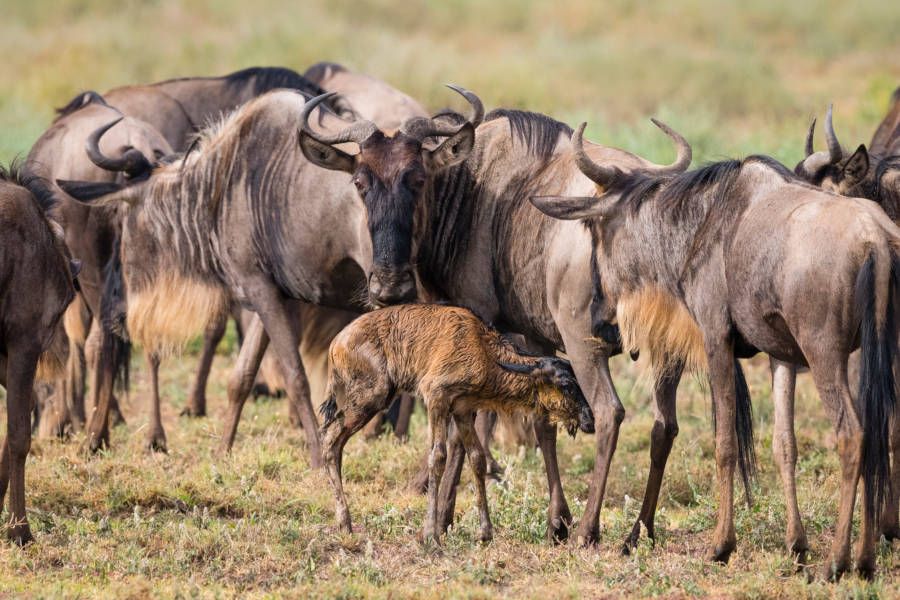
The best time to witness the dramatic calving season on a Tanzania wildlife safari is between January and March, with February serving as the absolute peak.
During this spectacular window, the Great Migration herds settle into the nutrient-rich, short-grass plains of the Southern Serengeti and the Ndutu region within the Ngorongoro Conservation Area. Driven by seasonal rains, over 400,000 wildebeest calves are born within a synchronized three-week period—averaging an astonishing 8,000 newborns every single day.
This massive influx of vulnerable young triggers unparalleled predator-prey interactions. Africa’s apex carnivores, including lions, cheetahs, leopards, and spotted hyenas, gather in high concentrations to seize the seasonal bounty. For wildlife enthusiasts and photographers, this green season offers a deeply moving, high-action safari experience characterized by wobbly-legged calves finding their feet within minutes and intense, raw displays of survival on the open African savanna.
3-days-ndutu-and-ngorongoro-crater-safari-in-tanzania
3-days-southern-serengeti-safari-tour-and-ngorongoro-crater-calving-season-package
4-days-ndutu-and-serengeti-safari-in-tanzania
5-days-tanzania-safari-to-tarangire-serengeti-ngorongoro-and-lake-manyara
6-days-lake-manyara-ngorongoro-crater-and-serengeti-tour-package
7-days-best-luxury-tanzania-safari-all-inclusive-tour-package
The Spectacle: 8,000 New Beginnings Daily
Witnessing the calving season during a Tanzania wildlife safari is an emotionally charged experience that redefines the concept of raw nature. Between late January and March, the southern Serengeti and Ndutu plains transform into the world’s largest natural maternity ward. The sheer scale of life entering the world simultaneously is staggering: approximately 8,000 wildebeest calves are born every single day. This synchronized birthing strategy, known as predator satiation, is a brilliant evolutionary tactic designed to overwhelm local carnivores by sheer numbers, ensuring a higher survival rate for the collective herd.
For travelers on a Tanzania wildlife safari, the magic lies in the intimate, micro-moments playing out across the vast savanna. A mother wildebeest will suddenly isolate herself from the moving mass, and within a remarkably short window—often less than thirty minutes—a new life is introduced to the African plains. The true marvel, however, is the immediate race against time. A newborn calf is highly vulnerable, yet it displays an astonishing instinct for survival. Within three to five minutes of hitting the ground, the calf is already wobbling onto its fragile, oversized legs. Within ten minutes, it is taking its first tentative steps, and in less than half an hour, it is capable of running fast enough to keep pace with its mother.
A spectacular example of this can be witnessed along the shores of Lake Ndutu. Here, the mineral-rich volcanic soils support highly nutritious short grasses, giving mothers the energy required for lactation. Visitors sitting quietly in their safari vehicles can watch dozens of calves taking their first steps simultaneously. The air fills with a distinct chorus of low bleating grunts as mothers and newborns imprint on each other's unique scents and sounds—a critical bond, as a calf separated from its mother in a herd of hundreds of thousands faces near-certain demise.
Predator Action (The Ultimate Survival Arena)
While the birth of hundreds of thousands of calves is a celebration of life, it simultaneously sets the stage for some of the most intense, high-stakes predator-prey dynamics on earth. The sudden concentration of millions of migratory animals, combined with an influx of defenseless newborns, turns the southern plains into a primary hunting ground. For anyone seeking high-octane wildlife encounters, this period of a Tanzania wildlife safari provides unparalleled opportunities to witness apex predators utilizing diverse, highly sophisticated hunting strategies.
The open, short-grass terrain stripped of tall hiding spots creates a fascinating tactical challenge. Cheetahs thrive in this environment; their exceptional vision allows them to scan the plains for isolated or lagging calves, utilizing their unmatched acceleration to execute high-speed chases across the flat terrain. Lions change their pride dynamics, often waiting until the heat of the day when the herds are resting near acacia thickets, or using the cover of sudden afternoon downpours to launch coordinated ambushes. Meanwhile, spotted hyenas—incredibly successful and intelligent endurance hunters—patrol the fringes of the mega-herds, looking for any opportunity to separate a newborn from its protective mother.
A classic manifestation of this survival battle occurs around the marshy areas of the Ngorongoro Conservation Area's northern periphery. A lioness might be seen stalking patiently through the low herbage, tracking a mother wildebeest that has briefly lowered her guard while nursing. If the pride attacks, the mother faces a harrowing choice: flee to survive or attempt to shield her offspring. It is not uncommon to witness the dramatic bravery of a mother wildebeest swinging her sharp horns to fend off jackals or a lone hyena, buying her calf precious seconds to find its footing and slip back into the safety of the dense, swirling herd.
The "Green Season"(A Photographer's Paradise)
Choosing the calving period for a Tanzania wildlife safari means embracing the gorgeous, revitalizing transition known as the "Green Season." Driven by the short rains that begin late the previous year, the typically dusty, golden African savanna undergoes an overnight transformation into a vibrant, emerald carpet. For the wildlife, this green explosion is a nutritional lifeline; the grasses in this specific volcanic region are uniquely packed with high concentrations of calcium, potassium, and phosphorus, providing the lactating wildebeest mothers with the exact fuel needed to produce rich milk for their young.
For photographers and safari enthusiasts, the aesthetic benefits of this seasonal shift are unmatched. The air, washed clean by periodic, dramatic afternoon thunderstorms, is completely devoid of the dry-season dust and haze that can often mute distant horizons. This results in pristine atmospheric clarity and incredibly crisp light, allowing the sweeping vistas of the Serengeti to pop with dramatic contrast. The deep, rich green of the rejuvenated plains sets a striking, cinematic backdrop against the dark coats of the wildebeest herds, the golden hides of lions, and the dramatic, bruised-purple storm clouds hanging on the horizon.
Consider the photographic composition available near the Gol Kopjes—massive granite rock islands rising out of the flat plains. During the green season, these ancient rocks are surrounded by fields of fresh green grass dotted with colorful wildflowers. A photographer can capture a cheetah perched atop a kopje, silhouetted against a brilliant, hyper-clear blue sky, looking down onto a sea of green filled with thousands of active animals. Furthermore, the soft, diffused golden hour light characteristic of this time of year eliminates harsh shadows, providing the perfect illumination to capture the intricate details of a newborn calf's fur or the intense, focused gaze of a stalking predator.
Which months cover the Tanzania wildebeest calving season?
The peak calving season occurs between January and March. During this brief window, the Great Migration herds pause their continuous journey and settle in the southern reaches of the Serengeti ecosystem.
The timing is dictated by weather patterns. Short rains in November and December trigger the growth of fresh grass, prompting over 1.5 million wildebeest to trek south. By January, the herds blanket the plains. February serves as the absolute apex of the birthing phenomenon. Statistically, roughly 80% of all pregnant females give birth within a synchronized three-week period during this month.
For example, a safari guide operating around Lake Ndutu in mid-February can routinely show guests multiple live births in a single morning. By late March, the rains begin to taper off, the calves grow stronger, and the herds slowly prepare to move west and north, bringing an end to this localized wildlife spectacle.
Where exactly does the calving season take place?
The calving season unfolds across the Southern Serengeti and the Ndutu region, which bridges the Serengeti National Park and the Ngorongoro Conservation Area.
This specific geographic zone spans thousands of square kilometers of wide-open, flat savanna. The herds avoid the dense woodlands of the north during this time because the open plains offer unparalleled visibility, making it much harder for predators to sneak up on the newborns.
A prime example of a calving hotspot is the area surrounding the Gol Kopjes. These massive granite rock formations protrude from the flat grass plains, acting as excellent vantage points. Safari travelers in this region will observe that the ground is completely saturated with wildebeest, zebras, and gazelles, turning the southern volcanic soils into a massive, concentrated cradle of life that stretches from horizon to horizon.
Why do wildebeest choose this specific southern region?
The primary driver behind choosing the southern plains is the unique nutrient profile of the volcanic soil and grass.
Thousands of years ago, eruptions from the nearby Ngorongoro highlands blanketed these southern plains in volcanic ash. Today, this translates into soil that is exceptionally rich in essential minerals, particularly calcium, phosphorus, and potassium. When the seasonal rains fall, the grass that sprouts here absorbs these minerals, turning the plains into a superfood buffet for pregnant and lactating wildebeest.
For instance, a lactating mother requires massive amounts of calcium to produce milk that will rapidly develop a calf’s bone structure. The short-grass species Digitaria macroblephara, prevalent in Ndutu, provides double the phosphorus content found in northern Serengeti grasses. Without these specific minerals, the calves would grow slower, making them easy targets during the grueling migration ahead.
How many calves are born during this peak?
An astonishing 400,000 wildebeest calves enter the world during this highly synchronized, two-to-three-week birthing window.
This equates to an average of 8,000 to 12,000 births every single day. This massive burst of life is an evolutionary defense mechanism known as predator swamping or satiation. By introducing an overwhelming number of vulnerable animals to the environment all at once, the wildebeest ensure that local predators simply cannot consume them all.
To visualize this data, consider the local lion prides or cheetah populations around Ndutu. Even if every single predator hunted to its maximum physical capacity daily, they would only impact a tiny fraction—less than 5% to 10%—of the newborn population. The remaining 90% survive the initial weeks of life purely due to the sheer safety in numbers provided by this biological flood.
How quickly can a newborn calf start running?
A newborn wildebeest calf can stand within two to three minutes and run with the herd within five to twenty minutes.
This rapid motor development is one of the most remarkable survival adaptations in the animal kingdom. Unlike human infants or predatory cubs that spend months being nurtured in isolation, a wildebeest calf is born directly onto an open, predator-heavy battlefield. There is no time for a slow recovery from birth.
For example, a calf dropped at 9:00 AM will typically be on its feet, nursing, by 9:05 AM. By 9:20 AM, if a spotted hyena approaches, that same calf is capable of galloping at speeds of up to 30 to 40 kilometers per hour alongside its mother. This immediate mobility prevents the herd from being slowed down and denies predators an easy, stationary target.
Which predators are most active during calving season?
The highest concentrations of lions, cheetahs, leopards, and hyenas gather to exploit the calving herds.
Because food is suddenly incredibly abundant, predators do not have to travel far to find a meal. Cheetahs, in particular, thrive on the open, short-grass plains during this season because the low vegetation allows them to utilize their extreme speed without tripping or losing sight of their targets.
For instance, researchers monitoring the Serengeti lion prides note that pride sizes often appear larger and healthier during February due to the easy availability of meat. It is common to see a single pride of 15 lions lounging near a kopje with multiple kills. Hyenas are equally active, patrolling the edges of the herds at night and using their incredible endurance to wear down mothers trying to protect their slow-moving newborns.
What makes calving season ideal for safari photography?
The combination of the Green Season clarity, dramatic storms, and high-action creates perfect photographic conditions.
Unlike the dry season, which fills the air with a dusty, grey haze, the periodic afternoon rains wash the atmosphere completely clean. This results in hyper-vibrant colors and extreme visual clarity. The contrast between the emerald-green grass, deep blue or bruised-purple storm clouds, and the golden coats of stalking predators is a dream for wildlife photographers.
A tangible example of this advantage is the soft, diffused lighting provided by intermittent cloud cover. Instead of the harsh, overexposed midday shadows typical of the African dry season, photographers in February enjoy extended periods of "golden hour" quality light. This allows for beautifully detailed shots of wildlife behavior, such as a cheetah cub playing in wildflowers or a lioness shaking rain off her mane.
How do rain patterns affect the migration's timing?
The migration is entirely nomadic, tracking the unpredictable path of localized rainstorms across the savanna.
Wildebeest possess an uncanny ability to detect rainfall from up to 50 kilometers away, likely by hearing the low-frequency rumble of thunder or smelling the moisture in the air. If the short rains are delayed in the south, the herds will halt their journey in the central Serengeti. If the rains arrive early, the calving season shifts accordingly.
For example, in anomalous years where the southern plains experience an unexpected mid-season drought, the herds will completely bypass their traditional Ndutu calving spots and scatter toward the Western Corridor to find water. Safari operators rely heavily on real-time satellite rain tracking and radio reports from mobile camps to pinpoint exactly where the mega-herds are congregated each week.
What behavior helps mothers protect their newborn calves?
Mothers rely on herd density, continuous movement, and aggressive defense to protect their young.
A lone wildebeest mother is incredibly vulnerable, but inside a dense mega-herd of 500,000 animals, she is shielded by a wall of horns and hooves. When a predator approaches, the herd forms a tight defensive barrier. Furthermore, mothers utilize a highly developed vocalization system, constantly emitting low, guttural grunts to ensure their specific calf stays glued to their flank amidst the chaos.
If a jackal or a lone hyena attempts to snatch a newborn, the mother will actively charge the predator. For example, field guides frequently document instances where a mother wildebeest uses her sharp, curved horns to repeatedly ram an opportunistic side-striped jackal, successfully driving it away and allowing her wobbly calf time to retreat deeper into the safety of the main herd.
Why is this season called the Green Season?
The term refers to the transformative rains that turn the arid savanna lush and green.
Many travelers associate Africa with dry, yellow grass and dusty landscapes, which characterizes the dry season from July to October. The Green Season, running from November to May, turns that stereotype on its head. The landscape is reborn, waterholes fill to the brim, and migratory birds from Europe arrive in droves, creating an ecosystem teeming with color and vitality.
Financially and logistically, this season offers unique perks for travelers. Because it is historically labeled the "low" or "green" season, luxury safari lodges often drop their rates by 30% to 50% compared to the July peak crossing season. Visitors get to experience the highest concentration of wildlife action on earth, surrounded by beautiful landscapes, with far fewer safari vehicles crowding the view.
Booking Calving season with s Roads of Adventure safaris
Secure your front-row seat to nature's ultimate arena with our 5-Days Ultimate Ndutu Migration Safari. To witness over 8,000 newborn calves daily and intense predator action, plan your journey between mid-January and early March.
Our private, tailored itineraries range from $300 to $1,000 per person/day, featuring eco-friendly tented camps nestled directly in the Ndutu action. Gather a group of four or more to unlock special group rates! A 50% deposit secures your dates.Contact us to lock in your 2027 calving season adventure today!
