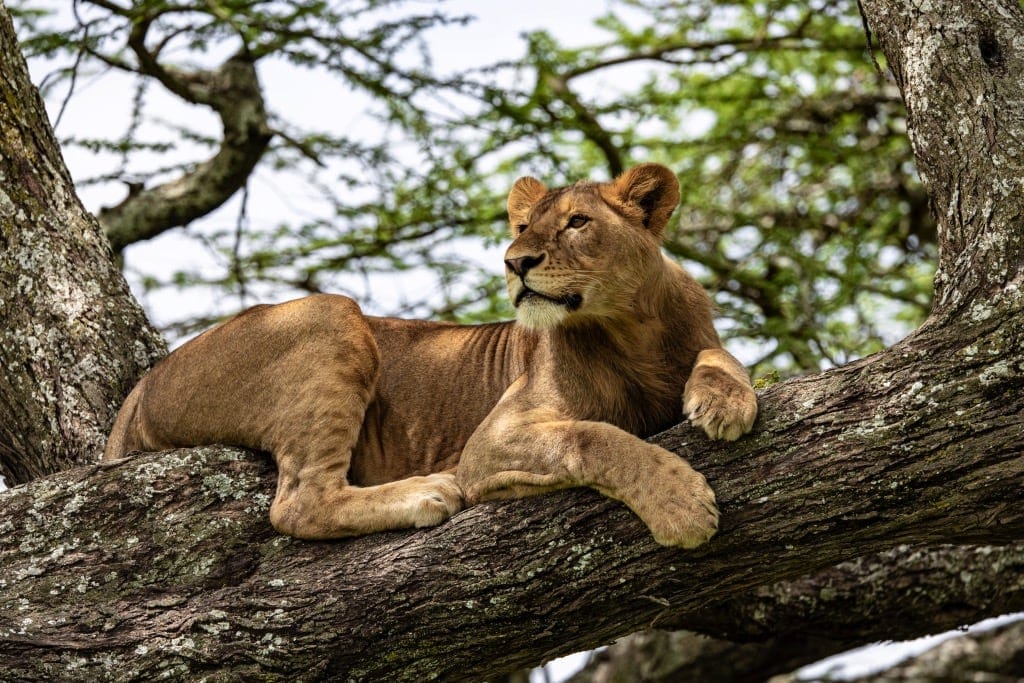
A Uganda wildlife safari in Queen Elizabeth National Park offers premier game viewing, including the famous tree-climbing lions in Ishasha, chimpanzee tracking in Kyambura Gorge, and boat cruises on the Kazinga Channel to see massive hippo pods, crocodiles, and elephants. The park is known for its diverse volcanic crater lakes and savannah landscapes.
2-days-affordable-budget-uganda-safari-to-queen-elizabeth-national-park
2-days-quick-escape-to-queen-elizabeth-park-safari-holiday
3-days-uganda-safari-itinerary-to-queen-elizabeth-national-park
3-days-fly-luxury-uganda-safari-to-queen-elizabeth-national-park
Tree-Climbing Lions (Ishasha Sector)
The Ishasha Sector, tucked away in the southern reaches of Queen Elizabeth National Park, is the stage for one of Africa’s most peculiar wildlife phenomena: tree-climbing lions. Unlike most lions that remain ground-bound, the prides here have developed the unique habit of ascending ancient sycamore fig and acacia trees to lounge in the branches during the heat of the day. While there are several theories for this behavior—ranging from escaping the irritating bites of tsetse flies to catching a cooling breeze above the tall savannah grass—seeing a 400-pound predator draped effortlessly over a limb is a highlight of any Uganda wildlife safari.
The sight is as surreal as it is majestic. Often, an entire pride, including cubs, can be found scattered across the boughs of a single massive tree. The Ishasha landscape itself is distinct from the northern sectors, characterized by open woodland and vast, flat savannahs that stretch toward the border of the Democratic Republic of Congo. Beyond the lions, this sector is also an excellent place to spot the sleek Topi antelope, which are not found in the northern part of the park. Because Ishasha is a transit point for those traveling between Queen Elizabeth and Bwindi Impenetrable Forest, it offers a perfect "wildlife bridge" where the drama of the savannah meets the mystery of the primate forests.
Kazinga Channel Boat Cruise
The Kazinga Channel is a 40-kilometer natural waterway that bisects the park, linking Lake Edward to the west and Lake George to the east. It is arguably the most biodiverse corridor in the park and serves as the primary "watering hole" for thousands of animals. A boat cruise along this channel is a foundational experience for a Uganda wildlife safari, offering a relaxed yet high-impact vantage point to view wildlife from the safety of the water. The banks are famously home to one of the world's highest concentrations of hippos, which can be seen wallowing in massive, grunting schools just meters from the boat.
As you glide along the fertile shores, you will encounter prehistoric-looking Nile crocodiles basking with their mouths agape, alongside massive herds of Cape buffaloes and elephants that descend to the water to bathe and cool off. The birdlife is equally staggering; the channel is a haven for both resident and migratory species, including the African Skimmer, Great White Pelicans, and the iconic African Fish Eagle. The cruise provides a unique "water-level" perspective that is impossible to achieve on a land-based game drive, making it a favorite for photographers who wish to capture intimate shots of wildlife against the backdrop of the Mweya Peninsula’s cliffs.
Kasenyi Plains Game Drives
The Kasenyi Plains, located in the northeastern sector of the park, represent the quintessential African savannah. These vast, rolling grasslands are the primary breeding grounds for the Uganda kob, a beautiful antelope that serves as the main prey for the park’s healthy population of lions. Because of this high concentration of prey, Kasenyi is the most reliable area for predator sightings. Early morning game drives here often reward visitors with the sight of a lion pride on a kill or a solitary leopard silently patrolling the thickets.
The scenery in Kasenyi is punctuated by iconic Euphorbia candelabra trees and distant views of the snow-capped Rwenzori Mountains. Large herds of African elephants and buffaloes are frequent sights, often moving in majestic processions toward the nearby crater lakes. The open landscape ensures excellent visibility, allowing trackers to spot movement from miles away. For travelers, Kasenyi is the heart of the action; it is where the raw cycle of life and death plays out daily, offering a classic safari experience that perfectly captures the untamed spirit of the Albertine Rift.
Chimpanzee Tracking (Kyambura Gorge)
Known as the "Valley of the Apes," the Kyambura Gorge is one of the most geologically and biologically stunning features in Uganda. This 100-meter-deep "sunken forest" was carved by the Kyambura River over millennia, creating a lush, tropical rainforest oasis right in the middle of the parched savannah. The gorge is home to a small, isolated community of habituated chimpanzees. Descending into this emerald world is like stepping back in time; the air is cool, the canopy is dense, and the sounds of the savannah are replaced by the rhythmic "pant-hoots" of primates and the calls of exotic forest birds.
Tracking chimpanzees in Kyambura is a physical adventure. It involves navigating steep slopes and river crossings, but the reward of seeing our closest relatives in such a dramatic setting is unparalleled. Because the community is small and the habitat is self-contained, the encounter feels incredibly intimate. Beyond the chimpanzees, the gorge is a refuge for other primates like Black-and-White Colobus and Red-tailed monkeys. The stark contrast between the golden plains above and the prehistoric jungle below makes Kyambura one of the most visually and ecologically diverse spots on any Uganda wildlife safari.
Crater Lakes & Katwe Salt Works
Queen Elizabeth National Park is a landscape shaped by volcanic fury, evidenced by dozens of stunning explosion craters scattered across the northern hills. Driving through the "Crater Drive" offers some of the most breathtaking panoramic views in East Africa, with deep, turquoise lakes nestled in the hearts of emerald-green volcanic cones. Among these, the Katwe Salt Lake is of particular historical and cultural significance. For centuries, the local community has practiced traditional salt mining here, using an intricate system of salt pans and evaporation ponds that has remained largely unchanged for generations.
A visit to the Katwe Salt Works provides a profound human dimension to a Uganda wildlife safari. Visitors can watch as miners labor in the harsh, salty water to harvest the "black gold" that is traded across the region. Nearby, the Lake Munyanyange crater often hosts thousands of migratory Lesser Flamingos (usually between October and April), turning the water a shimmering shade of pink. The crater highlands are not just about the views; they are a testament to the resilient spirit of the people who live within this volcanic landscape and the incredible geological forces that continue to define the Great Rift Valley.
Maramagambo Forest
Bordering the southern edge of the Kazinga Channel, the Maramagambo Forest is one of the largest tracts of medium-altitude moist semi-deciduous forest in East Africa. Its name, in the local language, roughly translates to "the end of words," reflecting a local legend about people becoming lost in its vast depths. Today, the forest is a haven for hikers, birders, and primate enthusiasts. Well-maintained trails lead through the towering ironwood and mahogany trees, offering sightings of L’Hoest’s monkeys, Blue monkeys, and the rare Chimpanzee (though they are not habituated for tracking here).
One of the most famous features of Maramagambo is the "Bat Cave." A viewing platform allows visitors to look into a massive volcanic cavern that is home to millions of Egyptian Fruit Bats. Interestingly, the cave is also inhabited by massive African Rock Pythons that have learned to live off the bat population, creating a fascinating, if slightly eerie, ecological spectacle. The forest is also a birdwatcher’s paradise, hosting species like the African Finfoot and various forest kingfishers. Maramagambo provides a cool, shaded retreat from the heat of the savannah and a chance to experience the "jungle side" of the park’s biodiversity.
Equator Point
No Uganda wildlife safari to Queen Elizabeth National Park is complete without a stop at the Equator Point. Located in the northern sector of the park along the Kasese-Mbarara road, this iconic landmark marks the spot where the Earth is divided into the Northern and Southern Hemispheres. Two large, circular concrete monuments provide the perfect frame for photographs, standing against the backdrop of the park’s rolling savannah and the distant Rwenzori Mountains.
While it is a popular "tourist stop," the Equator represents the unique geographic positioning that gives the park its incredible climate and biodiversity. Being on the equator means the park experiences relatively consistent day lengths and temperatures year-round, which supports the growth of the diverse flora that feeds the park’s massive mammal populations. Many visitors enjoy the "water experiment" often demonstrated by locals, showing how water swirls in different directions on either side of the line due to the Coriolis effect. It is a symbolic and fun milestone that marks your journey through one of the most geographically significant wildlife reserves in Africa.
1. Where can I see the famous tree-climbing lions in Queen Elizabeth Park?
The famous tree-climbing lions are the crown jewel of the Ishasha Sector, located in the remote southern region of Queen Elizabeth National Park. While lions are generally ground-dwelling predators, the prides in Ishasha have perfected the art of ascending large sycamore fig and acacia trees. On a Uganda wildlife safari, seeing these massive cats draped across thick branches—sometimes with their paws dangling in the air—is a surreal and iconic sight.
There are several ecological theories as to why the lions here exhibit this rare behavior. The most common explanation is that they climb to escape the irritating bites of tsetse flies and other ground-dwelling insects that thrive in the tall grass. Others suggest they are seeking a cooling breeze or a better vantage point to spot prey like Topi and Uganda kob across the plains. The Ishasha sector is less crowded than the northern plains, offering a more tranquil and "wild" atmosphere. The best time to spot them is during the heat of the day (between 10:00 AM and 4:00 PM) when they retreat from the sun into the deep shade of the canopy.
2. What is special about the Kazinga Channel boat trip?
The Kazinga Channel boat cruise is often described as the highlight of a Uganda wildlife safari. This 40km natural waterway connects Lake Edward and Lake George and acts as a magnet for the park's diverse inhabitants. What makes it special is the sheer density of wildlife visible from the water. It is home to one of the world's highest concentrations of hippos, which can be seen in grunting "schools" of fifty or more, splashing and yawning just meters from the boat.
As you glide along the banks, you will witness massive Nile crocodiles basking in the sun and family herds of elephants coming down to bathe and drink. The channel is also a premier destination for birdwatchers; you can spot everything from the African Fish Eagle to the vibrant Malachite Kingfisher and colonies of Great White Pelicans. The boat offers a stable, "water-level" perspective that is perfect for photography. Unlike a game drive where animals might be hidden by bushes, the animals at the channel are out in the open, providing some of the most reliable and intimate wildlife encounters in all of East Africa.
3. Where can I track chimpanzees in the park?
Chimpanzee tracking in Queen Elizabeth National Park primarily takes place in the breathtaking Kyambura Gorge, also known as the "Valley of the Apes." This 100-meter-deep "sunken forest" is a lush, tropical ribbon of green cutting through the surrounding dry savannah. Descending into the gorge feels like entering a different world, where the temperature drops and the air is filled with the sounds of the river and the calls of primates.
The gorge is home to a community of habituated chimpanzees. Tracking them involves hiking through the dense forest floor and across the Kyambura River. While the sightings are never 100% guaranteed (around 60% success rate), the experience of finding our closest relatives in such a dramatic, prehistoric setting is unforgettable. For those who want even higher sighting probabilities, many travelers also visit the nearby Kalinzu Forest, which is just outside the park boundaries. Kalinzu hosts over 300 chimpanzees and offers a high success rate (over 80%) for sightings, making it an excellent alternative or addition to the Kyambura experience.
4. What wildlife can be spotted during game drives in Kasenyi Plains?
The Kasenyi Plains are the primary stage for terrestrial wildlife action in the northern sector of the park. These vast, rolling savannahs are the main breeding grounds for the Uganda kob, a beautiful antelope that exists here in massive herds. Because there is such an abundance of prey, Kasenyi is the best place to find the park's top predators. Early morning game drives frequently result in sightings of lions and, occasionally, leopards.
In addition to the cats, you will encounter large herds of Cape buffaloes and African elephants moving across the plains. The landscape is dotted with the unique Euphorbia candelabra trees, which provide a quintessential backdrop for wildlife photography. Warthogs are a common sight, often seen kneeling on their front legs to graze, while various smaller carnivores like the Side-striped jackal and Spotted hyena are often spotted returning from their nocturnal hunts. The open nature of the plains ensures excellent visibility, allowing your guide to track movements across the horizon and provide a classic African safari experience.
5. Are there any volcanic features to explore?
Queen Elizabeth National Park is a landscape shaped by ancient volcanic activity, and the Katwe Explosion Craters are its most dramatic geological features. These craters are a collection of dozens of extinct volcanic cones and deep basins scattered across the northern hills. A drive along the "Crater Drive" offers some of the most stunning panoramic views in Uganda, with the shimmering lakes below and the towering Rwenzori Mountains—the "Mountains of the Moon"—in the distance.
Some of these craters have become lush forests, while others contain saltwater lakes, such as Lake Katwe and Lake Munyanyange. The scenery is starkly beautiful and provides a fascinating look at the tectonic forces of the Albertine Rift. At the Katwe Salt Works, you can see how local communities have traditionally mined salt for centuries. For photographers and geography enthusiasts, the crater highlands are a must-visit; the scale of the "explosions" that created these features is humbling, and the views at sunset, when the light hits the caldera rims, are arguably the best in the park.
6. What bird species are highlights for birdwatchers?
With over 600 recorded species, Queen Elizabeth National Park is one of the most bird-rich areas in Africa. A Uganda wildlife safari here is an ornithological dream, spanning diverse habitats from papyrus swamps to forest canopies. A major highlight is the African Skimmer, often seen "ploughing" the surface of the Kazinga Channel for fish. Another prize for birders is the prehistoric-looking Shoebill stork, which is occasionally spotted in the marshy edges of the park's lakes.
Other highlights include the massive Martial Eagle, the largest eagle in Africa, and the Pink-backed Pelican. The park’s various wetlands host the Papyrus Canary and the Papyrus Gonolek, while the savannah is home to the elegant Grey Crowned Crane—Uganda's national bird. During the northern winter (October to April), the park serves as a vital stopover for millions of migratory birds from Europe and Asia, such as the Lesser Flamingo that often turns the crater lakes a vibrant shade of pink. Whether you are a dedicated twitcher or a casual observer, the constant presence of colorful and rare birds adds a rich layer of detail to every safari activity.
7. What is the Mweya Peninsula known for?
The Mweya Peninsula is the tourism hub and the central "pulse" of Queen Elizabeth National Park. Situated on a raised plateau overlooking the confluence of the Kazinga Channel and Lake Edward, it offers some of the most spectacular views in the country. It is home to the park's main visitor center, several high-end lodges, and the jetty from which the famous boat cruises depart.
The peninsula itself is a high-density wildlife area. Because it is surrounded by water on three sides, animals like elephants, buffaloes, and bushbucks are frequently seen grazing right around the lodges. It is also a notorious hotspot for leopards, which are often spotted in the thickets along the peninsula's tracks during evening drives. The Mweya area provides a perfect blend of comfort and wilderness; you can enjoy a sundowner on a terrace while watching hippos emerge from the channel below. Its central location makes it the ideal base for exploring both the Kasenyi Plains to the north and the Kyambura Gorge to the east.
8. Can I see elephants in Queen Elizabeth National Park?
Yes, seeing elephants is a nearly guaranteed experience on a Uganda wildlife safari in this park. Queen Elizabeth is home to a thriving population of over 2,500 African elephants. These giants are most frequently spotted in large family herds in the Kasenyi Plains and along the banks of the Kazinga Channel. The elephants here are particularly interesting as they are often a hybrid of the larger savannah elephant and the smaller, darker forest elephant from the nearby Congo basin.
During the heat of the day, it is common to see them congregating at the water's edge to drink and splash themselves with mud to cool their thick skin. On a boat cruise, you might even see them swimming across the channel, with only their trunks visible above the water like snorkels. Watching these intelligent, social animals interact—mothers protecting their calves and young bulls mock-sparring—is one of the most moving parts of any safari. Their presence is a testament to the park's successful conservation efforts and the abundance of forage available in its diverse landscapes.
9. Is there a place for a nature walk in the park?
For those who want to step out of the safari vehicle and stretch their legs, the Maramagambo Forest offers exceptional guided nature walks. This vast, dark-green canopy is a stark contrast to the sun-drenched savannahs and provides a cooling retreat. The forest is famous for its towering ancient trees, including ironwood and mahogany, and its network of well-maintained trails that lead to several unique attractions.
A major highlight of the forest walk is the "Bat Cave," where millions of Egyptian Fruit Bats roost. From a safe viewing platform, you can observe the bats and even the massive African Rock Pythons that live in the cave and prey on them. Maramagambo is also home to several primate species that are easier to see on foot, such as the L'Hoest's monkey, Blue monkey, and Black-and-White Colobus. Birders will find the forest particularly rewarding, as it hosts specialized species like the African Finfoot and various forest kingfishers. These walks offer a "slower" safari experience, focusing on the intricate details of forest ecology, medicinal plants, and the smaller creatures of the jungle.
10. What makes the Katwe Salt Lake unique?
The Katwe Salt Lake is a unique destination because it blends geological wonder with living human history. This hyper-saline lake is located inside an explosion crater and has been a center of traditional salt mining for over 600 years. Unlike modern industrial mines, the process at Katwe is entirely manual. Local miners use traditional methods to create salt pans—shallow ponds where the sun evaporates the water, leaving behind crusts of salt that are then harvested by hand.
Visiting Katwe provides a profound insight into the resilient spirit of the local community. You can walk along the salt pans and learn about the different grades of salt produced—from the high-quality "Table Salt" to the "Rock Salt" used for livestock. The environment is harsh, with intense heat and high salinity, yet the industry remains a vital part of the local economy. Nearby, the Lake Munyanyange often hosts thousands of flamingos, creating a beautiful natural contrast to the industrial activity. A visit to Katwe is a reminder that national parks are not just for wildlife, but are also home to ancient human traditions that continue to thrive alongside the natural world.
11. How can I see hippos on land?
While hippos are usually seen submerged in water during the day to protect their sensitive skin from the sun, seeing them on land is a highlight of late afternoon boat cruises and early evening game drives. The Kazinga Channel supports an estimated 5,000 hippos, one of the highest densities in the world. As the sun begins to set and the temperatures drop, these massive "river horses" begin to emerge from the water to graze on the surrounding grasslands.
A single hippo can consume up to 40kg of grass in a night, and they often travel several kilometers inland to find the best forage. On an evening game drive near Mweya or the channel banks, you can see them grazing peacefully like giant lawnmowers. On a boat cruise, you will often see them standing in the shallows or on the muddy banks, providing a full view of their barrel-shaped bodies and stubby legs. While they look bulky and slow, hippos are surprisingly agile and can run faster than a human, so they are always viewed from a safe distance by your guide. Seeing them out of the water allows you to truly appreciate their immense scale and power.
12. Can I visit local communities for cultural experiences?
Yes, community tourism is a vibrant part of the Uganda wildlife safari experience in Queen Elizabeth National Park. One of the best ways to engage is through the Katwe Tourism Trail, which takes you into the heart of the local fishing and salt-mining villages. Here, you can learn about the daily lives of the people who have lived in harmony with the park's wildlife for generations. You might visit a traditional homestead, see how local crafts are made, or watch fishermen bringing in their catch from Lake Edward.
Another popular cultural activity is the Kikorongo Equator Cultural Performers, a group of local women who showcase traditional dances and music. These performances are a celebration of their heritage and often tell stories of the land and its animals. By participating in these tours, your visit directly supports local livelihoods and provides a financial incentive for communities to protect the park. It adds a rich human dimension to your journey, showing that the "Pearl of Africa" is defined as much by its welcoming and resilient people as it is by its majestic wildlife.
13. What is the best way to see the park from above
The best way to appreciate the park's dramatic scale and geological diversity from an elevated perspective is by taking the Explosion Crater Drive. This scenic route winds through the highest points of the park, along the rims of ancient volcanic calderas. From these vantage points, you get a 360-degree view of the park's various landscapes: the sparkling turquoise crater lakes, the vast Kasenyi plains, the winding Kazinga Channel, and the dark ribbon of the Kyambura Gorge.
On a clear day, the backdrop is the massive wall of the Rwenzori Mountains, with their snow-capped peaks visible above the clouds. This drive is particularly spectacular at sunrise or sunset when the low light emphasizes the contours of the craters and turns the lakes into shimmering mirrors. For those looking for an even more exclusive "aerial" experience, Hot Air Balloon Safaris are occasionally available. Floating silently over the savannah as the sun rises, watching herds of elephants and buffaloes from above, is the ultimate way to see the park's scenic beauty and is a highlight for any traveler seeking a romantic and unique perspective.
14. What types of antelopes are common in the park?
Queen Elizabeth National Park is a haven for a wide variety of antelope species, each adapted to a different niche within the park. The most common is the Uganda kob, which is the national animal and appears on the country's coat of arms. You will see them in their thousands on the Kasenyi plains, especially at their "lekking grounds" where males compete for territory and mates.
In the southern Ishasha sector, you can find the Topi, a fast and elegant antelope with a distinct purplish-brown coat and "yellow stockings" on its legs. In the more wooded areas and near the forest edges, you will spot the shy Bushbuck and the tiny Oribi. The Defassa Waterbuck, with its shaggy coat and white ring on its rump, is common near the Kazinga Channel. For the dedicated wildlife enthusiast, searching the swampy fringes of the lakes might reveal the rare and semi-aquatic Sitatunga, an antelope with splayed hooves designed for walking on floating vegetation. This diversity of antelopes ensures that every game drive is filled with movement and provides a constant food source for the park's resident predators.
15. Is there a place to see nocturnal animals?
To see the "night shift" of the African wilderness, you can participate in Night Game Drives, which are conducted in the outskirts of the park or in specialized buffer zones with the help of powerful spotlights. These drives offer a completely different atmosphere, as the sounds of the bush change and elusive nocturnal species emerge from their daytime hiding spots.
The most sought-after sighting at night is the leopard, which is a primary nocturnal hunter. Watching a leopard move silently through the shadows is a thrilling experience. You are also likely to see Spotted hyenas as they begin their evening patrols, and smaller carnivores like the Serval cat or the Civet. Night drives are also the best time to see "bushbabies" (Galagos) with their large, glowing eyes reflecting the light, and the Pennant-winged Nightjar, a bird that flies almost like a large butterfly in the dark. These excursions provide a glimpse into the secretive world of Africa's night-dwellers and are the perfect way to cap off a day of adventure on a Uganda wildlife safari.
Booking Uganda wildlife safari with us Roads of Adventure safaris
Book a tailored Uganda wildlife safari with Roads of Adventure Safaris to experience gorilla trekking, chimpanzee tracking, and game drives in parks like Murchison Falls and Bwindi. They offer diverse, customizable packages ranging from 1 to 38 days, including specialized birding, photography, and luxury safaris.
