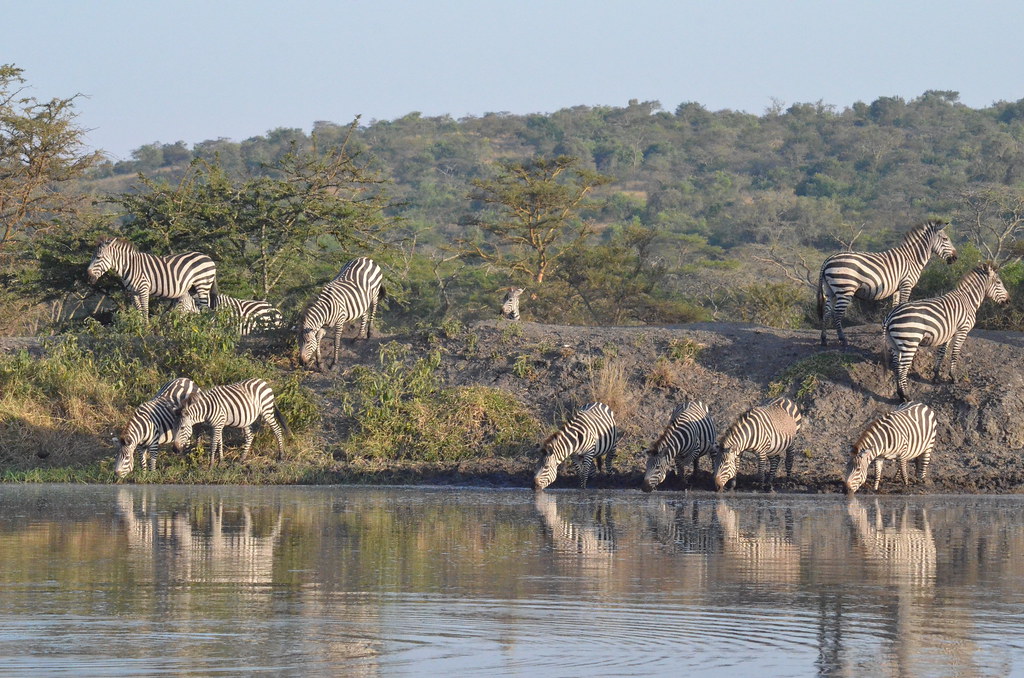
Nestled as Uganda's smallest savanna gem at just 370 square kilometers, Lake Mburo National Park—locally known as Akanyanja ka Mburo—offers a beautifully intimate, active safari. Because lions and elephants are absent, the landscape transforms into a safe haven where you can freely explore the rolling acacia hills on foot, on horseback, or by mountain bike. The park is home to over 5,000 Burchell's zebras (enzebra), a thriving population of newly reintroduced Rothschild's giraffes, and Uganda's only herds of graceful impalas. You can unwind on a scenic 2-hour boat cruise to watch wallowing hippos and prehistoric Nile crocodiles, or head to the Rubanga Forest canopy platform to spot some of the park's 350 bird species. Finally, staking out the natural Rwonyo salt lick gives you a front-row seat as buffaloes and giant elands gather to lick the mineral-rich soils.
2-days-lake-mburo-national-park-uganda-safari-holiday
3-days-best-of-lake-mburo-national-park-uganda-safari-tour-package
4-days-queen-elizabeth-park-and-lake-mburo-uganda-safari-tour
4-days-perfect-honeymoon-uganda-safari-to-lake-mburo-national-park-and-lake-bunyonyi
Key Wildlife to See in Lake Mburo national park
Burchell's Zebras (Equus quagga)
Known locally as Entuha, Burchell’s zebras are the true soul of Lake Mburo. Walking or driving through the park's rolling acacia valleys, you are surrounded by these monochromatic figures munching grass gracefully. The park boasts Uganda’s highest zebra density, with an estimated thriving population of over 5,500 individuals.
Because Lake Mburo lacks apex predators like lions, these zebras lead a remarkably relaxed lifestyle. They are famous for a unique habit: gathering around the park's natural salt licks. Here, you can watch hundreds of them eagerly licking the mineral-rich soils. They are also incredibly vocal; as you pass by, you will hear a distinct, high-pitched "barking" or hissing sound, a localized trait that gives the park its famous tagline, "Whispers of the Wild".
Impalas (Aepyceros melampus)
The elegant impala, or Akampala, is so deeply woven into the identity of this region that Uganda's capital city, Kampala, was named after them. Lake Mburo is the only place in western Uganda where these slender antelopes naturally reside. They are a park-defining species, with thousands of them forming active, highly social herds throughout the woodland-savannah borders.
Impalas are the Olympic athletes of the bush. When startled by a passing vehicle or a sudden rustle in the grass, they don't just run—they explode into the air, capable of leaping up to 3 meters (10 feet) high and a staggering 9 meters (30 feet) forward. Watching a synchronized "leaping display" of fifty impalas gracefully bounding over bushes is a mesmerizing sight. Only the males sport the beautifully ridged, lyre-shaped horns, which they proudly display while guarding their harems.
Rothschild's Giraffes (Giraffa camelopardalis rothschildi)
In July 2015, the Uganda Wildlife Authority undertook a historic conservation effort, translocating 15 endangered Rothschild's giraffes from Murchison Falls National Park to Lake Mburo. The ecological experiment was a massive success: today, the population has doubled, exceeding 30 individuals.
Locally called Entwiga, these gentle giants have completely transformed the park’s skyline. Because they prefer towering Acacia hockii and Acacia sieberiana trees, they are most frequently spotted wandering the open plains of the northern tracks. Seeing a 5-meter-tall giraffe moving with slow-motion elegance against the backdrop of an African sunrise—its long, blue-purple tongue deftly plucking leaves from thorn-covered branches—is a profoundly peaceful experience that reminds visitors of the resilience of nature.
Common Elands (Taurotragus oryx)
The Common Eland is an absolute titan. Standing up to 1.8 meters (6 feet) at the shoulder and weighing a massive 900 kilograms (nearly 2,000 lbs) for an adult male, it holds the title of Africa’s largest antelope. In western Uganda, Lake Mburo is the exclusive sanctuary for these magnificent, ox-like creatures.
Despite their enormous, muscular frames and spiral horns, elands are surprisingly shy and skittish. They require a silent, respectful approach from safari-goers. However, their size hides incredible power; an eland can easily leap over a 2.5-meter (8-foot) fence from a standing position. If you sit quietly on the park's Eland Track, you might hear a peculiar clicking sound as a herd walks past—this is caused by their heavy hooves splaying and snapping back together under their immense weight.
Other Herbivores (Waterbucks, Bushbucks, Oribis, Topis, and Buffaloes)
Lake Mburo’s ecosystem supports a diverse cast of supporting herbivores, each occupying its own unique niche. The robust African Buffaloes (Embogo), numbering in the hundreds, wander the southern sections in mud-caked herds, acting as the park's heavy lawnmowers. Alongside them are the distinctively patterned Topis (Eshure), easily recognized by their dark, purplish-blue "thigh-high socks" and their habit of standing sentinel atop termite mounds to scout for danger.
Closer to the thickets, you will encounter the Defassa Waterbuck (Eshama), heavily built with shaggy, water-resistant coats and a distinct white patch on their rumps. In the shorter grasslands, the tiny, delicate Oribis (weighing just 12–22 kg) dart around in pairs, while the solitary Bushbucks hide in the dense riverine woodlands, perfectly camouflaged by their white-spotted, chestnut coats.
Predators (Leopards and Spotted Hyenas)
As the sun sets, Lake Mburo transforms into a realm of nocturnal drama. The park is widely regarded by guides as the premier destination in Uganda for tracking Leopards (Engo). Because there are no lions to compete with, leopards thrive here at a healthy density, particularly along the Kigarama-Rwonyo rocky belt. A nighttime game drive with a powerful spotlight frequently reveals these elusive cats draped over branches or resting on the park's famous "Leopard Rock".
Sharing the night shift are the Spotted Hyenas (Empisi), the park's vocal opportunists. While they are highly skilled hunters in their own right, you are most likely to hear them before you see them. The eerie, echoing "whoop-whoop" call of a hyena cutting through the pitch-black African night is a spine-chilling, authentic safari experience you won't soon forget.
Water Life (Hippos and Nile Crocodiles)
The heartbeat of the park's aquatic ecosystem is Lake Mburo itself, explored best via a tranquil boat safari. Here, you will encounter massive pods of Hippopotamuses (Enfubu). Spending their days submerged to keep their sensitive, hairless skin safe from the intense Ugandan sun, these 1,500-kg giants peer out with just their eyes and nostrils exposed. Every few minutes, a dominant male will let out a booming, resonant honk that ripples across the water.
Sharing the shoreline are ancient predators: Nile Crocodiles (Mgoona). These living fossils, some stretching over 4 meters in length, can be seen sunning themselves on the muddy banks with their mouths wide open—a behavior used to regulate their body temperature. As your boat glides past, you will witness a fascinating contrast between the chaotic huffing of the hippos and the silent, deadly stillness of the basking crocodiles.
Birdwatching
Lake Mburo National Park is a legendary sanctuary for twitchers, boasting a vibrant checklist of over 315 to 330 distinct bird species. Among these, three highly sought-after avian celebrities draw enthusiasts from across the globe:
The Shoebill Stork (Balaeniceps rex): Standing nearly 1.5 meters (5 feet) tall with a prehistoric, shoe-shaped bill, this vulnerable giant is one of Africa’s ultimate birding prizes. In Lake Mburo, a small, highly prized resident population of 2 to 3 shoebills moves seasonally through the quiet, papyrus-fringed wetlands. Spotting one standing completely motionless in the shallows like a living statue is a jaw-dropping experience.
The African Finfoot (Podica senegalensis): Known as a notoriously shy and elusive waterbird, the finfoot looks like a cross between a duck and a cormorant, featuring striking bright-red feet. Lake Mburo is arguably the most reliable place in all of East Africa to see them. They are best spotted during early morning boat cruises as they nervously paddle along the quiet, overhanging riverine shorelines.
The Papyrus Yellow Warbler (Calamonastides gracilirostris): This tiny, vibrant master of camouflage is a specialized Albertine Rift asset. It spends its entire life darting deep within the dense stalks of true papyrus swamps. Hearing its melodious, liquid song piercing through the morning mist is often the first clue before a lucky visual confirmation.
Unique Attractions & Experiences
Lake Mburo Boat Cruises
Stepping onto the double-decker launch boat at the Rwonyo jetty feels like entering a living documentary, as this two-hour voyage across the calm, glassy waters of Lake Mburo is the park's crown jewel experience. As the engine gently hums, you are brought within mere meters of massive pods of hippos, allowing you to watch them yawn, display their enormous tusks, and spray water in dramatic huffs. Along the muddy banks, giant Nile crocodiles, some stretching over 3.5 meters, bask like ancient logs with their mouths gaped open. For birders, this cruise is paradise, offering the region’s best chance to spot the famously elusive African Finfoot paddling near the overhanging roots, alongside Rufus-bellied Herons and majestic African Fish Eagles diving for their afternoon catch.
Rubanga Forest
While Lake Mburo is celebrated for its savannah, the hidden jewel in its western pocket is Rubanga Forest, a small but remarkably vibrant pocket of true tropical high forest that provides a cool, shaded canopy feeling worlds away from the sun-drenched plains. Led by an armed Uganda Wildlife Authority ranger, a morning hike here rewards you with a completely different ecosystem where the forest floor is alive with unique flora and the canopy echoes with the calls of over 40 forest bird species. Keep your binoculars ready for localized specialties like the stunning Narina Trogon, the Green Pigeon, and the Double-toothed Barbet. It is also a sanctuary for primates, where you can frequently spot playful Vervet monkeys and agile Black-and-white Colobus monkeys swinging through the branches.
Salt Lick Viewing Platforms
Hidden near the Rwonyo rest camp lies one of the park’s smartest conservation features in the form of raised timber viewing platforms overlooking a natural, mineral-rich salt lick. Animals require these essential minerals for digestion, making this muddy depression a bustling wildlife crossroads. By climbing up to the camouflaged wooden hides, you can watch the drama of the wild unfold completely undetected. On any given afternoon, you might see a peaceful truce where over 100 Burchell's zebras, elegant impalas, Defassa waterbucks, and nervous topis jostle gently for the best spots to lick the salty soil, allowing photographers to capture stunning, close-up shots of natural animal behavior without the sound of a car engine disturbing the peace.
Kigambira Loop & Kazuma Viewpoint
To truly comprehend the scale of this stunning ecosystem, you must explore the northern tracks where the Kigambira Loop winds through dense acacia thickets, which serve as prime territory for spotting elusive leopards, before leading you to the trailhead of the iconic Kazuma Lookout. A brief but invigorating hike up a steep, rocky path brings you to the highest point in the park, where you are rewarded with a breathtaking, 360-degree panorama. Standing next to the wooden signpost, you can gaze down at the rolling green hills, acacia-dotted valleys, and a spectacular view of five interconnected lakes glistening in the sun, making it the ultimate spot to pause, breathe in the fresh breeze, and appreciate the ancient landscape of western Uganda.
Ankole Long-Horned Cattle
On the grassy fringes of the park boundaries, you will witness a scene unique to this corner of the world as magnificent Ankole Long-Horned cattle graze side-by-side with wild zebras and impalas. Belonging to the local Bahima pastoralists, these cattle are not just livestock, but living cultural currency valued for their striking, sweeping horns that can measure up to 2.4 meters from tip to tip and act as natural cooling systems in the equatorial heat. This harmonious blending of domestic pastoral life and wildlife conservation showcases a rare, successful model of community coexistence, and watching the evening sun glint off the massive, white horns of a grazing herd against the African savannah is an unforgettable cultural snapshot.
Top Activities to do in Lake Mburo national park on Uganda tour
Game Drives
The classic African safari comes alive on Lake Mburo’s well-maintained network of game tracks, and because the park is compact, covering just 260 square kilometers, game drives here are remarkably rewarding and require less driving time than in larger reserves. The adventure begins at dawn, around 6:30 AM, as the golden morning sun pierces through the acacia mist, which is the optimal time to track the park’s vibrant wildlife before the equatorial heat sets in. Cruising along the Zebra Track, you will drive right into the middle of massive, dazzling herds of Burchell’s zebras and families of impalas skipping across the road, while heading toward the Research Track provides the best chance to witness the magnificent Common Eland moving in large, nomadic groups. Late afternoon drives, starting around 4:00 PM, offer a completely different atmosphere as predators like leopards begin to stir from their daytime hiding spots in the thickets and spotted hyenas emerge from their dens. Furthermore, Lake Mburo is one of the very few national parks in Uganda where the Uganda Wildlife Authority permits night game drives, and venturing out after dark with a high-powered spotlight opens up a mysterious nocturnal world, offering a high success rate for spotting leopards on the hunt, bush babies with glowing eyes, and secretive porcupines.
Walking Safaris
There is a profound difference between seeing the African bush from the window of a safari vehicle and feeling the wild earth crunch beneath your boots, and because Lake Mburo lacks dangerous apex predators like lions and elephants, it is widely considered the premier destination in Uganda for guided walking safaris. The journey begins early in the morning from the Rwonyo jetty, where you are paired with an expert, armed Uganda Wildlife Authority ranger who serves as both your protector and translator of the wild. Stepping out onto the savannah plains on foot sharpens your senses, forcing you to notice the small, intricate details of nature that are easily missed from a car, such as the distinct, floral scent of a crushed acacia leaf, the complex architecture of a 6-foot-tall termite mound, and the fresh prints of a leopard pressed into the morning mud. Your ranger will teach you how to track wildlife by reading dung and broken twigs, but the true highlight of a walking safari is the thrill of approaching a herd of zebras or a family of giraffes on foot, standing completely exposed just 30 meters away from these wild animals while they look back at you with curious eyes.
Horseback Riding
For a truly elegant and eco-friendly safari experience, Lake Mburo offers horseback riding adventures operated exclusively by Mihingo Lodge, providing an entirely unique perspective of the park’s valleys and ridges. Because horses are natural herd animals, wild wildlife views them as non-threatening, which allows riders to get extraordinarily close to wild game without causing panic or disruption. The excursions cater to all experience levels, from absolute beginners to advanced riders, where a gentle, one-hour ride typically explores the peaceful, rolling valley floors directly below the lodge to ride alongside relaxed herds of impalas and topis. For seasoned riders, the half-day excursion is an epic four-hour journey that climbs up onto the scenic hilltops, allowing you to gallop gently across the open grassy plateaus, marvel at the panoramic views of the lakes below, and travel side-by-side with herds of elands and zebras with no engine noise to disturb the peace.
Cycling Safaris
For adventure junkies and fitness enthusiasts, a cycling safari around Lake Mburo offers the ultimate combination of cardio and conservation. While riding a mountain bike directly into dense wildlife zones inside the park is restricted for safety, guided cycling safaris thrive along the beautifully rugged ranch lands and community buffer zones that continuously border the park’s boundaries. Equipped with a sturdy, multi-gear mountain bike and accompanied by an experienced local guide, you will pedal your way across a dynamic landscape of hard-packed dirt tracks, gentle rolling hills, and rocky single-tracks that take you directly through local Bahima homesteads for a front-row seat to traditional pastoral life. As you ride, it is common to find yourself pedaling parallel to a running herd of Burchell's zebras or catching the eye of a curious warthog family dashing into the bush, all while winding past the vast rangelands where the iconic Ankole long-horned cattle graze and local children run to the edge of the dirt roads to cheer you on with bright smiles.
When is the best time to visit lake Mburo on Uganda tour
The best time to visit Lake Mburo is during the dry seasons from June to August and December to February. During these months, vegetation is thinner, making it much easier to spot wildlife like leopards and zebras. Furthermore, animals naturally congregate around Lake Mburo and the remaining waterholes, offering spectacular wildlife viewing opportunities. This dry weather also provides ideal trail conditions for walking safaris, horseback riding, and mountain biking. While the wet seasons bring lush green landscapes and excellent birdwatching opportunities, muddy tracks can occasionally make navigating certain park loops a bit challenging.
Where to stay in lake Mburo on Uganda tour
Lake Mburo offers excellent accommodation options tailored to every traveler's budget. For a luxury experience, Mihingo Lodge provides stunning, eco-friendly tented cottages perched on rocky kopjes with panoramic wilderness views and an infinity pool. Arcadia Cottages offers great mid-range comfort, situated close to the Rwonyo jetty and featuring cozy rooms with beautiful views over the lake. For budget-conscious travelers and authentic nature lovers, Rwonyo Rest Camp provides affordable safari tents and bandalas operated by the Uganda Wildlife Authority, allowing you to stay close to the park's natural salt licks.
How to get to lake Mburo national park on Uganda tour
Reaching Lake Mburo National Park is a straightforward and highly scenic journey. The most popular option is a 4-to-5-hour road trip (about 228 kilometers) from Kampala or Entebbe along the smooth tarmac of the Masaka–Mbarara Highway.
Along the way, the ultimate highlight is pulling over at the Kayabwe Equator line, roughly 77 kilometers into the drive, for a hot cup of Ugandan coffee, souvenir hunting, and the classic two-hemispheres photo. Back on the road, you will drive past Lyantonde town before turning off at either the Nshara or Sanga Gate, followed by a quick 20-minute drive down to the Rwonyo park headquarters.
If you want to skip the highway traffic, you can hop on a quick 45-minute domestic flight from Entebbe or Kajjansi Airstrip to Mbarara Airstrip, where a 4x4 will be waiting to drive you the final hour straight into the bush.
Booking Uganda tour to lake Mburo with us Roads of Adventure safaris
Booking your Lake Mburo adventure with Roads of Adventure Safaris ensures a seamless, expertly curated Ugandan experience. As a premier local ground operator based right here in Kampala, we design custom itineraries that effortlessly combine classic game drives with unique activities like horseback safaris and cultural encounters with the Bahima pastoralists. Our professional guides possess intimate knowledge of the park’s hidden loops and birding hotspots. We handle all logistics, ground transportation, and accommodation bookings, leaving you free to immerse yourself completely in the magnificent "Whispers of the Wild." Contact us today to begin planning your journey.
