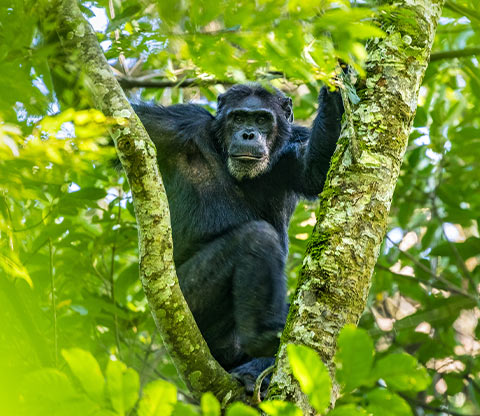
Chimpanzee tracking in Kyambura Gorge, located in the eastern sector of Queen Elizabeth National Park, offers an immersive, physically engaging adventure in the "Valley of Apes". Treks typically last 2 to 4 hours, combining a steep 200-meter escarpment descent, tracking via vocal cues, and one hour observing habituated chimpanzees
3-days-trips-to-queen-elizabeth-national-park-for-chimpanzee-tracking-in-kyambura-gorge
The Chimpanzees (Pan troglodytes)
The chimpanzees of this region are uniquely famous because they live in an isolated "underground" community, cut off from the main maramagambo forest by human settlements and savannah. This isolated pocket of habituated chimpanzees shares roughly 98.7% of their DNA with humans, a connection that becomes instantly obvious when you look into their expressive eyes.
As you follow your guides through the thick riverine canopy, tracking them relies heavily on vocal cues. Chimpanzees are highly communicative and incredibly loud; their "pant-hoots"—a building crescendo of shrieks and grunts—can echo through the gorge from over a kilometer away. On the ground, you will look for fresh nests woven hastily from branches in the treetops the night before, knuckle-print tracks in the mud, and discarded, chewed figs or wild fruits.
Once located, your one-hour encounter offers an intimate window into a complex fission-fusion society. You will observe individuals interacting within an explicit social hierarchy led by an alpha male. You might witness two allies grooming one another, a social behavior that strengthens political bonds and lowers heart rates. Young chimps are fiercely playful, practicing their swinging and climbing skills while staying within arm's reach of protective mothers. Watching them use tools, like stripping a twig to fish for ants or using heavy stones to crack nuts, highlights their immense problem-solving intelligence. Because the gorge is narrow and forested, your encounter is often close and vertical, with chimps moving seamlessly from the dark forest floor up into the sun-dappled branches above.
Red-Tailed Monkeys (Cercopithecus ascanius)
Peering into the mid-to-high canopy of the gorge, you are very likely to spot the flashing colors of the red-tailed monkey. These are smaller, incredibly agile primates easily distinguished by their striking facial markings. They feature a prominent, bright white nose patch shaped like a heart or a spot, dark fur framing their face, whitish cheek whiskers, and a long, coppery-red tail that can measure up to double their body length. This tail isn't prehensile (it can't grasp branches), but it acts as a critical balancing pole as they leap effortlessly across massive gaps in the treetops.
Red-tailed monkeys live in large, dynamic social groups usually consisting of 10 to 30 individuals, dominated by a single resident male and a close-knit group of related females. They are highly active during the early morning and late afternoon, foraging primarily for fruits, flowers, leaves, and opportunistic insects. They possess specialized cheek pouches, allowing them to rapidly stuff food away while foraging in exposed areas and digest it later in safer, secluded branches.
As you walk, listen for their distinct vocalizations—a series of bird-like chirps, clicks, and trills used to keep the group cohesive across the thick leaves. They are remarkably tolerant of other species and are frequently seen in "polyspecific associations," meaning they travel alongside colobus monkeys. This teamwork benefits both species: more eyes in the forest mean a much higher chance of spotting predators like eagles or leopards before it is too late.
Black-and-White Colobus Monkeys (Colobus guereza)
One of the most visually stunning sights in the riverine forest is the elegant movement of the black-and-white colobus monkey. These primates look like they are dressed for a formal event, sporting a jet-black body sharply contrasted by a snow-white u-shaped mantle of long fur running down their backs, white hair framing their dark faces, and a magnificent, flowing white tail. Interestingly, the word "colobus" comes from a Greek word meaning "mutilated," a reference to the fact that, unlike most other monkeys, they lack thumbs. This is an evolutionary adaptation; their hands act like smooth, curved hooks, allowing them to quickly catch branches while traveling at high speeds through the upper canopy.
Colobus monkeys are largely leaf-eaters (folivores). Because leaves are tough to break down and contain little energy, these monkeys have evolved a large, complex, multi-chambered stomach packed with specialized bacteria to ferment and digest cellulose. Consequently, they spend a large portion of their day resting and sunbathing on high branches while their bodies process their heavy meals.
When they do move, they are spectacular to watch. They utilize the elasticity of high branches to launch themselves across wide chasms, spreading their long mantle hair and fluffy tails to create a parachute effect as they glide downward through the air. They live in small, tight-knit groups of up to a dozen individuals. They are generally peaceful and quiet, though males will occasionally emit a loud, guttural roar in the early morning to advertise their territory across the gorge.
The resilient Olive Baboon.
As you transition between the open savannah edge and the steeper drops of the gorge, you will likely encounter the formidable olive baboon. Named for their thick coat of coat fur that looks greenish-gray from a distance, these are large, heavily built primates with a distinct, dog-like muzzle, powerful jaws, and a long, broken-looking tail that points upward before dropping down. Unlike the arboreal colobus and red-tailed monkeys, baboons are primarily terrestrial, meaning they spend the vast majority of their time walking confidently on all fours along the forest floor, clearings, and cliff paths.
Olive baboons are incredibly resilient, intelligent, and highly adaptable omnivores. They will eat almost anything they can find, using their nimble fingers to dig up nutrient-rich roots and tubers, strip grass seeds, pick wild berries, and hunt insects or small mammals like rodents and young antelope.
They live in highly complex, large social groups called troops, which can number from 20 to over a hundred individuals. Their society is governed by a strict, shifting hierarchy of dominant males and complex matrilines (family lines tracked through the mothers). Communication within the troop is constant and loud, featuring an array of vocal barks, screams, and grunts, alongside physical gestures like intense staring, teeth-flashing, and yawning to display their long canine teeth as warnings. While they forage on the ground during the day, they are excellent climbers and will retreat up into the safety of tall trees or sheer rock faces along the gorge walls when evening falls to sleep away from nocturnal predators.
1. What physical fitness level is required for the trek?
The trek into Kyambura Gorge demands a moderate to high level of physical fitness, primarily due to the unique topography of the landscape. Unlike tracking chimpanzees in relatively flat or gently rolling terrain, Kyambura requires navigating a dramatic, steep descent to reach the forest floor and a demanding, strenuous climb back out at the end of your trek. The gorge walls plunge roughly 100 meters down from the flat, hot savannah plateaus above. The trail consists of rough-hewn dirt steps, exposed tree roots, and narrow paths that can become incredibly slick, muddy, and unstable after a fresh rainfall.
You do not need to be an elite athlete, but you should possess good balance, steady footing, and decent cardiovascular endurance. Your legs and knees will do significant work cushioning your weight on the way down and powering you up the steep incline on the return journey. The pace of the trek is deliberately measured; rangers are highly experienced and will adjust the speed to accommodate the slowest member of the group, ensuring everyone moves safely. They will also offer regular breathing breaks to help you adjust to the humidity.
If you have pre-existing knee injuries, joint instability, or severe respiratory conditions, the constant incline and uneven surfaces can prove challenging. Preparing with light cardiovascular training, stair-climbing, or hiking on uneven trails prior to your trip will immensely improve your comfort levels. Additionally, hiring a local porter at the start of the trailhead is an excellent option; they can carry your heavy daypack and provide a steady, reassuring hand during the most challenging, slippery sections of the gorge walls.
2. What should I pack in my daypack for the trek?
Packing the right essentials in your daypack ensures you remain comfortable, hydrated, and prepared for the rapidly changing microclimate inside the gorge. The most critical item is a reliable supply of drinking water—at least two to three liters per person. The humidity beneath the thick forest canopy can cause rapid sweating, making consistent hydration essential to prevent fatigue and muscle cramps. You should also pack a selection of high-energy snacks, such as trail mix, dried fruit, nuts, or energy bars, to quickly replenish your strength during short rest breaks.
Protection against insects and the elements is equally vital. Ensure you include a premium insect repellent containing DEET or a strong natural alternative to guard against tsetse flies and mosquitoes. A lightweight, packable rain jacket or poncho is non-negotiable; rain can sweep across the gorge unexpectedly, even during the designated dry seasons. A small, basic personal first-aid kit containing adhesive bandages, blister pads, antiseptic wipes, and any personal medication is highly recommended for managing minor trail scrapes.
For your electronics, bring a microfleece or lens-cleaning cloth to wipe away the heavy humidity condensation that can quickly fog up camera lenses and binoculars. Pack all sensitive gear, including spare camera batteries, memory cards, and your phone, inside lightweight, waterproof dry bags or heavy-duty zip-top bags within your backpack. Finally, throw in a pair of lightweight, durable gardening gloves; these will protect your hands from thorns, stinging nettles, and rough bark when you need to grab passing vines or branches for stability on the steep slopes.
3. What is the best clothing and footwear to wear?
Dressing appropriately for Kyambura Gorge is all about protection, traction, and temperature regulation. The environment transitions quickly from a hot, sun-exposed savannah into a shaded, deeply humid, and densely vegetated riverine forest. You should wear lightweight, long-sleeved shirts and long trousers made from breathable, moisture-wicking synthetic fabrics. Avoid wearing jeans or heavy cotton, which absorb sweat and rainwater, become heavy, and take a long time to dry. Long clothing serves as your primary shield against biting insects, sharp thorns, and stinging nettles.
Footwear is arguably your most important choice. You need sturdy, broken-in hiking boots or high-top trail shoes featuring deep rubber lugs for maximum grip on wet clay, slippery rocks, and steep inclines. Running shoes, flat-soled sneakers, or open sandals are highly unsafe for this terrain. Pair your boots with thick, moisture-wicking hiking socks to prevent friction blisters. A classic insider technique is to tuck your trousers securely into your socks; this simple adjustment prevents safari ants and ticks from crawling up your legs while walking through leaf litter.
Consider wearing neutral earth tones like khaki, green, brown, or tan. Avoid bright colors like white, which can startle wildlife, and steer completely clear of blue or black clothing, as these specific colors are highly attractive to biting tsetse flies. Finally, bring a wide-brimmed safari hat to protect your face during the sunny ridge walks, and wear a lightweight neck gaiter that can easily be pulled up to protect your neck from low-hanging branches and bugs.
4. How do the guides track the chimpanzees in the gorge?
Tracking the chimpanzees of Kyambura Gorge is a sophisticated art that relies heavily on the profound forest literacy, sensory awareness, and experience of your Uganda Wildlife Authority rangers. Because the gorge is a sunken, enclosed valley packed with dense riverine vegetation, visual tracking from a distance is impossible. Instead, the guides lead primarily with their ears. Chimpanzees are highly vocal animals that live in a dynamic, expressive community. Guides listen intently for their signature "pant-hoots"—a loud, rising sequence of vocalizations that starts as deep grunts and climaxes in piercing shrieks, echoing off the sandstone gorge walls.
Beyond vocal cues, the rangers closely scan the forest floor and undergrowth for physical evidence of recent primate activity. They look for fresh knuckle-prints pressed into the damp mud along the riverbanks, disturbed or freshly broken undergrowth, and discarded food remnants. Chimpanzees are messy eaters; guides can estimate how recently a troop passed through by inspecting dropped wild figs, crushed oil palm fruits, or chewed bark to see if the pulp is still wet and freshly oxidizing in the humid air.
Rangers also look skyward to read the canopy architecture. Every single evening, chimpanzees construct fresh sleeping nests by bending and weaving sturdy branches together high in the treetops. Identifying the location of fresh, green nests gives the tracking team an exact starting point for where the community woke up at dawn. By combining these fresh nesting sites with their intimate knowledge of seasonal fruit trees currently in bloom, the guides can accurately predict the community's movement patterns through the gorge corridor.
5. Why is this chimpanzee community considered unique?
The chimpanzees of Kyambura Gorge are among the most behaviorally and ecologically fascinating primate populations on the planet, often referred to by scientists as the "lost chimpanzees of Kyambura." This description stems from their complete, stark geographical isolation. Thousands of years ago, this forest strip was seamlessly connected to the massive Maramagambo forest ecosystem. However, decades of expanding human settlements, agricultural clearing, and open savannah fragmentation have completely cut this valley off, leaving it a literal underground island of green.
This isolation means the community of roughly 30 to 35 chimpanzees is completely surrounded by a sea of open grassland and human activity, unable to migrate or interbreed with outside populations. From a conservation standpoint, this presents unique challenges regarding genetic diversity, but from an observational standpoint, it makes them extraordinary. They have adapted perfectly to life inside a deep, narrow trench, utilizing the steep cliffs as natural boundaries and focusing their territory heavily along the banks of the Kyambura River.
Their isolation has driven fascinating behavioral adaptations, and they are closely monitored by researchers studying how a small primate community manages resources and social structures in a confined territory. Because they are fully habituated to human presence through years of gentle, consistent exposure by researchers and rangers, they carry out their daily lives without fear or disruption when visitors arrive. Watching this specific group allows you to witness an incredibly resilient community that serves as a living symbol of wildlife preservation amidst a changing human landscape.
6. What are the core rules of chimpanzee etiquette?
To ensure both your safety and the well-being of the chimpanzees, visitors must strictly adhere to a firm set of forest etiquette rules explained during the morning briefing. The most important rule is maintaining a mandatory minimum distance of 8 meters (about 26 feet) from the chimpanzees at all times. While these animals are habituated to human presence, they remain entirely wild, incredibly strong, and highly protective of their social space. If a chimpanzee intentionally moves toward you on a narrow trail, you must quietly step aside and allow them the right of way.
Furthermore, human diseases can be devastating to primates. Because we share nearly 99% of our genetic blueprint, chimpanzees are highly susceptible to human respiratory infections, coronaviruses, influenza, and common colds. If you are feeling unwell, coughing, or experiencing a fever on the morning of the trek, you are required to declare it, as entering the gorge while sick poses a severe biological threat to the community. When you are with the chimps, wearing a surgical mask is mandatory to prevent aerosol transmission.
While observing the troop, you must keep your voice at a low, muted whisper. Loud noises, sudden shouting, or frantic arm movements can easily be misinterpreted as signs of aggression, potentially agitating the alpha males or scaring away protective mothers. Eating, drinking, or smoking anywhere near the chimpanzees is strictly prohibited; dropped food scraps can introduce dangerous bacteria or habituate the animals to seeking human food. Finally, always clear all trash out of the gorge, ensuring the ecosystem remains pristine.
7. How long is the trek and how much time do we spend with them?
The total duration of a Kyambura Gorge chimpanzee tracking excursion typically ranges between two to three hours, though the exact timing is highly unpredictable and dictated entirely by the movement of the animals. The trek is split into two distinct phases: the active tracking phase and the structured encounter phase. The tracking phase begins at the ranger station and involves descending into the gorge and hiking through the dense riverine forest until the guides successfully locate the community. This search can take anywhere from thirty minutes to over an hour of active walking.
Once the guides officially locate the chimpanzees, a strict one-hour countdown begins. This one-hour limit is a non-negotiable international conservation standard designed to minimize stress on the habituated community and limit their daily exposure to human pathogens. During these sixty minutes, your group will quietly shadow the chimpanzees as they move, allowing you to watch them forage, groom, rest, or play. The rangers keep a precise eye on the clock to ensure compliance.
Once your one hour concludes, the guides will gently instruct the group to pack up their gear and begin the return hike back up the escarpment. It is important to approach the experience with an adaptable mindset; while the encounter time is fixed, the physical effort required to secure that hour depends entirely on where the chimpanzees chose to forage that morning. This blend of wild unpredictability and structured, respectful observation makes the encounter exceptionally rewarding.
8. What should I expect during "The Encounter"?
The moment you finally catch up with the chimpanzee community is an unforgettable rush that contrasts beautifully with the quiet hike leading up to it. Unlike observing wildlife from the safety of a safari vehicle, during a foot encounter you are standing directly inside their living room. You will find yourself looking up into the massive canopy branches or standing a short distance away on a shaded forest path, completely immersed in their daily routine. The sheer proximity allows you to hear the rustle of leaves, their deep breathing, and the distinct smacking sound of social grooming.
During the encounter, you will witness a complex display of social dynamics. You might observe the dominant alpha male patrolling the area, asserting his status with a brief display of hair-erection to make himself look larger. Nearby, females may be resting quietly while their incredibly expressive, big-eared infants climb vines, stumble over roots, and curiously peer at the human visitors. You will see firsthand how dexterous they are, using their hands and feet with equal precision to peel wild fruits or clean each other's coats.
It is common for the encounter to shift dynamically. The chimpanzees might spend twenty minutes relaxing on the ground before a sudden vocalization prompts the entire troop to scramble effortlessly up into the high branches to feed on a fruiting tree. As a visitor, you will move quietly with them, guided by the rangers to ensure you always have a clear line of sight while maintaining a respectful, safe distance. The hour passes remarkably fast as you absorb their complex, human-like expressions and interactions.
9. Can I use a camera flash during the trek?
Using a camera flash is strictly prohibited during chimpanzee tracking in Kyambura Gorge, and violating this rule can create an immediate safety hazard. Flash photography can easily blind, startle, or terrify a wild animal. In an enclosed environment like the gorge, a sudden, blinding burst of artificial light directed at a dominant alpha male or a protective mother can provoke a defensive, aggressive charge toward the group. Therefore, you must double-check your camera settings before descending into the forest to ensure your built-in flash is completely disabled.
Photographing inside the gorge presents unique challenges that require manual camera adjustments rather than relying on an automatic flash. The thick, multi-layered forest canopy creates a dark environment with highly uneven, dappled light filtering through the leaves. To capture sharp, clear images of moving chimpanzees without a flash, you will need to manually increase your camera's ISO setting, typically ranging between 800 and 3200 depending on the density of the overhead leaf cover. This adjustment increases your sensor's sensitivity to low light.
Additionally, you should utilize a wide aperture setting (a low f-number like f/2.8 or f/4) to allow as much natural light into your lens as possible, which helps maintain a fast shutter speed to prevent motion blur. Because you must maintain an 8-meter distance, a telephoto zoom lens (such as a 70-200mm or 100-400mm) is absolutely essential for capturing detailed close-ups of their expressions. Be sure to bring a soft microfiber cloth, as the intense forest humidity can quickly cause your cold glass lenses to fog up.
10. What happens if a chimpanzee shows signs of aggression?
While the Kyambura Gorge chimpanzees are fully habituated and generally view human visitors as neutral, harmless components of their environment, they are incredibly strong wild animals that can occasionally display intense, dramatic behavior. It is vital to understand that what looks like anger to a human is often just natural communication, dominance display, or excitement within the troop. An alpha male might perform a charging display—stamping his feet, slapping tree trunks, dragging branches, and pant-hooting loudly—to assert dominance over a rival or impress the group.
If a chimpanzee directs a display toward your tracking group, the most important directive is to remain completely calm and follow your ranger's instructions instantly. You must never run away. Running triggers a natural chase instinct in primates and signals that you are a subordinate threat. Instead, you should stand your ground, keep your body posture low, and cast your eyes downward. Avoiding direct eye contact is critical, as a fixed, intense stare is interpreted across the primate world as a direct challenge or act of aggression.
Your UWA guides are highly trained professionals who read primate body language perfectly. They will step forward, speak to the chimpanzees in low, soothing, guttural tones that they recognize, and gently guide your group to step backward slowly to give the animal more physical space. Rangers carry firearms for safety precautions, but these are only used to fire warning shots into the air as an absolute last resort to disperse animals. By listening to your guide, potential tension resolves safely within moments.
11. What are the age restrictions and permit requirements?
To participate in chimpanzee tracking within Kyambura Gorge, all visitors must meet strict age restrictions and secure an official tracking permit ahead of time. The minimum age requirement set by the Uganda Wildlife Authority is 12 years old. This age limit is strictly enforced for multiple reasons: children are more likely to carry common childhood diseases that can devastate primate populations, and they may struggle to manage the demanding physical climb. Furthermore, younger children are harder to keep quiet and calm if a chimpanzee performs a loud dominance display.
In addition to age limits, you must possess a valid Kyambura Gorge chimpanzee tracking permit. These permits are highly regulated and limited to a small number of entries per day to protect the gorge ecosystem from overcrowding and minimize human impact on the chimp community. Permits are typically issued for either a morning session (starting around 8:00 AM) or an afternoon session (starting around 2:00 PM). It is highly recommended to book these permits months in advance through a licensed tour operator or directly with the UWA.
When you arrive at the ranger station on the morning of your trek, you must present your physical permit alongside your original passport to verify your identity and age during the mandatory check-in registration. The funds collected from these tracking permits are vital for conservation, directly financing daily anti-poaching ranger patrols, long-term habitat restoration projects, community health initiatives, and continuous veterinary monitoring to ensure this unique population survives for generations to come.
12. What kind of weather should I expect during the trek?
The weather during your Kyambura Gorge trek is defined by a fascinating contrast between the open savannah of Queen Elizabeth National Park and the unique microclimate enclosed within the gorge walls. On the rim of the gorge, the weather is typically hot, dry, and sunny, with temperatures frequently reaching between 28°C and 32°C (82°F to 90°F). However, the moment you descend past the cliff edge and enter the deep gorge corridor, the environment shifts dramatically.
Inside the gorge, the thick, multi-layered riverine forest canopy blocks out direct sunlight, causing ambient temperatures to drop noticeably, creating a cooler but significantly more humid environment. The humidity levels here are consistently high due to the moisture rising from the flowing Kyambura River and the dense transpiration of the lush vegetation. This combination means you will likely sweat heavily despite the shade, making breathable clothing and abundant water essential.
Uganda’s weather patterns feature two primary dry seasons (December to February and June to August) and two wet seasons (March to May and September to November). Tracking operates year-round, but during the wet seasons, downpours can occur rapidly, transforming the clay trails into slick, muddy slides and causing the river to rise. Conversely, during the dry seasons, tracking can occasionally take longer as the chimpanzees travel further down the gorge corridor in search of scarce fruiting trees. Preparing for both heat and sudden rain ensures you remain comfortable regardless of the season.
13. What other wildlife might I encounter in the gorge?
While the habituated chimpanzee community is the undeniable centerpiece of the trek, Kyambura Gorge is a rich, bio-diverse ecological corridor that serves as a refuge for a spectacular array of other wildlife. As you walk through the shaded forest floor and look up into the canopy, you are highly likely to encounter several other primate species that share this sunken habitat, including agile red-tailed monkeys, elegant black-and-white colobus monkeys, vervet monkeys, and troops of powerful olive baboons.
The gorge is also an absolute paradise for bird watchers, harboring numerous forest-dwelling species that cannot be found in the surrounding open savannah. Keep your eyes peeled and binoculars ready for the flashing, brilliant blue and red colors of the Great Blue Turaco bouncing through the high branches, or listen for the distinct call of the Black Bee-eater. You might also spot various species of kingfishers, sunbirds, and hornbills nesting in the ancient tree hollows along the riverbanks.
On the forest floor, though more elusive, mammals like forest elephants, giant forest hogs, and bushbucks utilize the gorge as a vital source of water and shade, occasionally wandering down from the savannah plains. The Kyambura River itself is home to hippos and wallowing water buffaloes, which can sometimes be seen or heard splashing in the deeper bends of the river channel. This incredible concentration of diverse species makes every single minute of the hike an engaging, multi-layered safari experience.
14. How does the terrain change from start to finish?
The physical landscape of the Kyambura Gorge trek is a dramatic study in contrast, offering an evolutionary journey through distinct micro-ecosystems over a short distance. The trek begins on the flat, sun-bleached, open savannah grasslands of Queen Elizabeth National Park. Here, the ground is wide, dry, and exposed, offering sweeping views across the rift valley floor. This open terrain ends abruptly at the edge of the escarpment, where the earth drops away into a massive, green fissure.
The second phase is the steep descent down the gorge walls, dropping roughly 100 meters down a sharp incline. The trail here transitions rapidly into narrow, rough-cut dirt paths, steep switchbacks, and areas where massive tree roots form natural, uneven staircases. The soil shifts from dry savannah dust to rich, damp, and often slippery forest clay. As you drop lower, the open sky disappears, replaced by a thick, dark canopy of ancient riverine trees, causing the light to dim significantly.
Once you reach the bottom, the terrain levels out into the dense forest floor corridor tracking alongside the meandering Kyambura River. Walking here involves navigating thick undergrowth, stepping over decaying logs, crossing small tributary streams via simple log bridges, and managing swampy patches of mud. The air becomes heavy, still, and thick with the earthy scent of wet soil and vegetation. The final phase reverses this experience, requiring a slow, steady, and cardio-intensive climb straight back up the steep walls to emerge back into the bright savannah sunshine.
15. How does this trek compare to tracking in Kibale Forest?
Comparing chimpanzee tracking in Kyambura Gorge to Kibale National Park highlights two entirely different, highly rewarding styles of primate trekking. Kibale Forest is widely known as the primate capital of East Africa, home to a massive, continuous rainforest ecosystem that hosts over 1,500 chimpanzees. Because of the vast population and flatter terrain, tracking in Kibale typically offers a higher statistical success rate of locating the chimps quickly, and multiple fully habituated communities mean you can choose from various standard tracks or full-day habituation experiences.
Kyambura Gorge, by contrast, offers a much more dramatic, raw, and intimate adventure. Because the forest is confined within a deep, narrow canyon, the entire tracking experience is defined by the striking topography. You are tracking a single, small, isolated community of roughly thirty individuals within an atmospheric "underground" rainforest. The dramatic descent into the gorge walls and the presence of a winding river create a highly cinematic, adventurous atmosphere that feels like entering a hidden world.
Furthermore, group sizes in Kyambura are kept small, which often results in a more private, exclusive encounter with less tourist traffic around the primates compared to the busier trails of Kibale. While Kibale shines in terms of pure sheer numbers and expansive rainforest depth, Kyambura Gorge excels in offering a unique landscape, breathtaking scenic views, and a raw sense of discovery. Choosing between them depends on whether you prefer the sheer scale of a vast primal forest or the dramatic adventure of a hidden valley canyon.
Booking Kyambura gorge chimpanzee tracking with us Roads of Adventure safaris
Booking a Kyambura Gorge chimpanzee tracking trip with Roads of Adventure Safaris is a seamless process. They offer tailored packages (such as 4-day tours of Queen Elizabeth National Park) that secure your gorilla/chimp permits, 4x4 transport, and full-board accommodations
