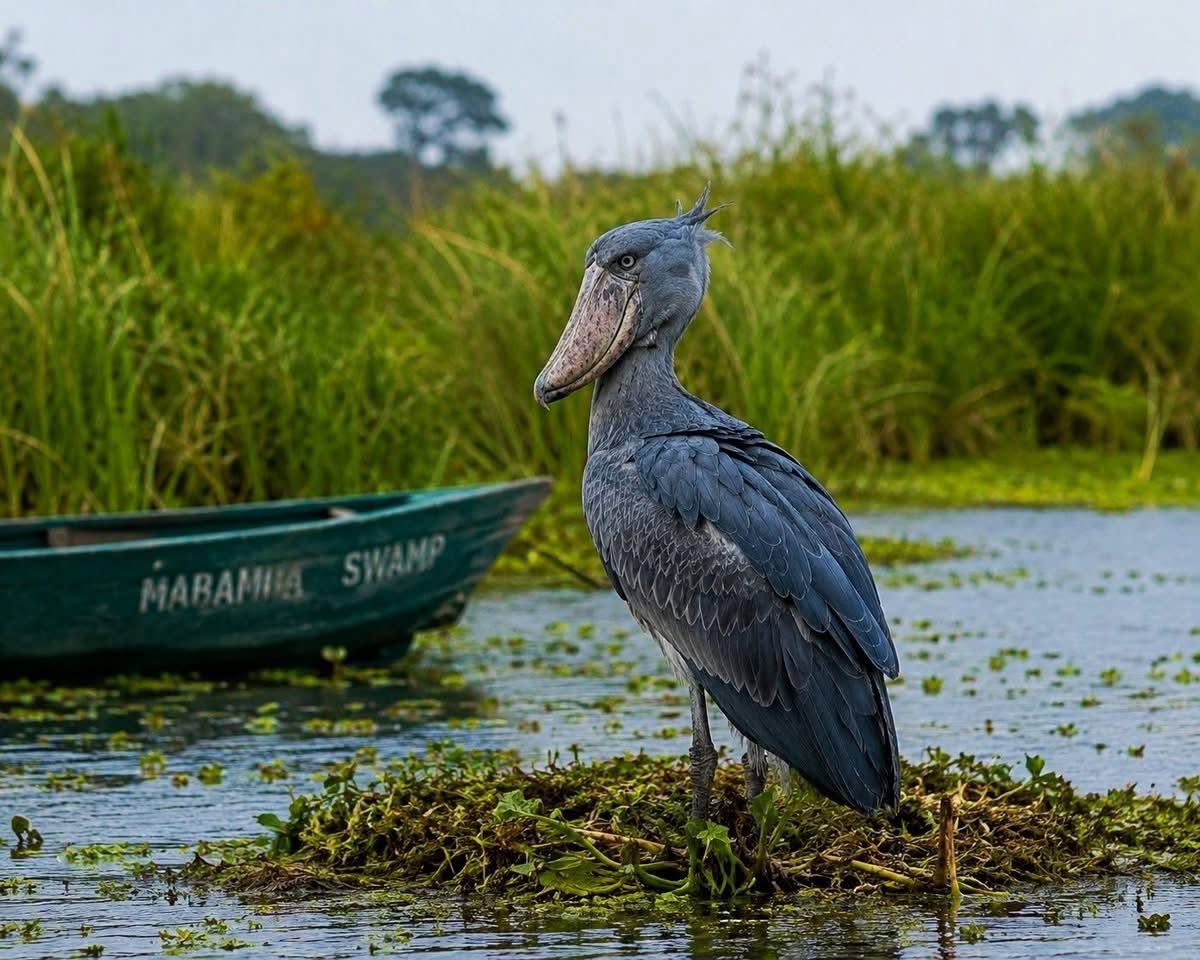
A 10-day Uganda birding tour covers diverse habitats—from papyrus swamps and savannahs to ancient rainforests and the Albertine Rift—yielding sightings of rare species like the Shoebill Stork, Green-breasted Pitta, and Congo Serpent Eagle
Day 1: Entebbe & Mabamba
Day 2: Lake Mburo
Days 3-5: Bwindi Impenetrable
Days 6-7: Queen Elizabeth
Days 8-9: Kibale & Bigodi
Day 10: Return to Entebbe
10-days-best-uganda-birding-safari-and-wildlife-experience
9-days-classic-uganda-birding-safari-tour
11-days-uganda-birding-safari-and-primate-experience
12-days-uganda-birding-tour-looking-for-rift-valley-endemic-birds-west-circuit
21-days-uganda-birding-safari-extravaganza-to-best-uganda-safari-parks
A 10-day Uganda birding tour is the ultimate bucket-list journey for wildlife enthusiasts. Uganda packs an incredible punch, hosting over 1,000 avian species across diverse ecosystems, including lush papyrus swamps, expansive savannahs, and ancient volcanic rainforests. This day-by-day itinerary is designed to maximize your sightings of iconic species like the Shoebill Stork, Green-breasted Pitta, and legendary Albertine Rift endemics while keeping travel times smooth and comfortable.
🛶 Day 1: Arrival in Entebbe & Mabamba Swamp
Your African birding expedition kicks off the moment you touch down at the airport. Skip the city rush and head straight to the tranquil shores of Lake Victoria. Here, you will step into a traditional wooden canoe to navigate the narrow, maze-like papyrus channels of the famous Mabamba Swamp.
This pristine wetland is globally renowned as the absolute best place to look for the prehistoric, giant-billed Shoebill Stork. Watching this massive bird stand completely motionless in the marsh is a spine-tingling experience. As your local guide quietly paddles through the reeds, keep your binoculars ready for vibrant waterbirds darting across the lilies. You will wrap up your first day checking into your comfortable hotel, setting up your life list, and sharing a warm welcome dinner.
- Target Species: Shoebill Stork, African Jacana, Malachite Kingfisher, Lesser Jacana, Swamp Flycatcher.
- Vibe: Immersive, peaceful, and instantly rewarding.
🚗 Day 2: Transfer to Lake Mburo National Park
Today, you leave the lakeside behind and journey southwest toward the rolling hills of Lake Mburo National Park. The drive itself is a cultural tapestry, winding past lively roadside markets and emerald-green cattle country.
I highly recommend keeping your camera handy during the drive, as we make frequent stops along the acacia-lined roads to scan the skies and fence posts for early sightings. You will arrive at the park just in time for a late afternoon game drive or a guided bush walk, where you can watch zebras, giraffes, and impalas graze under a golden sunset. When darkness falls, a thrilling night safari introduces you to the mysterious world of nocturnal hunters.
- Target Species: Lizard Buzzard, Grey Crowned Crane, White-headed Barbet, African Scops Owl, Verreaux's Eagle-Owl.
- Vibe: Classic African savannah transition with a nocturnal twist.
🚤 Day 3: Lake Mburo Savannah Trails & Boat Safari
Wake up to a stunning dawn chorus echoing through the acacia woodlands. Your morning is dedicated to exploring the park’s hidden tracks, focusing heavily on specialized dry-savannah birds that thrive in this unique microclimate.
After a midday rest, the highlight of the day is a peaceful afternoon boat launch on Lake Mburo. Drifting quietly along the heavily forested eastern banks allows you to get incredibly close to secretive waterbirds that refuse to show themselves from the shore. Watch the overhanging branches closely for the remarkably rare African Finfoot hiding in the shadows. All the while, massive hippos and lazy crocodiles provide a dramatic backdrop to your bird-watching tally.
- Target Species: African Finfoot, White-backed Night Heron, Red-faced Barbet, Coqui Francolin, Pied Kingfisher.
- Vibe: Relaxed water safari paired with active savannah tracking.
⛰️ Day 4: Journey to Bwindi Impenetrable Forest (Ruhija)
Get ready for a breathtaking change of scenery as you leave the dry plains and climb high into the misty Kigezi Highlands. Your destination is the rugged Ruhija sector of Bwindi Impenetrable National Park, a dense, primeval rainforest legendary among international birders.
As the air grows cooler and the jungle thickens, the bird life changes completely. Ruhija sits at a high altitude, making it the perfect gateway to search for specialized species found nowhere else on earth except the Albertine Rift. After checking into your mountain lodge, you will take a slow, introductory walk along the forest fringe, listening to the mysterious calls echoing from the deep green canopy.
- Target Species: Handsome Francolin, Mountain Masked Apalis, Shelley's Crimsonwing, Stripe-breasted Tit.
- Vibe: Misty mountain air, deep green vistas, and high-altitude specialties.
🌲 Day 5: The Mubwindi Swamp Trek
Lace up your sturdiest hiking boots because today is a true forest adventure. You will head deep into the ancient heart of Bwindi, descending along a steep, fern-fringed trail that drops into the mystical Mubwindi Swamp.
This damp, untouched valley is a sacred grail for serious birders. With a steady pace and absolute quiet, your expert guide will help you scan the tangled bamboo zones and dense canopy for the crown jewel of the region: the rare and enigmatic African Green Broadbill. If you choose to mix your birding with a primate encounter, this is also the perfect window to split off for an unforgettable, optional mountain gorilla trekking experience.
- Target Species: African Green Broadbill, Grauer's Rush Warbler, Purple-breasted Sunbird, Regal Sunbird.
- Vibe: Challenging, rewarding, and deeply wild jungle hiking.
🦅 Day 6: Birding 'The Neck' to Buhoma
Today you travel between sectors, moving smoothly from the high ridges of Ruhija down to the lower valleys of Buhoma. The journey takes you right through a famous riverine forest corridor affectionately known by locals as "The Neck."
This low-lying forest bridge is an absolute magnet for both birds and spectacular jungle butterflies. Because the road cuts directly through the dense trees, it provides an exceptional canopy opening where you can easily spot colorful species that are usually hidden from view. You will spend hours pulling over, stepping out of the vehicle, and scanning the river banks and high branches before arriving at your new lodge in Buhoma for a relaxing evening.
- Target Species: Black-billed Turaco, Cassin's Hawk-Eagle, Bar-tailed Trogon, Black Bee-eater, Mountain Wagtail.
- Vibe: Scenic, slow-paced roadside birding through lush river canyons.
🦁 Day 7: Descending to Queen Elizabeth National Park (Ishasha)
Say goodbye to the dense mountain jungles as you drop back down into the western arm of the Great Rift Valley. You will enter the southern, wild stretches of Queen Elizabeth National Park, starting with the untamed Ishasha sector.
Ishasha is globally famous for its unique population of tree-climbing lions that love to laze away hot afternoons on the low limbs of sprawling fig trees. While scan-searching the branches for dangling paws, your focus remains on the rich riverine thickets and open grasslands. The mix of woodland and open savannah here creates an incredible edge-effect, allowing you to log an impressive variety of predatory raptors and colorful rollers.
- Target Species: Southern Carmine Bee-eater, Martial Eagle, Bateleur, Broad-billed Roller, Ross's Turaco.
- Vibe: Thrilling big-game viewing mixed with classic savannah birding.
⛵ Day 8: Kasenyi Plains & Kazinga Channel Boat Cruise
An early morning start brings you to the northern Kasenyi Plains, a vast savannah ecosystem teeming with wildlife. As huge herds of Uganda Kob graze in the morning mist, large birds of prey sit perched on high termite mounds, watching for any sign of movement.
In the afternoon, you will experience what many describe as the finest water safari in Africa: a private boat cruise along the natural Kazinga Channel. This spectacular waterway links Lake Edward and Lake George. As your boat glides past pods of wallowing hippos and watering elephants, you will be surrounded by thousands of nesting waterbirds, creating a chaotic, deafening symphony of color and sound.
- Target Species: African Skimmer, Great White Pelican, Martial Eagle, Temminck's Courser, White-winged Tern.
- Vibe: High-density wildlife spectacles and breathtaking water views.
🐒 Day 9: Kibale Forest & Bigodi Wetland Sanctuary
Today, you head north toward the lush tropical landscapes of Kibale National Park, proudly celebrated as the primate capital of the world. By afternoon, your focus shifts to the beautiful, community-managed Bigodi Wetland Sanctuary.
Walking along a network of raised wooden boardwalks, you will wind through a dense gallery forest that rings out with exotic wildlife calls. Bigodi is an absolute paradise for spotting spectacular, heavy-bodied turacos and colorful forest kingfishers. As you scan the dense vegetation for rare hidden birds, look up to see playful red-tailed monkeys, grey-cheeked mangabeys, and black-and-white colobus monkeys leaping effortlessly through the high branches.
- Target Species: Great Blue Turaco, Blue-breasted Kingfisher, Green Hylia, Papyrus Gonolek, Yellow-billed Barbet.
- Vibe: A vibrant community-led walk bursting with birds and primates.
✈️ Day 10: Chimpanzee Tracking & Return to Entebbe
Your final morning offers an exhilarating grand finale. You can choose to join an optional, expert-guided trek into the emerald depths of Kibale Forest to track a wild community of chimpanzees as they wake up, feed, and swing through the high canopy.
Afterward, you will pack up your binoculars, load your gear, and begin the comfortable drive back toward Entebbe. We will make a celebratory stop at the Equator monument for lunch and photos before arriving back at the airport in the evening. You will head home with an incredibly full memory card, a vastly expanded life list, and a deep love for the Pearl of Africa.
- Target Species: Green-breasted Pitta, African Emerald Cuckoo, Joyful Greenbul, Narina Trogon.
- Vibe: A thrilling primate finish transitioning into a smooth journey home.
Which bird species on this itinerary are the absolute hardest to spot, and how do we find them?
While Uganda boasts over a thousand species, the Shoebill Stork at Mabamba and the African Green Broadbill in Bwindi’s Mubwindi Swamp are the most challenging targets. The Shoebill is massive but relies on perfect camouflage, standing completely still like a statue among dense papyrus. Spotting it requires native canoe captains who track territory movements daily.
The African Green Broadbill is an even tougher puzzle. It is tiny, bright green, lives in the high canopy of remote valleys, and rarely calls. To find it, we hike into Bwindi's deep interior, mapping known nesting sites and listening for the distinct, subtle wing-snapping noises it makes during courtship displays. The key to success is relying on specialized local guides who memorize individual territory calls, carry high-quality spotting scopes, and know exactly how weather shifts affect bird activity. We also prioritize early morning hours when birds are actively foraging.
Can I genuinely combine world-class birding with gorilla and chimpanzee trekking without ruining the avian focus?
Yes, you can absolutely do both, as the habitats overlap perfectly. Bwindi and Kibale are premier birding hotspots that also serve as primary sanctuaries for mountain gorillas and wild chimpanzees. Choosing to trek primates doesn't detract from your birding goals; it enhances them by taking you deep into pristine, trackless forest zones you wouldn't otherwise access.
On Day 5 in Bwindi or Day 10 in Kibale, the morning can be split. While you follow a specialized park ranger to spend an hour sitting feet away from a gorilla family or watching chimps groom in the canopy, your ears will still pick up distinct forest calls. Once the primate encounter concludes, you immediately pivot back to birding the trail on the hike out. Park rangers are highly cross-trained, meaning a gorilla guide is often just as skilled at identifying an Albertine Rift endemic by its call as they are at tracking primate footprints, giving you the absolute best of both worlds.
What kind of physical fitness do I need for the Mubwindi Swamp and Bwindi forest trails?
Bwindi lives up to its name as an "Impenetrable" forest, demanding a moderate to high level of physical fitness, especially for Day 5. The trek down to Mubwindi Swamp is a serious mountain hike. You will descend hundreds of meters down steep, muddy, and slippery ridges blanketed in thick vegetation and tangled roots, only to turn around and hike straight back up at high altitudes exceeding 2,000 meters.
To prepare, you should focus on cardio endurance and leg strength before arriving. Leg joints take a beating on the steep descents, so sturdy, broken-in hiking boots with excellent ankle support are non-negotiable. I highly recommend hiring a local porter at the park headquarters. For a small fee, they carry your heavy camera gear, backpacks, and tripods, leaving you free to focus entirely on steady footing and keeping your binoculars steady. Walking sticks are provided and are life-savers on muddy slopes.
What is the best camera gear and lens setup to pack for a fast-paced Uganda birding safari?
Birding photography in Uganda shifts constantly between open, sunlit savannahs and dark, heavily shadowed jungle canopies. For open areas like Lake Mburo and the Kazinga Channel, a telephoto lens of at least 400mm to 600mm is essential for pulling in distant raptors or skimmers without disturbing them.
However, deep inside Bwindi and Kibale forests, light levels drop dramatically. Here, you need a fast lens with a wide aperture (ideally f/4 or f/2.8) and an adjustable ISO capability on your camera body to capture crisp images of fast-moving greenbuls and sunbirds in low light. Bring plenty of extra, fast-charging batteries since cold mountain nights drain power quickly. Most importantly, pack high-quality weatherproof dry bags and rain covers. Tropical downpours can strike instantly, and protecting your expensive glass from sudden jungle moisture is critical to keeping your gear functional throughout the trip.
How safe is the food and water on this route, and how do I avoid getting sick?
Staying healthy is vital when you are tracking rare species through remote jungles. Tap water is strictly unsafe to drink anywhere in Uganda. You must use bottled, filtered, or purified water for everything, including brushing your teeth. Reliable tour operators and eco-lodges provide unlimited safe drinking water throughout the vehicle transfers and inside your rooms.
When it comes to food, the lodges selected along this tourist circuit maintain very high hygiene standards, serving excellent meals that blend fresh local produce with international cuisine. To stay safe on the road, follow the classic travel rule: eat food that is piping hot and freshly cooked. Avoid raw street foods, unpeeled fruits, or salads from small roadside stalls. Because birding involves long hours in the bush, pack dynamic snacks like energy bars, nuts, and electrolyte packets to keep your stamina high during humid swamp walks or intense heat on the savannah plains.
What should I pack to wear to protect myself from both the elements and biting insects?
Jungle birding requires highly practical, protective clothing. The most important items are lightweight, long-sleeved shirts and long trousers in neutral, earthy tones like khaki, green, or brown. Bright colors scare away sensitive birds, and dark blue or black clothing actively attracts tsetse flies in savannah parks like Lake Mburo.
To protect against safari ants and biting midges during forest walks, you will want to tuck your trousers directly into long hiking socks. A lightweight, breathable waterproof rain jacket is mandatory, as tropical storms can catch you by surprise even during the dry season. For insect defense, bring a high-concentration DEET or Picaridin insect repellent. Spray your clothing down thoroughly each morning, focusing heavily on ankles and wrists. A wide-brimmed safari hat protects your eyes from glaring equatorial sun when scanning open water channels from the boat.
When is the absolute best time of year to book this specific 10-day birding itinerary?
While Uganda offers spectacular birding year-round, the prime window falls between late December and February, or from June to August. These months mark the dry seasons, offering clearer trails, predictable road conditions, and much easier hiking conditions through Bwindi's steep valleys. Furthermore, lower vegetation makes spotting small canopy specialists much easier.
If your primary goal is maximizing your life list with migratory species, consider booking between October and April. This is when millions of palearctic migrants arrive from Europe and northern Africa, filling wetlands like Mabamba and the Kazinga Channel with massive, swirling flocks of waders, terns, and raptors. The trade-off is higher rainfall, which can make forest trails muddy and challenging. If you want a balance of resident Albertine Rift endemics, breeding plumages, and comfortable trekking weather, January and July are the ideal months to target.
How much time will we spend driving in the vehicle versus actually out on foot birding?
Uganda is a relatively compact country, but its infrastructure means travel days require patience and offer great roadside birding. Day 2 (to Lake Mburo), Day 4 (to Bwindi), and the return leg on Day 10 involve several hours in a customized 4x4 safari vehicle. However, these drives are never wasted; the vehicles feature pop-up roofs, turning travel times into rolling safaris where you scan canopy lines and wetland fringes.
The rest of the itinerary is highly active and foot-focused. Days 1, 3, and 8 lean heavily into boat safaris, where you sit comfortably while the wildlife comes to you along the water's edge. Days 5, 6, and 9 are entirely on your feet, walking forest loops, boardwalks, and swamp trails. The itinerary balances long transit blocks with deep, slow-paced tracking days, ensuring you get plenty of exercise and immersive field time rather than just staring out of a window.
What are the accommodation styles like along this remote birding circuit?
The accommodations along this classic route are a highlight of the trip, ranging from charming mid-range eco-lodges to ultra-luxury forest chalets. Even in remote areas like Ruhija or Buhoma, lodges are designed to blend seamlessly into the environment, offering spectacular views right from your private veranda. You can expect hot solar showers, comfortable beds draped in mosquito netting, and excellent hospitality.
Importantly, many of these lodges double as active birding sites. It is common to sit on your deck with morning coffee and watch sunbirds, weavers, and hornbills feeding in the surrounding gardens. Electricity is widely available, though remote jungle lodges often rely on solar power or generators that turn off late at night. They always provide centralized charging stations in the main lounge areas, ensuring your cameras, phones, and laptop batteries are fully powered up for the next morning's adventure.
How do community sanctuaries like Bigodi directly support conservation, and what is expected of me?
The Bigodi Wetland Sanctuary on Day 9 is a shining example of community-led conservation. The sanctuary is managed entirely by the local Kibale Association for Rural and Environmental Development (KAFRED). Money gathered from your entry fees and guiding services goes directly into funding local primary schools, clean water initiatives, and women’s business cooperatives, turning the community into active guardians of the wetland.
As a visitor, you are expected to follow strict eco-tourism principles. Stay firmly on the designated wooden boardwalks to protect the delicate papyrus root systems, pack out any trash you bring in, and respect the wildlife by keeping voices low. Tipping your local guide is highly encouraged; these guides grew up in the surrounding villages and possess an unbelievable mental map of every nest and call in the swamp. Supporting them directly ensures that preserving habitats remains more profitable for the community than agricultural clearing.
Booking Uganda birding tour with us Roads of Adventure safaris
Book your Uganda birding tour with Roads of Adventure Safaris to explore Africa's top avian paradise. Discover over 1,065 bird species, including the Shoebill Stork at Mabamba Swamp and Albertine Rift endemics in Bwindi. Our custom-tailored trips feature specialist guides, 4x4 transport, and handpicked lodges, seamlessly combining birdwatching with gorilla and wildlife tracking. We manage all permits and logistics for you. Contact us at info@roadsofadventuresafaris.com to build your dream safari.