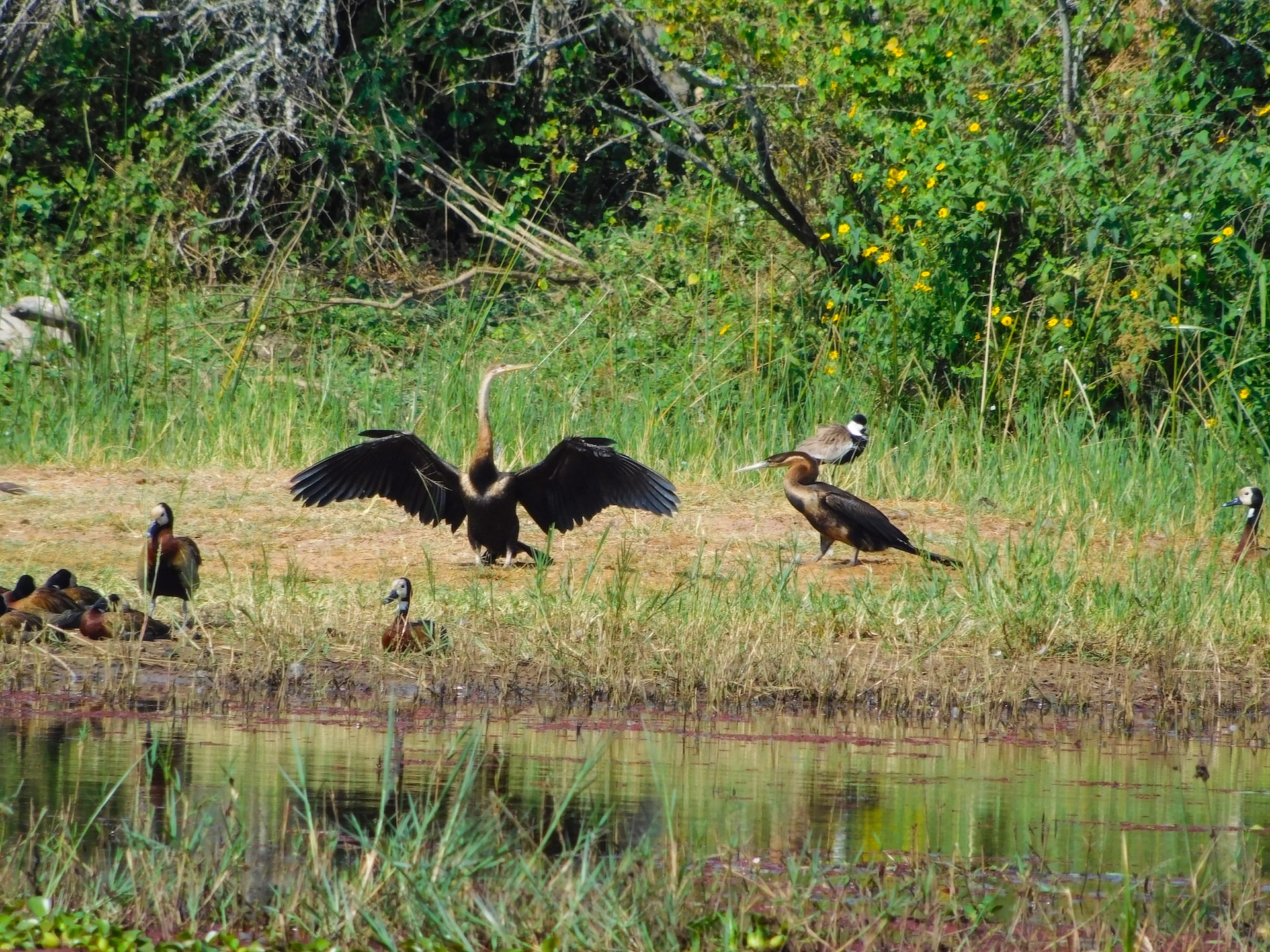
On the 11-day birding safari in Uganda is an intense, dawn-to-dusk adventure through diverse ecosystems to target the country’s over 1,060 recorded bird species, including the elusive Shoebill Stork, the African Green Broadbill, and dozens of Albertine Rift endemics.
11-days-uganda-birding-safari-and-primate-experience
10-days-best-uganda-birding-safari-and-wildlife-experience
12-days-uganda-birding-tour-looking-for-rift-valley-endemic-birds-west-circuit
Mabamba Wetland (Lake Victoria)
An early morning venture into the Mabamba Wetland introduces you to one of Africa’s most iconic and surreal birding experiences. Situated on the edge of Lake Victoria, this vast papyrus maze is globally renowned as one of the most reliable sites to spot the prehistoric Shoebill Stork. Navigating the narrow, hand-cut channels in a traditional motorized wooden canoe adds a layer of quiet suspense to the excursion. As the morning mist lifts over the water, your local guide expertly searches the dense stands of papyrus, looking for the massive, gray silhouette of the Shoebill standing motionless in the shallows as it hunts for lungfish.
While the Shoebill is the undisputed star of Mabamba, the wetland’s unique ecosystem supports a diverse community of specialized waterbirds. The vibrant, strawberry-pink and yellow plumage of the Papyrus Gonolek provides a stunning visual contrast against the green stalks, though this secretive bushshrike is often heard before it is seen. Overhead, the brilliant turquoise and cinnamon tones of the Blue-breasted Bee-eater flash in the sunlight as it darts from the reeds to catch insects.
Mabamba is also home to a variety of migratory species and regional specialists, including the Lesser Jacana, Malachite Kingfisher, and the elusive African Pygmy Goose. The dynamic interplay of open water, floating water lilies, and dense papyrus canopies ensures that every turn of the canoe reveals something new. This swamp is a critical staging ground for birders entering Uganda, offering an immediate and unforgettable introduction to East Africa's avian wealth.
Lake Mburo National Park
Characterized by a beautiful mosaic of sculptured landscapes, rolling hills, and tranquil lakes, Lake Mburo National Park serves as a premier destination for savanna and acacia-dwelling woodland species. Unlike western Uganda’s dense rainforests, Mburo features open habits that allow for excellent visibility, making it a favorite for tracking down regional specialties. The park is highly prized among ornithologists as the absolute best place in the country to spot the elusive African Finfoot, a shy, river-dwelling bird that frequents the quiet, overhanging vegetation along the edges of the lake.
Exploring the lake by boat reveals the African Finfoot paddling silently near the banks, alongside white-backed night herons and giant kingfishers. On land, the savanna walks and game drives yield a completely different suite of species. Uganda’s national bird, the elegant Grey Crowned Crane (locally known as the Crested Crane), is a frequent sight, gracefully foraging in pairs through the seasonally flooded valleys. Birders also search the grassy plains for the striking Brown-chested Lapwing, a localized migrant that favors the short-grass areas heavily grazed by the park’s abundant impalas and zebras.
The acacia woodlands are alive with activity, producing a steady chorus of bird calls. Here, you can check off specialized woodland residents like the Red-faced Barbet, Bare-faced Go-away-bird, and the Long-tailed Starling. The park’s unique combination of wetland, forest edge, and dry acacia savanna creates an exceptional ecological edge effect, packing over 350 distinct bird species into a relatively compact, highly accessible geographic area.
Queen Elizabeth National Park
Spanning the equator, Queen Elizabeth National Park boasts a staggering bird list of over 600 species, a testament to its incredibly diverse terrain. The park seamlessly transitions from sprawling open savannas and humid lowland forests to pristine volcanic crater lakes and extensive marshlands. The crown jewel of any birding itinerary here is the legendary boat cruise along the Kazinga Channel, a natural oasis that links Lake Edward and Lake George. This waterway attracts an astonishing concentration of both resident waterbirds and large mammals, offering unmatched photography opportunities.
Cruising slowly down the channel brings you face-to-face with flocks of African Skimmers cutting through the water's surface, alongside thousands of Great White Pelicans and Pink-backed Pelicans. The unmistakable, piercing cry of the African Fish Eagle echoes along the banks, where these regal raptors sit perched on dead snags watching for prey. The park is an absolute paradise for birds of prey; its open skies are continuously patrolled by numerous raptors, including the Martial Eagle, Bateleur, and several species of vultures soaring on the thermal currents.
Away from the water, the grassy Kasenyi plains and the remote Ishasha sector offer excellent birding amidst big game. You will find savanna specialists like the Rufous-naped Lark, Flappet Lark, and the striking White-tailed Lark. Moving toward the moist, forested pockets of the Maramagambo, the avian composition shifts entirely, introducing colorful forest edge species such as the Black-bee-eater and various sunbirds, cementing the park's status as a mega-diversity hotspot.
Bwindi Impenetrable Forest & Ruhija
Bwindi Impenetrable Forest is a profound, ancient jungle that ranks among the absolute top birding destinations on the African continent. This steep, mountainous rainforest is a crucial refuge for Albertine Rift Endemics—highly specialized species found nowhere else on earth outside this specific geological rift valley. The high-altitude sector of Ruhija serves as the perfect gateway for targeting these evolutionary marvels. Trekking beneath the multi-layered canopy requires patience, sharp eyes, and a keen ear, as the dense, moss-draped forest can hide even the most brightly colored birds.
The absolute holy grail of this region is the near-mythical African Green Broadbill. To find it, dedicated birders hike down the steep, challenging trails to the isolated Mubwindi Swamp. This tiny, lime-green bird with a bright blue throat is incredibly localized, often found quietly foraging in the sub-canopy. Along the same misty mountain trails, you will encounter the spectacular Rwenzori Turaco, a large bird displaying a brilliant combination of red, green, and blue plumage that flashes dramatically when it takes flight through the misty trees.
The undergrowth holds its own treasures, including the Handsome Francolin and the elusive Archer's Robin-Chat. Bwindi’s complex altitudinal gradient means that the bird life changes significantly from the valley floors to the high ridges. As you scan the thick foliage, you can expect to find other Albertine gems like the Regal Sunbird, Strange Weaver, and Grauer's Broadbill, making every challenging, muddy mile walked fully rewarding.
Kibale National Park
Kibale National Park is universally celebrated for its thriving primate populations, but for birders, this moist evergreen forest is an enchanting cathedral of sound and color. The park supports an incredibly rich community of true forest interior birds that thrive in the dark, humid lower strata and the towering emergent trees. The primary target for any serious birder visiting Kibale is the magnificent Green-breasted Pitta. Sighting this legendary bird requires a pre-dawn entry into the forest, sitting quietly on the damp floor listening for its distinctive, mechanical wing-snapping display call.
When the light pierces the canopy, the Green-breasted Pitta reveals its breathtaking plumage—a brilliant blend of emerald green, sky blue, and crimson that camouflages perfectly with the leaf litter. Beyond the pitta, the canopy overhead is alive with the joyful chatter of various forest birds. The loud, raucous calls of the Black-billed Turaco echo through the trees as it leaps agilely from branch to branch, while the more subtle, elusive Western Bronze-naped Pigeon hides quietly in the dense mid-tier foliage.
Kibale’s extensive trail network allows birders to systematically explore different forest microhabitats. You can observe massive Black-and-white-casqued Hornbills crashing through the fruit-laden figs, alongside delicate, iridescent sunbirds feeding on forest blossoms. On the forest edge and nearby Bigodi Wetland Sanctuary, the species mix expands to include papyrus specialists and colorful weavers, offering an incredible, multi-layered birding experience that perfectly complements the deep-forest tracking.
11 Days bird watching Safari in Uganda
Uganda hosts over 1,000 bird species within an area the size of Great Britain. This 11 Days bird watching Safari in Uganda will guide you through an exceptional tapestry of habitats, including vast papyrus swamps, savanna plains, and prehistoric rainforests. Your journey will target unique avian evolutionary wonders, most notably the giant Shoebill Stork, the secretive Green-breasted Pitta, and numerous Albertine Rift endemics found nowhere else on earth. Guided by expert local ornithologists, you will navigate remote water channels by boat, walk quietly along misty mountain tracks, and explore dense jungle understories. Along the way, large African mammals like elephants, tree-climbing lions, and chimpanzees will complement your sightings. This carefully designed route maximizes your time in premium birding zones, promising a comprehensive and highly rewarding African birding experience.
Day 1: Arrival and Birding in Entebbe
Your 11 Days bird watching Safari in Uganda begins with your arrival at Entebbe International Airport. After settling into your hotel, you will spend the afternoon exploring the lush Entebbe Botanical Gardens on the shores of Lake Victoria. This lakeside habitat introduces you to common regional species. You will look for the Great Blue Turaco, Ross’s Turaco, and the Double-toothed Barbet in the canopy. The shoreline will produce sightings of the African Openbill, Malachite Kingfisher, and various gulls or terns. Black-and-white-casqued Hornbills will likely fly overhead while orange weavers’ nest in the reeds. This gentle walk serves as an ideal introduction to the country's avian diversity before you venture into more remote wilderness areas tomorrow.
Day 2: Shoebill Tracking at Mabamba Swamp
You will depart early for Mabamba Swamp, a massive papyrus wetland on Lake Victoria. Boarding a motorized wooden canoe, you will navigate narrow channels to search for the prehistoric-looking Shoebill Stork. Your guide will seek out this massive bird as it stands motionless hunting lungfish. Beyond the Shoebill, the marsh will provide sightings of the Lesser Jacana, African Pygmy Goose, and Squacco Heron. You will watch for the vibrant Papyrus Gonolek moving deep within the reeds, while Blue-breasted Bee-eaters hawk insects from exposed perches. In the afternoon, you will begin your drive westward toward Lake Mburo National Park, checking roadside woodlands and seasonal swamps for broad-billed rollers and long-crested eagles along the highway.
Day 3: Woodland Birding in Lake Mburo National Park
The morning will feature a boat trip on Lake Mburo to find the secretive African Finfoot. You will scan the overhanging riverine vegetation for this quiet bird, alongside White-backed Night Herons and Giant Kingfishers. Later, a game drive through the acacia woodlands will yield different specialties. You will look for the Red-faced Barbet, Bare-faced Go-away-bird, and the striking Long-tailed Starling. Pairs of Grey Crowned Cranes will forage in the moist valleys, while the localized Brown-chested Lapwing occupies areas with short grass. The park’s unique mix of wetland and savanna habitats creates a rich environment where you will also see large mammals like impalas, zebras, and topis alongside the birds.
Day 4: Journey to Queen Elizabeth National Park
You will leave Lake Mburo and drive toward Queen Elizabeth National Park, crossing the equator along the way. The route offers excellent birding opportunities as the landscape transitions into open savanna and crater lakes. Upon arrival, you will explore the Kasenyi plains, where you will look for savanna specialists like the Rufous-naped Lark, Flappet Lark, and the Black-bellied Bustard. Raptors will dominate the skies, and you will scan the thermal currents for the Martial Eagle and Bateleur. In the evening, you will check the edges of various volcanic craters for specialized waterbirds and flamingos, which occasionally visit the salt lakes depending on water levels.
Day 5: Kazinga Channel Boat Cruise and Savanna Birding
An early morning drive through the northern sectors of the park will target the African Crake, Harlequin Quail, and various pipits. In the afternoon, you will board a boat for a cruise along the Kazinga Channel. This waterway links Lake Edward and Lake George, attracting thousands of birds. You will observe dense concentrations of Great White Pelicans, Pink-backed Pelicans, and African Skimmers. The distinct call of the African Fish Eagle will guide your eyes to the shoreline trees. You will also see herds of hippos and elephants drinking at the water's edge, sharing the banks with Goliath Herons, Saddle-billed Storks, and Yellow-billed Storks.
Day 6: Forest Birding and Transfer to Kibale Forest
You will spend the morning birding the fringes of the Maramagambo Forest, looking for the Black Bee-eater, Blue-breasted Kingfisher, and various greenbuls. Afterward, your journey will continue northward to Kibale National Park, a prime destination for forest interior birds. As you approach the rainforest, the roadside trees will host Black-and-white-colobus monkeys and various hornbills. In the afternoon, you will take a guided walk around the forest edge to look for the Joyful Greenbul, Western Nicator, and the Purple-headed Starling. This evening will involve an early rest to prepare for tomorrow's challenging forest walk, which starts well before sunrise.
Day 7: Green-breasted Pitta Search and Bigodi Swamp
You will enter Kibale Forest before dawn to search for the rare Green-breasted Pitta. Success requires sitting quietly on the forest floor, listening for the bird’s mechanical wing-snapping display call. Once daylight breaks, you will look for its green and blue plumage against the leaf litter. The rest of the morning will yield sightings of the Black-billed Turaco and Western Bronze-naped Pigeon. In the afternoon, you will visit the Bigodi Wetland Sanctuary. This community-managed swamp features a boardwalk system where you will spot the Great Blue Turaco, Papyrus Canary, and various sunbirds, alongside several primate species feeding in the wild fruit trees.
Day 8: Travel to Bwindi Impenetrable Forest
Your route will take you south toward Bwindi Impenetrable Forest. You will travel through the Ishasha sector of Queen Elizabeth National Park, keeping watch for its famous tree-climbing lions resting in fig trees. Along the road, you will bird the riverine forests and open valleys, looking for the Broad-billed Roller and the Greater Honeyguide. As you ascend into the mountains of Kigezi, the vegetation will shift into a dense, high-altitude rainforest. You will arrive at the Ruhija sector of Bwindi in the late afternoon, where cooler temperatures and misty ridges signal your arrival at one of Africa's most important locations for endemic birds.
Day 9: Hunting for Albertine Rift Endemics at Mubwindi Swamp
This day will focus entirely on tracking Albertine Rift endemics. You will hike down the steep trails of the Ruhija sector toward the isolated Mubwindi Swamp. Your primary target is the near-mythical African Green Broadbill, a small bird that favors the sub-canopy in this specific valley. Along the forested paths, you will look for the spectacular Rwenzori Turaco, Handsome Francolin, and Archer’s Robin-Chat. The dense foliage will also reveal the Regal Sunbird, Strange Weaver, and Mountain Masked Apalis. Your guides will use calls and keen eyesight to locate these highly localized species, which exist only within this specific montane rift ecosystem.
Day 10: Birding the High-Altitude Ridges of Ruhija
You will spend the morning birding the higher ridges of the Ruhija area, targeting species you might have missed the previous day. You will search for the Grauer's Warbler, Stripe-breasted Tit, and the White-tailed Blue Flycatcher along the forest gallery tracks. The bamboo zones will provide opportunities to see the African Greenboul and the Mountain Yellow Warbler. In the afternoon, you will begin your drive back toward central Uganda, stopping at various wetlands and forested pockets along the highway to break up the journey. You will overnight at a comfortable lodge near Entebbe or Kampala, preparing for your final departures.
Day 11: Final Birding and Departure
On the final day of your 11 Days bird watching Safari in Uganda, you will explore any remaining habitats around Entebbe based on your flight schedule. You will visit the Lutembe Bay wetland, another critical bird area on Lake Victoria known for migratory waders and terns. Here, you will look for the Caspian Tern, Gull-billed Tern, and various sandpipers foraging in the mudflats. After a final review of your bird checklist with your guide, you will transfer to Entebbe International Airport for your evening departure flight, concluding your comprehensive ornithological journey through Uganda.
When is the best time for 11 Days bird watching Safari in Uganda
The best time for an 11 Days bird watching Safari in Uganda spans from late May to September, and from December to February. During these dry seasons, forest trails remain manageable, and the skies clear up for excellent visibility. For birders looking to maximize their checklist, the period from November to April welcomes thousands of palearctic migratory birds to Uganda’s wetlands and savannas, boosting overall diversity. If your main objective is capturing the breeding plumage of resident species or observing active nesting, the months immediately following the heavy rains—particularly June and December—provide optimal conditions. Nesting activity peaks during these transitional windows, making birds far more active, vocal, and easier to locate within the dense forest canopies and vast papyrus swamps across the country.
Where to stay on 11 Days bird watching Safari in Uganda
Accommodations on an 11 Days bird watching Safari in Uganda blend wilderness comfort with prime avian habitats. In Entebbe, lakefront hotels provide instant access to shoreline waders. Moving inland, lodges within Lake Mburo National Park, such as Rwakobo Rock or Mihingo Lodge, place you directly within the acacia woodlands. For your time in Queen Elizabeth National Park, locations like Mweya Safari Lodge or Kasenyi Safari Camp overlook the Kazinga Channel, allowing you to observe waterbirds right from your veranda. In the dense rainforests of Kibale and Bwindi, staying at eco-lodges like Primate Lodge or Ruhija Gorilla Lodge is essential. These properties are built directly into the forest canopy, meaning the morning dawn chorus begins just outside your window, allowing you to log forest endemics before breakfast.
What to pack on 11 Days bird watching Safari in Uganda
Packing for an 11 Days bird watching Safari in Uganda requires preparation for both humid jungles and hot savannas. High-quality, waterproof binoculars are the absolute most important tool you will bring. Lightweight, long-sleeved shirts and trousers in neutral earthy colors like khaki or green will shield you from biting insects and sharp foliage. Sturdy, broken-in waterproof hiking boots with excellent ankle support are vital for navigating the steep, slippery mud tracks of Bwindi Forest. You must include a high-quality rain jacket or poncho, as tropical downpours happen unexpectedly in the rainforests. A wide-brimmed sun hat, polarized sunglasses, and broad-spectrum sunscreen protect against the equatorial sun. Finally, pack a dry bag to protect your cameras, lenses, field guides, and notebooks from moisture.
Booking 11 Days bird watching Safari in Uganda with s Roads of Adventure safaris
Booking your 11 Days bird watching Safari in Uganda with Roads of Adventure Safaris ensures a seamless, highly specialized itinerary tailored specifically for birders. As a reputable ground operator based in Kampala, they provide custom 4x4 safari land cruisers featuring pop-up roofs that optimize visibility during game drives. Their biggest asset is their team of certified, professional local ornithological guides who possess deep knowledge of regional bird calls, behaviors, and hidden hotspots. Roads of Adventure Safaris manages every detail of your expedition, from securing entry permits for national parks to organizing motorized canoes at Mabamba Swamp. By coordinating your transport, eco-lodge bookings, and specialized trackers under one umbrella, they ensure you spend less time worrying about logistics and more time focusing your binoculars on Uganda's rare avian specialties.
