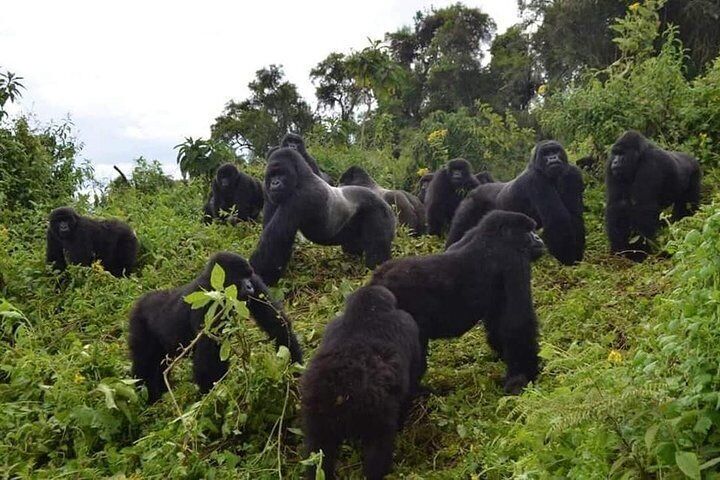
A 10-day Rwanda safari offers a comprehensive, high-end experience blending primate trekking (gorillas, chimps, golden monkeys) in Volcanoes and Nyungwe National Parks, savannah game drives in Akagera, and relaxation at Lake Kivu. Expect scenic landscapes, cultural encounters, and well-paced travel, usually beginning with a Kigali city tour
10-days-best-photography-uganda-wildlife-safari-holiday-and-gorilla-trekking
10-days-luxury-uganda-gorilla-trekking-safari-and-big-five-safari-vacation
10-days-budget-uganda-safari-holiday-vacation-tour-road-trip
10-days-best-honeymoon-uganda-safari-tour-vacation-holiday
10-days-best-uganda-birding-safari-and-wildlife-experience
10-days-best-of-uganda-and-rwanda-all-big-five-animal-and-gorilla-trekking
10-days-uganda-gorilla-trekking-and-safari-tour-vacation-holiday
10-days-9-nights-midrange-uganda-wildlife-safari-and-cultural-experience
10-days-uganda-safari-all-big-five-gorilla-and-chimpanzee-tracking-adventure
10-days-uganda-rwanda-primate-safari-vacation-and-game-drive-safari
10-days-exclusive-family-uganda-safari-with-kids
1. Gorilla Trekking (Volcanoes National Park)
Gorilla trekking remains the emotional cornerstone of Rwandan tourism. Located in the northern Virunga Massif, Volcanoes National Park is home to approximately one-third of the world’s remaining mountain gorillas. The experience is highly regulated by the Rwanda Development Board to ensure the safety of the primates; currently, only 96 permits are issued daily across 12 habituated families. A permit costs $1,500, with a significant portion of the revenue reinvested into local communities and vet services.
The trek itself can last anywhere from one to six hours depending on the movement of the family. You’ll navigate through bamboo thickets and giant lobelias until you encounter the troop. For one hour, you are a silent observer of their social dynamics—watching silverbacks protect their young or juveniles play in the canopy. To protect the gorillas from human pathogens, a 10-meter social distance is strictly enforced. It is a profound, silent encounter that often feels like a spiritual homecoming.
2. Chimpanzee Tracking & Canopy Walk (Nyungwe Forest)
Nyungwe Forest is one of the oldest and largest Afro-montane rainforests in Africa, serving as a vital sanctuary for 13 primate species. Chimpanzee tracking here is a high-octane adventure; unlike the stationary gorillas, chimps are highly mobile and vocal. You’ll follow their "pant-hoot" calls through the ancient mahogany trees. There are two main habituation sites: Uwinka and the fragmented Cyamudongo Forest, which offers a smaller but more easily tracked community.
The Canopy Walkway is the perfect afternoon complement. Suspended 70 meters above the forest floor, this 160-meter-long bridge provides a bird's-eye view of the rainforest's upper layers. From this vantage point, you can spot rare orchids, endemic butterflies, and primates like the L'Hoest's monkey that are rarely seen from the ground. For $100–$250 (depending on the season and zone), Nyungwe offers a world-class rainforest experience that is both physically exhilarating and botanically diverse.
3. Golden Monkey Trekking (Volcanoes National Park)
The endangered Golden Monkey is a striking, "Old World" primate found only in the bamboo forests of the Virunga range. These monkeys are famous for their brilliant orange-gold fur and their hyperactive nature. Unlike the deep-forest hikes required for gorillas, golden monkey treks are generally shorter and less strenuous, as the monkeys live in the bamboo thickets at the base of the volcanoes.
Tracking starts early at the Kinigi headquarters (permit cost: $100). Because the monkeys are habituated to humans, they often jump between bamboo stalks just meters away from visitors. They are particularly fun to watch during feeding time when they scramble for bamboo shoots and fruit. Their playful antics provide a lighthearted contrast to the gravity of the gorilla trek and offer fantastic opportunities for high-speed photography in the dappled forest light.
4. Savannah Safari (Akagera National Park)
Akagera National Park is Rwanda’s only savanna park and a miracle of modern conservation. After being nearly decimated in the 1990s, the park was restored through a partnership with African Parks and now hosts the "Big Five" (Lion, Leopard, Elephant, Buffalo, and Rhino). Spanning 1,122 square kilometers, the park's terrain shifts from acacia woodlands to open plains and the extensive wetland systems of the Akagera River.
A highlight of this park is a boat trip on Lake Ihema, where you’ll glide past some of the highest hippo and crocodile concentrations in East Africa. For birders, it is a haven for over 500 species, including the prehistoric shoebill stork. Game drives in Akagera are best conducted in the early morning or at night (night drives cost approx. $40) to spot nocturnal predators like leopards and hyenas. It is a quintessential African safari experience that adds a necessary layer of diversity to the primate-focused itinerary.
5. Lake Kivu Relaxation (Kibuye/Gisenyi)
Lake Kivu is the "reset button" of the Rwandan circuit. Nestled in the Albertine Rift, this Great Lake is surrounded by steep, emerald-green terraced hills. The two main resort towns, Gisenyi (Rubavu) and Kibuye (Karongi), offer very different vibes. Gisenyi is a bustling border town with a beach-resort atmosphere, while Kibuye is more tranquil, with many small islands scattered across the bay.
Activities focus on the water: you can take a sunset boat cruise to Napoleon Island to see a massive colony of fruit bats or kayak along the scenic coastline. For the more adventurous, the Congo Nile Trail offers world-class hiking and biking paths that follow the lake's eastern shore. Relaxation here is about slow living—watching the "singing fishermen" set out in their three-hulled boats at dusk while enjoying fresh-caught "Sambaza" fish and locally grown coffee.
6. Cultural and Historical Visits
A visit to the Kigali Genocide Memorial is a non-negotiable part of the Rwandan journey. Built on the site where 250,000 victims are buried, it serves as a place of remembrance and a world-class peace education center. The memorial provides the essential context of Rwanda's 1994 tragedy and its subsequent transformation into a beacon of unity and development.
In the mountains, the Iby'Iwacu Cultural Village (now the Gorilla Guardians Village) offers a vibrant celebration of Rwandan heritage. This community project, run by former poachers, allows you to participate in traditional drumming, archery, and herbal medicine demonstrations. It is a powerful example of how conservation and community development can work hand-in-hand. Between the urban pulse of Kigali’s markets and the traditional dances of the Virungas, these cultural stops ensure you leave Rwanda with a deep understanding of its people as well as its wildlife.
Planning a 10-day safari in Rwanda is a journey into one of Africa’s most successful conservation stories. As of 2026, the country has solidified its reputation as a premium destination, offering an "all-in-one" circuit that links savannah wildlife with the mist-covered rainforests of the Great Rift Valley.
1. What are the main highlights of a 10-day safari in Rwanda?
A 10-day itinerary is designed to cover Rwanda's "Big Three" national parks. The journey usually begins with gorilla trekking in Volcanoes National Park, where you spend a transformative hour with a habituated mountain gorilla family. This is often followed by chimpanzee tracking and the famous Canopy Walk in the ancient Nyungwe Forest.
The adventure then shifts to the eastern plains of Akagera National Park for a traditional "Big Five" safari. Between the parks, you’ll enjoy a scenic interlude at Lake Kivu, specifically in the resort towns of Kibuye or Gisenyi, which offer boat trips and sunset views. The trip is rounded out by cultural immersions, such as the Iby'Iwacu Cultural Village and the Kigali Genocide Memorial, providing a deep understanding of the country's history and its inspiring modern-day resilience.
2. Is a 10-day safari in Rwanda suitable for all ages?
While the itinerary is diverse, age restrictions apply to the primary primate activities. As of 2026, the minimum age for gorilla and chimpanzee trekking is 15 years old. This rule is strictly enforced by the Rwanda Development Board to protect the primates from childhood illnesses and to ensure participants can handle the physical rigor of the forest.
For families with younger children, Akagera National Park is a fantastic alternative, as game drives are suitable for all ages. Lake Kivu and the cultural tours in Kigali are also family-friendly. Many luxury lodges offer specialized children's programs, allowing parents to trek while children engage in educational nature walks or craft activities. However, for the full "primate and wildlife" loop, the trip is best suited for teenagers and adults.
3. What kind of accommodation is provided?
Rwanda has intentionally shifted toward a high-end, low-impact tourism model. On a 10-day safari, you can expect some of the most spectacular eco-lodges in Africa. In Volcanoes National Park, accommodations like Bisate Lodge or Singita Kwitonda offer ultra-luxury experiences, while Nyungwe Top View Hill Hotel provides excellent mid-range comfort with panoramic forest views.
In Akagera, you might stay at Magashi Camp, a high-end luxury camp overlooking Lake Rwanyakazinga, or the Ruzizi Tented Lodge, which offers a more intimate connection with nature. These properties typically feature en-suite bathrooms, gourmet dining, and private decks. Even at the mid-range level, the service is world-class, with a strong focus on sustainability and community integration.
4. Is it safe to visit Rwanda?
Rwanda is consistently ranked as one of the safest and cleanest countries in the world. The government prioritizes tourist safety through a visible but professional security presence in all national parks. As a traveler, you will notice the "Tourism Police" and armed park rangers who accompany every trek, ensuring both the safety of the visitors and the protection of the animals.
In urban areas like Kigali, the crime rate is exceptionally low compared to other global capitals. You can safely walk the streets or use "motto-taxis" (motorcycle taxis) for short trips. The country is also a pioneer in environmental safety; the ban on plastic bags is strictly enforced, and the monthly "Umuganda" (community service) keeps the infrastructure in pristine condition.
5. How much physical fitness do I need?
A moderate level of fitness is required for the primate trekking portions of the trip. Gorilla trekking involves hiking through "impenetrable" forests at altitudes between 2,500m and 3,000m. The terrain can be steep, muddy, and densely vegetated. Chimpanzee tracking in Nyungwe is often even more athletic, as chimps move quickly and vocalize from deep within the canopy, requiring hikers to maintain a steady pace over uneven ground.
However, your guide and a team of trackers will always work at your pace. You also have the option to hire porters (highly recommended for $25 per trek) to carry your backpack and provide a steady hand during difficult sections. For the non-trekking portions, such as game drives in Akagera or boat trips on Lake Kivu, very little physical exertion is required.
6. What should I pack for the 10 days?
Packing for Rwanda is about preparing for two different worlds: the hot savanna and the cold, wet rainforest.
- For Trekking: Sturdy, waterproof hiking boots with good grip are essential. Pack long trousers, long-sleeved moisture-wicking shirts, gardening gloves (to grab onto vegetation), and high-quality gaiters.
- For Savanna: Light, neutral-colored clothing (khakis and tans) for game drives.
- Essentials: A high-quality rain jacket or poncho is mandatory. Bring a wide-brimmed hat, high-SPF sunscreen, and insect repellent with DEET. Don't forget a "dry bag" to protect your camera gear from the mountain mists.
7. When is the best time to book?
The Dry Seasons (June to September and December to February) are the peak times for a Rwanda safari. During these months, the trails are less slippery, making trekking easier, and wildlife in Akagera is more concentrated around water sources, simplifying game viewing.
Because permits and luxury lodges are in high demand and limited in number, it is recommended to book 6 to 12 months in advance. If you travel during the "Shoulder Seasons" (late May or early October), you might find better availability and occasional discounts on accommodation, but you should be prepared for more frequent tropical downpours.
8. Will I be able to see the 'Big Five'?
Yes. Through a series of successful reintroductions by African Parks and the RDB, Akagera National Park is now a Big Five destination. Lions were reintroduced in 2015, followed by black rhinos in 2017 and a large group of white rhinos in 2021 and 2025.
While seeing all five (Lion, Leopard, Elephant, Buffalo, and Rhino) in a single visit is never 100% guaranteed in any wild park, your chances in Akagera are exceptionally high. The park’s diverse ecosystem—savanna, woodland, and the largest protected wetland in Central Africa—ensures that you see these iconic animals alongside Masai giraffes, zebras, and hundreds of bird species.
9. How are the roads for travel?
Rwanda is famous for its high-quality road network. The main highways connecting Kigali to the national parks are paved and well-maintained. Unlike some neighboring countries where "pothole fatigue" is common, travel between Rwanda’s parks is smooth and relatively quick.
Most drives between the parks take between 2 and 5 hours. For example, the drive from Kigali to Volcanoes National Park is a scenic 2.5-hour journey through terraced hills. Within the parks, particularly in Akagera and the final approaches to Bwindi or Nyungwe lodges, the roads are unpaved "murram" tracks, which is why a 4x4 safari vehicle is a standard requirement for all tours.
10. Do I need a visa?
As of April 2026, Rwanda offers a visa-on-arrival for citizens of all countries. Many nationalities, including members of the African Union, Commonwealth, and La Francophonie, can enter free of charge for 30 days. For others, a 30-day tourist visa costs $50 USD.
If your 10-day trip includes a quick crossing into Uganda (which is common for those seeking more gorilla options), you should apply for the East Africa Tourist Visa ($100 USD). This multi-entry visa allows you to travel between Rwanda, Uganda, and Kenya for 90 days. Always check the official Rwanda Directorate General of Immigration and Emigration portal before departure for any last-minute policy changes.
11. What is included in the cost?
An all-inclusive 10-day luxury safari typically covers:
- Permits: The gorilla permit ($1,500) and chimpanzee permit ($150).
- Accommodation: Full-board stays at luxury or high-end mid-range lodges.
- Transport: A private 4x4 safari vehicle with a professional driver-guide and fuel.
- Activities: Game drives, boat cruises, cultural village visits, and park entrance fees.
- Meals: All meals at the lodges and bottled water throughout the journey.
Generally, international flights, tips, and personal expenses like laundry or premium alcoholic drinks are excluded.
12. Is it possible to customize the itinerary?
Absolutely. Most 10-day safaris serve as a template. You can easily pivot the focus based on your interests. For example, birdwatchers can add extra days in Nyungwe (home to 27 Albertine Rift endemics) or Akagera’s wetlands. Active travelers might add a hike to the summit of Mount Bisoke or Mount Karisimbi.
Conversely, if you prefer a slower pace, you can add "relaxation days" at Lake Kivu or an extra night in Kigali to explore the city's burgeoning culinary and art scenes. Customization allows you to spend more time in the areas that resonate with you, whether that’s deep-forest trekking or sipping coffee overlooking a volcanic crater lake.
13. What is the food like?
The food on a Rwanda safari is a highlight in itself. Most lodges serve a sophisticated blend of international cuisine and traditional Rwandan flavors. You can expect fresh, locally sourced ingredients—Rwanda’s volcanic soil is incredibly fertile, producing exceptional avocados, passion fruit, and pineapples.
Common local dishes you may encounter include Brochettes (grilled meat or fish skewers), Melange (a traditional buffet), and fresh Tilapia or Sambaza from Lake Kivu. Lodges are very accustomed to dietary restrictions; whether you are vegan, gluten-free, or have specific allergies, the chefs are highly trained to provide gourmet alternatives. And, of course, you will enjoy some of the world’s finest coffee and tea, grown right on the surrounding hills.
14. How early do I need to book my gorilla permit?
Because permit numbers are strictly limited to 96 per day for the entire country, it is critical to book at least 3 to 6 months in advance, especially if you are traveling during the peak dry seasons (June–August and December–January). For "last-minute" travelers, availability does occasionally pop up, but you may not have a choice of which gorilla family you visit.
Booking early through a licensed tour operator is the most reliable method. They will handle the complex logistics of the Rwanda Development Board (RDB) booking system on your behalf. Once a permit is issued, it is tied to your passport and is non-transferable, making it the most important document in your safari portfolio.
15. What kind of cultural experiences are included?
The Iby'Iwacu Cultural Village (now known as the Gorilla Guardians Village) is the most famous cultural stop. Here, you can watch traditional Intore dancing, try your hand at archery, and learn about the ancient kingdom of Rwanda. This project is particularly significant because it was founded to provide livelihoods for former poachers, turning them into conservationists.
In Kigali, you will experience the modern pulse of the country. Visits to local cooperatives, such as the Nyamirambo Women’s Center, offer a chance to learn traditional weaving or take a walking tour through one of the city’s oldest neighborhoods. These experiences ensure that your safari isn't just about animals, but about the people who have made the country's wildlife recovery possible.
16. Are there any health precautions needed?
Yes, a few essential precautions are required for a safe trip. Malaria prophylaxis is strongly recommended, as you will be in forested and lakeside areas where mosquitoes are present. It is also advised to consult your doctor for routine vaccines like Hepatitis A/B and Typhoid.
A Yellow Fever vaccination certificate is mandatory if you are arriving from a country where the disease is endemic (such as neighboring Uganda or various West African nations). As of April 2026, most COVID-19 restrictions have been lifted, but you should always carry proof of vaccination as some establishments or airlines may still require it. Finally, ensure you have comprehensive travel insurance that covers emergency medical evacuation, just in case of an injury during a remote forest trek
Booking 10 days Rwanda safari with us Roads of Adventure safaris
Book a 10-day Rwanda safari with Roads of Adventure Safaris for an immersive experience, combining Gorilla Trekking in Volcanoes National Park, chimpanzee tracking in Nyungwe Forest, and Big Five game drives in Akagera National Park. These itineraries often include Kigali City tours and cultural experiences, with accommodation in luxury or mid-range lodges.
