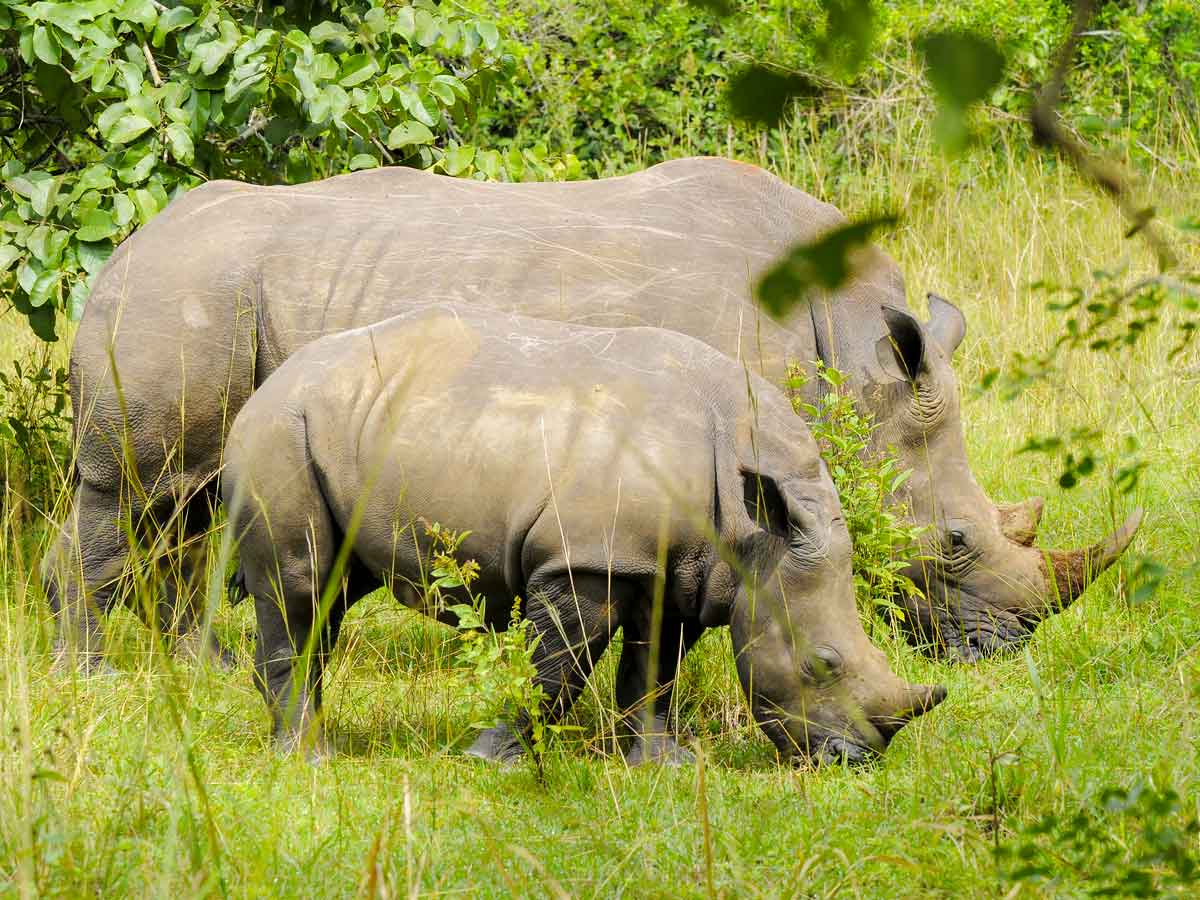
Ziwa Rhino Sanctuary is the exclusive, essential stop that allows travelers to complete the coveted African "Big Five" (lion, leopard, elephant, buffalo, and rhino) on a 3-day Murchison Falls safari. Because wild rhinos are currently absent from Murchison Falls National Park, this sanctuary acts as the only location in Uganda to see these animals in the wild
3-days-murchison-falls-via-ziwa-rhino-sanctuary-uganda-wildlife-safari
1. Exclusive Rhino Tracking
The true centerpiece of starting your 3 Days Murchison falls safari is the rare privilege of tracking wild southern white rhinos on foot. Unlike traditional game drives where you observe wildlife through the window of a closed safari vehicle, Ziwa Rhino Sanctuary offers an intimate, sensory-rich encounter with these prehistoric giants. Upon arrival, you are paired with highly trained, expert rangers who live alongside the rhinos. These rangers monitor the crash (the term for a group of rhinos) 24/7, tracking their daily movements through the sanctuary's 7,000 hectares of savannah and woodlands.
The experience begins with a brief safety orientation before you head into the bush. Walking quietly through the terrain forces you to tune into the sounds of the wilderness—the crunch of dry leaves, the warning calls of birds, and eventually, the heavy breathing and munching of the rhinos. Because the rhinos are habituated to the presence of the rangers, you can safely approach as close as 6 to 7 meters. Standing just a few paces away from a three-ton mammal while it grazes peacefully or rests in the tall grass is an adrenaline-inducing and profoundly humbling experience.
Your guides share fascinating insights into the rhinos' daily behaviors, social hierarchies, and the distinct personalities of individual family members. This foot safari provides unparalleled photography opportunities, allowing you to capture the textures of their thick skin and their massive horns without any vehicle frames blocking your shot. It shifts your perspective from being a mere spectator to an active participant in the wild, setting an adventurous, immersive tone for the rest of your safari.
2. Completing the "Big Five"
For many travelers, the ultimate safari goal is witnessing Africa’s iconic "Big Five"—lions, leopards, elephants, buffaloes, and rhinos. Historically, the phrase was coined by big-game hunters to denote the five most dangerous animals to hunt on foot, but today it represents the pinnacle of wildlife viewing. However, due to severe poaching in the 1970s and 1980s, rhinos became completely extinct within Uganda’s national parks, meaning a direct drive to Murchison Falls would leave your checklist permanently incomplete.
Integrating a stop at Ziwa into your 3 Days Murchison falls itinerary acts as the crucial missing link. Because Murchison Falls National Park proper possesses thriving populations of elephants, massive herds of Cape buffaloes, elegant leopards, and prides of lions, it has everything you need—except the rhino. Ziwa Rhino Sanctuary is currently the only place in Uganda where you can see these animals roaming in a wild, protected environment.
By dedicating your first morning to tracking rhinos at Ziwa, you effectively "lock in" the first and rarest member of the Big Five. When you cross the Nile River later that afternoon to enter the northern sector of Murchison Falls, the pressure is off, and the excitement builds. Over the next two days of game drives across the Borassus palm-studded savannah, you can focus purely on scanning the thickets for leopards, watching elephants cross the tracks, and tracking lions on the hunt. Ziwa perfectly bridges this geographic and conservation gap, transforming a standard wildlife tour into a complete, triumphant Big Five achievement.
3. The Rare Shoebill Stork
Beyond the heavy mammals, Ziwa is a legendary sanctuary for avid birdwatchers and nature enthusiasts due to its unique wetland ecosystems. The sanctuary encompasses the vast, pristine Lugogo Swamp, a labyrinth of papyrus reeds and stagnant waters that provides the perfect habitat for the elusive and highly sought-after Shoebill Stork. For birders, a sighting of this prehistoric-looking bird is often a bucket-list event that rivals seeing any large predator.
To hunt for the Shoebill, you must wake up at dawn, when the swamp is cool and the birds are most active. You will board a narrow, traditional canoe, quietly paddled by a specialized local birding guide. As the mist rises off the water, you glide through narrow channels of papyrus, surrounded by an incredible array of avian life, including kingfishers, herons, and the African Fish Eagle. The ultimate goal is to spot the Shoebill standing completely motionless in the shallows, waiting to ambush lungfish with its massive, shoe-shaped bill.
With its giant clog-like beak, intense yellow eyes, and an impressive eight-foot wingspan, the Shoebill looks less like a modern bird and more like a lingering dinosaur. Witnessing one take flight or snap its beak in the quiet of the morning is a surreal experience. Including this swamp excursion at the very beginning of your 3 Days Murchison falls journey adds an entirely different dimension to your trip, balancing the classic big-game savannah experience with the quiet, specialized magic of Africa’s ancient wetlands.
4. Breaking the Journey
The physical logistics of a Ugandan safari can often be grueling, as the journey from the bustling capital of Kampala to the heart of Murchison Falls National Park spans roughly 300 kilometers. Driving this distance straight through can take anywhere from five to six hours, depending on traffic exiting the city and road conditions. Sitting in a safari vehicle for that long can leave travelers feeling stiff, fatigued, and impatient to see wildlife.
Ziwa serves as the ultimate strategic and scenic antidote to "safari burnout." Situated roughly halfway along the route in the Nakasongola district, it breaks the long, monotonous drive into two highly manageable halves. Instead of watching the Ugandan countryside blur past your window for six hours straight, you pull into a tranquil, green oasis just three hours into your trip. It turns what would be a wasted day of transit into an active, high-yield safari day.
Stopping at Ziwa gives you the perfect opportunity to stretch your legs, use clean facilities, and enjoy a fresh lunch at the sanctuary's restaurant. More importantly, the active nature of the on-foot rhino tracking gets your blood pumping and burns off energy, clearing away any lingering jet lag or travel fatigue. By the time you climb back into your vehicle for the final leg of your 3 Days Murchison falls adventure, you are fully re-energized, relaxed, and already buzzing with the excitement of having stood mere meters away from wild rhinos. You enter the national park gates refreshed and ready to enjoy your evening game drive.
3 Days Murchison falls safari and Ziwa Rhino sanctuary
This thrilling 3 Days Murchison falls safari beautifully bridges Uganda’s leading savannah landscapes with vital conservation initiatives. Centered around the iconic River Nile, this compact itinerary provides a diverse wildlife experience that ranks among East Africa's finest. Your journey begins with a highly rewarding detour to Ziwa Rhino Sanctuary, the exclusive home of wild rhinos in Uganda, where you will track these gentle giants on foot. From there, you venture deep into Murchison Falls National Park to discover towering giraffes, elephants, and lions patrolling the sprawling grasslands. Beyond the classic game drives, you will navigate the waters of the Nile on a scenic boat cruise, culminating in an exhilarating hike right to the roaring crest of the world’s most powerful waterfall. It is a fast-paced, high-yield adventure perfectly crafted to unlock Africa's legendary Big Five wildlife checklist in just three unforgettable days.
Day 1: Kampala to Murchison Falls via Ziwa Rhino Sanctuary
Your 3 Days Murchison falls adventure begins with an early morning departure from Kampala, driving northward through scenic woodlands and rural trading centers. The first major highlight is a strategic stop at the Ziwa Rhino Sanctuary in Nakasongola. Accompanied by experienced rangers, you will head into the bush on foot to track southern white rhinos, safely approaching within meters of these majestic mammals. This critical stop secures the first member of your Big Five checklist. Following a relaxed lunch at the sanctuary, you will continue your journey toward Murchison Falls National Park. As you enter the park gates, the landscape transforms into dramatic savannah plains. You will check into your lodge in the evening, enjoying a peaceful dinner surrounded by the sounds of the African wilderness.
Day 2: Morning Game Drive and Afternoon Nile Boat Cruise
An early sunrise call marks the true safari experience in Murchison Falls National Park. You will cross to the northern delta sector for a morning game drive, a prime time for spotting predators like lions and leopards on the hunt. The savannah is teeming with Rothschild’s giraffes, elephants, Cape buffaloes, and elegant Uganda kobs. After a mid-day rest and lunch at the lodge, the afternoon introduces a legendary boat cruise along the Victoria Nile. Drifting toward the base of the falls, you will observe massive pods of hippos, giant Nile crocodiles basking on the banks, and thirsty elephants arriving at the water's edge to drink. The boat stops near the thunderous "Devil's Cauldron," offering a front-row view of the crashing waters before you return to camp.
Day 3: Top of the Falls Hike and Return to Kampala
On the final morning of your 3 Days Murchison falls safari, you will bid farewell to the park's wildlife and head toward the spectacular top of the falls. Here, you will witness the massive River Nile forcefully compressing its waters through a remarkably narrow 7-meter gorge. The water plunges 43 meters downward with a thunderous, ground-shaking roar, casting a permanent, beautiful rainbow in the mist. This dramatic vista offers unparalleled photography opportunities to crown your trip. After exploring the viewpoints, you will begin your return journey toward central Uganda. A pleasant lunch stop in Masindi town breaks up the drive, allowing you to reflect on your wildlife encounters before arriving back in Kampala by the evening.
1. Why is Ziwa Rhino Sanctuary considered the essential prologue to a 3 Days Murchison Falls safari?
Ziwa Rhino Sanctuary functions as the perfect logistical and conceptual prologue to a 3 Days Murchison falls safari because it establishes immediate immersion into Uganda’s conservation landscape. For many travelers, the six-hour journey from Kampala directly to the national park can feel like tedious transit time. Ziwa breaks this monotony by transforming a long day of driving into an active, high-yield safari day. Positioned precisely halfway along the Gulu highway, it shifts your mindset from urban chaos to wilderness tranquility within a few hours of leaving the capital.
Conceptually, the stop introduces you to the fragile realities of African wildlife management before you see the seemingly boundless herds of Murchison Falls. Understanding that the rhinos you are tracking are the foundation for a future reintroduction program into the very park you are about to visit adds profound depth to your itinerary. It primes your observational skills, gives you your first taste of the bush, and ensures that your three-day journey kicks off with a massive wildlife triumph rather than a fatiguing day on the road.
2. How does Ziwa Rhino Sanctuary allow travelers to complete the "Big Five" checklist?
The "Big Five" checklist—consisting of the lion, leopard, elephant, Cape buffalo, and rhino—is the gold standard for African wildlife viewing. However, due to rampant poaching and civil unrest in the 1970s and 1980s, wild rhinos were completely wiped out across Uganda, disappearing from Murchison Falls National Park by 1983. Consequently, a standard game drive through Murchison Falls today can only yield four of these iconic species.
Ziwa Rhino Sanctuary is the only location in Uganda where you can see rhinos roaming in a wild, protected environment. By incorporating a walking safari at Ziwa on your way north, you successfully check off the rarest and most endangered member of the Big Five list. When you cross the Nile later that evening to begin your exploration of Murchison Falls, you do so with the confidence that the missing piece of the puzzle is already secure, maximizing the value and prestige of your compact three-day window.
3. What makes the on-foot tracking experience at Ziwa unique compared to standard game drives?
Most savannah safaris are experienced behind the glass or from the open roof of a customized 4x4 vehicle. While safe and efficient, this places a mechanical barrier between the traveler and nature. Ziwa completely shatters this barrier by mandating that its primary attraction be experienced entirely on foot. Under the protection and guidance of armed, expert sanctuary rangers, you step out of the vehicle and into the ecosystem.
Walking through the acacia woodlands and savannah grasslands heightens every single human sense. You hear the snap of twigs, smell the crushed earth, and feel the adrenaline of sharing the ground with three-ton mammals. Rangers safely guide you to within 6 to 7 meters of the rhinos, a proximity that is rarely matched on vehicular game drives. This intimate perspective allows you to view the fine details of their ancient physical structures and hear the deep rumble of their communication in a way no vehicle allows.
4. How does Ziwa enhance the photographic opportunities of a 3 Days Murchison Falls safari?
Photography from a safari vehicle often presents specific challenges, such as window frames, roof pillars, dust kicking up from other cars, and unpredictable angles dictated by established tracks. At Ziwa, the on-foot format gives photographers complete physical freedom to position themselves for the perfect shot. Because you are walking, your guide can help you maneuver safely around a clearing to find optimal lighting, avoid distracting branches, and achieve a clear line of sight.
Furthermore, being at eye level with a white rhino produces infinitely more dramatic and intimate images than looking down on them from an elevated car seat. You can capture low-angle shots that emphasize their massive horns, the texture of their skin, and their impressive stature against the tall savannah grasses. Combining these intimate ground portraits from Ziwa with the classic, wide-angle savannah action shots you will capture over the next two days in Murchison Falls creates a dynamically balanced photographic portfolio of your trip.
5. What role does the Lugogo Swamp play in attracting birdwatchers during the safari?
While the rhinos are the main draw for the general public, avid birdwatchers recognize Ziwa Rhino Sanctuary as a world-class birding haven, largely thanks to the Lugogo Swamp. This massive, undisturbed wetland ecosystem carves through the sanctuary, offering a completely different habitat from the dry acacia woodlands that dominate the rest of the ranch. The abundance of water, papyrus reeds, and specialized fish creates an ideal feeding and breeding ground for over 300 avian species.
Integrating a canoe ride through the Lugogo Swamp into your 3 Days Murchison falls safari introduces a tranquil, aquatic birding experience right at the start of your journey. As you glide silently through the narrow water channels, you can easily spot water-loving specialists like the African Fish Eagle, giant kingfishers, herons, and malachite kingfishers. It adds an unexpected layer of biodiversity to your trip, proving that Ziwa is a multi-dimensional ecological destination rather than a one-species enclosure.
6. How does the chance to spot the Shoebill Stork elevate Ziwa's status on this itinerary?
The Shoebill Stork is arguably the most sought-after avian encounter in all of East Africa. With its massive, clog-shaped bill, prehistoric features, and intense yellow eyes, this vulnerable bird looks like a creature out of ancient history. Because Shoebills are highly solitary and favor deep, inaccessible papyrus swamps, finding them in the wild can be exceptionally difficult on standard safaris.
Ziwa Rhino Sanctuary’s Lugogo Swamp stands out as one of the few places in Uganda where sightings of the Shoebill are almost guaranteed on an early morning canoe trek. For travelers embarking on a three-day Murchison tour, this provides a golden opportunity to see a rare creature without needing a dedicated birding expedition. Checking off both the southern white rhino and the elusive Shoebill Stork before even entering Murchison Falls National Park proper sets an incredibly high bar for the rest of your safari.
7. What other mammals can be encountered at Ziwa beside the white rhinos?
Though the sanctuary was custom-built to protect and breed rhinos, its 70 square kilometers of fully fenced savannah and woodland have naturally become a safe haven for a multitude of other Ugandan wildlife. Free from the heavy presence of larger predators like lions, populations of various herbivores and smaller mammals have thrived within Ziwa’s borders.
While conducting your rhino trek or exploring the nature trails, it is common to cross paths with elegant bushbucks, oribis, grey duikers, and reedbucks. The sanctuary is also home to primates like vervet monkeys and black-and-white colobus monkeys jumping through the tree canopies, as well as nocturnal residents like porcupines, aardvarks, and mongooses. Encountering these diverse species at eye-level on foot serves as a fantastic warm-up, introducing you to the smaller, subtler nuances of East African wildlife before you encounter the grand scale of Murchison Falls.
8. Why is the architectural and rustic charm of Amuka Safari Lodge a highlight for overnight visitors?
For travelers who choose to expand their 3 Days Murchison falls safari into a more relaxed pace, spending a night at Amuka Safari Lodge inside the sanctuary is a highlight in its own right. Tucked away deep within the pristine woodlands of the ranch, Amuka is constructed out of local stone and timber, blending seamlessly into the surrounding wilderness. The lodge offers an authentic, rustic "bush luxury" experience that immediately disconnects you from modern city life.
Staying overnight at Amuka allows you to experience the sanctuary when it truly comes alive—at dusk and dawn. You can enjoy high-quality dining, take a dip in a swimming pool surrounded by wild trees, and fall asleep to the chorus of nocturnal insects and distant mammal calls. Furthermore, it is not uncommon for rhinos to graze right up to the lodge's perimeter fences at night, offering an unforgettable canopy-side encounter that few other luxury lodges in East Africa can replicate.
9. How does Ziwa introduce travelers to the vital concept of rhino conservation and reintroduction?
An often overlooked aspect that makes Ziwa an exceptionally interesting safari destination is its educational and emotional value. Ziwa is not a zoo or a static wildlife park; it is an active, booming conservation laboratory managed alongside the Uganda Wildlife Authority. The long-term goal of the sanctuary is to breed a healthy population of at least 50 to 60 rhinos before systematically reintroducing them back into their original habitats in Murchison Falls and Kidepo National Parks.
When you take part in a trek, your ranger does not just show you the animals; they explain the intense logistics of 24-hour anti-poaching surveillance, the genetics of their breeding program, and the history of how the sanctuary grew from just six initial rhinos in 2006 to over 40 today. Learning about these triumphs firsthand gives travelers a profound appreciation for the ecosystem. It transforms your safari from a simple sightseeing tour into an educational journey, allowing you to witness conservation in action.
10. What makes the guided night nature walks at Ziwa an exciting addition to a 3-day itinerary?
Most national parks in Uganda have strict regulations forbidding independent or late-night movement within the gates to protect visitors from large predators. Because Ziwa does not harbor large prides of lions or packs of hyenas, it possesses the unique flexibility to offer guided night nature walks. If your safari itinerary includes an overnight stay at the sanctuary on Day 1, this activity becomes an absolute must-do.
Heading out into the dark savannah with a flashlight and an armed ranger reveals a completely different world. The daytime heat dissipates, replaced by the cool night air and the sounds of creatures you would never see during the day. Armed with infrared cameras and spotter lights, rangers frequently help visitors locate secretive nocturnal species like owls, nightjars, porcupines, bush babies, and elusive genets. It injects a thrilling element of mystery and exploration into the early stages of your three-day journey.
11. How does the geography of Ziwa perfectly mitigate the physical fatigue of the long drive from Kampala?
The drive from Kampala to Murchison Falls National Park covers a distance of roughly 300 kilometers, taking anywhere from five to six hours depending on the traffic leaving the city. Sitting in a closed safari vehicle for this long can cause physical stiffness and mental fatigue, particularly for international travelers adjusting to a new time zone. Ziwa is positioned roughly 176 kilometers north of Kampala, making it the perfect geographical antidote.
Stopping at Ziwa after about three hours of driving breaks the long journey into two highly manageable, bite-sized phases. Instead of spending an entire day in a seat watching the countryside blur by, you stop, stretch your legs, and immediately engage in a refreshing outdoor activity. The physical exertion of walking through the wild burns off any lingering travel restlessness, ensuring that you arrive at Murchison Falls later that afternoon feeling active, energized, and ready for your evening game drive.
12. What are the key safety protocols that make Ziwa’s walking safaris family-friendly?
Entering the immediate territory of a wild, three-ton rhinoceros on foot sounds incredibly daunting, but Ziwa’s impeccably managed safety protocols make it a highly secure, family-friendly activity. The sanctuary employs a massive, dedicated team of over 70 expertly trained rangers who monitor each rhino group 24 hours a day, 7 days a week. These rhinos have grown up habituated to the daily presence of human rangers, meaning they perceive humans as a neutral part of their environment rather than an active threat.
Before any trek begins, your group receives an extensive safety briefing detailing how to read rhino body language, the importance of maintaining a quiet demeanor, and what steps to take if an animal shows signs of distress. While out in the bush, multiple rangers coordinate to ensure you always maintain a safe distance of 6 to 7 meters, using natural terrain features like thickets for cover. This structured, disciplined approach means that children above the age of six can safely join the trek, making it a standout educational highlight for families on a 3 Days Murchison falls journey.
13. How does the presence of professional ranger guides enrich the educational value of Ziwa?
A safari experience is only as good as the storytelling and knowledge of the guides who lead it. At Ziwa, the rangers possess an intimate, highly specific level of expertise because they do not just travel through the sanctuary—they live there alongside the animals. Every rhino in the sanctuary has a unique name, an established tracking history, and a distinct personality profile known thoroughly by the team.
As you track a specific crash, your ranger guide will point out subtle indicators like tracking footprints, fresh dung piles, and territorial horn scrapings on trees. They educate you on how white rhinos use their square lips to graze grass efficiently, how mothers protect their calves, and how alpha males defend their territories. This rich, customized stream of information elevates the walk from a basic wildlife viewing exercise into an interactive masterclass on large-mammal ecology, enriching the overall intellectual value of your brief three-day safari.
14. What makes the dry season the absolute prime time to experience Ziwa during a 3-day tour?
While Ziwa Rhino Sanctuary is open and functional all year round, its true colors shine brightest during the dry seasons (spanning June to August and December to February). The weather conditions during these months directly translate to an easier, highly efficient tracking experience that fits perfectly into a tight three-day schedule.
During the dry months, the thick savannah grasses recede and dry up, dramatically increasing visibility across the ranch. This makes locating the rhinos much faster, often reducing your walking time to a highly predictable one to two hours. Furthermore, the natural walking tracks and bush trails remain firm and dry, eliminating the muddy, slippery conditions that can slow down groups during heavy rains. The rhinos also tend to congregate more predictably around key watering holes and shaded woodlands, allowing you to capture stunning, sun-drenched photographs that will serve as the opening highlight of your Murchison trail.
15. How does a visit to Ziwa provide a profound contrast to the landscape of Murchison Falls National Park?
One of the secret joys of travel is experiencing the dramatic shifts in natural landscapes over a short period. Ziwa and Murchison Falls National Park offer a beautiful physical contrast that keeps your short three-day itinerary feeling fresh and visually engaging throughout. Ziwa consists largely of dense acacia woodlands, thick shrubbery, and enclosed papyrus swamps. The atmosphere is intimate, quiet, and enclosed, forcing you to focus on the immediate details of the bush around you.
The moment you leave Ziwa and cross into the northern sector of Murchison Falls, the horizon opens up dramatically. You are suddenly greeted by vast, open savannah plains studded with iconic Borassus palm trees, rolling hills, and the immense, wide waters of the Victoria Nile. Transitioning from the intimate, enclosed footpaths of Ziwa to the sweeping, cinematic vistas of Murchison Falls creates a sensory journey that makes your short three-day trip feel like a much grander, far more extensive African expedition.
16. Why is supporting Ziwa a direct contribution to the future of Uganda’s wild ecosystems?
Beyond the immediate thrill of wildlife viewing, visiting Ziwa Rhino Sanctuary injects an element of purposeful, sustainable travel into your 3 Days Murchison falls safari. Ziwa is managed as a non-profit conservation partnership dedicated entirely to the preservation and expansion of Uganda's biodiversity. The sanctuary relies heavily on the revenue generated from tourist tracking permits, entrance fees, and lodge stays to fund its intensive operations.
The money from your visit goes directly toward paying the salaries of the 70+ rangers who risk their lives protecting the perimeter, maintaining the high-voltage security fencing, and funding veterinary care for newborn calves. By choosing to pause at Ziwa, you are not a passive observer; you are directly financing the multi-decade dream of returning the wild rhinoceros to Murchison Falls National Park. Knowing that your travel footprint is actively building a legacy that will allow future generations to see the Big Five roaming completely free in Uganda’s national parks adds an emotional depth to your journey that stays with you long after you return home.
Booking 3 Days Murchison Falls safari and Ziwa with us Roads of Adventure safaris
To book your 3-day safari, contact Roads of Adventure Safaris. Their standard itinerary covers tracking white rhinos at Ziwa Rhino Sanctuary, Nile River boat cruises, and Big Five game drives. Prices range from $450 to $800+ per person, depending on your preferred level of lodging
