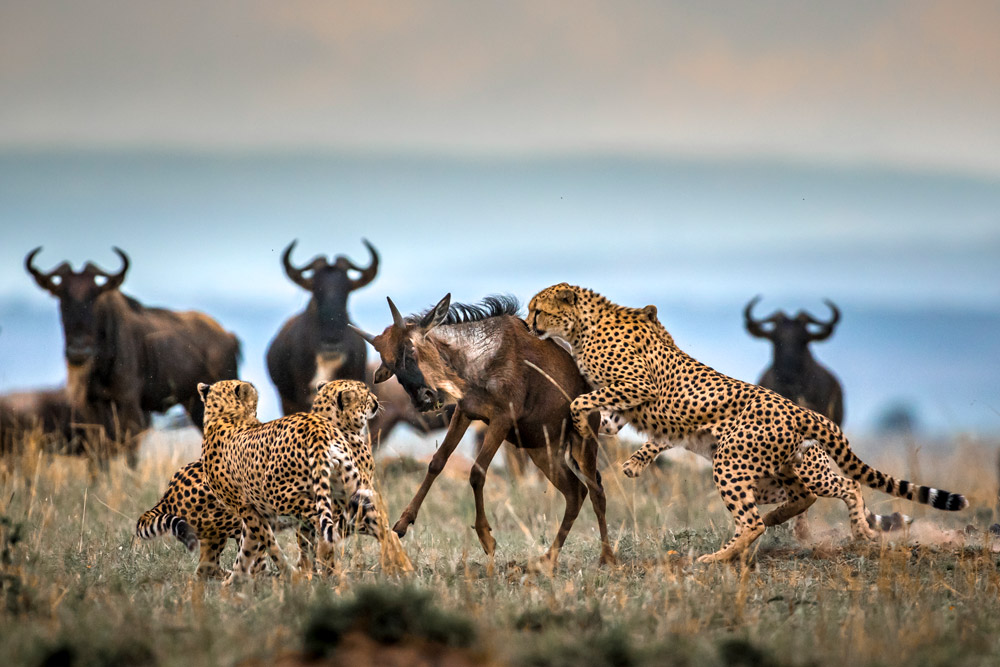
Watching the Great Migration or spotting lions across the Maasai Mara is a bucket-list dream, but figuring out the price tag for a 6 days Kenya safari can feel overwhelming. During peak season from July through October, daily costs range anywhere from $150 to over $1,500 per person. If you choose a budget itinerary, expect to pay roughly $1,000 to $1,500 total for shared group minivans, simple tented camps, and standard meals. Stepping up to a mid-range experience runs between $2,500 and $3,500 per person, securing private 4x4 Land Cruisers, en-suite safari lodges, and extra comfort. For total luxury, prices climb from $5,000 to over $9,000, unlocking fly-in bush transfers, high-end private conservancy camps, expert guiding, and fine dining. Keep in mind that peak season drives these numbers up significantly due to high lodge demand and doubled park conservation fees in popular reserves like the Maasai Mara.
6-days-maasai-mara-nakuru-amboseli-affordable-budget-kenya-safari
6-days-mid-range-kenya-wildlife-safari-all-inclusive-tour-package
6-days-5-nights-midrange-kenya-wildlife-safari-vacation
6-days-luxury-safari-to-kenya-best-parks
6-days-circuit-kenya-safari-to-masai-mara-lake-nakuru-and-amboseli-park
6 days Kenya safari
This standard 6-day Kenya safari takes you through East Africa's most famous natural landscapes. Traveling in a private 4x4 safari Land Cruiser with a pop-up roof, you will experience the best of Kenya’s diverse ecosystems. Your journey begins in the bustling capital of Nairobi, moving into the marshlands of Amboseli National Park. Next, you will explore the dramatic Great Rift Valley to see the birdlife and rhinos of Lake Nakuru National Park. The safari reaches its peak in the vast plains of the Masai Mara National Reserve. Here, you can witness the incredible Big Five predators and the annual Great Migration. Along the way, you will enjoy premium full-board meals and stay at authentic eco-lodges.
Day 1: Nairobi to Amboseli National Park
Your safari adventure begins at 07:30 AM when your professional guide picks you up from your Nairobi hotel in a private 4x4 safari Land Cruiser. You will set off on a 4.5-hour journey across the scenic Athi Plains toward the Tanzanian border, arriving at the Maasai-themed Amboseli Serena Safari Lodge in time for a fresh lunch. Following a short rest, you will head out at 03:30 PM for a 3-hour afternoon game drive to explore Amboseli's landscapes, famous for its massive herds of free-ranging African elephants. Alongside these majestic mammals, you can spot lions, Cape buffaloes, and wildebeests grazing with the iconic, snow-capped Mount Kilimanjaro in the background. As the sun sets, you will return to the lodge for a warm buffet dinner and your overnight stay on full-board basis.
Day 2: Full Day in Amboseli National Park
You will start the day early at 06:30 AM with a 2-hour sunrise game drive to track active morning predators like cheetahs and spotted hyenas against the backdrop of Mount Kilimanjaro. Returning to the lodge at 08:30 AM, you will enjoy a full English breakfast before spending the middle of the day relaxing by the palm-shaded pool or enjoying a buffet lunch. At 02:00 PM, you will set off on a 2-hour cultural visit to an authentic Maasai Manyatta to witness traditional beadwork and the famous Adumu jumping dance. This is followed by a 2.5-hour evening game drive around the Enkongo Narok marshlands to observe swimming hippos, giraffes, and diverse birdlife. The day wraps up with a traditional dinner accompanied by local tribal songs back at the Amboseli Serena Safari Lodge.
Day 3: Amboseli to Lake Nakuru National Park
After an early 06:00 AM breakfast, you will depart on a 7-hour drive north, traveling through Nairobi and climbing the escarpment of the Great Rift Valley. You will enjoy a brief 20-minute pause at the Rift Valley viewpoint for panoramic photos before continuing to Sarova Lion Hill Game Lodge inside Lake Nakuru National Park, arriving just in time for a late lunch. At 04:00 PM, you will set out on a 2.5-hour evening game drive along the shores of Lake Nakuru, a sanctuary dedicated to protecting endangered black and white rhinoceroses. During the drive, keep an eye out for rare Rothschild’s giraffes, waterbucks, impalas, and elusive leopards resting in acacia branches. In the evening, you will head back to the lodge for a cozy dinner beside a log fire.
Day 4: Lake Nakuru to Masai Mara National Reserve
Following breakfast at 07:00 AM, you will embark on a 5.5-hour drive southwest toward the world-renowned Masai Mara. You will make a 30-minute stop in the agricultural town of Narok to stretch, browse local Maasai handicrafts, and then enter the reserve via Sekenani Gate. Upon checking into the Sarova Mara Game Camp, you will enjoy a fresh lunch before embarking at 03:45 PM on a 3-hour afternoon game drive across the savannah. The Mara plains immediately yield sightings of large lion prides, herds of elephants, topis, and zebras. In the evening, you will return to your luxury tented camp to savor a fine dinner to the ambient nighttime sounds of the African wilderness.
Day 5: Full Day in the Masai Mara Plains
Your entire day is dedicated to exploring the vast wilderness of the Masai Mara National Reserve. After an 06:30 AM breakfast, you will leave camp with a packed picnic lunch for an intensive 8-hour game-tracking expedition (07:30 AM – 03:30 PM). Your guide will navigate toward the Mara River, where thousands of wildebeests and zebras attempt river crossings during the Great Migration from July to October, under the watchful eye of Nile crocodiles and stealthy cheetahs. You will pause for your picnic lunch safely near a designated hippo pool before continuing your search for elusive leopards and other big game. In the late afternoon, you will return to camp for a classic campfire sundowner drink, capped off by a special bush barbecue dinner under the stars.
Day 6: Masai Mara to Nairobi
You will begin your final morning with a refreshing 2-hour sunrise game drive (06:15 AM – 08:15 AM) to catch active big cats, spotted hyenas, jackals, and early-rising herbivores. Return to camp at 08:30 AM for your final safari breakfast before checking out and boarding your Land Cruiser for the 5.5-hour drive back to Nairobi. You will travel across the Rift Valley landscape once more, making a stop for independent lunch en route. You will arrive back in Kenya's capital by mid-afternoon, where your driver-guide will drop you off at your hotel or transfer you directly to Jomo Kenyatta International Airport for your evening departure flight.
What is the average total cost of a 6-day Kenya safari during peak season?
Planning a 6-day Kenya safari during the peak months of July through October means preparing for higher seasonal rates across all categories. On average, total costs range from roughly $1,000 per person on the low end to well over $9,000 for ultra-exclusive packages. If you opt for a budget itinerary, expect to pay between $1,000 and $1,500 total, which relies on shared minivans and simple tented camps outside main park borders. Moving up to a comfortable mid-range tier elevates the cost to between $2,500 and $3,500 per person, granting you private 4x4 vehicles and en-suite lodges. For high-end luxury, prices easily span $5,000 to $9,000 or more, unlocking fly-in domestic transfers, private conservancy stays, top-tier guiding, and gourmet bush dining. Understanding these tier differences helps you balance comfort with budget expectations while planning your bucket-list trip.
When is peak safari season in Kenya?
Kenya’s peak safari season runs from July through October, aligning directly with the region's main dry season and the world-famous Great Wildebeest Migration. During these months, over two million wildebeest, zebras, and gazelles trek from Tanzania’s Serengeti into the Maasai Mara in search of fresh grazing grounds. This massive movement creates dramatic river crossings and unprecedented predator action, making it the most coveted time of year for wildlife enthusiasts. Beyond the migration, the dry weather causes vegetation to thin out and water sources to shrink, forcing animals to gather around predictable rivers and waterholes. While this provides extraordinary game viewing, it also triggers peak rates for lodges, high vehicle density in popular parks, and doubled daily park conservation fees.
What is the average daily cost per person during peak season?
During the July to October peak season, daily costs per person typically start around $150 and can exceed $1,500. Budget travelers can expect to spend $150 to $250 per day, covering basic road transport, entry tickets, and rustic accommodations. Mid-range travelers generally pay between $400 and $600 daily, which buys upgraded private 4x4 transport, en-suite rooms, and better lodge amenities. Luxury travelers spend anywhere from $800 to $1,500+ per night for all-inclusive fly-in experiences with private guides. These daily numbers reflect the combined totals of lodging, food, transport, and daily park entrance fees, which scale significantly depending on your chosen level of comfort and exclusivity.
Why are safari prices significantly higher between July and October?
The dramatic price surge during peak season is driven by classic supply and demand alongside structural fee increases. Thousands of global travelers head to Kenya specifically to witness the Great Migration, causing prime safari lodges and tented camps to fill up up to a year in advance. To manage this massive influx and maximize conservation revenue, governing bodies like the Narok County Council increase daily park entry fees during these months. For instance, non-resident adult fees to the Maasai Mara National Reserve double from $100 to $200 per 12-hour stay starting in July. Combined with higher room rates, increased fuel demands, and premium guiding costs, overall trip pricing reaches its annual ceiling.
What does a budget 6-day Kenya safari include?
A budget 6-day Kenya safari package, usually priced between $1,000 and $1,500 total per person, provides an accessible entry point to Kenya's top wildlife spots. These packages typically cover shared road transport in a safari minivan equipped with a pop-up roof for game viewing. Accommodations are usually basic tented camps or budget budget lodges located just outside the national reserve boundaries rather than inside the park. Standard, fixed-menu meals (breakfast, lunch, and dinner) are provided throughout the journey, along with essential park entry permits and a professional local driver-guide. While accommodations are simpler and road travel takes longer, these tours deliver the exact same wildlife sightings as high-end options.
What kind of transportation do you get on a budget safari?
On a budget safari, primary ground transport is provided via a shared safari minivan—commonly a customized Toyota HiAce with a pop-up roof. These vehicles seat six to eight passengers, each with a window view when viewing wildlife. Minivans are fully functional and reliable on main highways and established dirt tracks; however, they lack four-wheel-drive capability in deep mud and offer less ground clearance over rough terrain. Group members share the vehicle for all transfers between Nairobi and the parks as well as during daily game drives. While minivans are less cushioned than heavy-duty Land Cruisers, they keep overall package prices significantly lower for cost-conscious travelers.
What can I expect from a mid-range 6-day safari package?
Priced between $2,500 and $3,500 per person, a mid-range safari offers an ideal balance between affordability and comfort. Transport is upgraded to a private or semi-private 4x4 Toyota Land Cruiser, providing superior off-road performance, higher clearance, and smoother rides on rough bush tracks. Accommodations feature mid-scale permanent lodges or classic tented camps located inside or very close to park borders, equipped with private en-suite bathrooms, hot showers, flush toilets, and swimming pools. Meals feature varied buffet options, and the smaller group size ensures flexible schedules during game drives, allowing you to spend more time tracking preferred animals with your dedicated driver-guide.
Why is a 4x4 Land Cruiser preferred over a minivan?
A customized 4x4 Toyota Land Cruiser is considered the gold standard for African safaris due to its durability, comfort, and off-road capability. Unlike minivans, Land Cruisers feature heavy-duty suspension systems that handle rough, corrugated bush roads with ease, minimizing travel fatigue. Their raised chassis and larger pop-up roofs or open sides provide better sightlines for photography and wildlife spotting, especially over tall savannah grass. Additionally, in the event of heavy rain—which can make dirt tracks slippery and muddy—four-wheel drive ensures your vehicle won't get stuck, allowing access to deeper off-road river areas where big cats often hide.
What makes a luxury safari cost $5,000 to $9,000+ per person?
Luxury safaris command premium prices because they eliminate the logistical hassles of traditional road travel while providing uncompromised comfort. Guests fly directly between Nairobi and bush airstrips on scheduled or private domestic flights, skipping long hours on bumpy highways. Accommodations consist of intimate, high-end tented camps situated in private conservancies where guest numbers are strictly capped. These packages include top-tier expert trackers, fully open-sided custom 4x4 vehicles, gourmet multi-course bush dining, premium alcoholic beverages, and personalized butler services. By offering total privacy, exclusivity, and unrestricted night game drives or walking safaris, luxury operators deliver a deeply immersive, hassle-free wilderness experience.
How do fly-in transfers impact safari costs?
Choosing fly-in domestic transfers via bush planes adds roughly $200 to $350 per flight leg per person, but saves tremendous time and physical energy. A typical drive from Nairobi to the Maasai Mara takes six to seven hours over rough, dusty roads; a bush flight from Wilson Airport takes under 45 minutes. For a 6-day itinerary covering multiple parks like Amboseli and the Mara, flight hops add $800 to $1,400 per person to the base price. However, eliminating long driving days maximizes your actual time out on game drives and allows seamless access to remote luxury camps with private airstrips.
Are Park conservation fees included in safari packages?
Most reputable safari operators bundle mandatory daily park conservation fees into the overall package price, but it is vital to double-check line items before booking. Conservation fees cover the administrative and security costs of maintaining national parks and protecting wildlife from poaching. Over a 6-day itinerary, these fees accumulate rapidly—especially during peak season when daily entry to primary parks like the Maasai Mara reaches $200 per adult per day. If an operator's quote seems unusually cheap, confirm whether park entry permits are included, as paying those out of pocket upon arrival can instantly add $1,000+ per person to your total expenses.
What are the daily Maasai Mara entrance fees in peak season?
During the peak season running from July 1st through December 31st, non-resident adult entrance fees for the Maasai Mara National Reserve are fixed at $200 per person per 12-hour period. (For children aged 9 to 17, the fee is $50, while children 8 and under enter free). This high rate was instituted to curb over-tourism, support community conservancy initiatives, and fund anti-poaching units across the ecosystem. Because entry permits are charged on a 12-hour cycle rather than a full 24 hours, spending multiple days inside the public reserve adds up quickly, making daily park fees one of the largest single budget line items on a Kenya itinerary.
How do private conservancy fees compare to the national reserve?
Private conservancies surrounding the main Maasai Mara National Reserve—such as Mara North, Naboisho, and Olare Motorogi—charge conservation fees ranging from $110 to $160 per person per night. While these nightly rates are slightly lower or comparable to national reserve entry, staying in a conservancy yields higher overall value. Conservancies strictly limit vehicle density, restrict bed counts, and allow specialized activities banned in the main reserve, such as off-road tracking, night game drives, and guided walking safaris. Furthermore, conservancy fees go directly to local Maasai landowners, supporting community development while maintaining exclusive wildlife viewing away from crowd clusters.
Are international flights included in these price estimates?
No, standard safari price quotes cover "land-only" or internal domestic transport within Kenya and exclude round-trip international airfare. Travelers must arrange their own flights into Nairobi’s Jomo Kenyatta International Airport (NBO). Depending on your departure city, season, and airline choice, international flights typically add between $800 and $1,600 per person to your overall trip budget. When calculating total vacation costs, factor in international airfare, mandatory yellow fever vaccinations (if traveling from endemic areas), and eTA visa processing fees alongside the main safari quote provided by your tour operator.
Are meals included in 6-day safari packages?
Yes, nearly all Kenya safari packages operate on a "full-board" accommodation basis, meaning breakfast, lunch, and dinner are included in the price. Because safari lodges and tented camps are situated in remote wilderness areas far from commercial towns or independent restaurants, dining on-site is the only practical option. Meals range from simple set menus at budget camps to extensive buffets at mid-range lodges and multi-course gourmet dining at luxury properties. Packed picnic lunches are usually provided on full-day game drives so you can remain out in the bush without returning to camp midday.
What extra expenses should I budget for during the trip?
Beyond the base package price and international airfare, you should budget for several mandatory and optional out-of-pocket expenses. Essential costs include the Electronic Travel Authorization (eTA) processing fee ($30), comprehensive travel insurance, and routine cash tipping for your driver-guide and lodge staff. Optional extras include hot air balloon rides over the Mara ($450–$550), guided Maasai village cultural visits ($20–$30), alcoholic beverages at non-inclusive lodges, personal souvenirs, and laundry services. Budgeting an extra $300 to $700 per person covers these incidental costs smoothly without unexpected financial surprises during your holiday.
How much should I tip safari guides and lodge staff?
Tipping is an integral part of safari culture in Kenya and rewards the hard work of crew members behind the scenes. For your dedicated driver-guide, the industry standard tip is $10 to $20 per day per group/couple, presented in cash at the end of the trip. At lodges and camps, tip boxes are usually placed in the communal reception or dining area; contributing $5 to $10 per day into this central box ensures kitchen staff, housekeepers, and security personnel share the tip equitably. For specialized trackers or night-drive spotters, a direct tip of $5 to $10 per activity is appropriate.
Is a hot air balloon safari over the Maasai Mara worth the extra cost?
A hot air balloon safari over the Maasai Mara costs between $450 and $550 per person, making it a significant add-on, but it remains one of East Africa's premier bucket-list activities. The experience begins before dawn and offers unmatched, silent aerial views of the sun rising over the savannah as herds of wildebeest and elephants move below. Upon landing in the open bush, guests are treated to a full hot champagne breakfast prepared on-site. While expensive, most travelers consider it a once-in-a-lifetime highlight well worth the investment for celebrating special milestones or capturing extraordinary photography.
How does traveling solo affect the cost of a Kenya safari?
Solo travelers face higher relative costs due to the "single supplement" fee charged by lodges and transport operators. Because room prices and private vehicle charters are based on double occupancy, a solo guest must absorb the baseline operational costs alone—often adding 20% to 50% extra to room rates and vehicle fees. To keep costs manageable, solo travelers can either join a scheduled small group departure in a shared minivan or Land Cruiser, or travel during the shoulder season when many lodges waive single supplement surcharges to attract single guests.
Can families save money on peak-season safaris?
Yes, families traveling with children can lower per-person costs thanks to structured youth discounts offered across Kenya. National Park fees for children aged 9 to 17 are significantly reduced ($50 per day compared to the adult $200 peak fee in the Maasai Mara), while kids under 8 enter free. Many mid-range and luxury lodges offer discounted child rates when sharing a family tent or triple room with parents. Additionally, chartering a private vehicle as a family spreads the fixed daily vehicle and driver fee across four or five family members, lowering the overall cost per individual.
What is the accommodation difference between budget and mid-range?
The jump from budget to mid-range accommodations represents a major upgrade in structural comfort, amenities, and location. Budget camps usually feature small, dome-style tents with basic cots, shared portable toilets, or simple attached canvas bathrooms outside park gates. Mid-range properties offer permanent wood-framed or stone-built rooms and spacious safari tents mounted on elevated wooden platforms. These feature full en-suite bathrooms, running hot water, flush toilets, electricity for charging equipment, swimming pools, manicured grounds, and superior dining rooms located directly inside or immediately adjacent to prime game reserves.
What makes luxury conservancy camps unique?
Luxury conservancy camps offer an exclusive wilderness experience defined by low tourist footprint and high freedom of movement. Because these camps are situated on privately leased community land outside busy national reserves, they limit total visitor numbers to ensure low vehicle density around sightings. Unlike national parks that enforce strict rules, conservancy camps allow guided walking safaris with armed rangers, night game drives with spotlight trackers, bush dinners under the stars, and off-road driving to track rare predator behavior. The result is an intimate, uncrowded, and deeply authentic African safari.
How far in advance should I book a peak-season safari?
Due to high global demand during the Great Migration, booking a peak-season Kenya safari 6 to 12 months in advance is highly recommended. Prime mid-range lodges and intimate luxury camps in the Maasai Mara have limited bed capacities (often just 8 to 15 tents total) and sell out fast for July, August, and September dates. Securing your booking early guarantees access to preferred accommodations, optimal flight routes, and experienced top-tier driver-guides. Booking last-minute during peak months often means settling for distant accommodations far outside park boundaries, resulting in long daily transit times to view wildlife.
What other Kenyan parks are commonly combined with the Maasai Mara on a 6-day trip?
A popular 6-day Kenya safari itinerary pairs 3 nights in the Maasai Mara with 2 nights in either Amboseli National Park or Lake Nakuru National Park. Amboseli, located at the base of Mount Kilimanjaro, is world-famous for its massive herds of free-ranging elephants and dramatic views of Africa's highest peak. Lake Nakuru offers guaranteed sightings of both black and white rhinoceroses alongside flamingo populations and tree-climbing lions. Combining these distinct ecosystems within a single 6-day journey provides a well-rounded showcase of Kenya's diverse landscapes, birdlife, and big game species.
Is it cheaper to book through a local Kenyan operator or an international agency?
Booking directly through a licensed local Kenyan tour operator is typically 15% to 30% cheaper than working with an overseas agency. International travel agents often act as middlemen, adding overhead costs and commission fees on top of the local operator's ground rate. Local operators based in Nairobi manage their own vehicle fleets, maintain direct relationships with lodge managers, and employ local guides. Booking directly keeps your money within the host country's economy, allows easier customization, and provides immediate, real-time ground support throughout your journey across Kenya.
What is the cost difference between driving and flying between parks?
Driving between parks in a private 4x4 Land Cruiser cost around $200 to $350 per day for the vehicle, fuel, and driver—a cost that gets divided among all passengers in your party. In contrast, domestic bush flights cost between $200 and $350 per person for every single hop (e.g., Nairobi to Mara, or Mara to Amboseli). For couples or small groups on a budget, driving is vastly more economical despite long highway hours. For luxury travelers prioritizing time over budget, flying eliminates 5- to 8-hour road trips between reserves, converting travel days into full game-viewing days.
Are drink packages included in safari pricing?
At budget and mid-range tiers, safari packages include unlimited bottled water inside the safari vehicle during game drives, along with basic coffee, tea, and water during lodge meals. Sodas, beer, wine, and spirits are billed separately upon checkout at the end of your stay. Conversely, high-end luxury safari camps usually operate on an all-inclusive pricing model where standard house wines, local beers, spirits, and non-alcoholic drinks are completely bundled into the nightly room rate, with only ultra-premium champagne or vintage imports carrying extra charges.
How do I avoid hidden fees when booking?
To avoid surprise expenses, request a fully itemized invoice from your tour operator that explicitly states what is and is not included in the final quote. Verify that mandatory charges like government taxes, vehicle park entry permits, driver-guide accommodation/allowances, and daily individual conservation fees are covered. Check whether optional activities like cultural village visits or specialized game drives are included. Clear written confirmation regarding payment schedules, cancellation policies, and required luggage limits on domestic light aircraft protects you from unexpected out-of-pocket costs during your trip.
Can I visit during peak season on a strict $1,000 total budget?
Yes, traveling during peak season on a strict $1,000 budget per person is doable by joining a scheduled group overland camping tour. On these budget departures, 6 to 8 travelers share a standard safari minivan, divide fuel/driver costs, and stay at public campsites or simple budget camps outside park gates. While amenities are basic and itineraries rigid, these budget group tours cover mandatory park entry permits and essential meals. This allows budget-conscious travelers to experience the peak-season migration firsthand without exceeding a conservative $1,000 total expenditure for 6 days.
How can I lower the price if peak season is too expensive?
If peak-season pricing stretches your financial limits, consider scheduling your trip during the "shoulder season" months of November, December, or March. During these periods, park conservation fees in major reserves drop significantly (for example, Mara fees drop from $200 to $100 per day), and lodges offer room discounts of 20% to 40% to attract guests. Wildlife remains abundant year-round in Kenya, and shoulder months offer lush green landscapes, fewer crowd clusters around animal sightings, and superb bird-watching conditions while delivering tremendous overall savings.
Booking 6 days Kenya safari with us Roads of Adventure safaris
Booking a 6-day Kenya safari is an excellent choice for a comprehensive, classic East African wildlife experience. Since you are planning with a private tour operator, a well-structured itinerary can optimize your time across Kenya's premier national parks and reserves.
