A Murchison Falls safari is famous for being home to the world's most powerful waterfall and Uganda's largest national park. It is celebrated for offering a perfect blend of dramatic scenery and exceptional wildlife viewing along the mighty Victoria Nile
3-days-murchison-falls-national-park-best-uganda-safari-road-trip
3-days-best-honeymoon-uganda-safari-escape-to-murchison-falls-national-park
5-day-best-safaris-to-uganda-kidepo-and-murchison-falls-national-parks
5-days-kidepo-valley-uganda-safari-via-ziwa-rhino-sanctuary
6-days-best-of-murchison-and-kidepo-uganda-safari-via-ziwa
7-days-murchison-falls-uganda-safari-trip-via-ziwa-rhinos-kidepo-valley-and-jinja
7-days-uganda-tour-to-murchison-falls-via-ziwa-kibale-and-queen-elizabeth-national-park
9-days-africa-big-five-safari-in-uganda-safari-parks-and-gorilla-trekking
Key Highlights That Make It Famous
The Thunderous Falls: Nature’s Hydraulic Masterpiece
Murchison Falls (known natively as Kabalega Falls) is the absolute crowning jewel of Uganda's wilderness and stands as one of the most visually violent and awe-inspiring hydrological spectacles on Earth. The geographical phenomenon that occurs here is unparalleled: the entire, massive volume of the Victoria Nile—surging outward from Lake Victoria—is abruptly channeled and squeezed through a tortuous, razor-sharp rock canyon measuring a mere 7 to 8 meters wide. This extreme hydraulic bottleneck forces the water to contract, build immense pressure, and explode outward into the "Devil's Cauldron" with a terrifying, earth-shaking roar. Plunging 43 meters over a sheer cliff face, the sheer velocity of the water turns the river into a churning mass of white foam, generating a perpetual mist that cools the surrounding canyon walls and casts vibrant, shimmering rainbows across the gorge even under the midday sun. Standing at the cliff edge, the physical ground beneath your feet vibrates with the raw energy of millions of gallons of water forcing their way through ancient volcanic rock. This relentless display of natural power forms a dramatic sensory core for the national park, creating a hauntingly beautiful, high-contrast landscape where raw river violence gives way to calm, wide channels just a few kilometers downstream.
The Bottom-of-the-Falls Boat Cruise: A River Safari Classic
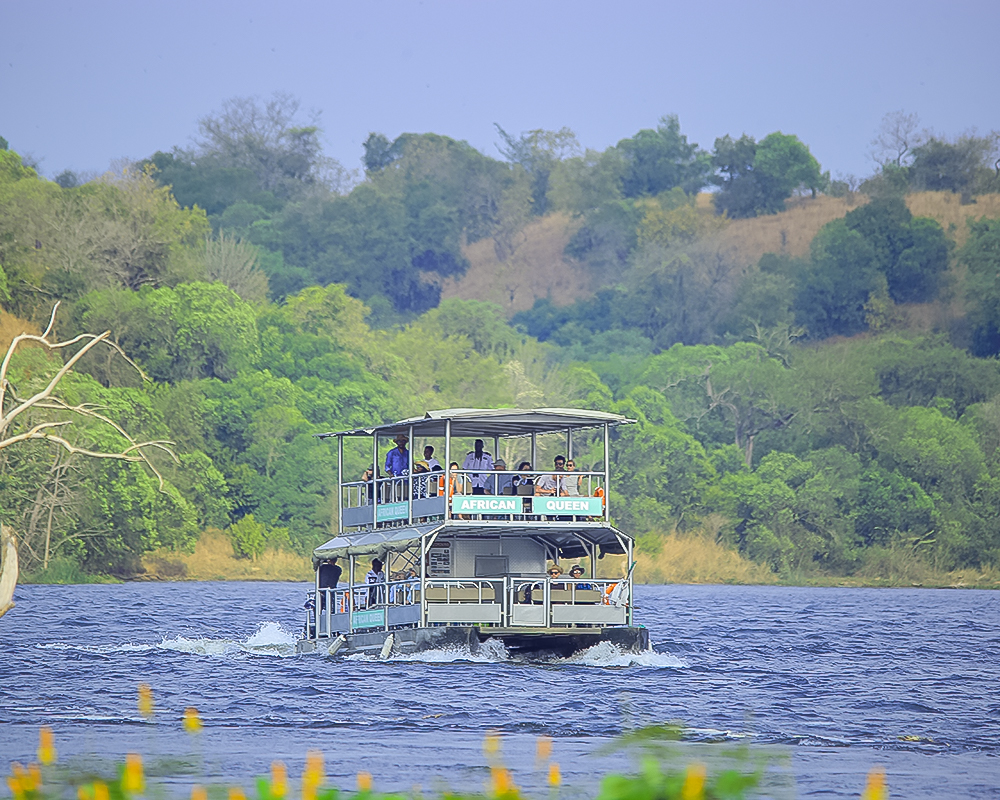
The launch cruise along the tranquil waters of the Victoria Nile to the base of Murchison Falls is widely celebrated as one of the premier river safari experiences on the African continent. This three-hour return boat trip departs from Paraa and glides slowly upstream, offering a low-slung, watery perspective of the park's diverse riverine ecosystems. The banks of the Nile are packed with an astonishing density of wildlife. The river is home to massive, territorial pods of hippos that grunt and submerge just meters from the boat, alongside one of the largest and most prehistoric concentrations of giant Nile crocodiles on the planet, often seen basking open-mouthed on the muddy banks. As the boat approaches the canyon, the peaceful river rhythm transitions into a high-stakes arena where elephants, waterbucks, and massive herds of Cape buffalos descend to the water's edge to drink and bathe. The cruise culminates at a safe, churning pool just below the "Devil's Cauldron," where guests can view the massive frothing waterfalls from a ground-level perspective, feeling the cool river mist on their faces while watching thousands of white-breasted cormorants and nesting red-throated bee-eaters navigate the sheer rock cliffs.
The "Big Four" Wildlife: Savannah Secrets of the North
The northern sector of Murchison Falls National Park is a vast, open expanse of rolling golden savannahs, whistling thorn acacia groves, and structural borassus palm forests that teem with classic big game. Because the Nile divides the park in two, the northern banks have evolved into a highly specialized sanctuary for large mammals, boasting rich populations of lions, leopards, African bush elephants, and massive herds of Cape buffalos—together making up the park’s famous "Big Four." The tracking visibility across this open landscape is exceptional, allowing guides to easily trace lion prides resting under lone acacia trees or scanning for prey from low ridges. Leopards are highly active along the riverine thickets and forested valleys, often spotted draped over the branches of large sausage trees. The park’s elephant populations have staged an incredible conservation recovery, with massive, multi-generational herds frequently seen moving gracefully between the palm trees. This dense predator-prey matrix ensures high-action game drives along tracks like the Albert and Queen’s circuits, where the sweeping savannah views and intense wildlife numbers create a classic, raw East African safari atmosphere.
Rothschild's Giraffes & Primates: Forest to Savannah
Murchison Falls holds a globally significant conservation status as one of the final premier strongholds for the endangered Rothschild’s giraffe (Giraffa camelopardalis rothschildi). The park's northern plains are home to the largest population of these elegant, long-necked giants, easily distinguished by their deep, dark patches and cream-colored legs that lack markings below the knee. Watching hundreds of these majestic towers browsing on the high canopy of the borassus palms against a golden sunset is a foundational highlight of the park's visual identity. What makes an excursion here truly extraordinary, however, is the ability to seamlessly pair this classic savannah safari with an immersive primate trek. Just across the park’s southern boundary lies the pristine, ancient canopy of the Budongo Forest Reserve. Budongo is an old-growth mahogany forest hosting over 800 chimpanzees (Pan troglodytes). Trekking through this damp, emerald underworld on foot allows travelers to listen to the booming vocalizations of chimp communities echoing through the canopy, observe their complex social hierarchies up close, and bridge the worlds of the open African plains and the dense tropical rainforest in a single day.
Birdwatcher's Paradise: Tracking the Legendary Shoebill
Murchison Falls National Park is an internationally recognized birding hotspot, boasting a species list that exceeds 450 distinct varieties, making it an absolute bucket-list destination for ornithologists and casual birdwatchers alike. The absolute holy grail of this avian ecosystem is the prehistoric-looking and highly sought-after Shoebill Stork (Balaeniceps rex). This rare, solitary giant—famed for its massive, clog-shaped bill and intense, yellow-eyed stare—survives in the dense, floating papyrus beds where the Victoria Nile opens out into the swampy wetlands of the Albert Delta. Specialized boat safaris float silently down to the delta at dawn, navigating narrow water channels to find this ancient bird standing completely motionless as it stalks lungfish in the shallows. Beyond the legendary shoebill, the river delta and surrounding woodlands are alive with a dazzling display of color and sound. Birders can reliably spot vibrant Goliath herons, rare marsh tchagras, elegant saddle-billed storks, and standard flocks of white-tailed larks, alongside an array of dazzling kingfishers and raptors, making the park’s avian tracking one of the most diverse, high-reward birding experiences in East Africa.
1. Why is Murchison Falls considered the most powerful natural waterfall in the world?
The primary fame of a Murchison Falls safari rests on its status as the world’s most explosive display of natural water power. The geographical phenomenon here is a dramatic lesson in hydraulic pressure. The Victoria Nile, which flows wide and placid across the Ugandan hinterland, is suddenly forced into a razor-sharp, ancient rock canyon measuring just 7 meters wide. This extreme bottleneck compresses the massive volume of the river, causing it to build immense energy before erupting outward over a 43-meter cliff into the "Devil's Cauldron." The sheer velocity of the water creates a thunderous roar that vibrates through the bedrock for kilometers. The violent churning transforms the river into a mass of white foam, sending up a permanent plume of mist that catches the equatorial sun to create vivid, perpetual rainbows across the gorge, offering an awe-inspiring spectacle of untamed raw energy.
2. What makes the Bottom-of-the-Falls boat cruise an iconic African river safari?
The launch cruise departing from Paraa to the base of Murchison Falls is globally famous as a premier river safari. Traveling slowly upstream along the Victoria Nile, this boat expedition offers a low-slung vantage point to observe wildlife packed along the fertile riverbanks. The river acts as a permanent life support system, playing host to massive, grunting pods of hippos and enormous Nile crocodiles basking open-mouthed on the sandbars. As the boat edges closer to the churning foam below the falls, travelers can watch elephants, waterbucks, and massive cape buffalos coming down to drink, bathe, and navigate the steep clay banks. The journey culminates in a safe pool just below the canyon, providing a dramatic frontal view of the exploding waters framed by sheer rock walls alive with nesting birds.
3. Why is the Albert Delta sector famous for tracking the prehistoric Shoebill Stork?
For birdwatchers worldwide, Murchison Falls is legendary because its Albert Delta sector is one of the absolute best places on earth to spot the rare, prehistoric-looking Shoebill Stork (Balaeniceps rex). This solitary bird, famous for its massive, clog-shaped beak and intense yellow eyes, thrives in the vast, slow-moving papyrus swamps where the Nile opens up into Lake Albert. Specialized morning boat safaris float silently into these wetlands, navigating narrow water channels to catch a glimpse of the giant bird standing completely motionless as it stalks lungfish in the shallows. The combination of pristine delta scenery, misty early morning light, and the thrill of tracking a living dinosaur makes the delta cruise a foundational highlight for wildlife purists visiting Uganda.
4. How does the park serve as a critical stronghold for the endangered Rothschild's Giraffe?
Murchison Falls is conservationally famous for harboring the world’s largest remaining population of the endangered Rothschild’s giraffe (Giraffa camelopardalis rothschildi). This specific subspecies is highly distinguished by its large, deep brown patches broken by crisp white borders, and its clean, unmarked cream-colored legs that resemble socks. Watching these majestic towers browse among the high canopy of the borassus palm forests is a signature visual of the park's northern sector. The park's successful anti-poaching campaigns have allowed this population to thrive so robustly that Murchison Falls has served as the primary source for historic translocation projects, where giraffes were successfully boated across the Nile to establish new breeding populations on the southern banks and in other Ugandan reserves.
5. What makes chimpanzee trekking in the adjacent Budongo Forest a unique safari addition?
An extraordinary dimension of a Murchison Falls safari is the ability to combine a classic open-savannah game drive with an intimate tropical rainforest primate trek in a single day. Situated on the park’s southern boundary, the Budongo Forest Reserve is a massive, ancient block of old-growth mahogany forest that protects over 800 chimpanzees (Pan troglodytes). Walking through this dense, emerald underworld accompanied by expert researchers allows visitors to track habituated chimpanzee communities. Guests can witness them grooming, playing, and communicating through loud vocalizations and rhythmic tree-buttress drumming that echoes through the canopy, providing a stark, beautiful contrast to the golden grasslands just a short drive away.
6. How does the Nile River bisect the park and create two distinct wildlife zones?
The Victoria Nile physically cuts completely through Murchison Falls National Park from east to west, dividing the protected area into two ecologically and geologically distinct zones. The northern sector is characterized by sweeping, rolling golden savannahs punctuated by borassus palms and acacia woodlands, which host the vast majority of the park’s big game and large herbivore herds. The southern sector is far more densely forested, featuring thick woodlands, bush country, and tropical forests like Budongo, which favor primates and secretive forest species. This river barrier historically shaped wildlife distributions, and today, crossing the river via the modern bridge or Paraa ferry marks an exciting transition from dense jungle paths into wide-open, predator-filled plains.
7. What is the historic significance of the "Top of the Falls" hiking trail?
The "Top of the Falls" trail is famous for offering an intensely visceral, close-up encounter with the Nile's raw power. Hikers disembark from boats below the falls and follow a steep, historic path that cuts up the canyon walls, tracing the footsteps of early explorers like Sir Samuel and Lady Florence Baker. As you ascend, the perspective shifts from a wide river view to a dramatic, cliff-edge vantage point looking straight down into the "Devil's Cauldron." The trail takes you directly to the point where the river enters the rock squeeze, allowing you to stand just meters from the roaring bottleneck. The air here is completely saturated with heavy spray, creating a refreshing drenching experience and a micro-climate where lush, wet-forest vegetation thrives amidst the parched cliffs.
8. Why is the northern savannah famous for "Big Four" tracking visibility?
The open grasslands of Murchison Falls’ northern sector, particularly along the Albert, Queen’s, and Buligi tracking loops, are highly famous for their spectacular "Big Four" viewing efficiency. Because the landscape is dominated by low, rolling plains and neatly spaced palm trees, visibility is incredibly sharp. Lion prides are resident and highly visible, often using the low crests of hills or the shade of lone acacias to monitor nearby herds of Jackson’s hartebeests and Uganda kobs. Leopards are regularly spotted lounging in the low, horizontal branches of large sausage trees that line the dry river valleys, while massive herds of cape buffalos and African elephants move freely across the horizons, ensuring high-action, classic savannah tracking.
9. How do the borassus palm forests give Murchison Falls a distinct visual identity?
Unlike many East African reserves dominated exclusively by thorny acacia trees, the northern plains of Murchison Falls are famously defined by vast forests of towering Borassus palm trees (Borassus aethiopum). These unique palms, with their straight, smooth trunks and large, fan-shaped leaves, give the landscape a distinctly tropical, primeval appearance that looks like a scene out of a bygone era. The palms play a vital role in the ecosystem; their large, orange fruits are a favorite food source for elephants and baboons. Watching a herd of elephants shake a massive palm trunk to drop fruits against the backdrop of a fiery red Ugandan sunset is an iconic, deeply evocative visual that belongs exclusively to Murchison Falls.
10. What makes the park a premier destination for specialized birding safaris?
Murchison Falls is formally recognized as an Important Bird Area (IBA) and stands as one of Uganda's most diverse avian sanctuaries, boasting over 450 recorded bird species. The park's fame lies in the variety of its distinct bird habitats, ranging from riverine forests and open savannahs to the vast delta wetlands. Beyond the iconic shoebill, birders flock here to see the spectacular nesting colonies of red-throated bee-eaters that tunnel into the sandy river cliffs, turning the rock faces into flashes of vibrant pink and blue. The river channels host elegant saddle-billed storks, goliath herons, and African skimmers, while the grasslands are alive with secretary birds, Abyssinian ground hornbills, and a spectacular array of raptors that hunt over the plains.
11. What role does the historical Paraa region play in the park’s tourism legacy?
The Paraa region is the historic and operational heart of Murchison Falls National Park. The word "Paraa" translates to "the place of hippos" in the local Luo language, a name that perfectly describes the massive pods that choke the riverbanks here. Historically, Paraa was the site of the park’s original river crossings and early luxury lodges, serving as the central hub from which all boat safaris, game drives, and conservation management activities radiate. Today, it remains the primary focal point for travelers, bridging the northern and southern sectors and offering a vibrant, bustling base where guests can watch hippos wallow right in front of their safari camps while planning their daily expeditions.
12. How did historical figures like Winston Churchill shape the park’s international fame?
Murchison Falls holds a colorful place in international travel history, having drawn numerous famous figures long before it was formally gazetted as a national park. In 1907, Winston Churchill hiked the trails here, famously writing about the region's beauty and cementing Uganda's reputation as the "Pearl of Africa." Later, in 1954, the legendary American author Ernest Hemingway famously survived two consecutive plane crashes within the park’s boundaries, near the top of the falls and at the Butiaba airstrip. These high-profile historical adventures injected an air of wild, romantic mystique into Murchison Falls, drawing generations of international travelers seeking a truly authentic, dramatic frontier exploration.
13. What unique wildlife species highlights can be found beyond the "Big Four"?
While predators and large mammals command the most attention, Murchison Falls is famous for hosting a rich diversity of specialized, lesser-known wildlife species that thrive in its varied habitats. The northern plains are alive with massive herds of Jackson’s hartebeest, an elegant antelope with a long, narrow face and high horns, alongside thousands of golden-coated Uganda kobs. Puku antelopes wander the marshy edges, and huge troops of olive baboons patrol the roadsides. In the river channels, visitors can spot massive monitor lizards sunning themselves on rocks, and the dense woodlands provide a sanctuary for black-and-white colobus monkeys and nocturnal bushbabies, ensuring every safari turn reveals something unique.
14. What are the distinct logistical advantages of visiting Murchison Falls?
From a logistical standpoint, Murchison Falls is famous for being one of Uganda’s most accessible and well-connected wilderness destinations. Situated roughly 300 kilometers northwest of Kampala, the park can be reached via a fully paved, highly scenic five-hour overland drive that passes through the Ziwa Rhino Sanctuary, allowing travelers to break up the journey with on-foot rhino tracking. For luxury travelers, the park features multiple well-maintained airstrips—such as Pakuba in the north and Bugungu in the south—enabling quick, comfortable 45-minute scheduled bush flights from Entebbe International Airport, making it an easy, high-value addition to any East African itinerary.
15. How does the emotional "vibe" of Murchison Falls differ from other Ugandan reserves?
The ultimate fame of a Murchison Falls safari lies in its high-contrast emotional energy. While gorilla trekking destinations like Bwindi feel quiet, misty, and deeply introspective, Murchison Falls feels vast, grand, and full of cinematic momentum. The omnipresence of the Nile River creates a soothing, living pulse that flows through the entire safari experience. The pace shifts effortlessly from the high-octane excitement of tracking a lion pride across the palm-studded plains to the tranquil, scenic relaxation of a afternoon boat cruise, culminating in the visceral, raw roar of the falls itself, leaving travelers with a profound sense of Africa’s timeless scale and natural power.
Booking Murchison falls safari in Uganda with us Roads of Adventure safaris
To book a Murchison Falls safari with Roads of Adventure Safaris, you can reach their local Kampala office directly. They offer customized 2 to 3-day itineraries that include 4WD transport, park fees, a Nile boat cruise, and game drives.
