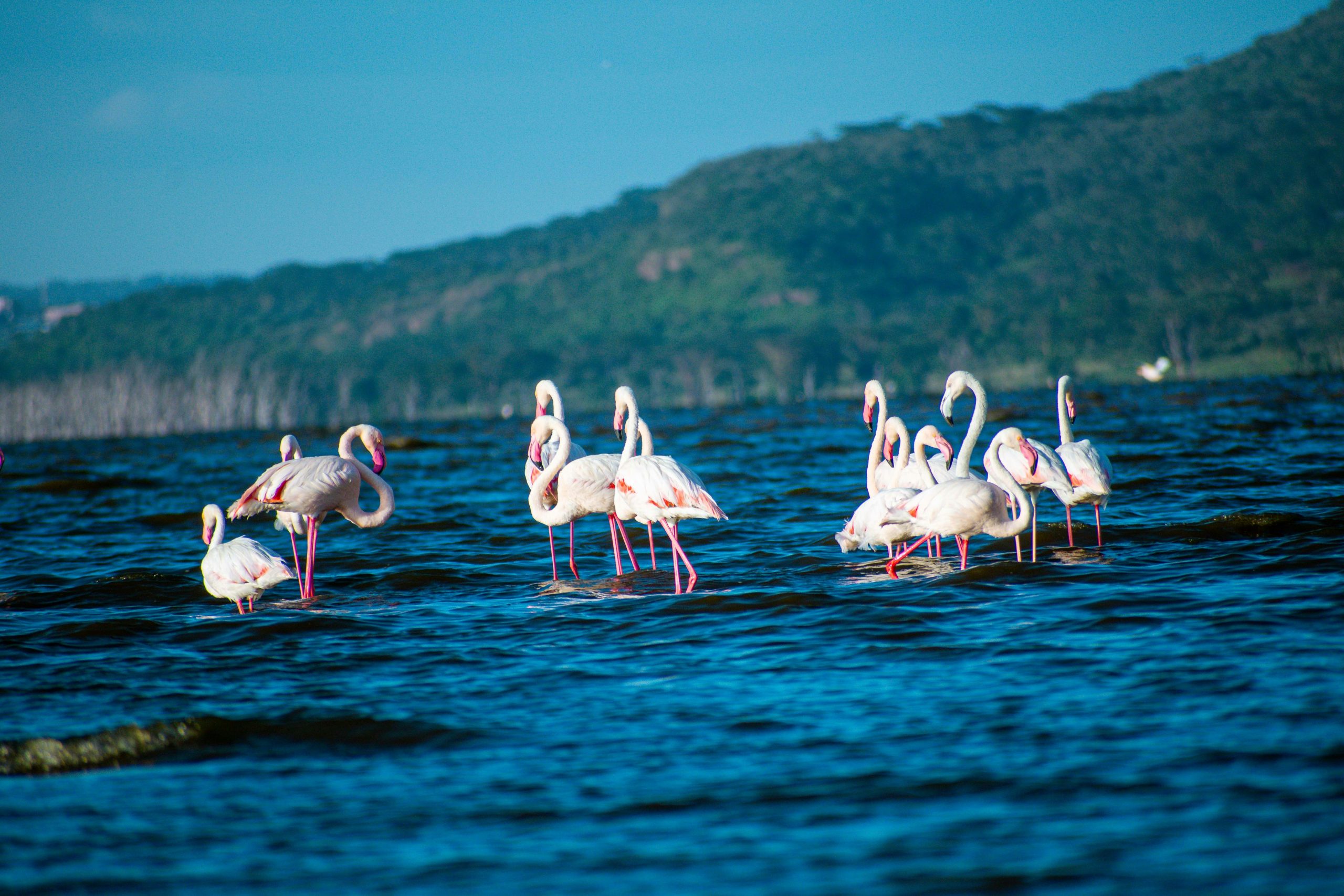
Kenya offers world-class birding opportunities, with over 1,100 species recorded across its diverse ecosystems, ranging from Rift Valley lakes to coastal forests. A standard Kenya wildlife safari easily yields sightings of iconic large birds, migratory waterfowls, and regional endemics alongside the Big Five.
29-days-kenya-birding-safari-extravaganza
20-days-kenya-bird-watching-safari-and-wildlife-expedition
14-days-kenya-birding-safari-and-wildlife-watching
1. Lake Naivasha
Lake Naivasha is a breathtaking freshwater lake perched at the highest elevation of the Great Rift Valley, making it a critical anchor point for any comprehensive Kenya birding safari. Spanning a diverse ecosystem of open waters, dense papyrus swamps, and yellow-barked acacia woodlands, Naivasha is home to over 350 recorded bird species. The sheer abundance of waterbirds here provides a visual spectacle that sets a high bar for the rest of your Kenya wildlife safari.
The undisputed monarch of the lake is the African fish eagle, whose haunting, evocative call echoes continuously across the water. Visitors embarking on motorized boat safaris can watch these majestic raptors swoop down with pinpoint accuracy to pluck tilapia from the surface. Gliding along the papyrus fringes also reveals brilliant flashes of color from malachite kingfishers, pied kingfishers, and giant kingfishers patiently waiting on low-hanging reeds. The marshy shorelines support large congregations of great white pelicans, yellow-billed storks, and grey herons. Back on dry land, the surrounding fever tree forest canopy is alive with noisy specialized terrestrial species, including the iridescent Rüppell's starling, the colorful red-fronted barbet, and various species of weavers, ensuring that every angle of this freshwater oasis delivers rewarding sightings.
2. Amboseli National Park
While Amboseli National Park is world-famous for its giant elephant herds traveling beneath Mount Kilimanjaro, it is equally a premier destination for a high-yielding Kenya birding safari. The park boasts an astonishing checklist of over 420 recorded avian species. This immense diversity is driven by Amboseli’s unique hydrology: while the surrounding terrain consists of arid, dusty plains, the park’s core is sustained by permanent, lush green swamps fed continuously by underground freshwater springs melting off Kilimanjaro's glacial peaks.
These vibrant wetlands create an ideal sanctuary for an array of waterbirds and shorebirds. Birdwatchers on a Kenya wildlife safari here can easily spot African jacanas—often called "lily trotters"—delicately balancing on floating vegetation alongside long-toed lapwings and glossy ibises. The elegant Grey Crowned Crane, Kenya’s national bird, is frequently seen performing its striking mating dances in the marshy grasslands. Amboseli is also an exceptional arena for observing birds of prey; the thermal wind currents coming off the Tanzanian border attract over 40 species of raptors. Serious birders can cross massive martial eagles, tawny eagles, pale chanting goshawks, and secretary birds off their life lists while watching them hunt across the open savanna plains.
3. Tsavo East & West National Parks
Spanning an enormous combined area of over 22,000 square kilometers, Tsavo East and Tsavo West together form an undisputed dry-country mecca for a Kenya birding safari. With a massive regional checklist exceeding 500 species, Tsavo offers an expansive environment where semi-arid scrublands, volcanic hills, and riverine forests converge. This complex habitat mosaic attracts a completely different set of specialized avifauna compared to the Rift Valley lakes, making it a vital addition to any serious Kenya wildlife safari itinerary.
The dry, whistling-thorn bush of Tsavo is the perfect place to look for iconic, arid-zone specialists. Travelers can easily observe flocks of the prehistoric-looking vulturine guineafowl walking through the red dirt, recognizable by their striking cobalt-blue chests and bare, vulture-like heads. The magnificent golden-breasted starling flashes its brilliant metallic plumage from the upper branches of acacia trees, while the Somali ostrich struts across the vast open plains. Tsavo also serves as a crucial geographical corridor for billions of palearctic migratory birds traveling south from Europe and Asia between November and April. During these months, the park transforms into a bustling avian crossroads, allowing visitors to spot rare rollers, bee-eaters, and various species of falcons and kestrels tracking the insect hatches brought on by the seasonal rains.
4. Arabuko Sokoke Forest Reserve
For a highly specialized and exclusive experience, a Kenya birding safari must head to the coast to explore the Arabuko Sokoke Forest Reserve. Covering roughly 420 square kilometers, Arabuko Sokoke is the largest remaining fragment of the ancient coastal forest complex that once stretched across East Africa. Because it is an isolated ecological island, it holds immense global conservation value and is recognized as an Important Bird Area (IBA). It trades the standard savanna drives of a Kenya wildlife safari for slow, immersive walking tracks under a dense, humid canopy.
The forest is a sanctuary for over 270 bird species, including six globally threatened and highly localized endemics that draw hardcore birdwatchers from all over the world. Walking quietly through the dry Brachystegia woodlands gives visitors a rare chance to spot the endangered Sokoke pipit foraging silently in the leaf litter, perfectly camouflaged by its mottled brown plumage. Looking up into the high canopy reveals the striking Amani sunbird flitting among the blossoms alongside the beautifully crested Fischer's turaco. For the ultimate birding triumph, an expert-led night walk into the dense Cynometra thickets can reveal the tiny, highly elusive Sokoke scops owl roosting silently on tree trunks, providing a deeply rewarding highlight to an equatorial birding expedition.
5. Nairobi National Park
Nairobi National Park offers one of the most surprising and efficient birdwatching experiences anywhere in Africa. Located literally on the outskirts of Kenya's bustling capital city, this 117-square-kilometer park features an incredible variety of habitats, including open rolling grasslands, deep rocky gorges, riverine woodlands, and man-made dams. This diverse matrix supports an astonishing checklist of over 500 bird species—nearly half of Kenya’s total bird population—making it a mandatory first stop for any dedicated Kenya birding safari.
The park’s compact size and high species density mean that an experienced birder on a Kenya wildlife safari can easily rack up over 100 distinct sightings in a single day, all with city skyscrapers reflecting in the background. The open grasslands are home to giant terrestrial birds like the Kori bustard—the world's heaviest flying bird—and the elegant secretary bird stalking through the grass for snakes. The park's forested pockets shelter the colorful Hartlaub's turaco and the white-tailed crested flycatcher. Meanwhile, the rocky gorges and riverine edges protect black-headed herons, saddle-billed storks, and a variety of nesting raptors like the endangered martial eagle. This unmatched accessibility allows you to jump straight off an international flight and into world-class birdwatching within minutes.
What is the peak season for birding in Kenya?
The absolute peak season for a Kenya birding safari runs from September to April. This massive window marks a dramatic transition across East Africa as millions of birds escape the freezing winters of the Northern Hemisphere. The influx of Palearctic migrants (birds migrating from Europe and northern Asia) and intra-African migrants completely supercharges the local bird populations.
During these months, Kenya's resident species are joined by a dazzling array of waders, warblers, and raptors. By November, the diversity reaches its absolute zenith. For birdwatchers, this timing means you can observe familiar European species, like the Barn Swallow or Common Buzzard, sharing a single acacia tree with exotic African endemics. Because this period overlaps with the breeding season of many resident species, the avian activity is highly intense, offering an unparalleled opportunity to quickly expand your life list.
How does the climate affect bird sightings?
Climate and rain cycles are the ultimate drivers of bird behavior on a Kenya wildlife safari. Kenya experiences two distinct rainy seasons: the "short rains" from November to December and the "long rains" from April to May. While rain can occasionally complicate travel logistics, it is a massive blessing for birdwatchers because water triggers an immediate explosion of life.
The rainfall sparks massive insect hatches and causes plants to flower and fruit, providing an overnight abundance of food. In response, resident birds enter a flurry of activity, initiating complex nesting behaviors and courtship displays. Crucially for photographers, this abundance of food prompts male birds to shed their dull non-breeding colors and molt into their vibrant, showy breeding plumage. Tracking birds during or immediately after the rains guarantees a spectacular show of hyperactive, beautifully colored birds feeding their young.
Which national parks offer the best birding opportunities?
While birds are everywhere in East Africa, a premier Kenya birding safari focuses on three core pillars: Lake Naivasha, Amboseli National Park, and the Maasai Mara National Reserve. Each of these destinations offers a fundamentally different habitat, ensuring you encounter a broad spectrum of species rather than seeing the same birds repeatedly.
Lake Naivasha represents the freshwater aquatic environment, dominated by lily pads, papyrus reeds, and towering fever trees. Amboseli introduces a marshy wetland dynamic fed by underground springs, creating a rich oasis for waders. Finally, the Maasai Mara offers expansive, open savanna grasslands and riverine forests, perfect for massive terrestrial birds, unique birds of prey, and grassland specialists that thrive alongside the great mammal migrations.
What are the must-see bird examples on a Kenya safari?
Every traveler embarking on a Kenya wildlife safari should keep an eye out for five iconic avian species that perfectly represent the region's diversity: the Lesser Flamingo, African Fish Eagle, Secretary Bird, Lilac-breasted Roller, and the Vulturine Guineafowl.
The Lesser Flamingo turns alkaline lakes into shifting sheets of bright pink, while the African Fish Eagle defines the sound of the Rift Valley lakes with its piercing call. On the ground, the Secretary Bird stalks the savanna like a prehistoric hunter, using its long legs to stomp snakes. The Lilac-breasted Roller, with its breathtaking palette of green, blue, lilac, and white, is a favorite for photographers. Finally, the Vulturine Guineafowl boasts striking cobalt-blue chest feathers and a bare head, looking beautifully ancient against the dry dirt.
Where is the best place to see millions of flamingos?
To witness the legendary spectacle of millions of flamingos, a Kenya birding safari must target the alkaline lakes of the Great Rift Valley, specifically Lake Nakuru, Lake Elmenteita, and Lake Bogoria. These shallow, highly caustic soda lakes provide the absolute perfect growing conditions for Spirulina platensis, a microscopic blue-green alga that serves as the primary food source for Lesser Flamingos.
When the water levels and algal blooms align, these lakes host massive, deafening congregations of birds that literally dye the shorelines a brilliant pink. Lesser Flamingos use their specialized, down-curved bills to filter the algae from the water, while the larger Greater Flamingos wade in deeper sections, feeding on small crustaceans. While shifting water levels cause the flocks to move between these three lakes from year to year, visiting this alkaline corridor offers one of the most awe-inspiring visual spectacles in the natural world.
What makes Lake Naivasha unique for birders?
Lake Naivasha’s primary appeal on a Kenya wildlife safari is its fresh water, a stark contrast to its salty, alkaline neighbors. This lack of salinity allows for a complex freshwater ecosystem to thrive, complete with dense beds of papyrus and floating yellow water lilies that attract a staggering variety of specialized waterbirds.
Furthermore, Naivasha is unique because it trades standard driving tracks for motorized boat safaris. Floating silently along the marshy fringes allows birdwatchers to get incredibly close to massive Goliath Herons, bright Malachite Kingfishers, and noisy rafts of pelicans without spooking them. The lake is also home to one of the highest densities of African Fish Eagles on earth. Watching these giant raptors launch from the branches of yellow-barked fever trees and dive down to snatch fish right in front of your boat is a foundational Kenyan highlight.
Are there any forest-specific birding destinations?
Yes, for birdwatchers looking for rare species, Kakamega Forest National Reserve is an absolute must-visit. Located in western Kenya, Kakamega is famous as the country's only remaining patch of the ancient Guineo-Congolian rainforest, which once stretched completely across Central Africa. This unique origin means the forest is home to dozens of West African canopy species found nowhere else in Kenya.
Walking beneath Kakamega's massive hardwoods reveals an environment alive with exotic calls and deep shadow. Birders flock here to find the magnificent Great Blue Turaco—a giant bird sporting deep blue, yellow, and red plumage—and the noisy Grey-cheeked Hornbill. The forest floor and dense undergrowth protect rare endemics like the Turner's Eremomela, the Blue-headed Bee-eater, and various illadopsises. It is a humid jungle paradise that provides a complete visual and ecological departure from the classic East African savanna.
Can birding be successfully combined with a standard "Big Five" safari?
Absolutely! One of the greatest things about a Kenya wildlife safari is that birdwatching and big-game tracking happen simultaneously in the exact same environments. You never have to sacrifice seeing lions, leopards, or elephants to enjoy world-class birding, particularly when exploring the Maasai Mara National Reserve.
As your open-sided 4x4 tracks a pride of lions through the short grass, your guide will routinely spot Kori Bustards marching nearby or a Martial Eagle watching the plains from a dead acacia branch. The seasonal migrations that bring millions of wildebeest to the Mara also trigger massive insect hatches, attracting flocks of storks, rollers, and birds of prey. This overlap means that every single game drive satisfies both the mammal enthusiast and the dedicated birder, making it an incredibly rich experience for couples or families with mixed interests.
What specialized gear should I bring?
Packing the right gear can make or break a dedicated Kenya birding safari. First and foremost, invest in high-quality, lightweight binoculars. An 8x42 or 10x42 specification from reputable brands (like Vortex, Zeiss, or Swarovski) offers the ideal balance of magnification, light transmission, and field of view for spotting fast-moving birds in dark canopies or open plains.
For photography, a telephoto lens with a focal length of at least 400mm (ideally 500mm or 600mm) is mandatory for capturing crisp details on small, distant birds. Finally, always carry a physical copy or download the app version of Birds of East Africa by Terry Stevenson and John Fanshawe. Widely considered the gold standard field guide for the region, this indispensable book illustrates over 1,400 species, complete with detailed distribution maps and plumage variations.
How do I book a specialized birding guide?
To guarantee a successful trip, it is highly recommended to explicitly request a guide certified by the KPSGA (Kenya Professional Safari Guides Association) through a licensed local tour operator. The KPSGA uses a strict tier system (Bronze, Silver, and Gold) to verify a guide’s knowledge of ecology, animal behavior, and identification.
A certified Silver or Gold-level guide possesses an unbelievable ability to identify hundreds of birds purely by their call, saving you hours of searching. When booking your Kenya wildlife safari, state clearly in writing that your primary focus is birdwatching. This prompt ensures the tour operator pairs you with a specialized naturalist guide rather than a general driver. A dedicated birding guide understands the patience required for photography, knows the exact fruiting trees that attract rare species, and will comfortably structure your days around peak avian activity.
Are there day-trip birding opportunities near Nairobi?
If you are facing a tight schedule or a brief layover in the capital, Nairobi National Park offers an exceptional birdwatching experience just minutes from the central business district. Despite its modest size of 117 square kilometers, this historic park boasts a checklist of over 500 recorded bird species—nearly half of Kenya's total avian population.
The park’s unbelievable species density is a product of its diverse habitat matrix, which packs open rolling grasslands, deep rocky river gorges, and highland dry forests into a compact area. An experienced birdwatcher on a morning drive can easily log over 100 distinct species before lunch. You can cross majestic grassland species like the Secretary Bird off your list, spot African Darters drying their wings on man-made dams, and watch endemic Hartlaub's Turacos flash their crimson flight feathers in the forested valleys—all with the city's modern skyscrapers cutting across the horizon.
What bird species can be found in arid regions?
Heading north to the semi-arid, sun-baked ecosystems of the Samburu National Reserve introduces a completely new set of desert-adapted species. The parched red-dirt plains, whistling thorn bushes, and doum palm forests along the Ewaso Ng'iro River support specialized birds that are entirely absent from the southern parks.
The absolute prize of this dry northern frontier is the spectacular Golden-breasted Starling, whose metallic violet and neon yellow plumage gleams intensely under the equatorial sun. Travelers will also encounter the massive Somali Ostrich, easily distinguished by the deep blue skin on its neck and legs. Sharing this rugged terrain are flocks of prehistoric-looking Vulturine Guineafowl searching for seeds in the dust, while elegant Black-faced Sandgrouse gather in the mornings by the drying riverbanks, offering an elite birding experience unique to Kenya's northern wilderness.
Is it possible to go on walking safaris for birdwatching?
Yes, stepping out of the safari vehicle on a guided walking safari offers the most intimate and rewarding way to experience Kenya's smaller avifauna. In standard parks, big predators keep visitors confined to their cars, but specialized areas like Hell’s Gate National Park and Crescent Island Game Sanctuary allow you to explore safely on foot.
Walking quietly through the towering volcanic cliffs of Hell’s Gate allows birdwatchers to look up at nesting colonies of rare Rüppell's Vultures and Verreaux's Eagles riding the thermal wind currents. Over on Crescent Island, a peaceful walk through the lakeside pastures brings you within arm's reach of nesting weavers, colorful lovebirds, and feeding pipits. Exploring on foot forces you to slow down, listen carefully to the canopy calls, and appreciate the subtle plumage details of smaller sunbirds, waxbills, and flycatchers that are easily missed from a moving vehicle.
What raptors can be spotted in the savannahs?
Kenya's open grasslands are arguably the best place in the world to observe large birds of prey in action. The constant rising thermal air currents and clear visibility across the Maasai Mara and Tsavo plains create an ideal hunting arena for over 50 species of diurnal raptors. The ultimate prize is the Martial Eagle, Africa's largest eagle, capable of hunting small antelopes and monkeys. Looking up into the midday sky reveals the distinctive silhouette of the Bateleur eagle, recognizable by its incredibly short tail and acrobatic, rocking flight pattern. When a predator makes a kill, the sky fills with massive scavengers; you can watch the huge Lappet-faced Vulture use its powerful beak to tear through tough hide, while flocks of critically endangered Rüppell's and White-backed Vultures squabble over the remains, displaying the raw, unfiltered circle of life.
What are the accommodation options for a birding safari?
Kenya's luxury eco-lodges and tented camps are designed to immerse you directly in prime wilderness, often doubling as world-class birding hot spots right on the property. Many premium lodges are positioned along riverbanks, natural waterholes, or lake shorelines to maximize wildlife viewing.
Staying at a tented camp in the Maasai Mara means your canvas tent is pitched beneath a canopy of indigenous acacias and green fig trees. Simply sitting on your private wooden veranda with a morning coffee can yield dozen of sightings, from colorful Double-toothed Barbets to nesting sunbirds and noisy hornbills. These eco-properties employ resident naturalists who maintain bird feeding stations and leading bird walks right within the camp's secure perimeter. This setup ensures your Kenya birding safari never pauses, offering exceptional birdwatching from the moment you wake up to the evening sounds of owls and nightjars under the African stars.
Booking birding safari in Kenya with us Roads of Adventure safaris
Booking a Kenya birding safari with Roads of Adventure Safaris is highly customizable. They offer expert-led birding and wildlife packages ranging from 7-day birding tours to extensive 20-day Kenya birding expeditions starting in Nairobi.
