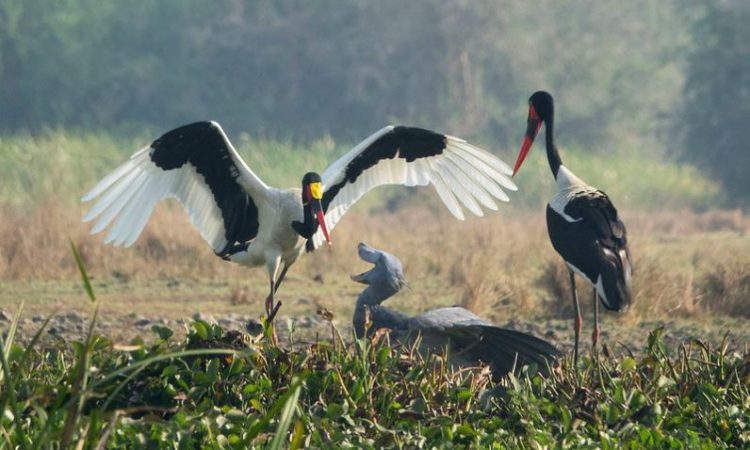
This 18-day itinerary is a meticulously crafted, high-tempo expedition covering Uganda’s premier birding hotspots. Designed specifically for specialist birders, it targets over 500 species, maximizing your chances of spotting rare Albertine Rift endemics, the elusive Shoebill, and elusive forest dwellers like the Green-breasted Pitta
Tour highlights for 18 Days bird watching safari in Uganda
Tracking wild lions
Cruising the Nile
Spotting rare rhinos
Watching majestic elephants
Seeing Mount Kilimanjaro
Hunting elusive leopards
Finding prehistoric shoebills
Canoeing quiet swamps
Witnessing massive migrations
Scouting hidden pittas
Exploring dense rainforests
Trekking mountain gorillas
Viewing pink flamingos
Walking Royal Mile
Watching playful chimpanzees
Scanning Congo specials
Counting colorful turacos
Photographing aquatic birds
Crossing geographic equator
Enjoying African sunrises
Day by day 18 Days bird watching safari in Uganda
Day 1: Arrival & Entebbe
Your magnificent 18 Days bird watching safari in Uganda begins upon your arrival at Entebbe International Airport. As you step out into the crisp equatorial air, your specialized birding guide will greet you and transfer you to your peaceful lakeside hotel. After checking in, you will enjoy a leisurely afternoon introduction to Uganda’s incredible avian life. You can choose to explore the tranquil trails of the Entebbe Botanical Gardens or visit the Uganda Wildlife Education Centre. Both hotspots sit beautifully on the shores of Lake Victoria and offer exceptional introductory birding. Keep your binoculars ready for resident species such as the Great Blue Turaco, Eastern Plantain-eater, African Openbill, and various vibrant sunbirds flitting through the canopy. It is the perfect, relaxed start to a thrilling expedition, allowing you to shake off your long travel fatigue while checking off your very first endemic lifers in a serene African setting.
Day 2: Mabamba Swamp
The second day of this 18 Days bird watching safari in Uganda takes you to the famous Mabamba Swamp. You will wake up early for a short drive to the wetland, where you will board a traditional motorized canoe. Quietly navigating through narrow channels of miscanthus and papyrus, you will search for the prehistoric, highly sought-after Shoebill stork. Watching this massive bird hunt lungfish in the morning mist is a true bucket-list experience for any global birder. While searching for the majestic Shoebill, you will also encounter fascinating swamp specialists. Keep a sharp eye out for the African Jacana balancing on lily pads, the Lesser Jacana, the elusive Papyrus Gonolek, and the Blue-breasted Bee-eater. You will also spot Malachite Kingfishers, Purple Herons, and Swamp Flycatchers darting across the water. After an exhilarating morning on the tranquil marsh, you will head back to the lodge to log your impressive species checklist.
Day 3: Murchison Falls National Park (Via Ziwa)
Setting off on the next leg of your 18 Days bird watching safari in Uganda, you will travel north toward Murchison Falls National Park. Along the way, you will make a strategic stop at the Ziwa Rhino Sanctuary. This protected sanctuary is famous for rhinos, but it also offers incredible woodland birding. You will look for the White-crested Turaco and the Western Banded Snake Eagle lurking in the branches. Afterward, you will continue your journey into Uganda's oldest and largest national park. As you cross the Nile, the landscape opens into breathtaking savannahs and Borassus palm forests. You will settle into your safari lodge overlooking the river, listening to the evening chorus of nightjars and owls. This diverse riverine ecosystem provides an exceptional habitat for hundreds of unique bird species, ensuring that your upcoming days of game drives and boat cruises will be incredibly rewarding.
Day 4: Murchison Falls Savannah Exploration
Today offers a deep dive into the rich savannahs of Murchison Falls during your 18 Days bird watching safari in Uganda. You will embark on a rewarding early morning game drive across the northern delta plains. The open grasslands are home to specialized raptors and terrestrial birds. You will scan the horizon for the bizarre Secretary Bird, the massive Abyssinian Ground Hornbill pacing through the grass, and Denham's Bustard. In the patches of acacia woodland, you will find the vibrant Red-throated Bee-eater, Swallow-tailed Bee-eater, and the Silverbird. Alongside the spectacular avian life, you will enjoy viewing classic African wildlife, including elegant Rothschild's giraffes, elephants, lions, and thousands of Ugandan kobs. Your expert guide will help you sort through tricky cisticolas and pipits, maximizing your daily count. You will return to the lodge during the heat of the day to relax and review your rapidly growing species list.
Day 5: Nile Boat Cruise to the Delta
Waterbirds take center stage today on your 18 Days bird watching safari in Uganda. In the morning, you will board a boat for a launch trip downstream toward the spectacular riverine delta where the Nile flows into Lake Albert. This tranquil wetland habitat is another crucial stronghold for the iconic Shoebill, which is often spotted standing motionless along the papyrus fringes. You will also get remarkably close views of Goliath Herons, Saddle-billed Storks, African Skimmers skimming the water surface, and pairs of African Fish Eagles calling from high perches. The riverbanks are packed with hundreds of nesting Pied Kingfishers and various species of plovers. In the afternoon, you will experience a contrasting boat trip heading upstream to the base of Murchison Falls itself. Here, you can watch the entire Nile crush through a tiny seven-meter gorge, creating a spectacular backdrop for spotting Rock Pratincoles clinging to the wet boulders.
Day 6: Travel to Budongo Forest
You will transition from savannah to dense tropical rainforest today on your 18 Days bird watching safari in Uganda. After a final morning look around Murchison Falls, you will drive to the nearby Budongo Forest Reserve, which boasts some of the most pristine mahogany woodlands left in East Africa. Budongo is a legendary destination among international birders, renowned for hosting an incredible diversity of elusive forest interior species. Upon arrival, you will check into your eco-lodge enveloped by a lush green canopy. The change in acoustic atmosphere is immediate, with the open savannah calls replaced by a dense symphony of hidden forest birds and primates. You will take a relaxed introductory walk along the forest edges before dusk, focusing on locating the Yellow-billed Barbet, Western Nicator, and various greenbuls, getting your eyes adjusted to the challenging but rewarding conditions of deep jungle birding.
Day 7: The Royal Mile (Budongo Forest)
Today features a legendary hotspot of this 18 Days bird watching safari in Uganda: the famous Royal Mile in Budongo Forest. This historic, wide forestry trail offers a flat, open corridor through a spectacular mature canopy, creating the absolute best forest birding conditions in Africa. You will spend the entire day quietly walking the trail, looking for rare understory specialists and canopy dwellers. The primary target species here is the localized Puvel's Illadopsis, a bird endemic to Budongo that requires an expert ear to locate. You will also search for the stunning Chocolate-backed Kingfisher, African Dwarf Kingfisher, and Cassin's Hawk-Eagle soaring high above the trees. The surrounding foliage is often alive with various Tinkerbirds, including the Yellow-throated and Speckled Tinkerbird, alongside the Chestnut-capped Flycatcher and Jameson's Wattle-eye. With patience, you will secure incredible looks at these colorful forest gems.
Day 8: Budongo Forest to Kibale
You will enjoy a final morning walk in Budongo, finalizing your forest checklist before continuing your 18 Days bird watching safari in Uganda. Your route today winds south along the scenic Albertine Rift escarpment, offering panoramic views of rural landscapes and traditional homesteads. You will drive past vast tea plantations that carpet the rolling hills in vibrant green as you approach the Fort Portal area. Your destination is Kibale National Park, globally famous for its dense primate populations but equally revered as a prime tropical rainforest birding habitat. You will arrive at your lodge adjacent to the forest in the late afternoon. As night falls, you will listen closely for the distinct calls of the African Wood Owl and the eerie screams of tree hyraxes, anticipating tomorrow's trek into the deep jungle for some of the rarest birds in East Africa.
Day 9: Kibale Forest & Green-breasted Pitta
This morning marks one of the absolute highlights of your 18 Days bird watching safari in Uganda. You will wake up before dawn to trek into the dark rainforest of Kibale National Park. Your primary target is the highly elusive Green-breasted Pitta, a legendary bird that displays on the forest floor only during the earliest morning light. Finding this beautifully camouflaged species requires stealth and expert guidance. Once the sun rises, you will shift your focus to other forest specials moving through the dense canopy. You will look for the chatty African Grey Parrot, the Joyful Greenbul, Grey-throated Barbet, and the Masked Apalis. Kibale is also home to thirteen primate species, so do not be surprised if your birding is pleasantly interrupted by troops of wild Chimpanzees, Red Colobus monkeys, and Grey-cheeked Mangabeys crashing through the branches above your birding trail.
Day 10: Bigodi Wetland Sanctuary
After a thrilling morning of forest birding, the afternoon of your 18 Days bird watching safari in Uganda leads you to the community-managed Bigodi Wetland Sanctuary. This rich papyrus swamp and boardwalk trail acts as an important buffer zone to Kibale National Park. The edge habitat makes it exceptionally easy to view birds that are otherwise difficult to see inside the dark, enclosed forest canopy. Bigodi is particularly famous for its abundant turacos; you can easily expect to see multiple Great Blue Turacos bouncing clumsily through the fruiting trees. You will also target swamp-dwelling species such as the White-winged Warbler, Papyrus Canary, Hairy-breasted Barbet, and the stunning Black-and-white Casqued Hornbill. The local community guides are incredibly knowledgeable, helping you spot hidden roosting frogs and unique butterflies while explaining how ecotourism funds directly support local schools and community health clinics.
Day 11: Travel to Semuliki National Park
You will depart the highlands of Kibale today and descend into the hot, humid lowlands of Semuliki National Park on your 18 Days bird watching safari in Uganda. This unique park represents the easternmost extension of the vast Congo Basin Guinea-Congolian rainforest. Because of this distinct geography, Semuliki allows birders to find dozens of Central African species that cannot be seen anywhere else in East Africa. The drive down the winding rift valley escarpment offers dramatic views of the roaring Semliki River snaking into Lake Albert. You will check into your lodge and prepare yourself for an intense birding environment. The air here is thick, and the forest is wild and untamed. In the late afternoon, you will explore the fringes of the park, immediately encountering species like the Piping Hornbill and the Blue-billed Malimbe, hinting at the incredible avian treasures waiting deep inside.
Day 12: Semuliki Forest Birding
Today is a thrilling, full-day immersion into Semuliki Forest during your 18 Days bird watching safari in Uganda. You will walk the rewarding Kirumia Trail, a deep-forest track that is legendary for yielding Central African specials. Your expert guide will actively search the dense vine tangles and towering ironwood trees for the Long-tailed Hawk, Nkulengu Rail, and the massive Black-casqued Wattled Hornbill. Keep your binoculars ready for stealthy raptors like the Congo Serpent Eagle and the Red-thighed Sparrowhawk. The forest undergrowth holds hidden gems like the Chestnut-bellied Wattle-eye, Maxwell's Black Weaver, and Crested Malimbe. You will also visit the famous Sempaya Hot Springs, where boiling geysers bubble out of the ground, creating a unique sulfurous clearing where hornbills and starlings love to gather. It is a challenging day of birding, but the rewards are unmatched anywhere else on the continent.
Day 13: Semuliki to Queen Elizabeth National Park
You will climb back out of the rift valley floor today, transitioning to a completely different ecological zone on your 18 Days bird watching safari in Uganda. You will travel south to Queen Elizabeth National Park, a reserve blessed with an astonishing variety of habitats, including open savannah, crater lakes, acacia woodlands, and humid forests. This incredible ecological diversity allows the park to boast a checklist of over 600 distinct bird species. You will arrive at your lodge in time for a scenic lunch overlooking the plains or the Kazinga Channel. In the afternoon, you will set out on your initial game drive through the Kasenyi plains. You will actively look for open country birds such as the Rufous-naped Lark, Flappet Lark, and the African Crake, while keeping an eye out for herds of buffaloes, elephants, and predatory lions.
Day 14: Kazinga Channel Boat Cruise
The fourteenth day of your 18 Days bird watching safari in Uganda delivers one of the finest waterbird spectacles in the world. In the afternoon, you will embark on an unforgettable boat cruise along the Kazinga Channel, a natural waterway connecting Lake Edward and Lake George. The banks of the channel are literally packed with hundreds of hippos, Nile crocodiles, and bathing elephants. Nestled among the wildlife are thousands of resident and migratory waterbirds. You will get close views of the massive Martial Eagle scanning for prey from the banks, the delicate Papyrus Canary, and the White-tailed Lark. The muddy shorelines host a treasure trove of migrant waders, including Gull-billed Terns, African Skimmers, Spoonbills, and various sandpipers. It is an effortless, highly productive afternoon of wildlife photography and birding that will easily add dozens of new entries to your list.
Day 15: Queen Elizabeth to Bwindi (Ruhija)
You will leave the open savannah behind and travel into the ancient, mist-shrouded mountains of Bwindi Impenetrable National Park on your 18 Days bird watching safari in Uganda. You will drive through the southern Ishasha sector of Queen Elizabeth National Park, famous for its unique tree-climbing lions, before ascending into the rugged highlands. Your destination is the high-altitude Ruhija sector of Bwindi, which sits over 2,300 meters above sea level. This ancient, dense forest is the absolute pinnacle for Albertine Rift endemics—species found only in this specific mountain chain. The air up here is beautifully cool and crisp. After checking into your mountain lodge, you will take a late afternoon walk along the forest boundary, targeting high-altitude specialists like the Rwenzori Batis, Stripe-breasted Tit, and the colorful Regal Sunbird, preparing for tomorrow's mountain trek.
Day 16: Ruhija Trails & Albertine Endemics
Today stands as the ultimate mountain birding day of your 18 Days bird watching safari in Uganda. You will pack a picnic lunch and descend deep into the dense, primary forest toward the Mubwindi Swamp. This steep trail is the best place in the world to find the critically endangered African Green Broadbill (also known as Grauer's Broadbill), a holy grail species for global birders. As you carefully navigate the mossy mountain trails, your guide will listen for its tiny, high-pitched call. The forest canopy is also home to other rare Albertine Rift endemics, including the beautiful Shelley's Crimsonwing, the striking Rwenzori Turaco, Archer's Robin-Chat, and the Strange Weaver. You will also scan the rushing mountain streams for the rare African Black Duck. It is a physically demanding day of hiking, but completing this legendary trek brings immense satisfaction.
Day 17: Bwindi to Lake Mburo National Park
You will descend from the misty heights of Bwindi today and travel east toward Lake Mburo National Park on your 18 Days bird watching safari in Uganda. Lake Mburo is a beautiful gem characterized by rolling acacia woodlands, quiet lakes, and extensive papyrus swamps, presenting a suite of dry-country birds that you have not encountered yet on this trip. You will arrive at the park by lunchtime and check into your lodge. In the afternoon, you will take a boat ride on Lake Mburo, specifically searching for the secretive African Finfoot as it swims along the quiet, overhanging mangrove roots. You will also look for the rare White-backed Night Heron and the Shining-blue Kingfisher. On the surrounding savannah, you will spot large herds of impalas, zebras, and elands walking alongside the spectacular, long-horned Ankole cattle.
Day 18: Lake Mburo to Entebbe & Departure
The final morning of your extraordinary 18 Days bird watching safari in Uganda begins with a targeted game drive through the acacia woodlands of Lake Mburo. Your main target species for the morning will include the localized Red-faced Barbet, Tabora Cisticola, and the highly nomadic Brown-chested Lapwing. You will also look for the Coqui Francolin and the Spot-flanked Barbet feeding in the scrub. After a rewarding morning of birding, you will return to the lodge for an early lunch and check out. You will then begin your smooth drive back to Entebbe, making a classic stop at the Equator crossing for photographs and souvenir shopping. Your driver will transfer you directly to Entebbe International Airport for your evening outbound flight home, marking the conclusion of an unforgettable, species-packed bird watching expedition across the Pearl of Africa.
1. What is the Best Time of Year to Embark on an 18 Days Bird Watching Safari in Uganda?
Timing is crucial when planning an 18 Days bird watching safari in Uganda because seasonal weather patterns directly dictate avian activity, nesting habits, and the presence of migratory species. The absolute best months to book this comprehensive tour are from late May through September, as well as from January to February. During these specific windows, the country experiences its dry seasons, which means less rainfall to disrupt your intensive daily field excursions. Navigating through dense, tropical rainforest environments like Bwindi Impenetrable National Park or Budongo Forest becomes significantly easier when the steep mountain trails and forest pathways are relatively dry and mud-free.
Furthermore, if your goal is to maximize your overall species checklist count by spotting thousands of wintering Palearctic and Afrotropical migrants, booking your safari between November and April is highly advantageous. During these wetter months, the skies and shorelines fill with spectacular migratory waders, terns, and raptors, transforming hotspots like Queen Elizabeth National Park into bustling avian crossroads. However, the rain can make wilderness roads challenging to navigate. Conversely, the main breeding season for resident birds peaks from May to June when food is highly abundant. During this time, many forest species exhibit vibrant breeding plumage and call out consistently to defend their nesting territories, making them much easier for your specialized guide to track by ear. Ultimately, choosing the right month depends entirely on whether your primary target list leans toward spotting rare Albertine Rift endemics or observing massive, mixed-species migratory flocks along the Great Rift Valley lakes.
2. Which Specific Binoculars and Camera Gear Are Recommended for This Extensively Long Expedition?
Packing the correct optical equipment is vital for ensuring the absolute success of an immersive 18 Days bird watching safari in Uganda. Because you will be constantly transitioning between wide-open, sunlit savannahs and dark, heavily shaded rainforest understories, your binoculars must be highly versatile. Top-tier birding specialists strongly recommend high-quality 8x42 or 10x42 binoculars. An 8x42 configuration is particularly exceptional for deep jungle tracking in places like Kibale or Semuliki National Park because it offers a significantly wider field of view and a brighter image, allowing you to quickly spot fast-moving greenbuls or sunbirds in low-light conditions. Ensure your optics are fully waterproof and fog-proof to successfully withstand the thick morning mists and sudden downpours.
When it comes to photography gear, flexibility is key. A high-performance digital camera body paired with a powerful telephoto zoom lens, such as a 100-400mm or a fixed 500mm lens, is absolutely essential for capturing crisp, detailed images of distant canopy dwellers or shy waterbirds. Because a massive portion of your time on this specific safari will be spent actively tracking forest interior birds like the elusive Green-breasted Pitta, you will frequently find yourself shooting in incredibly dark, challenging environments. A camera body with excellent high-ISO performance will allow you to maintain fast shutter speeds without sacrificing image quality. Additionally, bringing a sturdy, lightweight monopod is highly recommended for stability during long forest walks, along with multiple high-capacity memory cards and extra batteries, as charging opportunities can occasionally be limited while staying at remote eco-lodges deep in the bush.
3. How Reliable Are the Iconic Shoebill Stork Sightings Throughout This Comprehensive Safari Itinerary?
Securing a definitive sighting of the legendary, prehistoric-looking Shoebill stork is a primary objective for almost every international traveler booking an 18 Days bird watching safari in Uganda. Fortunately, this specific itinerary is deliberately designed to maximize your encounters with this highly sought-after species by targeting multiple distinct wetland strongholds. The most reliable and famous location on your route is the vast Mabamba Swamp, situated right on the fringes of Lake Victoria. At Mabamba, local community guides track individual birds daily, and by utilizing quiet, hand-paddled motorized canoes to navigate the narrow papyrus channels, your realistic success rate for finding a hunting Shoebill during an early morning excursion is remarkably high, often exceeding 90 percent.
Beyond Mabamba Swamp, this comprehensive itinerary provides excellent secondary opportunities to view this magnificent bird in completely different wilderness habitats. While exploring Murchison Falls National Park, your scheduled private boat cruise down the Victoria Nile toward the Albert Delta leads you directly into another vital Shoebill feeding ground. Spotting a Shoebill standing completely motionless along the delta's marshy banks offers a wilder, more remote viewing experience compared to Mabamba. While wild animals are naturally unpredictable and sightings can never be 100% guaranteed due to seasonal water level fluctuations that cause birds to move deeper into inaccessible marsh interiors, spreading your targeted tracking across multiple world-class locations over more than two weeks provides the ultimate safety net for checking off this incredible lifer.
4. What Physical Fitness Level is Required to Successfully Navigate the Diverse Terrains?
Participating in an 18 Days bird watching safari in Uganda requires a moderate to high level of physical fitness, primarily because the itinerary covers an incredibly wide range of demanding African terrains. While casual savannah game drives in Murchison Falls or relaxed boat cruises along the Kazinga Channel demand very little physical exertion, your extended excursions into the country’s ancient tropical rainforests are a completely different story. Trekking through Bwindi Impenetrable National Park to find endangered mountain gorillas or ultra-rare Albertine Rift endemics like the African Green Broadbill involves hours of active hiking. These trails are often steep, muddy, and covered in thick vegetation, requiring you to navigate uneven terrain at altitudes ranging from 1,500 to over 2,300 meters above sea level.
Similarly, walking the wild trails of Semuliki National Park exposes you to hot, humid, and sticky conditions, which can be physically draining during long, slow days of field tracking. To comfortably enjoy this trip, you should be fully capable of walking at a slow, steady pace for five to eight miles a day while carrying your own personal daypack, binoculars, and camera gear. It is highly recommended to prepare for your safari a few months in advance by engaging in regular cardiovascular exercise and hiking on inclined paths. Investing in broken-in, waterproof hiking boots with excellent ankle support and deep tread is non-negotiable for safety on slippery slopes, and utilizing a sturdy wooden walking stick provided by the park rangers will significantly reduce strain on your knees.
5. How Do Specialized Birding Guides Locate Camouflaged Forest Species in Dense Canopies?
The professional specialized guides who lead your 18 Days bird watching safari in Uganda possess an astonishing level of expertise that is critical for finding secretive species. In dense, multi-layered forest environments like Budongo's Royal Mile or Kibale National Park, visual tracking alone is practically impossible because thousands of birds remain completely hidden behind thick foliage or high up in the mature canopy. Therefore, these expert guides rely almost entirely on their highly trained auditory skills, locating roughly 80 percent of all forest interior birds by recognizing their specific territorial calls, alarm notes, and subtle contact songs. They can instantly distinguish between dozens of seemingly identical greenbuls, illadopsises, and tinkerbirds using sound alone.
Once a guide identifies a specific bird call, they utilize a combination of strategic techniques to help you spot the animal. They carefully scan the distinct strata of the forest—ranging from the leaf litter on the jungle floor up to the mid-story vines and the highest emergent trees—to narrow down the search area. Guides also look for subtle behavioral clues, such as the sudden shaking of a branch, the presence of fruiting figs that attract canopy feeders, or columns of moving safari ants that draw in opportunistic ant-thrushes and illadopsises. Furthermore, they are experts at handling laser pointers safely and describing positions using the classic "clock method" relative to distinctive tree trunks, ensuring that you can quickly align your binoculars and view the brilliantly camouflaged bird before it darts away.
6. What Key Albertine Rift Endemic Bird Species Can I Realisticly Expect to Check Off in Bwindi?
A massive highlight of embarking on an 18 Days bird watching safari in Uganda is the unparalleled opportunity to explore the Albertine Rift, a unique montane region celebrated for producing high concentrations of endemic wildlife. Bwindi Impenetrable National Park—specifically the high-altitude Ruhija sector—is widely considered the absolute pinnacle for montane birding in East Africa. The ultimate prize here is the critically endangered African Green Broadbill, a tiny, enigmatic green bird that nests near the remote Mubwindi Swamp. Because your extensive itinerary dedicates multiple focused days to exploring this rich sector, your chances of locating this global holy grail species with the help of specialized park rangers are exceptional.
Beyond the famous broadbill, you can realistically expect to encounter an array of other spectacular Albertine Rift endemics along the mountain trails. Keep a sharp eye out for the vibrant Rwenzori Turaco, with its unmistakable splashes of bright red and blue cutting through the emerald canopy. You will also actively target the secretive Shelley's Crimsonwing, the striking Handsome Francolin pacing through the undergrowth, and Archer's Robin-Chat. The surrounding mountain foliage frequently hosts busy, mixed-species feeding flocks containing the Rwenzori Batis, Stripe-breasted Tit, Regal Sunbird, and Blue-headed Sunbird. Sorting through these fast-moving flocks can be exhilarating, and because your comprehensive itinerary allows for an unhurried, patient approach, you will be able to check off a massive portion of the 23 endemic species found inside this UNESCO World Heritage site.
7. How Does This Lengthy Itinerary Directly Support Local Ugandan Communities and Wildlife Conservation?
Booking an 18 Days bird watching safari in Uganda serves as a powerful catalyst for grassroots wildlife conservation and community development across the country. High-end avitourism is one of the most sustainable forms of eco-travel because it relies directly on preserving intact, complex ecosystems rather than altering them. A significant portion of your park entry fees, permit costs, and vehicle conservation levies goes directly to the Uganda Wildlife Authority. These vital funds are used to pay ranger salaries, finance anti-poaching patrols in vulnerable border forests, and bankroll long-term scientific monitoring programs for endangered species like mountain gorillas, chimpanzees, and rare forest birds.
Moreover, this specific itinerary places a heavy emphasis on community-based tourism initiatives. When you explore the Mabamba Swamp or the Bigodi Wetland Sanctuary, you are utilizing services owned and managed entirely by local community cooperatives. The fees you pay for local site guides, canoe rentals, and handmade cultural crafts provide a direct, lucrative source of income for rural families living on the immediate borders of these protected areas. When local communities see that a standing papyrus marsh filled with Shoebills or an intact forest patch home to turacos generates steady economic benefits, they become active guardians of the wilderness. This financial incentive directly discourages illegal poaching, charcoal burning, and agricultural encroachment, ensuring that Uganda’s priceless biodiversity is protected for future generations.
8. What Unique Avian Treasures Await Travelers in the Deep Congo-Basin Ecosystem of Semuliki?
Including Semuliki National Park in your 18 Days bird watching safari in Uganda introduces an incredibly exciting ecological dimension to your tour. Semuliki is unique because it is the only genuine patch of lowland West African Guinea-Congolian rainforest found anywhere in East Africa. This means that by simply walking the park’s famous Kirumia Trail, you are essentially stepping into an extension of the massive Congo Basin ecosystem, allowing you to encounter a completely different suite of spectacular Central African bird specials that cannot be found in any of Uganda's other standard savannah or montane reserves.
The deep forest interior of Semuliki holds an array of spectacular avian prizes. One of the primary canopy targets is the massive, preposterous-looking Black-casqued Wattled Hornbill, along with the Piping Hornbill and the White-thighed Hornbill. As you quietly navigate the humid understory tangles, your specialized guide will actively listen for the distinct calls of the fierce Long-tailed Hawk and the highly secretive Nkulengu Rail. Raptor enthusiasts will also thrill at the chance to spot the rare Congo Serpent Eagle perched silently in the mid-story. The lower strata of the forest are alive with colorful, specialized insectivores, including the Blue-billed Malimbe, Crested Malimbe, and the striking Chestnut-bellied Wattle-eye. Exploring this wild, untamed lowland jungle adds an authentic edge of true discovery to your expedition, as you uncover rare species hidden deep within the dense ironwood groves.
9. What Practical Health and Safety Precautions Should Be Prioritized for This 18-Day Journey?
Prioritizing your personal health and safety is essential for ensuring an uninterrupted, comfortable experience during your 18 Days bird watching safari in Uganda. Because this comprehensive journey takes you through various remote regions and low-altitude wetland ecosystems, managing tropical health risks is a top priority. First and foremost, a yellow fever vaccination is a mandatory entry requirement for Uganda, and you must carry your physical certificate. Additionally, because you will be spending significant time in prime mosquito habitats like the Mabamba Swamp, Murchison Falls Nile Delta, and Queen Elizabeth National Park, taking a reliable malaria prophylactic prescribed by your travel doctor is strongly recommended.
To prevent insect bites and stay protected from annoying stinging flies or safari ants during long forest walks, always wear lightweight, long-sleeved safari shirts and durable trousers tucked securely into your socks. Apply a high-quality, insect repellent containing DEET to any exposed skin. Staying hydrated is equally vital; always drink bottled or filtered water provided by your safari vehicle, and avoid tap water entirely. When trekking in rugged rainforest environments, remember that you are in a wild, un-fenced ecosystem; always listen strictly to the safety briefings provided by your armed Uganda Wildlife Authority park rangers. By maintaining excellent hand hygiene, protecting your skin from the intense equatorial sun with a wide-brimmed hat, and pacing your physical exertion, you will stay energized and healthy throughout the tour.
10. How Does the Avian Diversity of Queen Elizabeth National Park Compare to the Mountain Forests?
An 18 Days bird watching safari in Uganda provides a fascinating study in ecological contrast, particularly when comparing the vast avian diversity of Queen Elizabeth National Park to the deep mountain forests of Bwindi or Kibale. Queen Elizabeth National Park boasts one of the highest bird checklists of any protected area in Africa, with over 600 distinct species recorded. This staggering number is a direct result of the park's diverse mosaic of open habitats, which includes rolling acacia savannahs, expansive wetlands, freshwater rivers, and volcanic crater lakes. This open landscape makes birding exceptionally visual, allowing you to easily view large raptors like the Martial Eagle, elegant waterbirds, and massive breeding colonies of colonial weavers.
In contrast, the ancient montane forests of Bwindi hold a lower overall quantity of species but boast an infinitely higher level of exclusivity. Forest birding is a slow, intimate, and highly focused endeavor where you trade the massive, mixed-species flocks of the open savannah for rare, specialized endemics that exist nowhere else on Earth. While Queen Elizabeth offers a high-volume spectacle of widespread East African waterbirds and larks along the Kazinga Channel, Bwindi delivers highly prized evolutionary specialists like the African Green Broadbill and Rwenzori Turaco. Experiencing both contrasting ecosystems back-to-back allows you to fully appreciate the complex evolutionary forces that make Uganda the ultimate birding destination on the African continent.
11. What Strategy is Used to Find the Secretive Green-breasted Pitta in Kibale National Park?
Locating the legendary Green-breasted Pitta in Kibale National Park is widely considered one of the ultimate field challenges of an 18 Days bird watching safari in Uganda. This small, beautifully colored bird is notorious for its highly secretive behavior, spending the vast majority of its life hopping silently through the darkest, most choked sections of the rainforest floor. To successfully find this avian masterpiece, your specialized guide will deploy a highly strategic, time-tested morning plan that requires an incredibly early wake-up call long before the forest begins to wake up.
You will enter the dark trails of Kibale National Park in complete darkness to reach known pitta territories before the first cracks of dawn. The key to finding the pitta lies within a very narrow, twenty-minute window at sunrise when the male bird performs its unique territorial display. The male hops up onto a low, mossy horizontal branch and delivers a sudden, mechanical wing-cllap that produces a distinct, muffled "pfft" sound, designed to attract mates. Your guide will stand completely frozen, listening intently for this subtle sound cutting through the morning mist. Once the sound is located, you will quietly approach the area with stealth. Seeing this stunning bird—with its brilliant green body, turquoise shoulders, and bright red vent—illuminated by a single shaft of early morning jungle light is an unforgettable, high-reward highlight.
12. What Typifying Non-Avian Wildlife Encounters Intersect With This Comprehensive Birding Route?
While the primary focus of an 18 Days bird watching safari in Uganda is undoubtedly the country's spectacular avian wealth, your route naturally intersects with some of the most iconic big-game wildlife encounters on earth. Because birding requires you to thoroughly explore an array of pristine national parks, you will frequently find your birding scopes trained on incredible mammals. While tracking savannah species in Murchison Falls or Queen Elizabeth National Park, your game drives will be filled with close encounters of lions, leopards, massive herds of African elephants, Cape buffaloes, elegant Rothschild’s giraffes, and thousands of native Ugandan kobs.
Furthermore, this specific itinerary seamlessly integrates Uganda’s world-famous primate experiences. While exploring the rich depths of Kibale National Park in search of forest birds, you will hear the echoing pant-hoots of wild Chimpanzee communities, often tracking them through the canopy alongside troops of rare Central African monkeys. The ultimate mammalian highlight occurs when your route enters the misty valleys of Bwindi Impenetrable National Park, where you can opt to stand face-to-face with a family of endangered Mountain Gorillas. Watching these gentle giants interact, play, and groom just meters away provides a profoundly emotional experience that perfectly complements your intense avian tracking, making this comprehensive safari the ultimate celebration of wild Africa.
13. What Accommodation Styles Can Travelers Expect Across This 18-Day Eco-Tour Route?
An 18 Days bird watching safari in Uganda features a wonderful, hand-picked selection of specialized eco-lodges, boutique lakeside hotels, and luxury tented camps that enhance your connection to the wild. In urban transit hubs like Entebbe, you will stay in charming, quiet boutique guest houses nestled in lush, bird-rich gardens right on the shores of Lake Victoria. As you transition into the remote national parks, your accommodations shift toward carefully designed eco-lodges that place a massive emphasis on environmental sustainability, utilizing solar power, local construction materials, and organic farm-to-table dining.
In deep forest sectors like Budongo or Kibale, your comfortable cabins will be completely enveloped by the dense jungle canopy. This allows you to bird directly from your private wooden veranda, watching sunbirds and monkeys move through the branches while enjoying your morning coffee. While exploring the open savannahs of Murchison Falls or the misty highlands of Bwindi, you will relax in upscale safari lodges that blend modern luxury with traditional African design, featuring stunning infinity pools, cozy open-air fire pits for evening checklist reviews, and panoramic views of the wilderness. These lodges employ highly trained local staff who understand the unique schedules of birders, cheerfully providing early breakfast spreads and customized picnic lunches for long days out in the field.
14. What are the Advantages of Using a Fully Pop-Up 4x4 Safari Land Cruiser on This Tour?
Utilizing a specialized, custom-built 4x4 Safari Land Cruiser with a fully opening pop-up roof is an absolute game-changer for an 18 Days bird watching safari in Uganda. This rugged, heavy-duty vehicle is engineered to conquer the country’s diverse road conditions, ranging from paved highways to deep, muddy forest tracks and bumpy savannah trails. The 4x4 capability ensures that regardless of unexpected weather changes, your vehicle will safely navigate tricky river crossings and slippery mountain passes without getting stuck, keeping your complex itinerary moving smoothly.
For a passionate birder or wildlife photographer, the pop-up roof design provides unmatched practical advantages in the field. When exploring wide-open savannah ecosystems like Murchison Falls, the roof elevates to create a spacious, 360-degree unobstructed viewing platform. This allows you to comfortably stabilize your heavy telephoto camera lenses or large binoculars on beanbags placed along the roof's edge, giving you a steady, elevated view over the high grasses to spot distant raptors, bustards, or lions. Furthermore, these spacious vehicles are intentionally configured with window seats for every single passenger and come equipped with handy charging ports for your camera batteries, a built-in fridge to keep your drinking water ice-cold, and ample storage space for your bulky gear daypacks.
15. How Can a Traveling Birder Effectively Prepare for the Tricky Group of Cisticolas and Larks?
Mastering the identification of small, streaky brown birds—collectively known to the global birding community as "LBJs" (Little Brown Jobs)—is a true rite of passage during an 18 Days bird watching safari in Uganda. Uganda's wide savannahs and seasonal wetlands host a confusingly large number of larks, pipits, and highly complex cisticolas, including the Winding, Croaking, and Tabora Cisticola. Trying to separate these species based on subtle plumage variations alone can frustrate even the most seasoned international birders, as many species look virtually identical when viewed through a camera lens.
To effectively prepare for this challenge, you should focus heavily on studying vocalizations and micro-habitats before your departure. Utilizing specialized African birding apps allows you to listen to the distinct, repetitive territorial songs and crisp clicking notes of different cisticolas, which is often the only definitive way to tell them apart in the field. Once you are out on safari, rely closely on the incredible field experience of your specialized guide, who can instantly identify a Flappet Lark by the unique, mechanical drumming sound its wings make during flight displays. Pay close attention to exactly where a bird is perched; whether it is singing from the very tip of an acacia bush, hiding deep in a wet papyrus stand, or running across a dry dirt track provides critical clues that narrow down the identity of these fascinating evolutionary puzzles.
Booking 18 Days bird watching safari in Uganda with us Roads of Adventure safaris
Booking an 18-day birding safari with Roads of Adventure Safaris offers an incredible deep dive into Uganda's biodiversity, covering hotspots like Mabamba Swamp, Bwindi Impenetrable, and Murchison Falls to spot over 600 bird species
