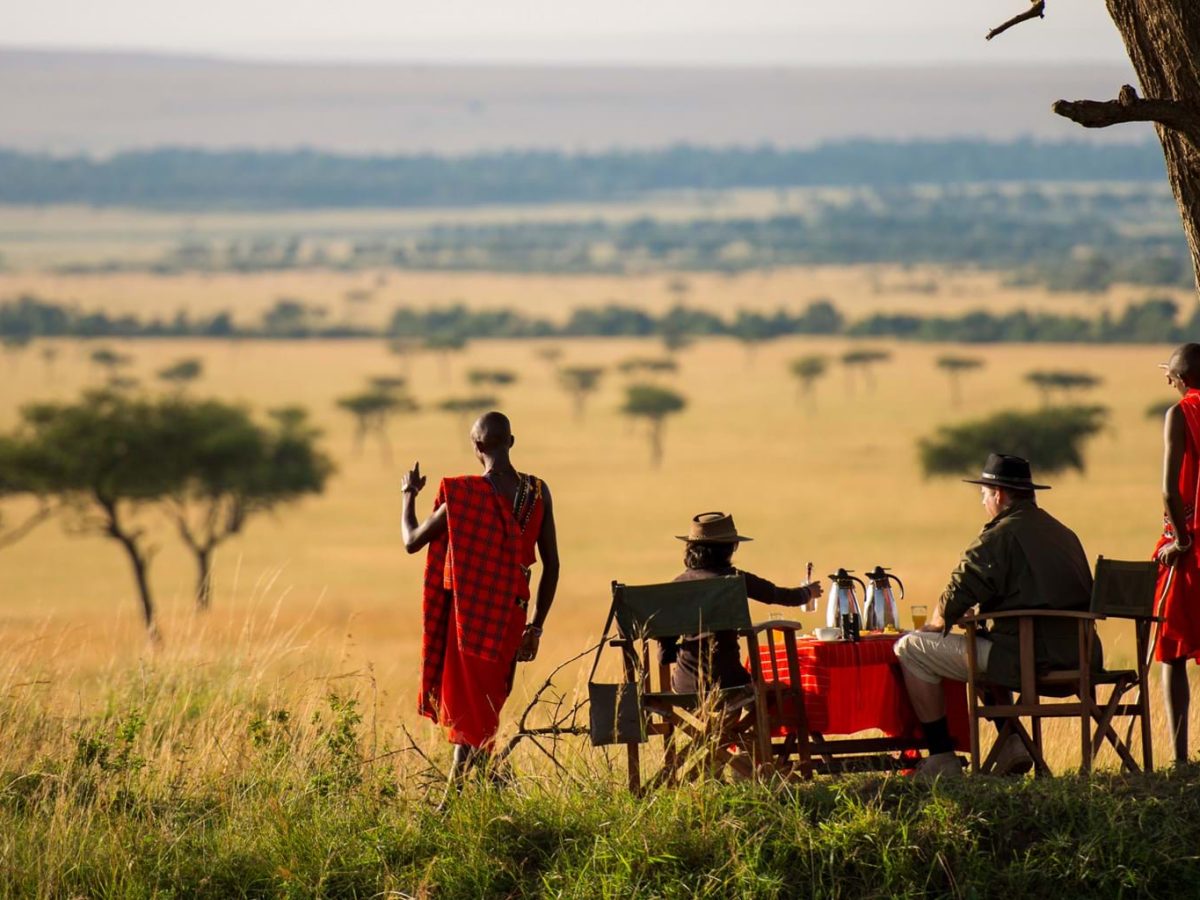
A 3-day Masai Mara safari typically starts and ends in Nairobi, featuring two nights of full-board lodging and daily game drives to spot the Big Five (lions, leopards, elephants, buffalos, and rhinos). Non-resident national park conservation fees are strictly set at $200 per adult per day during the peak season (July–December) and $100 per adult per day in the low season (January–June). Due to strict regulations, all park fees must be pre-paid via the official Kenya eCitizen Portal
Day 1: The Descent into the Savannah
Your adventure begins at 7:30 AM as your driver picks you up from your Nairobi hotel or Jomo Kenyatta International Airport (NBO). Leaving the capital's traffic behind, you will embark on a 240-kilometer journey lasting 5 to 6 hours. By 9:00 AM, the road winds down the Escarpment, where you will enjoy a 15-minute stop at the Great Rift Valley Viewpoint to snap photos of the breathtaking trench below. Pressing on through Narok Town, the cultural heart of the region, you will transition onto rougher dirt roads. You will arrive at your camp, such as Basecamp Masai Mara, by 1:30 PM just in time for a warm lunch. After settling into your tent, head out for a 2-hour evening game drive at 4:00 PM, capturing your first sights of grazing zebras as dusk settles.
Day 2: The Heartbeat of the Mara
Wake up at 5:30 AM to the sounds of the bush, grab a quick coffee, and board your 4x4 Land Cruiser by 6:15 AM. Today is a full-day tracking expedition spanning 8 to 9 hours across the Masai Mara National Reserve. Your guide will navigate through areas like the Mara Triangle to spot apex predators like lions (Olng'atuny in the Maasai language) and elusive leopards before the sun gets too hot. Around 1:00 PM, your driver will set up a packed picnic lunch under a lone acacia tree near the Mara River. Here, you will watch pods of hippos and enormous Nile crocodiles. Depending on the month, you might even witness thousands of wildebeest braving the river currents. You will return to camp around 4:30 PM, thoroughly dusty but exhilarated.
Day 3: Golden Hour and the Journey Home
Your final day begins with a crisp 6:30 AM sunrise game drive, lasting about 1.5 hours. At this hour, the savannah glows in a deep amber hue, offering perfect lighting to spot cheetahs finishing up a morning hunt or a herd of elephants moving gracefully against the horizon. You will return to the lodge by 8:00 AM for a hearty bush breakfast. After packing up, checking out, and saying goodbye to the staff, you will begin the 5-to-6-hour return drive to Nairobi at 9:30 AM. Breaking up the 240-kilometer trip, your driver will stop for a quick lunch or a souvenir break at a local Maasai curio shop. You will arrive back in Nairobi by mid-afternoon, around 3:30 PM, for your onward flight
What is the standard route and timeline for a 3-day Masai Mara trip?
A standard 3-day Masai Mara safari starts early in the morning in Nairobi, picking you up around 7:30 AM from your hotel or Jomo Kenyatta International Airport (NBO). You’ll travel southwest over 240 kilometers, a drive that typically takes 5 to 6 hours depending on Nairobi traffic and road conditions. Along the way, you descend into the Great Rift Valley, passing through the bustling hub of Narok Town before hitting unpaved dirt roads near the reserve.
You usually reach your camp or lodge by 1:30 PM, leaving plenty of time to check in, unpack, and enjoy a warm lunch. After a short rest, your wildlife experience officially begins with an evening game drive at around 4:00 PM, lasting until sunset at 6:00 PM. Day 2 is dedicated entirely to tracking wildlife across the vast reserve, while Day 3 features an early morning golden-hour game drive and a bush breakfast before you check out at 9:30 AM. The return drive gets you back to Nairobi by mid-afternoon around 3:30 PM, making it ideal for connecting onward flights.
How do park fees work, and how do I prepay them?
Park conservation fees for the Masai Mara National Reserve are mandatory and structured on a 24-hour non-resident rate. Under current regulations, non-resident adult fees are set at $200 per person per day during the peak season running from July 1st through December 31st. During the low season, which spans January 1st to June 30th, the fee drops to $100 per adult per day. Children's rates are typically discounted by 50% across both seasons.
Crucially, Kenya no longer permits cash or direct card payments at the park entrance gates. All park fees must be prepaid through the official government portal, eCitizen Kenya. When booking through an authorized safari operator, they usually handle the eCitizen transaction on your behalf, incorporating the park entrance codes into your master booking voucher. If you are traveling independently, you must set up an eCitizen account well before travel, select the Masai Mara entry passes, and carry printed digital receipts to show park rangers at the entry gate. Failing to pre-pay online will cause significant delays or outright denial of entry into the reserve.
What should I expect on the drive from Nairobi to the Mara on Day 1?
The journey from Nairobi to the Masai Mara is an event in itself, offering a vivid cross-section of Kenyan landscapes and local life. Departing Nairobi around 7:30 AM, you’ll gradually leave urban life behind and climb into the cool highlands. By roughly 9:00 AM, the road winds down the dramatic cliffs of the Great Rift Valley, where drivers pull over at the Great Rift Valley Viewpoint for a 15-minute photo stop overlooking the massive geological trench below.
Continuing downhill, you’ll head toward Narok Town, the agricultural and commercial center of the Maasai people. Narok is the last major stop for clean restrooms, fuel, and snacks before reaching the wild. Beyond Narok, asphalt transitions into bumpy, unpaved corrugated dirt roads—often called the "free African massage"—where dust rises and 4x4 suspension earns its keep. By 1:30 PM, you’ll roll into your safari camp, such as Basecamp Masai Mara, greeted with fresh towels and lunch. After settling in, you cap off Day 1 with a relaxed 2-hour evening game drive at 4:00 PM as grazing zebras and gazelles settle in for dusk.
What is included in "full-board" accommodation, and where do you stay?
Booking a 3-day safari on a full-board basis means all your daily meals—breakfast, lunch, and dinner—are included in your stay, starting with lunch on Day 1 and concluding with breakfast on Day 3. Accommodations range from mid-range tented camps like Basecamp Masai Mara to high-end luxury lodges located either inside the reserve or in private conservancies along the perimeter.
Even at canvas tented camps, "tents" are permanently pitched structures featuring raised wooden floors, comfortable real mattresses, en-suite bathrooms with hot water showers, and flush toilets. Dining is a highlight: morning coffee or tea is served at dawn, dinners are multi-course affairs featuring fresh Kenyan ingredients, and lunch on Day 2 is packed in picnic boxes to enjoy out in the bush under an acacia tree. Bottled drinking water is continuously supplied during game drives in your vehicle, though alcoholic beverages and specialty soft drinks at camp lounges are usually charged separately unless you book an all-inclusive package.
How does the full-day safari game drive on Day 2 work?
Day 2 is the centerpiece of your safari experience, built around an immersive 8-to-9-hour exploration across the Masai Mara. The day starts early with a 5:30 AM wake-up call to the sounds of surrounding wildlife, followed by a quick cup of coffee or tea. By 6:15 AM, you board your 4x4 Land Cruiser while the air is crisp and nocturnal predators are still active.
Your guide will spend the morning navigating famous regions like the Mara Triangle, scanning for lions (Olng'atuny in the Maasai language) resting in tall grass or elusive leopards draped across tree branches. Around 1:00 PM, your driver sets up a packed picnic lunch in the shade of a lone acacia tree or overlooking the Mara River. Here, you can eat while watching pods of grunting hippos and massive Nile crocodiles sunbathing on the banks. After lunch, the drive continues into the afternoon to track big herds and elephant families before returning to camp around 4:30 PM, thoroughly dusty, tired, and full of stories.
What are my actual chances of spotting the Big Five in 3 days?
Your chances of seeing the Big Five—lions, leopards, elephants, buffalos, and rhinos—are exceptionally high in the Masai Mara compared to almost any other park in Africa, even on a short 3-day itinerary. Lions, elephants, and African buffalos are virtually guaranteed; the Mara boasts one of the highest densities of lion prides on the continent, and elephant herds roam freely across the plains alongside massive buffalo herds.
Leopards and rhinos require a bit more luck and expert tracking. Leopards are solitary and camouflage masterfully in acacia trees or dense riverine vegetation along the Talek and Mara Rivers, though experienced guides spot them regularly. Black rhinos are the rarest of the five due to historical poaching; they are primarily concentrated in thick brush within the Mara Triangle. While a 3-day trip gives you a realistic shot at ticking off all five, viewing four out of five is the standard outcome, supplemented by abundant sightings of cheetahs, giraffes, hyenas, zebras, and hippos.
When is the best time to see the Great Wildebeest Migration?
The world-famous Great Wildebeest Migration reaches the Masai Mara between July and October, peaking in August and September. During these months, over 1.5 million wildebeest, accompanied by hundreds of thousands of zebras and gazelles, march north from Tanzania's Serengeti into the Mara in search of fresh green grazing pastures following the seasonal rains.
The highlight of this event is the dramatic Mara River crossing. Herds gather by the thousands on steep riverbanks, hesitating for hours until a single brave animal leaps into the treacherous currents. What follows is chaotic panic as hundreds plunge into the river, dodging snapping Nile crocodiles while scrambling up slippery mud walls on the opposite bank. If seeing river crossings is your top priority, book your 3-day safari between July and September. However, keep in mind that peak season brings higher park fees ($200/day) and larger crowds of safari vehicles at major sighting points.
What takes place on Day 3 before returning to Nairobi?
Day 3 balances a final burst of wildlife viewing with a smooth departure back to the city. Your day begins early at 6:30 AM with a 1.5-hour sunrise game drive. Morning light on the savannah creates ideal conditions for photography, turning the grass into a glowing deep amber color. Predators like cheetahs and lions are often on the move during this golden hour, wrapping up early morning hunts before the heat sets in.
By 8:00 AM, you return to camp for a hot bush breakfast featuring cooked eggs, fruit, pastries, and fresh juice. Afterward, you pack your bags, settle any personal bar tabs, check out, and say goodbye to the camp staff. At 9:30 AM, you begin the 5-to-6-hour drive back toward Nairobi. Your driver will stop along the way for a quick stretch, lunch, or a souvenir stop at a local Maasai handicraft workshop in Narok. You arrive in Nairobi around 3:30 PM, giving you plenty of time for an evening international flight or dinner in the capital.
What essential items should I pack for a 3-day Mara safari?
Packing for a safari requires balancing comfort, weather changes, and luggage constraints (especially if you opt for a light-aircraft fly-in safari later). Temperatures fluctuate dramatically: early mornings in the Mara can drop to 12°C (53°F), while mid-day sun reaches 28°C (82°F) or higher.
Key Essentials to Pack:
- Clothing: Layered outfit options are best. Bring fleece jackets or light sweaters for morning drives, alongside breathable, neutral-colored pants and shirts (khaki, tan, olive green). Avoid bright neon colors that startle animals, as well as dark blue or black, which attract tsetse flies.
- Footwear: Comfortable walking shoes or sturdy trail sneakers are sufficient; heavy hiking boots aren't necessary unless doing walking safaris.
- Sun & Insect Protection: High-SPF sunscreen, wide-brimmed hat, polarized sunglasses, and insect repellent containing DEET.
- Tech Gear: Camera with a telephoto zoom lens (at least 200–400mm), extra batteries, memory cards, power banks, and compact binoculars (8x42 or 10x42) for far-off predator sightings.
Is a 3-day safari enough, or should I extend to 4 or 5 days?
A 3-day safari is the absolute minimum duration needed to make the overland journey from Nairobi worthwhile. It offers approximately 12 to 14 total hours of dedicated game viewing spread across three separate drives, which is enough to see a vast majority of the reserve's wildlife, including big cats and general game. It is the perfect option for travelers on a tight schedule or budget.
However, if your schedule allows, extending to 4 or 5 days dramatically improves the quality and pacing of your trip. Extra days reduce driver fatigue from the 10+ hours spent commuting to and from Nairobi, allowing you to explore distant sectors of the Mara, visit a cultural Maasai village (Manyatta), or take a hot-air balloon safari at sunrise without feeling rushed. It also increases your statistical chance of witnessing rare moments like a live predator hunt or an elusive leopard sighting.
Booking Masai mara safari holiday with us Roads of Adventure safaris
Book your Maasai Mara safari with Roads of Adventure Safaris for an unforgettable African wildlife experience. We specialize in custom-tailored itineraries designed around your preferences, budget, and travel dates. Our expert guides track the Big Five and navigate prime viewing spots for the Great Migration. From luxury tented camps to budget-friendly lodges, we handle all lodging, park fees, and 4x4 transport arrangements
