Seeing all of Africa’s iconic Big Five—rhinos, lions, leopards, elephants, and buffaloes—in just 3 days might sound like a tall order, but it is completely doable in Uganda.
The secret lies in smart planning. Because wild rhinos were re-introduced at the Ziwa Rhino Sanctuary and do not live inside Murchison Falls National Park itself, you must pair a walking tracking session at Ziwa with strategic game drives and Nile boat cruises inside the park.
Popular Uganda safari tour packages to Murchison falls national park
3-days-murchison-falls-national-park-best-uganda-safari-road-trip
3-days-best-honeymoon-uganda-safari-escape-to-murchison-falls-national-park
5-day-best-safaris-to-uganda-kidepo-and-murchison-falls-national-parks
5-days-kidepo-valley-uganda-safari-via-ziwa-rhino-sanctuary
6-days-best-of-murchison-and-kidepo-uganda-safari-via-ziwa
7-days-murchison-falls-uganda-safari-trip-via-ziwa-rhinos-kidepo-valley-and-jinja
7-days-uganda-tour-to-murchison-falls-via-ziwa-kibale-and-queen-elizabeth-national-park
9-days-africa-big-five-safari-in-uganda-safari-parks-and-gorilla-trekking
Here is your ultimate, step-by-step field guide to finding every single member of the Big Five on a 3-day Murchison Falls itinerary.
1. Southern White Rhinos: Ziwa Rhino Sanctuary (Day 1 En Route)
You will not find rhinos wandering the plains of Murchison Falls National Park. To tick this heavy-hitter off your list, you need to break up your journey from Kampala or Entebbe with a stopover in Nakasongola District.
- Where to Find Them: Ziwa Rhino Sanctuary, conveniently located just off the main Kampala-Gulu highway.
- How to Spot Them: Once you register at the sanctuary headquarters, an experienced ranger will guide you into the bush. Unlike typical vehicle safaris, rhino tracking at Ziwa is done on foot. Rangers track the movements of the sanctuary’s southern white rhinos daily, leading you through grass plains and light woodland until you are standing just a safe distance away from these magnificent creatures.
- Pro Tips for Success:
- Timing is Everything: Aim to arrive at Ziwa by 8:00 AM or after 3:30 PM. Rhinos tend to lie down under thick brush during the scorching midday heat, making them harder to photograph clearly.
- What to Wear: Put on sturdy hiking boots or closed sneakers, long trousers, and neutral-colored clothing (khaki, green, or brown). Avoid bright colors or dark blues that attract tsetse flies.
- Likelihood of Sighting: Near 100%. Because armed rangers monitor the herds 24/7 for protection, your guide will know their exact location before you even set foot on the trail.
2. African Savannah Elephants & Cape Buffaloes: Murchison Falls (Days 1–3)
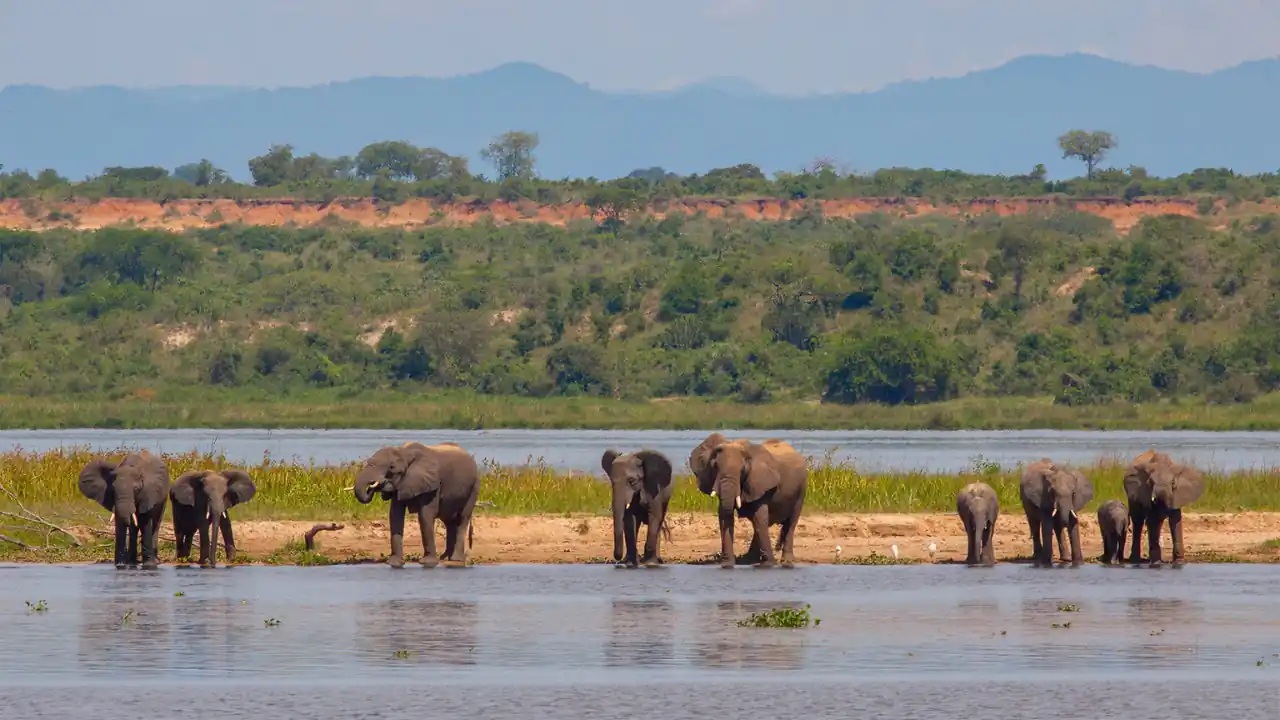
Once you enter Murchison Falls National Park, elephants and buffaloes will likely be your very first sightings. The park hosts massive populations of both species, particularly on the northern bank of the Victoria Nile.
African Elephants
- Where to Find Them: The open savannah plains along the Buligi Game Track, the borassus palm forests, and cooling off at the edge of the river near the Nile Delta.
- How to Spot Them: Keep an eye out during early morning game drives (around 6:30 AM to 9:00 AM) when family groups move across the plains to graze. Alternatively, take the 3:00 PM launch trip along the Victoria Nile to the base of Murchison Falls. Dozens of elephants frequently trek down to the water’s edge to drink, bathe, and splash around in the afternoon heat.
Cape Buffaloes
- Where to Find Them: Distributed across the entire northern section of the park, from Pakuba to the Albert Delta.
- How to Spot Them: Look for vast, dense herds grazing on open grasses early in the day, or single "lone bulls" wallowing in shallow mud holes.
- Pro Tips for Success:
- Watch the Riverbanks: On the boat cruise, look closely at the reed beds and river mudflats. Large herds of buffalo often stand chest-deep in the water to escape heat and insect bites.
- Stay Patient at Waterholes: If you spot an elephant herd approaching a water source during a drive, pull over, turn off the engine, and wait quietly. They will often cross right in front of your vehicle.
- Likelihood of Sighting: 100%. Both species are exceptionally abundant throughout the park.
3. Lions: The Northern Savannah (Days 2 & 3)
Murchison Falls is home to healthy prides of lions, but finding them requires a blend of early starts, sharp eyes, and local knowledge.
- Where to Find Them: The savannah tracks on the northern bank—specifically the Buligi, Queen, and Albert circuits—as well as the open grassy plains around the Pakuba Airfield area.
- How to Spot Them:
- Set Off at Dawn: Lions are nocturnal hunters. Start your morning game drive right at first light (around 6:30 AM) when the cats are still active, patrolling their territory, or finishing off a night catch.
- Look for Prey Clusters: Scrutinize herds of Uganda kob and Jackson’s hartebeest. If a group of antelopes is standing perfectly still, staring intently in one direction, or making sharp snorting sounds, a lion is almost certainly crouching nearby in the long grass.
- Scan Midday Shade: As the sun climbs higher, lions seek relief from the heat under the shade of large acacia trees, thick bushes, or thickets near dry riverbeds.
- Pro Tips for Success:
- Trust the Safari Network: Your driver-guide will be in touch with other park guides via radio. If another vehicle spots a pride resting, your guide can route you straight there.
- Consider a Night Game Drive: If your lodge offers an optional night drive with a ranger, take it. This is your best chance to see lions on the move and hunting under darkness.
- Likelihood of Sighting: Moderate to High. A early morning drive on the Buligi track gives you a strong chance of a memorable encounter.
4. Leopards: The Secretive Hunters (Days 1–3)
Leopards are notoriously secretive, perfectly camouflaged, and solitary, making them the trickiest member of the Big Five to check off a short 3-day itinerary.
- Where to Find Them: Dense riverine woodlands, thick acacia groves, and the rocky areas near Pakuba Lodge ruins.
- How to Spot Them:
- Look Up into the Trees: Leopards love resting on thick horizontal branches high off the ground during the day. Carefully scan the lower and middle branches of sausage trees (Kigelia africana) and large fig trees along the track edges.
- Listen to the Jungle Alarm System: Birds, vervet monkeys, and small antelopes like bushbucks make distinct, frantic alarm calls when a leopard breaks cover. If the bush suddenly gets noisy, stop and scan the undergrowth.
- Drive at Twilight: The late afternoon game drive (4:00 PM to 6:30 PM) as dusk settles is prime time to catch a leopard waking up, stretching, and descending from a tree to begin its evening hunt.
- Pro Tips for Success:
- Bring Quality Binoculars: A leopard blend smoothly into tree bark and dappled sunlight. A good pair of 8x42 or 10x42 binoculars helps turn an ambiguous shadow into a spotted cat.
- Spend Extra Time in Wooded Sectors: While most tourists hurry out to the wide-open plains for lions, ask your guide to spend some time slowly cruising through the brushier, tree-dense sections of the park where leopards prefer to hide.
- Likelihood of Sighting: Moderate to Low. Because 3 days gives you only a couple of game drive windows, spotting a leopard requires keen observation and a touch of safari luck.
Quick-Reference Checklist for Your 3-Day Trip
Big Five Animal
Best Location
Best Time of Day
Ideal Activity
Rhino
Ziwa Rhino Sanctuary
Morning (8:00 AM) or Late Afternoon
Guided Walking Safari
Elephant
Murchison Northern Bank & Nile Banks
Early Morning & 3:00 PM
Game Drive & Nile Boat Cruise
Buffalo
Buligi Track & River Swamps
All Day
Game Drive & Boat Cruise
Lion
Buligi & Pakuba Tracks
Dawn (6:30 AM–8:30 AM)
Early Morning Game Drive
Leopard
Sausage Trees & Riverine Thickets
Dusk / Late Afternoon (5:00 PM–6:30 PM)
Slow Twilight Game Drive
Key Takeaways for a Successful Big Five Safari
- Book an Experienced Local Guide: A skilled driver-guide knows the territorial ranges of lion prides and the favorite resting trees of local leopards.
- Cross to the Northern Bank Early: If you stay on the southern bank of the Nile, take the early ferry or bridge crossing so you are out on the northern tracks before sunrise.
- Patience Pays Off: Keep your eyes peeled, take your time scanning thick brush, and enjoy every wildlife encounter along the way—from giraffes and hippos to giant kingfishers!
Is it truly possible to see all of the Big Five on a 3-day safari in Uganda?
Yes, it is entirely possible, though success depends heavily on strategic route planning and a bit of safari luck. Because wild rhinos do not roam inside Murchison Falls National Park, visiting Ziwa Rhino Sanctuary en route from Kampala or Entebbe is an essential stop. At Ziwa, tracking southern white rhinos on foot yields an almost guaranteed sighting before you even reach the park boundary. Once inside Murchison Falls, species like elephants and Cape buffaloes are remarkably easy to locate in massive numbers across the northern savannah plains and along the Nile banks. Lions are regularly spotted on morning game drives along popular routes like the Buligi, Queen, and Albert tracks. The main wild card on a short three-day itinerary is the elusive leopard, as these solitary cats are expert hiding masters. To maximize your chances of completing the full checklist, plan early morning and late afternoon drives, work closely with a knowledgeable driver-guide who communicates with local ranger networks, and stay vigilant around riverine thickets.
Why are rhinos only found at Ziwa Rhino Sanctuary and not in Murchison Falls National Park?
Historically, both black and northern white rhinos roamed freely across northern Uganda, including the vast plains of Murchison Falls National Park. However, severe poaching during periods of civil instability in the 1970s and early 1980s completely wiped out the country's wild rhino population. To bring these prehistoric giants back from local extinction, the Rhino Fund Uganda established the Ziwa Rhino Sanctuary in 2005 in Nakasongola District. Ziwa provides a heavily guarded, 7,000-hectare fenced breeding sanctuary where southern white rhinos can safely reproduce away from poaching threats. Armed rangers monitor every individual around the clock to ensure maximum security. Because the sanctuary’s primary goal is to build up a sustainable breeding population before eventually reintroducing rhinos back into fully wild national parks, Ziwa currently remains the only destination in Uganda where you can see rhinos in a semi-wild environment. Including Ziwa as a stopover on your drive north is therefore mandatory if you want to complete the full Big Five checklist.
What is the best time of year to spot the Big Five in Murchison Falls National Park?
The dry season months—specifically from December to February and from June to September—offer the absolute best conditions for wildlife viewing. During these drier periods, vegetation thins out significantly, making predators like lions and leopards far easier to spot through the sparse acacia brush and tall grasses. Water sources across the savannah also dry up, forcing heavy concentrations of wildlife, including elephants, buffaloes, and antelopes, to gather around predictable permanent water locations such as the Victoria Nile and the Albert Delta. Furthermore, dirt safari tracks remain dry and easily navigable during these months, reducing the likelihood of getting stuck in deep mud during crucial early morning game drives. While the wet seasons (March to May and October to November) turn the park into a lush, green paradise ideal for birdwatching and scenic photography, tall grasses create natural camouflage for big cats, and sudden rain showers can briefly cause animals to scatter deeper into inaccessible bush sectors.
What is the ideal daily itinerary for a 3-day Murchison Falls and Ziwa Rhino safari?
A well-structured itinerary balances driving time with high-yield wildlife activities. Day 1 starts early from Kampala or Entebbe with a drive north to Ziwa Rhino Sanctuary for a 1.5-hour foot-tracking session. After lunch, continue to Murchison Falls National Park, cross to your lodge, and enjoy an optional sunset game drive. Day 2 is your primary wildlife day: set off at dawn (6:30 AM) for a 3- to 4-hour game drive on the Buligi circuit to track lions, leopards, elephants, and buffaloes. In the afternoon at 3:00 PM, take the three-hour boat cruise along the Victoria Nile toward the base of Murchison Falls to observe elephants and buffaloes drinking along the riverbanks alongside hippos and crocodiles. Day 3 begins with a short sunrise game drive or a hike to the top of Murchison Falls to witness the Nile thundering through a narrow 7-meter gorge, followed by your return journey back to Kampala or Entebbe, arriving in the evening.
How does foot tracking for rhinos at Ziwa work, and is it safe?
Rhino tracking at Ziwa is a unique, foot-based safari experience that is both thrilling and tightly regulated for visitor safety. Upon arrival at the sanctuary headquarters, guests receive a safety briefing from experienced, armed wildlife rangers. You then drive closer to the area where the herd was last spotted before continuing on foot through open woodland and savannah grass. The rangers monitor the movements of the rhinos 24 hours a day, meaning the walk to locate them typically takes between 20 minutes to an hour. Once you reach the rhino family, your ranger will guide you to a safe viewing distance of roughly 60 to 100 feet (18 to 30 meters). You get to spend about 45 to 60 minutes quietly observing and photographing them as they graze or rest. The activity is very safe because southern white rhinos are generally calm animals, and the highly trained rangers know individual rhino temperaments intimately, strictly directing group positioning relative to wind direction.
What packing essentials do I need for a Big Five safari in Uganda?
Packing appropriately ensures comfort and improves your wildlife viewing experience. Essential clothing items include lightweight, breathable, neutral-colored long pants and long-sleeved shirts (khaki, tan, or green) to protect against sun exposure, tall grasses during the Ziwa walk, and biting insects like tsetse flies. Avoid bright colors, as well as dark blue and black, which attract tsetse flies. Sturdy, closed-toe walking shoes or light hiking boots are necessary for rhino tracking. Bring a wide-brimmed sun hat, high-SPF sunscreen, and a reliable insect repellent containing DEET. For photography and wildlife spotting, a good pair of 8x42 or 10x42 binoculars is crucial for locating hidden leopards or distant lion prides. Pack a camera equipped with a telephoto zoom lens (at least 300mm), extra memory cards, and a power bank. Finally, bring a lightweight rain jacket or windbreaker for cool morning drives and river cruises, along with personal prescription medications and cash for tipping guides and rangers.
How common are leopard sightings in Murchison Falls, and how can I increase my chances?
Leopards are notoriously secretive, solitary, and nocturnal, making them the most challenging member of the Big Five to spot on a short three-day safari. However, Murchison Falls National Park supports a healthy leopard population, particularly in areas with dense tree cover and riverine woodlands. To significantly improve your chances, focus your search during prime activity windows: dawn (6:30 AM to 8:00 AM) and twilight (5:00 PM to 6:30 PM), when leopards are actively moving or preparing to hunt. Instruct your driver-guide to spend time scanning the large lower branches of sausage trees (Kigelia africana) and wild fig trees, where leopards frequently haul their prey or lounge away from ground heat. Pay close attention to animal behavior; sudden, harsh alarm calls from vervet monkeys, baboons, or small antelopes like bushbucks often reveal a hiding leopard. Lastly, maintain constant radio communication between your driver and other park guides to stay informed of recent sightings.
What is the difference between a morning game drive and a Nile boat cruise for wildlife viewing?
Morning game drives and Nile boat cruises offer complementary ways to view Murchison’s wildlife in different habitats. Morning game drives take place on land, specifically across the northern savannah circuits like Buligi. They offer your primary opportunity to spot big predators such as lions and leopards while they are active in the cooler early hours, as well as grazing herds of Jackson’s hartebeest, giraffes, and kob. In contrast, the afternoon boat cruise travels along the Victoria Nile to the base of the falls or down toward the Albert Delta. This water-based safari excels at providing close-up, unobstructed views of large herbivores congregating at the river’s edge. Dozens of elephants and buffaloes gather on the banks to drink and bathe in the hot afternoon, while hippos, Nile crocodiles, and aquatic birds crowd the waters. Combining both activities across your three days ensures a complete, balanced overview of the park’s diverse terrestrial and riverine wildlife.
Is a 3-day Murchison Falls safari suitable for families with children or elderly travelers?
Yes, a 3-day Murchison Falls and Ziwa Rhino trip is well-suited for travelers of all ages, provided the itinerary is tailored to comfortable travel speeds. Most of the wildlife viewing inside Murchison Falls takes place from the comfort of a pop-roof 4x4 safari vehicle or a spacious passenger boat, requiring minimal physical exertion. The main physical activity is the rhino tracking walk at Ziwa, which covers gentle, flat terrain at a relaxed pace for about an hour; rangers gladly adjust the walking speed to accommodate younger children or older adults. However, families should prepare for the long road trip between Kampala/Entebbe and Murchison Falls, which takes approximately 5 to 6 hours each way. Booking comfortable, air-conditioned vehicles, scheduling regular stretch stops, staying at lodges with swimming pools, and bringing extra snacks and entertainment for kids will keep long travel days enjoyable for everyone in the family group.
Are night game drives available in Murchison Falls National Park, and are they worth doing?
Yes, night game drives are available in Murchison Falls National Park and offer an incredible, high-thrill opportunity to experience the savannah after dark. Conducted in an open 4x4 safari vehicle equipped with powerful spotlights and accompanied by an armed Uganda Wildlife Authority (UWA) ranger, night drives typically last 2 to 3 hours after sunset. This activity dramatically increases your chances of spotting nocturnal wildlife that remains hidden during daylight hours. Night drives provide your best opportunity to see lions actively hunting, secretive leopards on the prowl, hyenas, civets, genets, bushbabies, and nightjars. Because a 3-day itinerary gives you limited daylight windows to find elusive carnivores, adding a night drive on Day 1 or Day 2 offers a valuable extra opportunity to check lions and leopards off your Big Five list. Note that night drives carry an additional UWA ranger fee and must be arranged in advance through your tour operator or safari lodge.
Which bank of Murchison Falls National Park is best for spotting the Big Five?
The northern bank of the Victoria Nile is unequivocally the superior sector for Big Five game viewing. The northern region features wide-open savannahs, borassus palm groves, and delicate river ecosystems, which host the vast majority of the park’s herbivores—including massive herds of elephants, Cape buffaloes, Rothschild's giraffes, and Uganda kob. Consequently, big predators like lions and leopards concentrate heavily on the northern bank where prey is plentiful, particularly along the Buligi, Queen, and Albert Game Tracks. The southern bank, by contrast, is characterized by denser forest cover and light woodlands, making animal spotting considerably more difficult, though it is home to top-of-the-falls viewpoints and select luxury lodges. If your accommodation is located on the southern bank, you must ensure your guide arranges an early crossing via the Karuma bridge or the local ferry to reach the northern tracks before the morning heat sets in.
How much does a 3-day Big Five safari to Murchison Falls and Ziwa generally cost?
The total cost of a 3-day safari varies based on your chosen accommodation style, transportation type, and group size. A budget safari using mid-tier budget lodges or tented camps generally ranges from $450 to $650 USD per person (based on double occupancy). A mid-range safari utilizing comfortable safari lodges with en-suite amenities costs between $700 and $1,100 USD per person. A luxury safari staying at high-end riverfront lodges with private safari vehicles can range from $1,300 to $2,500+ USD per person. Standard safari packages usually include 4x4 transport with a professional guide, fuel, park entrance fees (currently $45 USD per 24 hours for foreign non-residents), Ziwa rhino tracking fees ($50 USD per adult), the Nile boat cruise fee, accommodation, and all meals. Optional add-ons such as night game drives, hiking to the top of the falls, or flying between Entebbe and Pakuba Airfield will add to the overall cost.
What other notable wildlife can I expect to see besides the Big Five?
While the Big Five receive the most spotlight, Murchison Falls National Park boasts an astounding array of diverse wildlife that enriches your safari experience. The park is famous for holding the world's largest population of the endangered Rothschild’s giraffe (Nubian giraffe), which are frequently seen browsing in large herds across the northern plains. You will also spot abundant ungulates, including Jackson’s hartebeest, waterbucks, bushbucks, oribi, and thousands of elegant Uganda kob. The Nile River is densely populated with thousands of giant hippos and massive Nile crocodiles sunbathing on sandbars. Primate lovers will spot olive baboons, vervet monkeys, and black-and-white colobus monkeys near forest fringes. For birdwatchers, the park is a world-class haven home to over 450 species, including the prehistoric shoebill stork, goliath herons, African fish eagles, red-throated bee-eaters, and giant kingfishers along the water tracks.
What health precautions, vaccinations, and safety guidelines should I consider before going?
Prioritizing health and safety precautions ensures a worry-free safari across Uganda. Yellow fever vaccination is mandatory for entering Uganda, and you must present an official international certificate upon arrival. Because Murchison Falls National Park lies in a malaria-risk area, consulting a travel clinic to obtain recommended antimalarial medication (such as Atovaquone-Proguanil or Doxycycline) before departure is highly recommended. Apply insect repellent containing DEET and wear long clothing during dawn and dusk to minimize mosquito and tsetse fly bites. Drink only bottled or filtered water throughout your trip, and stay well-hydrated under the equatorial sun. From a wildlife safety perspective, always strictly obey your driver-guide and UWA rangers. Never step out of your safari vehicle during game drives except at designated picnic sites or viewpoints, keep noise levels low around dangerous animals, and maintain a safe, respectful distance during all encounters.
What are the key ethical safari practices to follow when viewing the Big Five?
Practicing ethical safari etiquette protects fragile wildlife habitats and ensures safe, rewarding encounters for future travelers. First, respect animal space by never pressuring your driver-guide to drive off designated park tracks; off-road driving crushes vegetation, disrupts delicate root systems, and stresses resting animals. Keep noise levels to an absolute minimum when close to wildlife—loud noises or sudden movements can startle animals, provoke defensive aggression, or disrupt hunting predators. Never feed wild animals, as this habituates them to human food and creates dangerous human-wildlife conflicts. When photographing wildlife, refrain from using flash photograghy, as bright flashes blind and disorient nocturnal predators and mother animals. Finally, manage your waste responsibly by taking all trash out of the park, support local conservation initiatives through park fee payments and community crafts, and choose safari operators that practice sustainable tourism and prioritize animal welfare above all else.
Booking 3-Day Murchison Falls and Ziwa Rhino Trip with us Roads of Adventure safaris
Booking a 3-Day Murchison Falls and Ziwa Rhino Trip with Roads of Adventure Safaris ensures a seamlessly planned Big Five Uganda expedition. Your journey begins with a pick-up from Kampala or Entebbe in a custom 4x4 safari vehicle accompanied by a professional driver-guide. You will track southern white rhinos on foot at Ziwa Rhino Sanctuary before heading to Murchison Falls National Park for scenic savannah game drives along the Buligi circuit. Complete your adventure with a Victoria Nile boat cruise to the base of the mighty waterfall—all bundled with accommodations, meals, water, and entry permits included