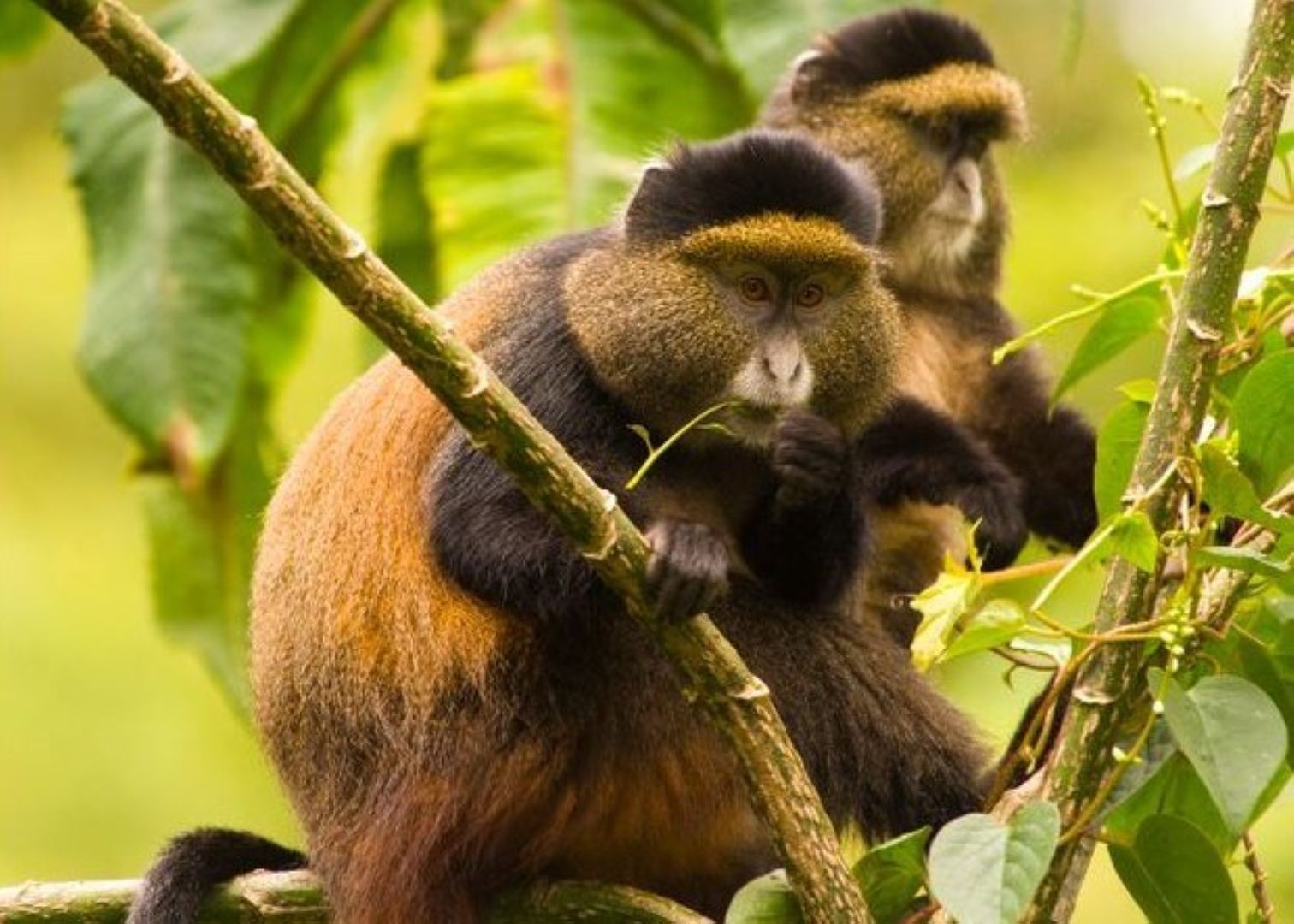
Golden monkey trekking in Rwanda takes place in the lush bamboo forests at the foot of the Virunga Mountains in Volcanoes National Park. This half-day, relatively gentle trek allows you to spend one magical hour observing playful, endangered golden monkeys in large troops of up to 100 members
2-day-golden-monkey-tracking-itinerary-in-volcanoes-national-park
3-days-rwanda-gorilla-trekking-and-golden-monkey-tracking-in-volcanoes
1. What is a golden monkey?
The golden monkey (Cercopithecus kandti) is a remarkably beautiful and rare primate that belongs to the Old-World monkey family. This striking species is entirely endemic to the Albertine Rift, meaning it cannot be found anywhere else on earth except within the high-altitude forests of the Virunga volcanic massif. What immediately sets these primates apart is their spectacular, vibrant appearance. They boast a dense, rich coat of golden-orange fur across their backs and flanks, which contrasts beautifully with the sleek, jet-black fur on their limbs and crowns. This unique coloration allows them to blend seamlessly into the sun-dappled canopies of their favorite bamboo habitats. They are also known for their exceptionally long, furry tails that help them maintain perfect balance as they leap through the trees.
Beyond their looks, golden monkeys are highly social creatures that live in large, dynamic troops that can number anywhere from 30 to over 100 individuals. Within these groups, they exhibit fascinating social behaviors, communicating through a complex system of distinct vocalizations, expressive facial gestures, and playful physical interactions. Because their natural range is so limited, their populations have faced significant pressure over the years from agricultural expansion and habitat fragmentation. Consequently, they are currently listed as an endangered species. Securing an opportunity to observe them in their natural habitat offers travelers an incredibly intimate look at one of Africa’s most endangered and captivating primates, making it a true bucket-list experience for wildlife enthusiasts, photographers, and conservationists alike.
2. Where does tracking take place?
In Rwanda, this incredible wildlife adventure takes place exclusively within the borders of the world-renowned Volcanoes National Park, locally known as Parc National des Volcans. Situated in the rugged northwestern corner of the country, this iconic park protects the Rwandan sector of the vast Virunga Massif, a chain of eight magnificent dormant and active volcanoes that straddle the borders of Rwanda, Uganda, and the Democratic Republic of Congo. The park itself is a sanctuary of breathtaking biodiversity, characterized by mist-shrouded peaks, dense montane forests, and expansive, ancient bamboo groves that climb up the volcanic slopes. This specific ecosystem provides the ideal microclimate and abundant food sources that the golden monkeys require to survive and thrive.
The park's dramatic landscape is dominated by five towering volcanoes: Karisimbi, Bisoke, Muhabura, Gahinga, and Sabyinyo. The unique topography means that as visitors trek through the park, they are treated to spectacular, panoramic views of the surrounding rolling hills, local terraced farms, and deep valleys. Volcanoes National Park is managed with world-class conservation standards by the Rwanda Development Board, ensuring that the fragile habitats are fiercely protected while still allowing sustainable tourism. The park is exceptionally accessible, located just a scenic two-hour drive from the capital city of Kigali along smooth, well-paved roads. This makes it an ideal destination for international travelers looking to experience pristine, wild Africa without enduring long, grueling travel days across the continent, blending raw wilderness perfectly with modern travel convenience.
3. What is the success rate of seeing them?
When clients book a golden monkey tracking excursion, one of their primary questions is whether they will actually manage to see the animals. Fortunately, the success rate for locating these primates in Volcanoes National Park is extraordinarily high, consistently sitting at well over 95%. This exceptional reliability is due to two critical factors: professional habituation and dedicated, daily monitoring by park authorities. Habituation is a meticulous, years-long process conducted by expert conservationists and researchers, during which wild monkey troops are gradually introduced to human presence. Over time, the monkeys learn to view humans as completely neutral elements of their environment, allowing researchers and eco-tourists to approach them closely without causing them stress or altering their natural feeding and socializing behaviors.
Furthermore, the park deploys dedicated teams of advanced trackers who head out into the forest at the break of dawn every single morning. These trackers excel at reading subtle forest signs, following fresh footprints, discarded bamboo shoots, and listening for distinct vocalizations to pinpoint the exact location of the habituated troops. Once they locate the monkeys, they immediately radio the coordinates back to the park headquarters. This means that by the time your clients begin their hike with their assigned guides, the guides already know precisely where to lead the group. While they are still wild animals moving through a dense forest, this sophisticated tracking infrastructure ensures that your clients can embark on their adventure with a massive amount of confidence, knowing a magical wildlife encounter is virtually guaranteed.
4. How long does the trek take?
The entire golden monkey trekking experience typically lasts between 2 and 4 hours from start to finish, making it a fantastic half-day activity that leaves plenty of flexibility for the rest of your itinerary. The overall duration is influenced by the exact movement of the monkey troops on that specific morning, as they naturally roam the forest in search of fresh food. The adventure begins with an informative orientation at the park headquarters, followed by a short drive to the edge of the forest canopy. From the park boundary, the hike through the beautiful bamboo zones to reach the monkeys usually takes anywhere from 30 minutes to two hours of steady walking.
Once the expert trackers guide you to the troop, the clock officially starts on your viewing time. Visitors are permitted a strictly monitored, highly exclusive 1 hour of direct observation with the golden monkeys. This time limit is a crucial international conservation standard designed to ensure the primates do not become overly stressed, dependent, or habituated to human presence, while also minimizing any potential risk of disease transmission. This single hour flies by incredibly fast as you watch the monkeys leap effortlessly through the branches, squabble over food, and groom one another right in front of you. After your sixty minutes of unparalleled viewing conclude, you will bid farewell to the troop and enjoy a leisurely hike back out of the forest to meet your safari vehicle, arriving back in time for lunch.
5. How far do I have to hike?
One of the most appealing aspects of golden monkey tracking is that the physical demand is significantly lower compared to other primate excursions in East Africa. Unlike the famous mountain gorillas, which frequently reside high up on the steep, rugged volcano slopes and require intense vertical climbing, golden monkeys typically restrict their daily movements to the lower, gentler bamboo zones. Because bamboo is their primary source of sustenance, these primates rarely have a reason to venture deep into the higher, more treacherous altitudes of the park. Consequently, the trek to find them is generally classified as moderate and highly accessible for a wide range of fitness levels.
The actual hiking distance varies daily depending on where the monkeys slept the previous night, but visitors can generally expect to walk anywhere from 30 minutes to 2 hours before making contact with the troop. The terrain involves gentle slopes, winding forest paths, and occasionally walking off-trail through thick vegetation. While it is not a grueling mountain climb, the ground can still be uneven, muddy, or slick due to forest moisture and exposed roots. The pace of the trek is always kept comfortable and leisurely, deliberately tailored to the slowest member of the group. Your park guides will pause regularly to share fascinating facts about the local flora and fauna, ensuring that the walk itself is just as enjoyable, educational, and scenic as the destination.
6. How much is a golden monkey permit in Rwanda?
Securing a golden monkey trekking permit is a mandatory requirement for anyone wishing to experience this adventure, and in Rwanda, the permit currently costs $100 USD per person. This price is uniform for all international tourists and represents excellent value, especially when compared to the premium pricing of mountain gorilla permits. This explicit fee covers several essential components of your trekking day to ensure a seamless, safe experience. Most notably, it includes the services of highly trained, English-speaking park rangers and armed guides who accompany you into the forest, sharing their deep ecological knowledge and ensuring your absolute safety throughout the entire excursion.
The permit fee also covers your formal park entry fees for Volcanoes National Park on that specific day, eliminating any hidden costs at the gate. It is important for clients to understand that this permit fee is non-transferable and specifically tied to the date of booking. It covers the administrative and operational costs of the tracking teams who scout ahead to locate the primates each morning. Payment for these permits is typically processed in advance through registered tour operators or directly via the Rwanda Development Board's official online platform, Irembo. When your clients purchase this permit, they are not just buying a ticket to see an animal; they are securing a fully managed, guided expedition into a pristine national park, backed by a professional infrastructure dedicated to delivering a safe, memorable, and world-class wildlife encounter.
7. Does the permit fee support conservation?
Yes, absolutely. One of the most rewarding aspects of purchasing a golden monkey trekking permit in Rwanda is knowing that your tourism dollars are actively contributing to the survival of the species and the well-being of local communities. Exactly 10% of all revenues generated from park permit sales are funneled directly into Rwanda's innovative Tourism Revenue Sharing Program. This highly acclaimed sustainability initiative was specifically designed by the government to ensure that the communities living on the immediate borders of Volcanoes National Park benefit directly from the presence of high-value eco-tourism.
These funds are used to finance vital community development projects, including building modern schools, clean water supply systems, local health clinics, and improved roads. By directly funding these projects, the park transforms local residents into active stakeholders in conservation. When communities see tangible benefits from tourism, it dramatically reduces incentives for poaching, illegal logging, and habitat destruction. Furthermore, the remainder of the permit fee directly funds the daily operational costs of protecting the park itself. This includes paying fair wages to the dedicated rangers, trackers, and anti-poaching patrols who monitor the forest day and night. It also supports ongoing scientific research and habitat restoration efforts. Therefore, your clients' participation in this trek plays a direct, measurable role in safeguarding this fragile ecosystem for future generations to enjoy.
8. Do I need to book my permit in advance?
While it is true that golden monkey permits are not capped quite as strictly as mountain gorilla permits—which allow only eight people per gorilla family per day—booking your permits well in advance is still highly recommended. Volcanoes National Park enforces daily limits on the total number of visitors allowed into the forest to protect the golden monkeys from environmental stress. During the peak tourism seasons, these slots can fill up surprisingly fast. Booking early ensures that you secure your preferred date, allowing you to build a seamless, stress-free itinerary around your primate tracking days.
Advanced booking is also incredibly helpful for your tour operator and the Rwanda Development Board, as it allows them to smoothly plan logistics, assign the appropriate number of guides, and coordinate tracking teams efficiently. Trying to secure a permit at the very last minute can introduce unnecessary stress to your holiday, potentially forcing you to alter your travel dates or miss out on the experience entirely if a large group books out the available slots. When you book your safari through a licensed tour operator, they will handle all the administrative paperwork and permit procurement on your behalf, long before you ever set foot in Rwanda. This ensures that when you arrive at the park headquarters on the morning of your trek, your permits are fully secured and ready, leaving you free to focus entirely on the adventure ahead.
9. Can I buy a permit on the day of the trek?
In some specific instances, it is technically possible to purchase a golden monkey trekking permit on the exact day of the trek directly at the Volcanoes National Park headquarters in Kinigi. The park administration maintains a service desk to handle walk-in requests and process last-minute payments. However, relying on this option is a highly risky strategy that we strongly discourage for anyone operating on a tight travel schedule. If you are traveling during the peak tourism months—such as June through September or December through February—the risk of being turned away due to maximum capacity being reached is exceptionally high.
Furthermore, arriving at the park headquarters at 7:00 AM hoping to purchase a permit can cause significant logistical delays. It requires you to navigate last-minute paperwork, credit card processing, or cash verification during the busiest time of the morning, which can cause you to miss the mandatory safety briefing or delay the departure of your tracking group. If availability is exhausted, you will have wasted an early morning drive and be forced to recalculate your entire day's plans. To guarantee a smooth, professional, and completely stress-free safari experience, it is always best to eliminate all guesswork. Securing your permits weeks or months in advance ensures that your holiday proceeds exactly as planned, without any unexpected disappointments at the park gates.
10. What is the minimum age for tracking?
To participate in a golden monkey trekking expedition in Rwanda, park regulations stipulate that trekkers must be at least 15 years old. This strict age limit is strictly enforced by the Rwanda Development Board at the time of registration, where passports are verified before anyone is permitted to enter the forest. This rule is in place for several critical reasons, revolving around both child safety and wildlife conservation. The forest environment can be unpredictable, requiring a level of physical stamina, emotional maturity, and strict adherence to verbal instructions that younger children may struggle to maintain over several hours of hiking.
Crucially, golden monkeys are highly sensitive primates that share a close genetic makeup with humans, making them incredibly susceptible to human illnesses. Children under the age of 15 possess developing immune systems and are statistically more likely to carry common childhood viruses, colds, or transmissible airborne infections that could devastate a habituated monkey troop. Additionally, if the monkeys suddenly jump close or make loud noises, younger children might panic, scream, or run, which can startle the animals and trigger a defensive or aggressive reaction from the dominant males. By maintaining a minimum age of 15, the park ensures that all participants can hike safely, maintain the required physical distance, and remain completely calm and quiet during the observation hour, protecting both the tourists and the primates.
11. Where do I go to start the trek?
The adventure begins at the main Kinigi Park Headquarters, which serves as the central operational hub for all tourism activities within Volcanoes National Park. Located in the small, vibrant town of Kinigi, the headquarters sits at the base of the spectacular Virunga Mountains, offering breathtaking morning views of the mist-covered volcanic peaks. All trekkers are required to arrive at this beautiful, manicured facility by no later than 7:00 AM. Arriving on time is absolutely essential, as this is where all the pre-trek administrative logistics, permit verification, and group allocations take place.
Upon arrival, your clients will be greeted by the warm hospitality of the park staff and can enjoy a complimentary cup of locally grown, fresh Rwandan coffee or tea while soaking in the traditional musical performances often hosted on the grounds. The beautiful visitor center features educational displays detailing the history, geology, and wildlife of the park. At the headquarters, your guide will present your permits to the park rangers for registration. Once checked in, everyone gathers in designated briefing areas where the lead park rangers deliver a mandatory safety and conservation briefing. This session outlines the rules of the forest, gives an overview of the specific monkey troop you will visit, and assigns your specific park guides, ensuring everyone is fully prepared before driving out to the park boundary trailheads.
12. What time does the day start?
The tracking day starts early, with registration and the mandatory pre-trek briefing beginning promptly at 7:00 AM at the Kinigi Park Headquarters. For travelers staying at local lodges nestled around the park boundaries, this means a wake-up call around 5:30 AM or 6:00 AM to enjoy a hearty breakfast before meeting their driver-guide for the short transfer to the headquarters. The park operates on a strict, synchronized schedule to ensure that all tracking groups enter the forest in a coordinated manner, minimizing disruption to the wildlife and maximizing daylight hours for a safe trek.
Following the 7:00 AM check-in, the formal briefing takes place around 7:30 AM. During this time, rangers explain the ecology of the golden monkeys and review the vital safety protocols. By approximately 8:00 AM, the briefing concludes, and visitors hop back into their safari vehicles with their assigned park guides for a short, scenic drive through local villages to the specific forest trailhead where your hike begins. The actual trek into the bamboo forest kicks off shortly after, usually by 8:30 AM. Starting early in the morning is highly advantageous because the mountain air is still cool and refreshing, and the golden monkeys are at their most active. Early morning is their primary feeding time, meaning you are highly likely to catch them vigorously foraging, playing, and leaping dynamically through the lower canopies.
13. What is the best time of year to track golden monkeys?
Golden monkey tracking can be successfully enjoyed in Volcanoes National Park all year round, but the absolute best times to visit are during the region's two distinct dry seasons. The long dry season runs from June to September, while the shorter dry season occurs between December and February. Traveling during these months offers several distinct advantages for hikers. With significantly less rainfall, the forest trails are substantially drier, firmer, and much less slippery, making the hike through the bamboo zones much easier and physically comfortable. Furthermore, lower humidity levels mean fewer insects along the paths, and clear skies provide gorgeous, unobstructed views of the dramatic volcanic peaks.
However, the rainy seasons—which span from March to May and October to November—should not be entirely discounted. During these wetter months, the park receives regular rainfall, which transforms the landscape into an incredibly lush, vibrant, and emerald-green paradise. This lushness offers spectacular backdrops for professional photography. Because rainfall stimulates rapid plant growth, fresh bamboo shoots are incredibly abundant at the very lowest slopes of the volcanoes. This often means that the golden monkeys don't have to travel far to find food, frequently resulting in much shorter, easier hikes to locate the troops. As long as your clients pack high-quality waterproof gear and sturdy hiking boots, a rainy season trek can be an equally magical, crowd-free adventure.
14. Can I combine golden monkey tracking with gorilla trekking?
Absolutely! In fact, combining golden monkey tracking with a mountain gorilla trek is one of the most highly recommended itineraries for anyone planning a wildlife safari in Rwanda. Because both of these world-class primate excursions operate out of the exact same Kinigi Park Headquarters, logistical planning is incredibly smooth and efficient. Travelers do not need to pack up and change hotels; they can comfortably base themselves at a single luxury lodge or cozy guest house near Volcanoes National Park for two or three nights while experiencing both adventures back-to-back.
A very popular strategy among smart travelers is to schedule the mountain gorilla trek on the first day, followed by the golden monkey tracking on the subsequent morning. This sequence works beautifully because gorilla trekking can occasionally be physically demanding and time-consuming, depending on how deep the gorillas are. Following that up with a golden monkey trek provides a much more relaxed, light, and celebratory conclusion to your primate safari, as the hike is typically shorter and flatter. This combination allows visitors to experience two completely different types of primate behavior: the calm, majestic, and grounded presence of the silverback gorillas, contrasted with the high-energy, acrobatic, and playful leaping of the golden monkeys, offering a beautifully complete and well-rounded perspective on the remarkable biodiversity of the Albertine Rift.
15. Is there a maximum number of people per group?
Unlike Rwanda’s world-famous mountain gorilla trekking, which strictly enforces a hard limit of exactly eight tourists per gorilla family per day, the group sizes for golden monkey tracking are significantly more flexible. Because golden monkey troops are naturally massive—often consisting of 60 to over 100 individuals spread out across a wide area of the bamboo canopy—they can comfortably accommodate larger groups of viewers without feeling crowded, overwhelmed, or threatened. However, park management still carefully monitors and caps the total number of permits issued daily to prevent overcrowding and ensure an elite experience.
Typically, tracking groups average around 16 to 20 people per habituated monkey troop. To ensure that everyone receives an intimate, educational experience, the park assigns multiple professional rangers and armed guides to accompany these larger groups. Once you make visual contact with the monkeys in the bamboo forest, the guides will expertly spread the group out along the trail, ensuring that everyone gets a completely unobstructed, front-row view of the primates as they move through the branches. This flexible group sizing makes golden monkey tracking a fantastic option for larger families, corporate retreats, or organized travel groups who wish to share a profound wildlife experience together in the African bush, without being split up into separate tracking teams.
16. What should I wear?
Dressing appropriately is absolute key to ensuring your clients comfort and safety while tracking golden monkeys in the rainforest. First and foremost, sturdy, waterproof hiking boots with excellent ankle support and deep tread are non-negotiable; the forest floor can be muddy, uneven, and slippery. Clients must wear long, thick trousers and durable, long-sleeved shirts. This clothing choice is critical to protect their skin against stinging nettles, sharp branches, and biting insects that are common in the dense undergrowth. Tucking trousers into long socks is a classic safari trick that prevents safari ants from crawling up legs.
We also highly recommend bringing a pair of lightweight, durable gardening gloves; hikers often need to grab onto nearby branches or vines for balance, and gloves protect hands from thorns and stinging plants. Layering is smart, as early mornings at Volcanoes National Park are quite chilly, but temperatures rise as you hike. A lightweight, breathable, and fully waterproof rain jacket should always be packed, as tropical downpours can occur completely unannounced at any time of year. Finally, a wide-brimmed safari hat and UV-blocking sunglasses will protect against the sun when crossing open terrain at the forest edge. Advise your clients to opt for neutral, earthy colors like khaki, green, or brown, while avoiding bright whites, neon colors, and camouflage patterns, which are reserved exclusively for the military.
17. What do I need to pack in my daypack?
When packing a daypack for a golden monkey trek, the goal is to be fully prepared for changing weather conditions while keeping the bag lightweight enough for comfortable hiking. A comfortable, lightweight, and waterproof backpack is ideal. Inside, clients must pack plenty of safe drinking water—at least two liters is recommended—to stay hydrated throughout the walk. Even though the trek is moderate, the high altitude can cause dehydration quicker than usual. It is also essential to carry a packed lunch and high-energy snacks like nuts, dried fruit, or energy bars, which provide a quick stamina boost during trail breaks.
A small, personal first-aid kit containing band-aids, blister pads, antiseptic wipes, personal medications, and rehydration sachets is highly recommended. High-strength insect repellent containing DEET and a quality sunscreen are absolute must-haves to protect skin from bugs and high-altitude UV rays. Photographers must protect their gear, so packing a completely waterproof dry bag or a heavy-duty plastic rain cover for cameras and smartphones is vital in case of a sudden tropical deluge. Finally, clients should ensure they pack their physical passport and printed booking vouchers, as these must be presented to the park rangers during the 7:00 AM check-in. Keeping a small amount of local currency (Rwandan Francs) on hand is also smart for tipping guides or purchasing local handicrafts at the park entrance.
18. Can I hire a porter?
Yes, absolutely. Upon arriving at the trailhead on the edge of the forest, clients will find a dedicated group of local porters available for hire. Hiring a porter costs roughly $20 to $25 USD per trek, plus an optional tip for exceptional service. This is an outstanding service that we highly recommend to all our safari clients, regardless of their age or fitness level. The porter's primary job is to carry your heavy daypack, camera bags, and water bottles, completely freeing you up to hike unburdened, take photos easily, and focus entirely on navigating the terrain.
Beyond carrying gear, porters act as personal hiking assistants. They are incredibly accustomed to the local terrain and will physically assist you over slippery mud patches, pull you up steep inclines, and ensure your balance over exposed tree roots. Most importantly, hiring a porter is a direct, incredibly powerful form of community conservation and sustainable tourism. Many of these porters are reformed poachers or local residents living right on the park boundary. The income they earn from porting allows them to feed their families, pay school fees, and support the local economy. By hiring a porter, your clients are directly demonstrating to the local community that keeping the forest and its wild primates alive is vastly more profitable than habitat destruction, making it a wonderful win-win for both the traveler and the local destination.
19. What are the rules while with the monkeys?
To protect both the health of the primates and the safety of the visitors, the Rwanda Development Board enforces a strict code of conduct during the trek. When you approach the golden monkeys, you must maintain a safe viewing distance of at least 7 meters (roughly 23 feet) at all times. This boundary prevents the monkeys from feeling cornered or threatened. If a curious monkey naturally hops closer to you along a bamboo branch, you must slowly and calmly step backward to re-establish the required safety buffer.
Furthermore, clients must keep their voices down to a low whisper throughout the encounter to avoid startling the troop. All mobile phones and electronic devices must be switched to completely silent or airplane mode. Flash photography is strictly and absolutely prohibited; the sudden, bright burst of a camera flash can blind, terrify, and agitate the primates, potentially causing the entire troop to flee deep into the forest or display aggressive behavior. Eating, drinking, or smoking anywhere near the golden monkeys is completely forbidden, as dropped food scraps can introduce dangerous human bacteria to the forest ecosystem. Finally, if a visitor feels the sudden need to sneeze or cough, they must turn their head away and cover their face completely to prevent spreading respiratory droplets into the air, safeguarding these precious animals from human illnesses.
20. Will I be able to take good photos?
Yes, you can absolutely take spectacular, award-winning photos of golden monkeys, but photographers should prepare themselves for a thrilling and fast-paced challenge. Unlike gorillas, which tend to sit majestically still on the ground for long periods, golden monkeys are incredibly high-energy, fast-moving, and erratic creatures. They spend the vast majority of their time high up in the canopy, constantly leaping from one swaying bamboo shoot to another, peeling bark, and playing. This means that capturing a crisp image requires a basic understanding of your camera settings before you enter the forest.
To freeze their rapid movements in the relatively low, dappled light of the bamboo forest, it is highly recommended to set your camera to a very fast shutter speed—ideally 1/500th or 1/1000th of a second or higher. Adjusting your camera’s ISO setting upward will help compensate for the shady forest canopy. A telephoto zoom lens (such as a 70-200mm or 100-400mm) is incredibly useful, allowing you to crop in tight on their expressive, golden faces and long tails without needing to be physically close. Remember to switch your autofocus mode to continuous tracking to keep up with their acrobatic jumps. Most importantly, don't spend the entire hour looking through a digital viewfinder; put the camera down occasionally to fully experience the magic of the wild forest with your own eyes.
Booking Golden monkey tacking in Rwanda volcanoes with us Roads of Adventure safaris
To book a Golden Monkey trek in Rwanda’s Volcanoes National Park with Roads of Adventure Safaris, you need to secure a $100 RDB (Rwanda Development Board) permit per person. The agency can package this with your transport, park guides, and lodging
