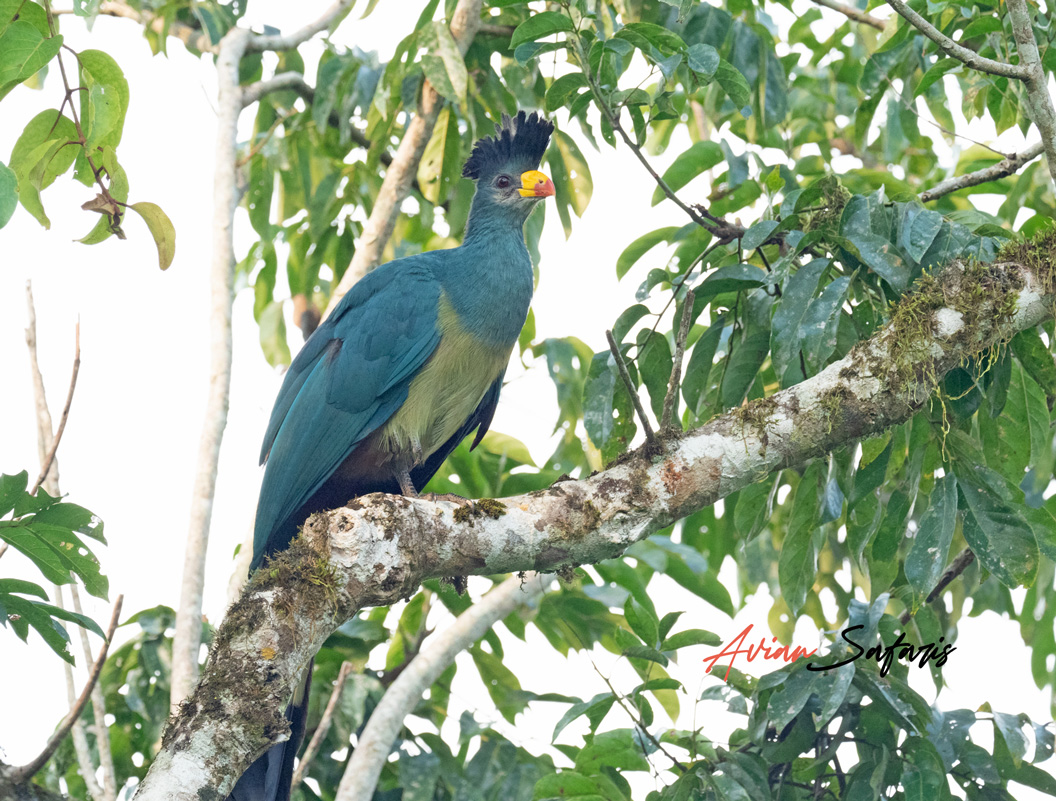
Cyamudongo Forest, an isolated 19-square-kilometer patch of montane rainforest located southwest of Nyungwe National Park in Rwanda, is a premier birdwatching destination. It is particularly famous for housing the rare Red-thighed Sparrowhawk, the Albertine Rift endemic Kungwe Apalis, and the Ross's Turaco
Key Bird Species to Spot
Due to its unique forest-edge habitat and location, Cyamudongo hosts multiple bird species from the Guinea-Congo forest biome
Kungwe Apalis (Apalis argentea)
The Kungwe Apalis is a holy grail for birders visiting the region. As a globally threatened and highly localized Albertine Rift endemic, its population is small and severely fragmented. This tiny, active insectivore is typically found darting through the high canopy or dense vine tangles of primary montane forests. Visually subtle but elegant, it features a greyish back, a white throat, and a distinct pale buff or pinkish wash across its breast. Spotting one requires sharp eyes and a good ear, as they are often detected first by their high-pitched, rhythmic trills. Because its natural habitat is continuously under pressure from agricultural encroachment, the secure enclave of Cyamudongo provides one of the few remaining reliable lifelines for this rare species.
Red-thighed Sparrowhawk (Accipiter erythropus)
This compact, elusive raptor is a true prize for Rwandan birding because Cyamudongo is the only known location in the entire country where it resides. Perfectly adapted to life inside dense forest interiors, it uses its short, rounded wings and long tail to weave seamlessly through the thick mid-story canopy. True to its name, adults feature striking rufous-red thighs, contrasting beautifully with a dark slate-grey back and a finely barred underbelly. They are ambush predators, sitting quietly on hidden perches before launching explosive, high-speed strikes at small forest birds and large insects. Because they rarely fly above the canopy line, catching a glimpse of this specialist requires patience, quiet tracking, and a bit of luck along the forest-edge trails.
Ross's Turaco (Musophaga rossae)
Bringing a spectacular burst of color to the Cyamudongo canopy, Ross's Turaco is one of the most visually stunning birds in the forest. It is a large, deep violet-blue bird capped with a thick, velvety crimson crest that practically glows when caught in the sunlight. Its face is accented by a bright yellow facial patch and a heavy bill. Like other turacos, it possesses unique copper-based pigments that create true greens and deep reds. In flight, it reveals magnificent, bright crimson primary feathers. These birds are highly social and noisy, often traveling in small family groups, bouncing heavily from branch to branch, and letting out cascading, guttural choruses that echo across the forest edges as they forage for wild fruits and berries.
Grey-chested Illadopsis (Illadopsis poliothorax) & Grauer's Warbler (Graueria vittata)
These two species represent the secretive, skulking understory community of the Albertine Rift. The Grey-chested Illadopsis is a small, terrestrial specialist with a warm brown back and a soft grey chest. It spends its days turning over leaf litter on the forest floor in search of invertebrates. It is notoriously difficult to see, though its presence is often revealed by its beautiful, whistling song. Sharing this dense, lower-stratum habitat is Grauer's Warbler, another localized endemic. This warbler is entirely olive-green and grey, heavily marked with distinct, dark horizontal barring across its chest and belly. Both species are masters of camouflage, requiring birders to remain entirely still near dense thickets, listening for their low calls to spot them moving through the shadows.
Dwarf Honeyguide (Indicator pumilio) & White-tailed Crested Flycatcher (Elminia albonotata)
This pairing highlights the structural diversity of Cyamudongo's avian life. The Dwarf Honeyguide is a tiny, highly inconspicuous bird with a tough, olive-green exterior. Like all honeyguides, it is a brood parasite, tricking other small forest birds into raising its chicks. It is also a dietary specialist, capable of digesting beeswax from wild hives. In stark contrast, the White-tailed Crested Flycatcher is an energetic, restless beauty found in the mid-story and canopy. Dipping and twisting through the air to catch insects on the wing, it constantly fans open its long, white-edged tail. Its soft blue-grey plumage and prominent pointed crest make it an absolute joy to watch as it leads mixed-species foraging flocks through the forest edge.
Blue-headed Sunbird (Cyanomitra alinae) & Ruwenzori Turaco (Gallirex johnstoni)
Rounding out the highlights are two magnificent Albertine Rift specialists. The Blue-headed Sunbird is a nectar-feeding jewel of the montane forest. The males display a spectacular, iridescent royal-blue head and throat that shifts and shimmers in the light, contrasting sharply with a dark olive body and bright yellow pectoral tufts. Alongside it sits the iconic Ruwenzori Turaco, a masterclass in avian color. Sporting a blend of moss-green and deep blue plumage, it features a brilliant peach-red patch on its breast and a striking magenta-crimson nape. Listening for the Ruwenzori Turaco's loud, echoing, monkey-like barking calls is a classic part of the Cyamudongo experience, often guiding birders to fruit-bearing trees where both it and the sunbird gather to feed.
Planning Your Birding Trip to Cyamudongo forest
Location of Cyamudongo forest
Tucked away in the southwestern corner of Rwanda within the Nyakabuye sector, Cyamudongo is a fascinating geographic anomaly. It is a completely isolated, 4-square-kilometer patch of dense, ancient montane forest entirely surrounded by a sea of rolling green tea plantations and smallholder farms. Though physically separated from the main, massive block of Nyungwe National Park, it sits just a short, scenic drive to the southwest of it, resting remarkably close to the border of the Democratic Republic of Congo. This unique isolation turns the forest into a literal ecological island. Because it acts as a pristine refuge amidst heavily altered agricultural lands, a dense concentration of rare, forest-dependent wildlife is packed into a compact, easily explorable area, making it a highly rewarding detour for birders and wildlife enthusiasts alike.
Permits & Guides
Navigating the logistics of Cyamudongo is straightforward because it is fully managed as part of Rwanda’s national park system. To enter, you must secure a valid national park permit ahead of time, which can be easily booked directly through the Rwanda Development Board (RDB) or via a registered local tour operator. Because the terrain is dense and trails can weave tightly through thick undergrowth, independent trekking is not permitted; you will be accompanied by an official, highly trained park ranger. These guides are indispensable. They are intimately familiar with the forest’s micro-habitats, possess an incredible ability to identify rare species like the Kungwe Apalis by sound alone, and carry real-time knowledge of where the wildlife has been moving, ensuring your trek is both safe and highly successful.
Combining Activities in Cyamudongo forest
While the birding here is world-class, the ultimate way to experience Cyamudongo is to pair an early morning bird walk with the forest's other famous draw: chimpanzee tracking. Cyamudongo is home to a highly predictable, beautifully habituated community of over 30 chimpanzees. Because this forest patch is relatively small, finding the chimps is often much easier and faster here than in the vast expanses of the main Nyungwe block. A typical itinerary starts at dawn when birds are most vocal in the dense undergrowth and mid-canopy. As the forest wakes up, you transition seamlessly into tracking the chimps by listening for their dramatic, echoing pant-hoots. Spending an hour watching them forage, play, and groom in the canopy, surrounded by rare Albertine Rift endemic birds, offers a truly concentrated, multi-sensory primate and avian safari.
Getting to Cyamudongo forest
Reaching this remote southwestern corner of Rwanda is a remarkably smooth experience thanks to excellent local infrastructure. The fastest and most comfortable option is to book a brief, 30-minute domestic flight via RwandAir from Kigali International Airport to Kamembe International Airport in Rusizi. This flight treats you to breathtaking aerial views of Rwanda’s famous "thousand hills" and Lake Kivu. From Kamembe Airport, Cyamudongo is roughly an hour's drive away. Alternatively, travelers who prefer a scenic overland journey can drive from Kigali, a trip that takes about five to six hours. This route winds along smooth, well-paved roads, cutting through terraced hillsides and directly crossing the stunning, high-altitude canopy corridors of the main Nyungwe Forest block before arriving at the edge of Cyamudongo.
Booking Cyamudongo forest birding with us Roads of Adventure safaris
Booking a birding excursion in Cyamudongo Forest with Roads of Adventure Safaris involves securing a specialized permit and combining it with Nyungwe National Park entry requirements
