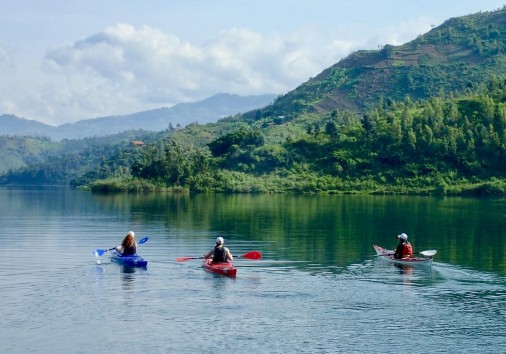
Kayaking at Lake Kivu typically costs between US$25 and $100 per person, depending on the duration and operator. Popular options include sunset tours for around $30 per kayak, short-day, or multi-day guided expeditions (e.g., 4 days for ~$395). Kayaking can easily be added to Rwanda safari itineraries.
16-days-exclusive-rwanda-safari-tour-and-gorilla-trekking-tour-package
12-days-best-rwanda-wildlife-safari-and-rwanda-primate-safari-vacation
10-days-9-nights-midrange-rwanda-gorilla-trekking-wildlife-and-culture
11-days-best-rwanda-safari-tour-holiday-vacation
3-days-budget-chimpanzee-tracking-in-nyungwe-forest-park
3-day-chimpanzee-trekking-tour-package-canopy-and-lake-kivu
- Sunset / Hourly Kayak — Approx. US$30 per kayak for 1 hour
The sunset or hourly kayak option on Lake Kivu is a compact, accessible experience tailored to visitors who want to sample the lake’s beauty without committing to a long excursion. Priced at roughly US$30 per kayak for an hour (as offered through outlets such as the Lake Kivu Serena Hotel), this option is typically ideal for couples or solo paddlers who prefer a relaxed, self-guided outing or a short-guided float timed to catch the light of the fading day.
An hour on the water at sunset transforms the shoreline into a warm tableau of orange, gold and pink reflections, with the Rwandan hills and the DRC coastline often silhouetted against the sky. The pace is intentionally gentle: paddlers can drift near shorelines, peer into shallow coves and watch fishing boats as they return. For photographers and casual sightseers, the low-angle light softens features and provides flattering conditions for portraits and landscape shots. Wildlife sightings at dusk—water birds in flight, small fish schooling near the surface—add quiet moments of discovery.
Operationally, the hourly kayak rental tends to be low-friction. Basic safety briefings, lifejackets and simple instruction are included for novices, while more experienced paddlers can typically launch quickly. Rentals may use stable recreational kayaks or tandems for couples. The relatively modest cost covers maintenance, staff, and the convenience of immediate access from hotel piers or nearby beaches.
Limitations are evident: hour-long trips constrain travel distance and exploration time, and paddlers should arrive a little early for the safety rundown. Weather can shorten or delay operations, and for those seeking deeper immersion—trailerable islands, long sheltered bays or guided interpretation—longer trips or guided options offer far more. Nonetheless, the sunset/hourly kayak remains an appealing, budget-friendly way to taste Lake Kivu’s scenery, especially for visitors with limited time or who want the delight of a quiet evening paddle.
- General Guided Kayaking — Approximately US$25–$30 per person
General guided kayaking tours on Lake Kivu, commonly advertised at about US$25–$30 per person, are a popular mid-range offering for travelers seeking both safety and local knowledge. Unlike unguided rentals, these tours pair participants with experienced guides who provide instruction, route planning and interpretation of the lake’s natural and cultural features. Pricing in this range makes the activity accessible to a broad cross-section of visitors while covering guide wages, equipment upkeep and often basic refreshments.
A typical guided session lasts longer than the one-hour rental—commonly 1.5 to 3 hours—permitting paddlers to move beyond immediate shorelines into scenic inlets, sheltered bays and notable viewpoints. Guides will orient participants to proper paddling technique and safety procedures, and they tailor the pace and route to the group’s ability. For families and novices, the presence of a guide significantly reduces risk and increases enjoyment; experienced kayakers benefit from local knowledge—ideal launch points, current behavior, and bird or plant identification.
Guided tours frequently incorporate cultural elements, such as stories about lakeside communities, the lake’s role in trade and local livelihoods, and seasonal fishing practices. This interpretive layer elevates the paddle from simple recreation to an educational excursion. Some operators include short stops on accessible islets or beaches for photos and snacks. Logistics like round-trip transfers from hotels and provision of lifejackets are commonly part of the package, though specifics vary by operator.
The US$25–$30 price point competes well with other regional activities and fits into many travelers’ daily budgets. It reflects a balance between affordability and quality: experienced guides, maintained kayaks, and moderate group sizes. Travelers should confirm group size limits, inclusions (drinks, transfers), and cancellation policies ahead of booking. Weather-dependence is a factor—operators may reschedule in poor conditions—so flexibility is wise. Overall, guided kayaking at this price offers a safe, informative and enjoyable way to experience Lake Kivu without a major time or financial commitment.
- Full Day Kayak Trip — Approximately US$100
A full-day kayak trip on Lake Kivu, typically priced around US$100, represents a substantial step up in immersion, covering more distance and delivering a richer combination of paddling, exploration and lakeside culture. This all-day experience is aimed at visitors who want to move beyond a sampler outing to a full-day adventure that may include guided routing through varied shorelines, island visits, picnic stops and deeper interpretation of the lake’s ecology.
At this price, the trip is usually guided by experienced local paddlers and includes higher-quality equipment—stable day-touring kayaks, properly fitted lifejackets, and repair or safety gear. The fuller schedule allows paddlers to explore sections of the lake that are inaccessible on an hourly rental: quiet coves, small islets, fishing hamlets and panoramic vantage points on secluded beaches. Stops are often built in for wildlife observation, swimming, lunch on a sandbar or a prepared picnic at a scenic shoreline spot. The guide’s knowledge of currents and wind patterns is particularly valuable on a full-day paddle, helping plan the route to minimize tough crossings and maximize enjoyable stretches.
Logistics included in the roughly US$100 rate may encompass transfers from hotels, a packed lunch or local lunch hosted at a lakeside restaurant, and sometimes extras like snorkel gear, binoculars, or short cultural visits to nearby communities. Safety measures—VHF radios, first-aid kits, and sometimes support craft—are more robust for longer outings.
Expect the day to be physically engaging: paddlers should have basic fitness and be prepared with sun protection, water, and weather-appropriate clothing. The length of time on the water calls for comfort with sustained paddling and occasional wind or chop. Groups are typically small to keep the experience personal and manageable.
For travelers who want to feel they’ve truly explored Lake Kivu, the full-day trip is excellent value. It balances active outdoor time, scenic variety and cultural context—making the US$100 investment an accessible way to create lasting memories and a fuller appreciation of the lake’s landscape.
- Multi-Day Expeditions — 4-Day Guided Kayaking Tours Start Around US$395 per Person
Multi-day kayaking expeditions on Lake Kivu, with typical 4-day guided trips starting at about US$395 per person, are for paddlers seeking a deeper, expedition-style immersion. These tours move beyond day trips to present a paced sequence of paddling, camping or lodge stays, guided cultural interactions and more comprehensive interpretive programming focused on ecology, conservation and local life.
At this price point, operators usually bundle a wide range of inclusions: professional guides with campsite or lodge knowledge, all kayak equipment, safety systems, meals (often including local cuisine), accommodation (camping or guesthouses/lodges), and sometimes transfers from major hubs. The multi-day format allows routes that traverse different parts of the lake, stop at remote villages, and include side hikes, evening talks or cultural visits. Each day’s itinerary is commonly tailored to prevailing weather and group ability, with moderate daily mileage that suits intermediate paddlers.
Expeditions emphasize storytelling and learning: guides often present material about Lake Kivu’s unique limnology, its fisheries, and conservation challenges. They also provide insights into regional history and the livelihoods of lakeside communities, giving paddlers context to what they see. Camping-style sections foster camaraderie and a sense of adventure—sunsets and dawns on the water, cooking over small campfires or at local homestays, and quiet nights under the stars.
The starting price of US$395 covers the basics but may vary with the level of accommodation, group size, and degree of service. Higher-end expeditions that include private transfers, more comfortable lodgings, or specialist guides (birding, photography) will cost more. Participants should be prepared with suitable gear, fitness for consecutive paddling days, and an appetite for simple, often rustic conditions. Weather and lake conditions can affect daily plans, so flexible attitudes are essential.
For committed outdoorspeople, multi-day expeditions are the most rewarding way to experience Lake Kivu—combining sustained paddling, immersive cultural contact and deeper exposure to the lake’s landscapes and life. The cost per day becomes economical when measured against the richness of the experience, and many paddlers consider such trips transformative rather than merely recreational.
How much does a 1–2 hour guided kayak tour cost?
(Guided kayak tours (1–2 hours) typically cost between $30 and $60 per person.)
A 1–2 hour guided kayak tour on Lake Kivu is an ideal short excursion for visitors who want an authentic aquatic taste of Rwanda without a full-day commitment. Typical rates range from about $30 to $60 per person, depending on operator, season, and inclusions. At the lower end you’ll usually find basic guided outings run by smaller, local operators—these tours often include a sit-on-top or recreational kayak, a life jacket, paddles, a short safety and paddling briefing, and a knowledgeable English-speaking guide. Mid-range offerings closer to $50–$60 often include additional comforts such as tandem kayaks for couples, a small snack or bottled water, beach stops for photographs, or short interpretive talks about local fishing traditions and island ecology.
Booking a guided 1–2 hour tour is particularly useful for travelers integrating a Lake Kivu paddle into a broader Rwanda safari itinerary. Guides not only handle logistics but also provide local context—pointing out notable shoreline communities, seasonal birdlife, and the best vantage points for vistas of neighboring hills and the Democratic Republic of Congo across the water. Safety is another key benefit: guides monitor wind and current changes, choose the safest routes for short outings, and assist with re-entry if conditions shift.
Prices vary by pick-up location (Gisenyi/Rubavu and Kibuye/Karongi are common launch points) and by whether hotel transfers are included. Peak travel windows during Rwanda safari high seasons may also push prices upward or require advance reservations. For solo travelers, group rates can lower the per-person cost, while private short tours cost more but deliver a tailored experience. When planning a concise Lake Kivu paddle during a Rwanda safari, confirm exactly what the rate covers—equipment quality, insurance, and cancellation policies—and request current pricing from your Rwanda safari operator to ensure availability and the best match for your schedule.
How much does a full-day kayaking trip cost?
(Full-day kayaking adventures, which often include island hopping, usually cost from $70 to $100 per person.)
Full-day kayaking trips on Lake Kivu, typically priced between $70 and $100 per person, are designed for travelers seeking a richer exploration than a short paddle. These excursions commonly run 6–8 hours and include guided island hopping, visits to local fishing villages, picnic stops on sandbars or small islets, and opportunities for swimming and wildlife observation. For many visitors on a Rwanda safari, a full-day paddle is an excellent way to combine active adventure with cultural encounters and photography time.
At the quoted price range, operators generally supply higher-quality day‑tour kayaks suitable for longer mileage, properly fitted lifejackets, paddles, and a professional English-speaking guide. The cost often covers a packed lunch or lakeside restaurant lunch, bottled water, and sometimes simple extras—dry bags, snorkeling masks, binoculars or support craft for safety. The guide curates a route that balances protected bays and scenic vistas with stops at points of interest such as Napoleon Island’s bat colony (Munini) or shoreline coffee and fishing communities, providing context about local livelihoods and conservation efforts tied to your Rwanda safari experience.
Logistics such as round-trip transfers from major towns (Kibuye/Karongi or Gisenyi/Rubavu) may be included or available for an extra fee. Expect moderate physical demands: full-day paddles require stamina and basic paddling competence, especially if winds rise in the afternoon. Operators will brief groups on safety protocols and monitor weather patterns to adapt the day’s itinerary. Small-group sizes are common to maximize safety and minimize environmental impact; private full-day trips cost more but give greater flexibility.
When choosing a full-day trip during your Rwanda safari, clarify inclusions—meals, transfers, equipment, guide qualifications and minimum participant numbers. Also ask about cancellation or weather‑related rescheduling policies. For those seeking an immersive day on Lake Kivu combining nature, culture and active travel, the $70–$100 bracket typically offers excellent value.
What is the cost of a sunset or sunrise kayak tour?
(Sunset or sunrise kayaking, popular for viewing the "singing fishermen," generally costs between $40 and $70 per person.)
Sunset and sunrise kayak tours on Lake Kivu—priced roughly $40 to $70 per person—provide evocative, time-sensitive experiences prized by photographers, birders, and visitors on a Rwanda safari seeking memorable, low-light moments. These tours are scheduled to coincide with the lake’s most atmospheric hours: the calm morning stillness at sunrise and the warm pastel spectacle at sunset. Both times offer excellent reflections on the water, cooler temperatures for comfortable paddling, and frequent sightings of local fishing activity—locally known as “singing fishermen”—who paddle traditional boats and sometimes sing while hauling nets.
The $40–$70 price range usually covers a guided outing of approximately 1.5 to 2.5 hours, with top-quality lifejackets, paddles, and an experienced English-speaking guide who knows the safest routes for low-light paddling and the best vantage points for photography and wildlife observation. Higher-priced departures often include hotel transfers, a short beach-side snack or tea, and sometimes photographic guidance. Sunrise trips often suit early-rising safari guests headed from a morning game drive or birding session, whereas sunset tours are an ideal capstone to a day on a Rwanda safari circuit.
Safety considerations are important during dawn or dusk paddles: operators select sheltered launch sites and limit excursions to calm weather windows. Guides will conduct a thorough safety briefing and may provide reflective gear or small lights for visibility. Group sizes are usually small to improve control and minimize disturbance to wildlife and local fishermen.
Advance booking is recommended, particularly during Rwanda safari peak months, because these specialized time slots fill quickly. When arranging a sunset or sunrise tour as part of a Rwanda safari, confirm pickup logistics, photographic opportunities, and whether any cultural interactions (meeting fishermen at landing sites) are included. For travelers seeking atmosphere and local flavor in compact sessions, these dawn and dusk tours are a highly rewarding, mid-price option.
How much do multi-day kayak expeditions cost?
(Multi-day kayaking trips, such as those paddling along the Congo Nile Trail, typically cost between $200 and $400 per person.)
Multi-day kayak expeditions on Lake Kivu—frequently priced between $200 and $400 per person—offer immersive travel that suits adventurous guests on an extended Rwanda safari or cross-border itinerary. These expeditions range from modest 2–3 day excursions to longer journeys that may follow sections of the Congo Nile Trail. Prices reflect the greater logistical complexity: professional guiding, multi-day equipment, meals, accommodations (camping or homestays), and often transfers of gear and participants at start and finish points.
At the $200–$400 level, basic expedition packages commonly include kayak and paddle rental, lifejackets, guided route planning, a professional guide (sometimes plus a support boat), camping gear or arranged night stays in lakeside guesthouses, and most meals. Higher-end offerings add comforts—higher-quality touring kayaks, dry bags, hot meals prepared by a cook, private transfers, cultural visits, and expert naturalist or photography guides—pushing per-person rates toward the top of the range.
These expeditions appeal to paddlers who want to chart more remote stretches of the lake, visit clustered islands and lakeshore communities, and enjoy multiple days of scenic paddling and cultural exchange as part of a longer Rwanda safari. Daily distances are planned to match group ability, and guides adjust itineraries for weather, allowing time for side hikes, village visits, and conservation-focused stops. Expedition participants should bring appropriate personal gear, sun protection, and suitable fitness for consecutive days on the water.
Booking in advance is especially important for multi-day trips, as operators coordinate accommodation and food logistics and may run limited departures. Ask prospective providers about group size limits, safety measures (support craft, first aid, communication), insurance, and cancellation terms. The richer immersion of a multi-day paddle adds meaningful depth to a Rwanda safari by combining active travel with sustained cultural contact, scenery, and a slower, more intentional way to appreciate the lake.
Can I rent a kayak without a guide, and what is the cost?
(Yes, you can rent kayaks without a guide. Rentals are generally affordable, costing around $10–$20. However, guided tours are recommended for safety and local insights.)
Yes—you can often rent a kayak on Lake Kivu without a guide, and independent rentals are typically the most budget-friendly option for visitors coordinating their own time during a Rwanda safari. Rental rates usually fall in the $10–$20 range for short periods (one hour to half-day), though prices fluctuate based on kayak type (single vs tandem), season, and the rental location. This choice is attractive for experienced paddlers who prefer their own itinerary or for travelers on a tighter budget who still want on-water access.
Independent rentals commonly include the kayak, paddles, and a lifejacket, and sometimes a brief safety orientation. More comprehensive rental providers will supply dry bags or basic local maps. However, independent rentals generally do not provide guided local knowledge, transfers, or included snacks and will leave route selection and safety decisions to you. For those unfamiliar with Lake Kivu, offshore winds and changing weather can create challenging conditions, and some shoreline areas may have submerged hazards or boat traffic. For these reasons, many Rwanda safari travelers prefer a guided tour, at least for their first paddle, to learn safe routes and to discover highlights they might otherwise miss.
If you choose to rent independently, check the provider’s safety policy: ask about lifejacket quality, weather cut-off rules, whether a support boat is available for emergencies, and if the rental company requires leaving identification or a deposit. Consider renting a tandem kayak if you prefer extra stability, or upgrading to a sturdier day‑tour kayak for longer paddles. Always tell your accommodation or host your planned route and expected return time.
For Rwanda safari planners, combining a self-guided rental with a later guided tour can be a smart approach—get comfortable with the water on your own, then deepen the experience with a guide’s cultural and ecological insights. Independent rentals are economical, but travelers should weigh cost savings against safety and the interpretive value offered by guided options.
Are there special prices for Rwanda residents?
(Yes, Rwandan residents can often get local currency prices or discounted USD rates compared to international tourists. It is recommended to contact local operators directly.)
Yes—many Lake Kivu operators and tourism providers offer special rates or local-currency pricing for Rwandan residents, and this practice is common across East African tourist sites. Local discounts reflect government or operator policies designed to make domestic travel more accessible and to encourage local engagement with natural and cultural attractions that are also part of Rwanda safari itineraries. Resident rates may be advertised as a distinctly lower price or offered upon presentation of a Rwandan ID or passport showing residency.
Discount formats vary: some providers publish reduced prices for Rwandan citizens, while others extend preferential rates to East African Community nationals. The discount amount and whether it applies to guided tours, equipment rentals, or island landing fees will depend on the operator’s policy. Many times, the advertised international USD price is not applicable to residents; instead, residents pay in local currency (Rwandan franc) and enjoy a lower charge. It’s good practice for residents to contact operators directly—via phone, WhatsApp, or email—to confirm eligibility, exact rates, and any documentation required.
For travelers organizing a Rwanda safari that includes both resident and international participants, clarify billing arrangements with the operator in advance to prevent confusion. Residents often find that guided experiences become far more economical, enabling more frequent exploration of Lake Kivu’s islands, fishing communities, and conservation projects.
Note that during peak tourist seasons or special events, discounts may be limited or subject to availability. Also confirm inclusions—transfers, meals, equipment—since discounted resident rates might exclude add-ons that international packages include. For anyone planning a Rwanda safari, reaching out to local operators directly provides the most accurate and current resident pricing and demonstrates respect for local booking procedures.
What is included in the cost of a kayaking tour?
(Guided tours typically include the kayak, life jacket, safety instructions, and an experienced, English-speaking guide.)
When you book a guided kayaking tour on Lake Kivu as part of a Rwanda safari, the advertised price typically covers the essentials needed for a safe, enjoyable outing. At a minimum, most guided packages include a seaworthy kayak (single or tandem), a properly fitting life jacket, a paddle, and a pre-departure safety briefing that covers re-entry techniques, local weather patterns, and basic paddling strokes. An experienced, English-speaking guide is also standard—this guide manages navigation, selects sheltered routes, interprets local natural and cultural features, and monitors group safety throughout the trip.
Beyond these basics, many operators bundle additional conveniences that enhance the overall experience: round-trip transfers from nearby hotels (especially for departures in Kibuye/Karongi or Gisenyi/Rubavu), bottled water, snacks or a packed lunch on half-day or full-day trips, and dry bags for storing valuables. For longer trips or premium packages, the cost may include binoculars, snorkeling masks, support craft or a safety boat, and local cultural experiences such as visits to lakeside communities or short guided walks on accessible islands.
Some tours integrate interpretive elements that connect well with a Rwanda safari narrative—guides will explain local fisheries, conservation challenges, and the ecology of the lake’s islands, and they may coordinate stops at sites of local significance (for instance, bat colonies or coffee-growing hamlets). Photography-focused tours sometimes offer tips or extra time for sunrises and sunsets.
Before booking, confirm the full set of inclusions with your Rwanda safari operator: transfers (and whether they’re from your specific lodge), food and drink policies, group size limits, insurance coverage, and the guide’s language skills. Understanding precisely what’s included helps you compare offerings and ensures your kayak outing complements your broader Rwanda safari plans without unexpected costs.
What is not included in the cost?
(Typically, costs exclude transport to the lake, tips for guides, dry bags (sometimes), personal items, and accommodation.)
While guided kayaking tours on Lake Kivu often include core services, there are common exclusions that travelers should expect to budget for separately—especially when combining paddling with a Rwanda safari. Many operators price the activity without including long-distance transfers from major hubs, so transport to and from the lake (or to a specific launch site) may be charged separately unless the operator explicitly lists round-trip transfers in the package. Accommodation—whether pre- or post-trip stays at lodges or guesthouses—is also typically outside the tour fee.
Other typical exclusions are gratuities for guides and support staff; tipping is customary rather than mandatory, and amounts are discretionary (a small tip of a few dollars per participant is common for short trips, more for multi-day expeditions). Some operators don’t provide dry bags, sunscreen, hats, or waterproof phone cases, so participants should bring their own personal items for comfort and protection. Insurance—travel or activity-specific coverage that includes paddling—often isn’t included and is the traveler’s responsibility.
Specialized equipment or optional extras—hotel pickup from a distant location, photography guides, higher-grade touring kayaks, or single-use protection kits—may also be priced separately. Similarly, entry or landing fees for particular islands or community donations might not be included; always ask if specific islands you plan to visit require additional payments. Food beyond what’s specified (for instance, drinks at a lakeside restaurant) and alcoholic beverages usually fall outside the tour rate.
Before confirming a booking as part of a Rwanda safari, request a written inclusions/exclusions list from the operator to prevent surprises. This clarity helps you pack appropriately (sun protection, change of clothes, water-resistant footwear) and budget for extra costs like transfers, tips, and any desired add-ons.
Where can I book kayaking tours on Lake Kivu?
(Tours can be booked through specialized operators like Kingfisher Journeys, Visit Lake Kivu Adventure (based in Kibuye), or through your Rwanda safari agent.)
There are multiple booking channels for Lake Kivu kayaking tours, and the best choice depends on how you’re organizing your Rwanda safari. Local, specialized operators—such as regionally based outfits and community-run adventure groups—offer direct bookings and often the most authentic, locally informed experiences. Examples include operators active around Kibuye (Karongi) and Gisenyi (Rubavu): Visit Lake Kivu Adventure in Kibuye and Kingfisher Journeys (or similar local providers) are known names that can arrange guided paddles, sunset trips and multi-day itineraries. These local companies are strong options for those wanting to support community-run initiatives and secure flexible start times.
Alternatively, many Rwanda safari agents and inbound tour operators incorporate Lake Kivu kayaking into broader safari packages. If you’re booking a multi-day Rwanda safari that includes gorilla trekking, game viewing and cultural visits, your safari operator can coordinate kayaking as a day or overnight activity—handling transfers, timing relative to park permits, and accommodation logistics. Booking through your main Rwanda safari agent simplifies logistics and helps ensure activities align with your overall schedule.
If you prefer independent booking, contact operators directly via email, WhatsApp or their websites; smaller providers often respond quickly via WhatsApp and can supply immediate availability and pricing. Hotels and lodges on Lake Kivu also frequently offer on-site kayak rentals or can make reservations with trusted local guides—this is especially convenient for guests preferring to book once they arrive.
Before confirming any booking, request clear details on price inclusions, safety provisions, group sizes and cancellation policies. For Rwanda safari travelers, coordinating kayaking with other activities—gorilla permits, park transfers, or inter‑city travel—often saves time and reduces the risk of schedule conflicts, so many visitors find booking through their Rwanda safari agent to be the most seamless option.
Does the price change based on the group size
(Yes, private and luxury tours often vary in price based on group size, with smaller groups potentially paying more per person.)
Yes—group size is a common factor influencing the per-person price of kayaking tours on Lake Kivu. Operators frequently price activities differently for walk-up group sessions, small shared groups, and private or luxury bookings. For shared guided trips where multiple independent travelers join a group, per-person rates tend to be lower because costs—guide time, transfers and equipment—are spread across more participants. Conversely, private tours and bespoke experiences tailored to couples or families typically command a premium per person because the operator commits exclusive guide attention, flexible routing and often private transport or special inclusions.
Small-group discounts apply when operators can fill standard departures to a minimum number of participants—this model keeps per-person costs down and is common for 1–2 hour and half-day tours. Private bookings (for instance, a private sunrise paddle or a tailored full-day itinerary during your Rwanda safari) eliminate the need to coordinate with others but are priced higher; you’re effectively buying the guide’s time and logistic convenience.
For multi-day expeditions, the cost structure is similar: larger groups benefit from shared fixed costs (chef, support boat, campsite fees), while solo travelers or couples may pay near single-supplement rates. Luxury operators may offer per-person rates that scale with group size but maintain a minimum price for private departures.
When planning a Rwanda safari that includes kayaking, clarify with your operator whether quoted rates assume a minimum group size, whether there’s a private-tour surcharge, and if there are discounts for larger groups. If you’re traveling in a small party and want to reduce costs, ask about joining scheduled group departures. Conversely, if privacy and customization are priorities during your Rwanda safari, expect to pay somewhat more for exclusive, smaller-group experiences.
Is there a cost to visit "Napoleon Island" by kayak?
(Yes, trips to Napoleon Island (Munini) to see the bat colony are often part of a guided package costing around $60–$100 depending on the distance from Gisenyi or Kibuye.)
Napoleon Island (Munini) is a popular Lake Kivu destination because of its notable bat colony and striking shoreline, and visits there are commonly offered as part of guided kayak trips. The cost for a kayak excursion that includes a landing at Napoleon Island typically falls within the $60–$100 range, depending primarily on launch location, trip duration, and whether additional services—transfers, lunch, or interpretive guidance—are included. Operators launching from Gisenyi (Rubavu) may charge differently than those based in Kibuye (Karongi), due to transfer distances and the time required to reach the island.
Because Napoleon Island involves an island landing and a short interpretive stop to view the bat colony and local flora, operators often bundle the cost of entrance or community landing fees into the package. Guides provide cultural context and ensure minimal disturbance to wildlife, and they manage safe beaching and reboarding procedures. Higher-priced excursions may combine Napoleon Island with other nearby islands or offer extended paddling routes with picnic lunches and photographic opportunities.
For travelers planning a Rwanda safari, the island visit provides a compact, memorable wildlife encounter that complements gorilla or game-viewing experiences by showcasing a very different ecosystem and local livelihoods. When booking, ask whether the quoted price includes any landing or park fees, whether there is a separate conservation or community contribution expected, and what safety measures are in place for landing and re-embarkation.
If independent kayak rental is available, a visit to Napoleon Island without a guide might be possible—but it’s generally not recommended due to landing logistics and conservation considerations. To ensure a respectful, safe, and informative visit to Munini, most visitors opt for a guided package that handles permissions and offers rich local interpretation.
Are there hidden costs, such as entry fees
(Generally, no. The cost of a guided tour usually includes the activity, but you should clarify if there are landing fees on specific inhabited islands.)
Typically, guided kayaking tour prices for Lake Kivu are transparent, and most operators include the core activity costs in their quotes—kayak, life jacket, guide, and basic safety measures. However, there are occasional additional charges or local fees you should confirm before booking. Some inhabited islands or community-managed landing sites may levy small landing or community contribution fees that are not always listed in online pricing. While these fees are usually modest, they are important to budget for and to respect as part of sustainable tourism practices that support local communities.
Other potential “hidden” costs include hotel-to-launch transfers (if not included), optional extras such as picnic lunches, snorkeling gear rental, or support-boat accompaniment. On multi-day expeditions, additional charges may arise for special accommodation upgrades, private transfers outside typical pickup zones, or park and conservation fees if the itinerary crosses protected areas. Gratuities for guides and support staff also fall outside the base tour cost but are customary and appreciated.
To avoid surprises during your Rwanda safari, request a detailed inclusions and exclusions list from your chosen operator. Ask explicitly whether any island landing fees, community contributions, permits or park entry charges apply to your planned route (for example, visits to Napoleon Island). If you have accessibility needs or require extra logistics, clarify whether those services incur extra charges. Reputable Rwanda safari operators and local providers will be transparent about any community levies and often incorporate them into the total price or note them clearly at booking.
How much should I tip the kayaking guide?
(Tipping is not mandatory but appreciated. Generally, a few dollars ($5–$10) per person for a guided tour is common.)
Tipping practices for kayaking guides on Lake Kivu tend to be informal yet appreciated, and while not mandatory, gratuities are a meaningful way to recognize excellent service—especially on a Rwanda safari where local guides often play a central role in shaping the experience. For short guided tours (1–2 hours), a tip in the region of $3–$10 per person is common; for half-day or full-day trips, tipping $10–$20 per person is typical depending on the guide’s level of service, local norms, and the inclusions provided. On multi-day expeditions, gratuities accumulate and groups sometimes collect a pooled tip to distribute among guides, cooks and support staff at the trip’s conclusion.
When deciding how much to tip, consider factors such as the guide’s professionalism, safety attentiveness, storytelling and interpretive value, and assistance with logistics like loading/unloading equipment. If your operator provided exceptional extras—transport coordination, photography assistance, or cultural introductions—you may wish to tip more. Conversely, if an excursion was hampered by operator issues or safety concerns, your tip could reflect your overall satisfaction.
If you’re unsure about local expectations when planning your Rwanda safari, ask your lodge or safari agent for guidance on customary amounts. It's good practice to carry small denominations in local or widely accepted currency (U.S. dollars are commonly used, but Rwandan francs may be more practical for smaller amounts). When tipping, hand gratuities directly to the guide and, if part of a longer expedition, consider a modest tip for other support staff as well. Ultimately, a thoughtful tip acknowledges personal service and supports the local individuals who make your kayaking and Rwanda safari experiences memorable.
What are the best places on the lake for affordable kayaking?
(Both Gisenyi (Rubavu) in the north and Kibuye (Karongi) in the middle are top spots. Kibuye is frequently recommended for its calm waters and many islands.)
For budget-minded travelers on a Rwanda safari, Gisenyi (Rubavu) and Kibuye (Karongi) stand out as the best Lake Kivu bases for affordable and accessible kayaking. Each offers slightly different character: Gisenyi in the north is more lively and closer to the border with the Democratic Republic of Congo, providing easy access for day-trip logistics and a selection of operators and accommodations. Kibuye, located centrally on the lake, is often the preference for paddlers seeking calmer water, a cluster of small islands, and scenic island-hopping routes that suit half-day or full-day tours at reasonable rates.
Kibuye’s protected bays and island-rich shoreline make it especially attractive for inexpensive guided outings and rentals: calmer conditions reduce rescue needs and support smaller local operators who can run frequent departures at lower per-person prices. The islands near Kibuye are ideal for picnics, short hikes and visits to fishing communities, increasing the value of a modestly priced tour. Gisenyi’s benefits include more developed hospitality options and easy connectivity for travelers combining the paddle with broader Rwanda safari elements like gorilla permits in the southwest or road transfers north.
To secure the best affordable options, consider booking through local guesthouses or community-run operators who often offer lower prices than international resellers. Lodges on Lake Kivu also frequently organize group departures for guests at reduced rates. Off-peak seasons and shared group departures reduce costs as well. When seeking economy options, check what’s included—equipment quality, safety briefing, and transfers—so that a low headline price still delivers a safe and enjoyable experience as part of your Rwanda safari.
Do I need to book in advance? (It is highly recommended to book in advance, especially during the dry seasons (June–September, December–February) to ensure availability.)
Yes—bookings for Lake Kivu kayaking should be made in advance whenever possible, particularly if you’re coordinating the paddle as part of a broader Rwanda safari. High-demand windows—the dry seasons roughly from June to September and December to February—coincide with peak international travel and increased domestic tourism. During these months operators, lodges and guides book up quickly, and specialized departures (sunrise/sunset slots, full-day island-hopping trips and multi-day expeditions) can sell out days or weeks ahead.
Advance booking ensures you secure preferred dates and times, guarantees the right kayak type for your party (single vs tandem, recreational vs touring kayaks), and helps operators plan logistics like transfers, meal provisioning and safety support. If you’re visiting during a busy period and combining kayaking with gorilla trekking or other permit-limited activities on a Rwanda safari, coordinating times is essential to avoid schedule conflicts. Operators also appreciate advance notice for arranging small-group departures, assigning qualified guides, and obtaining any required landing permissions for island visits.
Booking Kayaking at Lake Kivu on Rwanda safari with us Roads of Adventure safaris
Booking your Lake Kivu kayaking experience with Roads of Adventure Safaris offers a unique, serene adventure in Rwanda, perfect for relaxing after gorilla trekking. We arrange guided, safe paddling sessions on the clear, calm, crocodile-free waters of Lake Kivu, with options in Gisenyi or Kibuye. Paddle alongside local fishermen singing at sunset, explore hidden, scenic islands like Napoleon Island with its colony of fruit bats, or visit nearby coffee farms. Using stable, modern kayaks, our tours cater to all skill levels, providing an intimate, low-impact perspective of Rwanda's breathtaking "Inland Sea" and lush, terraced hillsides. It is an unforgettable, peaceful, and immersive adventure, ideal for nature lovers and photographers
