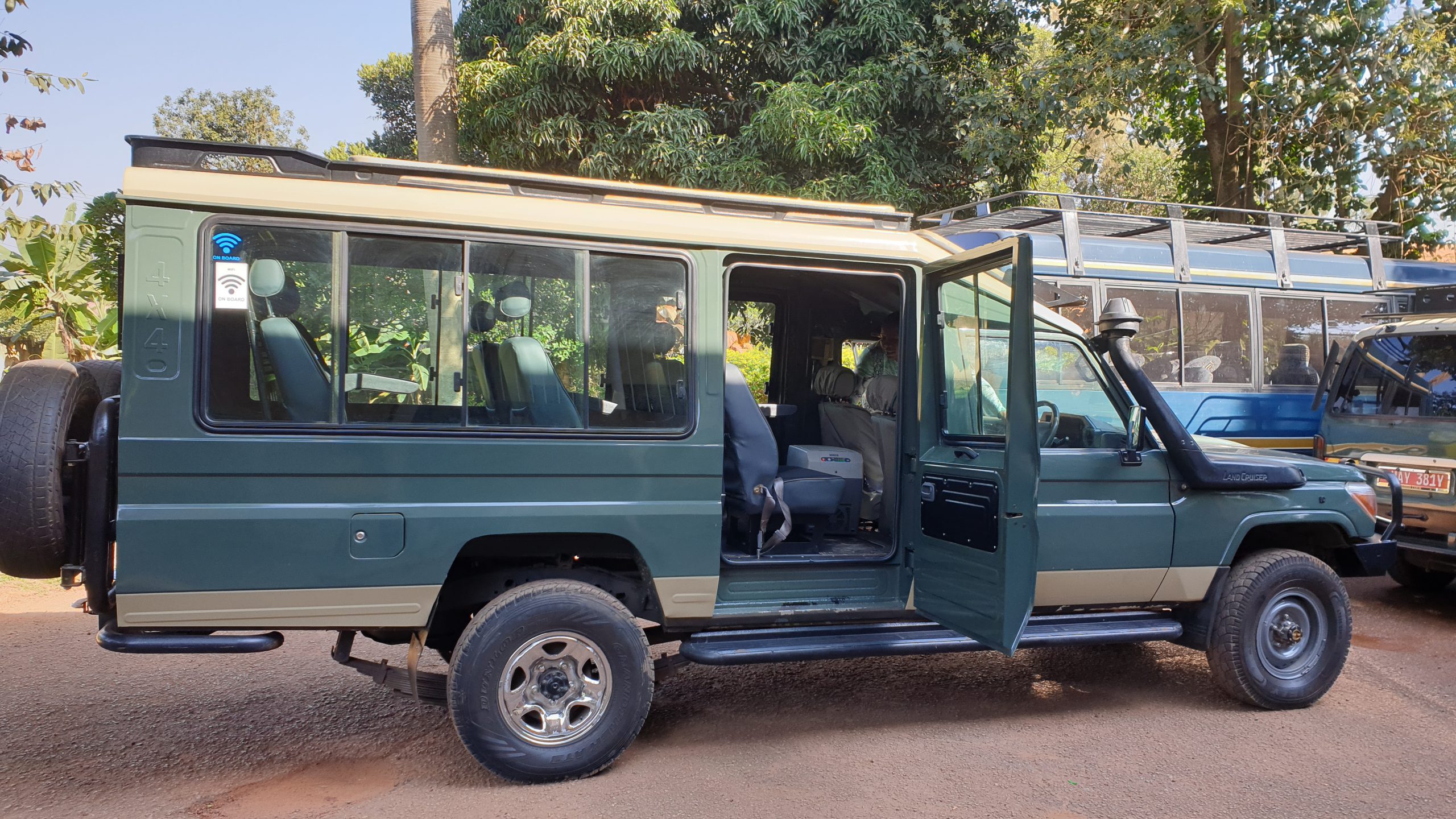
Renting a 4x4 vehicle is essential for navigating national parks like Murchison Falls park, Queen Elizabeth national park, Kidepoa valley national park, Kibale forest park, Lake Mburo national park or Bwindi Impenetrable. Rates range from $50 to $180+ per day without the cost of a professional safari driver guide depending on the model, with self-drive and driver-guided options available from Roads of Adventure safaris ltd, we have a fleet of vehicles that can assist you make your travel dream come true in Uganda
Some of the popular tour packages you can follow for your Uganda safari
18-days-best-of-uganda-safari-holiday-vacation-to-all-best-parks
16-days-classic-uganda-wildlife-safari-and-gorilla-trekking-tour
15-days-africa-big-five-safari-in-uganda-and-primate-vacation
14-days-uganda-and-rwanda-safari-tour-itinerary
10-days-9-nights-midrange-uganda-wildlife-safari-and-cultural-experience
7-days-best-gorilla-trekking-and-safari-in-uganda-to-see-big-fives
7 popular vehicles are highly recommended for a Uganda safari
Top Uganda safari vehicles include the Extended Land Cruiser, V8, and Prado for reliable 4x4 performance, alongside budget-friendly Safari Vans and RAV4s. The Toyota Hilux and Super Custom Van provide added durability and comfort for groups and campers. These vehicles offer tailored features like pop-up roofs, air conditioning, and heavy-duty 4x4 capabilities for diverse terrain
1) Extended Safari Land Cruiser (for Uganda safari comfort)
The Extended Safari Land Cruiser is one of the best choices when your Uganda safari involves frequent transfers between parks and you want high comfort on rough roads. This matters most on routes that include graded tracks, uneven ground, and sudden rain—conditions common around Murchison Falls and parts of Queen Elizabeth. The vehicle is designed with safari-focused features that improve real wildlife viewing time. A pop-up roof lets you scan for wildlife with better sightlines than seated viewing, which is useful in open savanna where animals may be far apart and partly hidden by grass. Raised suspension also improves stability on washboard roads and rocky sections by helping the wheels stay in contact more consistently, which usually reduces harsh bouncing and makes the ride easier for long driving days. Luggage space and extra legroom are also practical facts, because Uganda safaris often include early starts, packed day bags, and multiple lodge transfers where you don’t want to compress luggage into tiny spaces.
In suitability terms, this cruiser fits best for guided safaris and medium-to-large groups, typically around 5–7 passengers. That capacity range is important because you want each traveler to sit comfortably during long drives and still carry enough safari gear (jacket layers for early morning, water, binoculars, camera bags). For wildlife examples, this kind of vehicle is especially effective on game drives in Queen Elizabeth where you may track elephants, buffalo, antelope, and predator possibilities like lions and hyenas across open and semi-open landscapes. It also helps around Murchison Falls where you might drive to viewpoints and river edges to watch wildlife movement along the Nile corridor; scanning from a roof is a big advantage when animals are near riverbanks or in tall vegetation.
Cost-wise, many operators quote about 130–200 USD per day, and it often includes a driver-guide, which is valuable because local driving skills reduce risk on muddy access roads and help you time game-drive routes. When you choose this option, ask for concrete checks: the condition of tyres (tread depth for mud), suspension health, whether the roof mechanism is safe and reliable, air-conditioning performance for hot drives, and whether the vehicle is insured and whether a driver is included. For Bwindi-style steep roads, a well-maintained cruiser with good tyres and suspension is particularly comforting before and after gorilla-related activities.
2) Toyota Land Cruiser V8 (strong for muddy parks)
The Toyota Land Cruiser V8 is a tough, reliable option for Uganda safaris where road conditions can change quickly, especially after rainfall. Its main suitability strength is that it is commonly a full-time 4x4, which means traction can feel steadier on slippery or muddy ground compared with part-time systems. This becomes important on safari days that include rough tracks leading to park sectors, long transfer drives between parks, and unexpected muddy patches. It’s also a good choice when you expect more “driving time” than “short scenic hops,” because it tends to handle uneven terrain with less strain, keeping the ride controlled even when surfaces are not smooth.
In safari context, the V8 is well matched to destinations like Murchison Falls and Queen Elizabeth where you may travel on dusty tracks that later become wet, and where roads can be uneven near park gates and across access corridors. It is also suitable for mixed itineraries with camping or “gear-heavy” days because the vehicle can be configured to carry luggage efficiently without feeling unstable. For wildlife examples, a V8 works very well for sustained game-drive scanning in open ecosystems. In Queen Elizabeth, where plains game and predator sightings can be spaced across large areas, being in a stable 4x4 helps you keep moving and reach the right sectors at the right times. In Murchison Falls, it supports viewpoint and river-edge drives that help you observe wildlife patterns around the Nile system (such as elephants moving along corridors and buffalo/antelope near open river-adjacent zones).
Capacity is usually around 4–6 passengers depending on configuration, which makes it good for couples, small groups, or families that want more space per person than a van. Pricing is often around 90–120 USD per day, and that figure can vary depending on whether the rental includes a driver-guide or is self-drive. If you plan self-drive, suitability depends on two practical factors: (1) whether the tyres have adequate tread for mud/rock, and (2) whether you get clear insurance coverage and documented guidance. Ask whether the rental provides road-ready tyres, whether the spare tyre and jack are present, and whether the vehicle has reliable brakes, suspension, and air-conditioning.
Bottom line: choose the V8 if you want confidence on wet and muddy surfaces while maintaining strong comfort for long driving days. It often gives a “middle-to-premium” balance—more robust than smaller 4x4 options but sometimes less costly than extended cruiser safari models.
3) Toyota Land Cruiser Prado TX / TXLA (great for couples & small groups)
The Toyota Land Cruiser Prado TX/TXLA is a strong safari fit for couples and small groups who want reliable 4x4 ability plus manageable vehicle size. Its suitability comes from a balance: it can handle off-road tracks and uneven surfaces while being easier to maneuver than larger cruisers, which matters on narrower access roads around some park approaches. Uganda safaris include both highway-style driving and slower, rougher segments near parks. The Prado is designed to cope with this mix without making every transfer feel exhausting, which is essential if your itinerary includes multiple activities such as game drives plus forest excursions like chimp tracking in Kibale or primate-focused drives near forest edges.
For destinations, the Prado suits routes like Queen Elizabeth National Park for game drives and crater-lake/scenic day trips, because many driving segments are manageable but still require real ground clearance. It also works for parts of Murchison Falls trips where you may encounter rougher tracks before reaching viewpoint areas and river corridors. For Bwindi and similar steep-country roads, the Prado can be suitable if the vehicle is well maintained with strong tyres and suspension—because gorilla-related days often involve slow movement, waiting, and short drives that still add up to long total time.
Capacity is commonly up to about 4 passengers in many safari configurations, though some rentals may carry slightly more depending on layout. The advantage is that couples and small groups can sit comfortably, keep luggage organized, and avoid feeling squeezed. In wildlife terms, the Prado is ideal for classic safari viewing where you do repeated game-drive sessions. For example, in Queen Elizabeth, you may encounter elephants, buffalo, and antelope across open grasslands and woodland edges, and predator sightings like lions may appear depending on sector and timing. In forest-edge areas, the ability to move steadily on slower roads helps you reach chimpanzee tracking areas earlier, which is useful because tracking is time-sensitive and depends on where your group needs to be when the activity starts.
Typical rental pricing is about 60–80 USD per day, often making it one of the best cost-to-comfort options for serious travelers. When booking, ask for specific condition checks: tyre tread (mud and rocky track readiness), brake performance, suspension condition, and whether the vehicle’s air-conditioning handles long daytime drives. Also confirm whether the safari setup includes roof viewing options (if any) and ensure luggage space matches your group’s packing style.
Overall, the Prado is a smart choice when you want true 4x4 confidence without paying extended cruiser pricing, especially if your safari plan is classic and focused on activities that don’t require the biggest group-capacity vehicles.
4) Toyota Safari Van (Hiace) (best value for families)
The Toyota Safari Van (Hiace) is a practical and budget-friendly choice for Uganda safaris when you need capacity and group togetherness. The biggest suitability reason is that many safari vans are set up to carry more passengers than typical 4x4 cars, while still maintaining comfort for long travel days. This matters a lot for families and groups who want everyone to stay together—from lodge transfers to park gates and back—without splitting into multiple vehicles. For destinations, the Hiace can work well on routes that include Queen Elizabeth and Murchison Falls, especially if your itinerary is planned around accessible game-drive sectors and the road conditions on your specific route are not extremely muddy.
A key safari feature to confirm is viewing access. Many safari vans can be modified with a pop-up roof or elevated viewing arrangement. This matters because wildlife viewing is not only about being inside the vehicle; it’s about having the correct viewing height when animals are in tall grass, near riverbanks, or spread out across wide areas. With a roof arrangement, the van can still deliver meaningful wildlife scanning, especially for elephants, buffalo movement corridors, and birdlife along waterways. For families, that matters during downtime too—everyone stays comfortable while waiting for sightings, and the group can move efficiently between photo stops and activity start times.
Capacity is often up to about 9 passengers depending on configuration, which can be ideal for families. Pricing is frequently around 70–100 USD per day, and often a driver is included, which increases safety and reduces stress in unfamiliar roads. For wildlife examples, on Murchison Falls days you might drive to viewpoints or river edges where you see crocodiles in the Nile system and observe birds and mammals moving along the corridor. In Queen Elizabeth, your van can support group game drives where you may see elephants and antelope, and possibly predators depending on the sector and time of day. The elevated viewing setup is particularly useful when multiple people want to photograph without leaning or crowding.
When choosing this option, confirm luggage accommodation because family trips often include more bags (camera gear, gifts, extra clothing layers, and medical supplies). Ask whether the roof viewing setup is safe and sturdy, whether passengers sit with seatbelts, and whether luggage is secured away from passenger areas. Also ensure the van’s tyres and suspension are appropriate for your safari’s terrain, especially in wet months when roads can soften quickly.
In short, the Hiace is a strong value option when capacity and convenience are your priorities, and when you confirm that the vehicle is set up for safe elevated viewing and reliable road handling.
5) Toyota RAV4 (budget 4x4 for simpler routes)
The Toyota RAV4 is often the most affordable “4x4 category” rental, and it can be suitable for Uganda safaris if your route is planned around better-maintained tracks and you are comfortable with less extreme off-road capability. Its suitability depends on the exact terrain you’ll face. In many parts of Uganda, roads can become muddy after rain, and some park approaches include rocky or uneven segments. The RAV4 may handle lighter tracks well when tyres are good and driving is careful, but it may not feel as confident as a Land Cruiser type vehicle on deep mud or very rough stretches. Therefore, this option is best when your safari design minimizes risky secondary routes and focuses on accessible park-entry roads and structured game-drive schedules.
For destinations, the RAV4 can work for areas where driving segments are manageable and where lodges are reachable through relatively predictable roads. If you’re planning an itinerary that is mostly around main routes and scheduled activities, it becomes a realistic budget choice. For wildlife viewing, your success still depends on timing and sector selection. Even with a smaller vehicle, you can enjoy seeing wildlife at common viewing zones where animals gather—such as birds near water and open areas with regular sighting patterns. For example, many travelers experience strong birdlife across Uganda’s savanna and river-adjacent ecosystems, and a RAV4 can still reach these areas if the access road is not severely compromised.
Capacity is typically about 4 passengers, making it best for solo travelers or couples who travel light. The advantage is cost efficiency: you pay less for vehicle rental and you don’t need to pay for multiple vehicles for a small group. Typical pricing is often around 40–50 USD per day, which is a major factor for budget travelers.
However, the most important suitability checks are vehicle-condition and seasonality. Ask for tyre tread depth, brake condition, suspension health, and how the vehicle handles wet roads. Confirm the rental’s insurance terms and whether the operator discourages self-drive in certain park access situations. If you plan to visit remote sectors with bad roads, the RAV4 may become risky and could cost you money in delays or damages.
Wildlife examples that match this “simpler route” approach include scenic stops where bird photography is a focus, and moderate road game drives where the route stays mostly passable even in light rain. If you choose the RAV4 for parks like Murchison Falls or Queen Elizabeth, be selective: use it for sectors reached via roads that are known to be accessible during your travel month, and keep a contingency plan if weather changes.
Overall, the RAV4 is a budget 4x4 solution for travelers who plan carefully, travel light, and choose safari destinations and sectors that align with the vehicle’s comfort and traction limits.
6) Toyota Hilux Double Cab (rugged pickup for adventurous Uganda safari plans)
The Toyota Hilux Double Cab is a rugged pickup option for travelers who want adventure flexibility and good equipment-carrying capacity. Its suitability comes from durable construction and the practical advantage of carrying safari gear—especially if your plan includes camping equipment, rooftop tents, or extra bags for remote side visits. Compared with a standard passenger vehicle, the Hilux can be a smart match when your safari style involves hauling gear and taking a bit more independence in your daily logistics. This is particularly relevant if you are doing longer scenic routes or planning to visit additional viewpoints beyond the most common lodge-to-park pathways.
In Uganda, terrain can vary from smooth stretches to sections that are rocky, dusty, or muddy. A Hilux can handle many of these conditions well if tyres are appropriate and if the vehicle is maintained. However, it’s still important to match the vehicle to the destination: for deep-mud days and very rough access tracks (common in wet seasons and some countryside approaches), you need careful driving and a sensible route plan. If your itinerary includes Murchison Falls and Queen Elizabeth, the Hilux can work well for some transfer segments and for wildlife-viewing days where the roads remain manageable. For more extreme routes—especially where roads become rutted and slippery—the larger, safari-optimized Land Cruiser types may offer more comfort and confidence.
Capacity for the Hilux Double Cab is usually around 4–5 passengers depending on the setup. The pickup bed can carry equipment (with proper waterproof covers and secure straps), which is valuable because safari families of gear and camping travelers often pack more. Pricing is often about 80–100 USD per day, depending on whether a driver is included.
Wildlife examples that fit an adventure-focused pickup style include open-area scanning during early morning game drives and roadside viewing opportunities where wildlife movement is visible. In savanna regions like Queen Elizabeth, elephants and antelope often move through predictable landscape corridors, and a pickup vehicle can be useful for reaching sectors and keeping an efficient schedule. If your adventure includes birding or photography stops during transfers, the vehicle’s cargo practicality also helps you carry lenses, tripod bags, and protective covers without crowding seats.
When booking, confirm the Hilux is properly configured for safari use. Ask whether there are secure covers for the bed, whether luggage is properly restrained, whether tyres are suitable for mud and rocks, and whether the cabin seating is comfortable enough for long days. Also verify if self-drive is allowed for your route plan, and confirm insurance coverage.
In summary, the Hilux is a strong choice for travelers who prioritize hauling gear and have an adventurous itinerary, provided the road conditions are realistic for a pickup and the vehicle is properly prepared for rain, mud, and sustained driving.
7) Super Custom Van (comfortable mix for small groups)
The Super Custom Van is a comfort-first option for small groups who want enough space for passengers and luggage while still having some form of safari viewing advantage. Its suitability is mostly about the balance between comfort and visibility. Many variants can include air-conditioning and seating that feels easier on travelers during long transfer days, which is important when Uganda safaris combine early morning wildlife drives with midday lodge time and late afternoon scenic movement. Compared with some very rugged cruisers, the van approach often makes the “lodge-to-park day rhythm” smoother because it feels less tiring for passengers, especially for travelers who are not seeking maximum off-road toughness every single day.
For destinations, the Super Custom Van works best on itineraries that include classic parks like Queen Elizabeth and parts of Murchison Falls where access roads are not extremely severe for your travel month. It can also work well for forest-adjacent activities like chimp tracking in Kibale when your route includes slower drives and waiting time. Wildlife viewing can still be strong because safari success depends more on timing and sector selection than the brand name of the vehicle. If the van includes a pop-up roof or elevated viewing option, it improves scanning for animals in grass or near water.
Capacity is often around up to 7 passengers depending on layout, which makes it a great group-size fit for small families or friend groups who want shared transport. Pricing is commonly about 80–100 USD per day, and many rentals include a driver, which improves suitability because local driving helps you avoid risky shortcuts and improves safety on changing road conditions.
Wildlife examples that match the van style include day activities where you do repeat short game-drive sessions and more frequent photo stops. In Queen Elizabeth, visitors often enjoy seeing elephants, buffalo, and antelope across savanna sectors, and predators can appear depending on the time and area. In Murchison Falls, viewpoints and river corridors provide wildlife opportunities and strong birdlife; a comfortable van helps you stay alert and ready even when sightings take time.
Before booking, confirm the most important suitability details: whether there is a safe viewing setup (roof access if offered), whether seatbelts and passenger safety features are solid, and whether luggage can be secured without crowding passengers. Also ask for tyre condition and suspension checks, because comfort vehicles can still struggle if tyres are worn or if mud is deep.
Overall, the Super Custom Van is a practical middle-ground option: it keeps the safari comfortable for small groups and can deliver good wildlife viewing when the viewing setup and road suitability are confirmed for your specific destinations and travel dates.
Requirements and Eligibility: IDP and Age Requirements
When planning a Uganda safari, understanding the legal and regulatory framework for operating a vehicle is the first step toward a successful journey. If you intend to rent a car for a self-drive expedition, your domestic driver's license is legally valid for up to three months, provided it is printed in English. If your home license is in any other language, a certified translation or an International Driving Permit (IDP) is strictly required to facilitate roadside verification by local traffic police. However, even for English-speaking travelers, reputable local agencies highly recommend carrying an IDP. This serves as a universally recognized document that streamlines interactions at checkpoints, preventing unnecessary travel delays during your cross-country exploration.
Beyond licensing, strict age thresholds dictate eligibility for self-drive operations. While the statutory legal driving age in Uganda is 18, private providers apply much more stringent risk assessments. To rent a car without a chauffeur, the vast majority of local rental fleets mandate a minimum age of 23 or 24, combined with a clean driving record spanning at least two consecutive years.
This elevated threshold accounts for the demanding nature of navigating deep-country pathways. Agencies safely assume that younger drivers may lack the practical experience needed to manage a heavy 4x4 on unpaved roads. Upper age limits also exist, typically capping self-drive rentals between 70 and 75 years. If you fall outside this specific 23-to-75 window, your primary option for executing a safari is to hire an authorized company chauffeur. This option eliminates personal liability concerns regarding age, while transferring all operational responsibilities to a seasoned professional.
2. Costs and Fleet Logistics: Mileage Policies and Vehicle Selection
Budgeting for a remote Uganda safari requires a detailed analysis of mileage terms and vehicle suitability. Most dedicated self-drive agencies provide rates inclusive of unlimited mileage. This structure gives you the complete freedom to traverse vast distances—such as driving from Kampala to the isolated Kidepo Valley National Park near the northern border—without incurring incremental distance penalties. However, you must carefully read the fine print. Certain standard operators impose a strict daily cap, often between 100 and 150 kilometers. Exceeding this boundary triggers steep per-kilometer surcharges that can quickly compromise a budget-conscious itinerary. Always confirm that your contract explicitly states "unlimited mileage" before departing for distant wilderness regions.
When evaluating vehicle options for challenging conditions, selecting the right platform is critical. A compact Toyota RAV4 functions well as a light crossover for paved highways or well-maintained dirt paths. However, its all-wheel-drive system lacks the necessary low-range gearing and high ground clearance required to negotiate deep mud tracks.
Confronting the waterlogged clay roads of Bwindi Impenetrable National Park or Queen Elizabeth National Park in a RAV4 frequently results in chassis high-centering or loss of traction. For genuine off-road demands, a robust 4x4 like the Toyota Land Cruiser Prado is much better suited. Featuring a dedicated manual transfer case, superior wheel travel, and an elevated seating position, the Prado effortlessly powers through deep mud ruts. Investing an extra $20 to $30 per day to upscale from a RAV4 to a heavy-duty Prado protects your vacation from the logistical nightmare of getting stranded in remote areas.
3. Insurance and Emergencies: Coverage Boundaries and Breakdowns
Navigating the financial and mechanical risks of an African self-drive tour requires robust protective policies. When you rent a car for a Uganda safari, standard rates generally feature comprehensive insurance, which aggregates Collision Damage Waiver (CDW) and third-party liability. This policy protects against theft, vehicle fires, and major structural damage resulting from collisions.
However, "comprehensive" does not mean zero financial exposure. Every contract features an insurance excess—a deductible ranging from $500 to $2,000 depending on the vehicle class. In the event of an accident, you are personally liable for all repair expenses up to that specific deductible amount. Furthermore, standard policies explicitly exclude single-vehicle damages, such as shattered windscreens, punctured tires, ruined suspensions from potholes, or engine lock caused by driving through deep water. If damage results from reckless driving, speeding, or operating under the influence, the entire insurance policy becomes null and void.
In the event of a mechanical failure or if your 4x4 becomes immobilized in a remote area like Bwindi, you must execute an established roadside emergency protocol. First, secure the vehicle on a safe shoulder, step away from areas with heavy wildlife presence, and record your exact GPS coordinates. You must contact your rental agency's 24/7 emergency hotline immediately before authorizing any local repairs.
Reputable providers maintain active networks of regional mechanics situated near major tourism hubs. For minor issues like flat batteries or broken belts, a local mechanic will be dispatched to your location within a few hours. If the vehicle suffers a major mechanical breakdown that cannot be repaired on-site, the company is contractually obligated to dispatch a replacement 4x4 from Kampala. While awaiting rescue, remain with the vehicle, keep your communication lines open, and rely on the guidance of park rangers if you are stranded inside national park boundaries.
Guided vs. Self-Drive Options: Chauffeur Costs and Logistical Support
Choosing between an independent self-drive tour and a chauffeur-driven Uganda safari is a key decision that impacts both your budget and your overall travel experience. Opting to hire a professional local driver-guide typically introduces a modest premium, ranging from $30 to $50 extra per day. While this addition increases your upfront baseline expenses, it provides significant practical value.
An experienced guide handles the daily stress of navigating challenging mountain switchbacks, avoiding deep potholes, and managing aggressive city traffic. This allows you to relax and enjoy the scenery. Furthermore, professional safari guides possess expert tracking skills. They understand animal behavior and communicate via radio networks with park rangers, significantly increasing your chances of spotting elusive wildlife like lions, leopards, and mountain gorillas.
A common concern for travelers is managing the logistics of their driver's daily upkeep. Fortunately, standard industry practices in Uganda are designed to minimize your direct responsibilities. The daily driver fee paid to your agency is all-inclusive; it covers their professional salary, meals, and overnight accommodation
Most safari lodges and wilderness camps provide specialized, low-cost "driver quarters" and staff meals routinely built into their operational overhead. You are not responsible for hosting the driver at your dinner table or booking them a guest room at your luxury resort. The only out-of-pocket expenses you might consider are optional tips to reward exceptional service at the end of the trip, along with covering park entry fees for the driver and vehicle at official gates. Choosing a guided safari allows you to enjoy premium logistical support while avoiding the risks of navigating unfamiliar off-road tracks on your own.
Equipment and Cross-Border Travel: Camping Geometrics and Regional Transit
Transforming your 4x4 into a self-contained mobile home is an increasingly popular way to experience a Uganda safari. Leading agencies offer comprehensive outfitting packages, providing high-quality camping gear for an additional fee of $20 to $40 per day. This package typically features heavy-duty rooftop tents or ground tents, foam mattresses, sleeping bags, folding tables, camp chairs, a gas cooker, storage boxes, and full cooking utensils
Choosing a rooftop tent provides excellent protection from damp ground conditions and crawling insects, allowing you to set up camp in designated park campsites within minutes. When you rent a car with full camping gear, it is critical to verify the condition of the zippers, tent canvas, and cooking equipment before leaving the central depot in Kampala to ensure self-sufficiency in remote areas.
If you plan to expand your journey into neighboring East African countries like Rwanda or Kenya, you must arrange cross-border logistics well in advance. Driving a rental vehicle across international borders is highly feasible, but it requires explicit written permission from the vehicle owner and specialized documentation. You cannot simply drive through a border post without prior authorization.
Agencies charge a one-time processing fee of $50 to $100 to prepare a cross-border permit pack. This pack includes an official authorization letter, a certified copy of the vehicle logbook, and COMESA Yellow Card insurance—a regional third-party policy that extends liability protection across participating African nations. At the border, you will also need to secure a temporary importation permit for the vehicle. Inform your agency of your regional itinerary during the initial booking stage so they can prepare the necessary paperwork and ensure your 4x4 is fully cleared for international travel
Best Time for a Uganda Safari
The ultimate time to embark on a Uganda safari is during the country’s two distinct dry seasons: June to August and December to February. During these optimal months, rainfall is minimal, ensuring that remote dirt roads and hiking paths remain completely passable. In savanna reserves like Murchison Falls and Queen Elizabeth National Park, wildlife viewing reaches its peak as the bush thins out and animals naturally congregate around permanent waterholes and rivers. For travelers eager to track endangered mountain gorillas in Bwindi Impenetrable National Park or chimpanzees in Kibale Forest, the dry weather makes the steep forested terrain significantly less muddy and much easier to navigate. While a Uganda safari is technically viable year-round due to its stable equatorial climate, the wetter months of March to May often bring heavy downpours that can disrupt travel logistics and leave off-road tracks waterlogged.
What Places to Visit on a Uganda Safari
A classic Uganda safari delivers an extraordinary blend of primate encounters and traditional big-game viewing across diverse ecosystems. The undisputed highlight is Bwindi Impenetrable National Park, a UNESCO World Heritage site home to roughly half of the world's remaining mountain gorillas. For savanna game drives and boat cruises, Murchison Falls National Park showcases the dramatic explosion of the River Nile through a narrow gorge, alongside thriving populations of elephants, giraffes, and lions. Nearby, Queen Elizabeth National Park is famous for its unique tree-climbing lions in the Ishasha sector and the wildlife-rich Kazinga Channel. Primate enthusiasts should target Kibale Forest National Park, celebrated as the primate capital of East Africa with over 1,300 chimpanzees. For those seeking an isolated wilderness, Kidepo Valley National Park offers rugged, untouched landscapes filled with vast buffalo herds and rare carnivores.
Where to Stay on a Uganda Safari
Accommodations on a Uganda safari effortlessly cater to all travel styles, budgets, and comfort preferences, ranging from rustic campsites to world-class luxury lodges. In primate tracking hubs like Bwindi and Kibale, high-end choices like Clouds Mountain Gorilla Lodge or Primate Lodge provide exquisite forest views, gourmet dining, and private chalets built right into the jungle canopy. For travelers prioritizing mid-range comfort, highly reliable eco-lodges such as Bakiga Lodge or Turaco Treetops offer hot solar showers, cozy cottages, and exceptional hospitality. In the savanna parks like Murchison Falls and Queen Elizabeth, spectacular waterfront properties like Paraa Safari Lodge and Mweya Safari Lodge position you directly along the banks of the Nile and Kazinga Channel. Budget-conscious adventurers can opt for well-maintained safari tents, basic bandas, or public campsites managed by the Uganda Wildlife Authority, allowing you to sit by an open campfire under the stars.
Booking a Uganda Safari with Roads of Adventure Safaris
Booking your dream trip with Roads of Adventure Safaris guarantees a seamlessly organized, authentic East African journey. As a trusted local tour operator, they specialize in custom tailoring both private guided tours and flexible self-drive 4x4 itineraries to match your exact timeline and budget. Their expert team handles all the heavy lifting, from securing highly competitive gorilla and chimpanzee trekking permits well in advance to reserving top-tier safari lodges. Whether you want to rent a car fully equipped with rooftop camping gear for a rugged expedition or prefer an open-roof Land Cruiser with an expert local driver-guide, they ensure your vehicle is perfectly prepped for the terrain. To begin planning your Uganda safari, simply reach out through their digital booking platforms. A dedicated safari consultant will quickly draft a detailed, day-by-day itinerary to transform your bucket-list travel vision into reality
