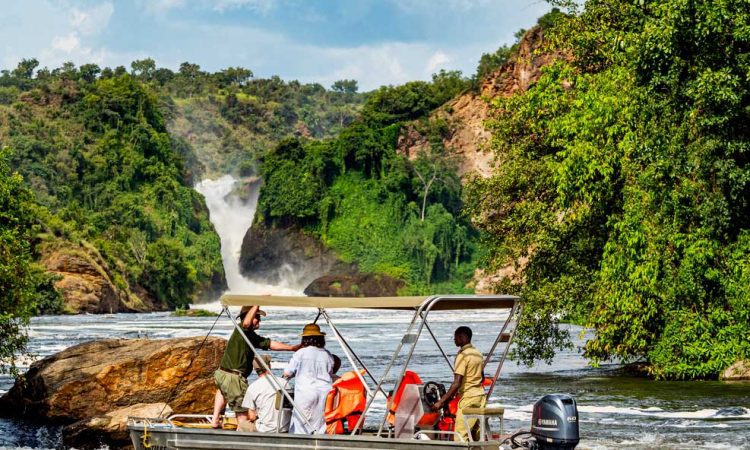
Combining a Murchison Falls safari with chimpanzee trekking in Budongo Forest gives you the best of both worlds: big game viewing across open savanna and intimate wildlife encounters in dense rainforest.
Located right along the southern boundary of Murchison Falls National Park, the Kaniyo Pabidi sector of Budongo Forest lets you track habituated wild chimpanzees without adding long travel detours to your trip.
4-days-murchison-falls-and-chimpanzee-tracking-in-budongo-forest
Key Trip Details & Logistics
- Location: Kaniyo Pabidi block, Budongo Forest Reserve (just past Kichumbanyobo Gate on the southern edge of Murchison Falls National Park).
- Chimp Trekking Times: Morning briefings start around 8:00 AM, and afternoon sessions begin at 2:00 PM.
- Trek Duration: Expect 2 to 4 hours of walking through the jungle, which includes a full 1 hour sitting with the chimpanzee group once located.
- Chimp Permit Fee: Approximately US$130 per person (managed via Uganda Wildlife Authority / National Forestry Authority guidelines; prices subject to change).
- Best Booking Window: Secure your chimp permits at least 2 to 3 weeks ahead during peak dry months (June–September and December–February).
Detailed Day-by-Day Itinerary
Kampala / Entebbe ──> Ziwa Rhino Sanctuary ──> Budongo Forest ──> Buligi Plains / Nile River ──> Kampala
Day 1: Drive from Kampala to Budongo Forest (via Ziwa Rhino Sanctuary)
- Morning: Set off early (around 6:00 AM) from Kampala or Entebbe to stay ahead of city traffic. Drive north along the paved Kampala-Gulu highway toward Ziwa Rhino Sanctuary in Nakasongola. The drive takes about 3 hours.
Upon arrival, join a ranger guide on foot for a 1.5 to 2-hour white rhino tracking experience, giving you a rare chance to walk close to Uganda's only wild rhino population.
- Afternoon: Stop for a hot lunch near the sanctuary or in Masindi town. Afterward, push further north toward Murchison Falls National Park. You will cross through Kichumbanyobo Gate and enter the cool, towering mahogany canopy of Budongo Forest. Check into your lodge (such as Budongo Eco Lodge) early enough to settle in and listen to the woodland sounds.
- Day 1 Summary: Rhino tracking at Ziwa, road transfer, scenic forest entrance, and lodge relaxation.
Day 2: Chimp Trekking in Budongo Forest & Transfer to Northern Murchison
- Morning: Wake up to early bird calls and enjoy breakfast at your lodge. Gather at the Kaniyo Pabidi visitor centre by 7:30 AM for a safety talk and orientation before venturing into the jungle at 8:00 AM.
Follow trained trackers as they listen for chimp vocalizations and crack branches. Along the way, keep your eyes peeled for black-and-white colobus monkeys, red-tailed monkeys, and rare forest birds like the chocolate-backed kingfisher. Spend one hour observing the chimps as they groom, feed, and interact in the high branches or forest floor.
- Afternoon: Head back to camp for lunch, then take a drive through the southern park sector toward the Victoria Nile riverbank. Cross over to the northern bank (via the bridge or ferry) where the dense woods clear out into open grasslands. Check into your northern lodge, unwind, and enjoy a brief sunset drive across the plains if time allows.
- Day 2 Summary: Morning chimpanzee tracking, forest birding, crossing the Nile, and late afternoon savanna views.
Day 3: Sunrise Game Drive, Nile River Boat Safari & Hike to the Top of the Falls
- Morning: Head out into the savanna by 6:30 AM to catch predators active at dawn. Focus your search around the Buligi Game Tracks, where you stand great chances of spotting lions, leopards, Rothschild's giraffes, African elephants, Jackson's hartebeests, and large herds of Uganda kob.
- Afternoon: Return to the lodge for a midday break and lunch. At 2:00 PM, board the famous 3-hour launch cruise heading upstream along the Nile toward the base of Murchison Falls. Watch pods of hippos, Nile crocodiles, and watering elephant herds lining the banks.
Disembark at the bottom of the gorge and take the steep 45-minute hike to the Top of the Falls. Watch millions of gallons of water squeeze through a narrow 7-meter rock gap before plunging 43 meters below. Meet your driver-guide at the top lookout point and head back to your lodge for dinner.
- Day 3 Summary: 3-hour morning game drive, Nile boat safari, and the dramatic hike to the top of Murchison Falls.
Day 4: Morning Nature Walk or Final Game Drive & Return to Kampala
- Morning: Take a quick morning game drive to catch any species you missed on Day 3, or go on a guided nature walk along the park edges. Say goodbye to the wilderness and begin your journey back south.
- Afternoon: Stop in Masindi town for a relaxed lunch before joining the highway back to Kampala or Entebbe Airport. Expect to reach the city by late afternoon (around 4:00 PM to 6:00 PM), completing your 4-day safari.
- Day 4 Summary: Morning wildlife wrap-up, en-route lunch, and transfer back to Kampala/Entebbe.
Quick Practical Tips for Your Safari
- What to Pack for Chimp Trekking: Lightweight long trousers, long-sleeved shirts, sturdy hiking boots with ankle support, garden gloves (for gripping vines), a rain poncho, and insect repellent.
- Fitness Level: Budongo's terrain is mostly flat compared to Kibale or Bwindi, making this trek manageable for anyone with basic walking fitness.
- Best Time to Visit: Dry seasons (December to February and June to September) offer drier forest trails and easier chimp tracking conditions.
Where is Budongo Forest located relative to Murchison Falls National Park?
Budongo Forest Reserve sits on the southwestern boundary of the greater Murchison Falls Conservation Area in Northwestern Uganda. Specifically, the Kaniyo Pabidi sector—where chimpanzee trekking takes place—is situated just past the Kichumbanyobo Gate, which is the main southern entrance to Murchison Falls National Park.
Because Budongo lies directly along the primary road connecting Masindi town to the park, travelers coming from Kampala or Entebbe drive through it before reaching the savanna plains or the Nile River. This geographical positioning makes Budongo an ideal pitstop. Rather than taking a multi-hour detour to alternative primate tracking destinations like Kibale National Forest or Kyambura Gorge, safari-goers can incorporate chimpanzee tracking right along their main transit route. The forest canopy creates a distinct ecosystem within the park's larger borders, transitioning from dense mahogany woodland in the south to open grassland savannas as you move further north toward the Victoria Nile.
How difficult is the chimpanzee trek in Budongo Forest compared to other parks in Uganda?
Chimpanzee trekking in Budongo Forest (Kaniyo Pabidi) is generally considered less physically demanding than trekking in Kibale Forest, Kalinzu Forest, or Bwindi Impenetrable National Park. The terrain across Budongo consists mostly of relatively flat forest floor, gently rolling hills, and established walking trails maintained by ranger guides.
Unlike the steep ridges of Bwindi or the densely tangled undergrowth of Kibale, Budongo allows for straightforward walking. Hikers still need basic fitness, as a typical trek lasts between 2 and 4 hours depending on where the habituated chimpanzee family spent the night or is currently foraging. However, you will rarely encounter severe inclines or vertical climbs. The primary challenges are dodging exposed tree roots, navigating muddy patches after rain, and keeping up with the primates if they move briskly through the underbrush. Overall, it remains one of the most accessible primate tracking experiences in East Africa, making it suitable for active travelers of varying ages.
What is the success rate of spotting chimpanzees in the Kaniyo Pabidi sector?
The success rate for sighting wild chimpanzees in the Kaniyo Pabidi sector of Budongo Forest is high, sitting at approximately 80% to 90% during the peak season. Budongo Forest Reserve hosts one of the largest wild chimpanzee populations in Uganda, estimated at over 600 to 800 individuals across the mahogany ecosystem.
A specific group of chimpanzees in Kaniyo Pabidi has undergone a multi-year habituation process, meaning they are accustomed to the presence of human researchers, rangers, and tourists. Before guests head into the woods, expert spotters and rangers enter the forest early in the morning to locate the nests where the chimps slept the previous night. Once the guides hear their distinctive vocalizations or pant-hoots, they direct tracking groups toward the animals. Sighting success can drop slightly during the wet seasons when fruiting trees are scarce, forcing the chimps to range deeper into the forest canopy, but overall, visitors stand an excellent chance of finding a troop.
How much does a Budongo chimpanzee trekking permit cost, and how do I book it?
A chimpanzee trekking permit for Budongo Forest (Kaniyo Pabidi) typically costs around US$130 per foreign non-resident participant. This rate is noticeably lower than the chimpanzee permit fees in Kibale National Park, making Budongo an economical alternative for travelers who want a quality primate experience within a sensible budget.
Permits are managed through partnerships involving the National Forestry Authority (NFA), the Uganda Wildlife Authority (UWA), and licensed lodge concessionaires like Budongo Eco Lodge. To secure a permit, travelers can book directly with the lodge management or reserve through a registered Ugandan tour operator as part of a safari package. During peak travel periods (June through September and December through February), permits can sell out due to capped daily visitor limits designed to protect the primates. It is recommended to reserve permits 2 to 3 weeks in advance to lock in your preferred morning or afternoon tracking slot.
What is the difference between a morning trek and an afternoon trek in Budongo?
Budongo Forest offers two daily chimpanzee trekking sessions: a morning shift starting around 8:00 AM and an afternoon shift starting at 2:00 PM. Choosing between them often comes down to your safari schedule and primate behavior patterns.
Morning treks are popular because chimpanzees are most active shortly after waking up. Between 8:00 AM and 11:00 AM, chimps frequently descend from their nests, feed heavily on fruit, groom each other, and call out across the canopy. Morning forest temperatures are cooler, making for a pleasant hike. Afternoon treks at 2:00 PM offer more flexibility for travelers arriving from Kampala on Day 1 or transferring from other park areas. However, during the heat of the early afternoon, chimps may rest high up in the shady branches, making them slightly harder to photograph on the ground. Both sessions grant visitors a full hour of observation time once the troop is located.
What packing gear is required for chimpanzee trekking in Budongo?
Proper packing ensures safety and comfort while moving through the rainforest. The most essential gear includes:
- Footwear: Sturdy, broken-in hiking boots with good rubber traction to handle muddy trails and slippery tree roots.
- Clothing: Lightweight, long-sleeved shirts and full-length trousers (preferably neutral tones like khaki, green, or brown) to shield skin against sharp thorns, stinging nettles, and biting insects.
- Protection & Grip: High-stem hiking socks (which you can tuck your trousers into to prevent driver ants from crawling up), pair of garden gloves for gripping muddy vines, and a lightweight waterproof rain jacket or poncho, as tropical downpours happen unpredictably.
- Essentials: Insect repellent containing DEET, a wide-brimmed hat, at least 2 liters of drinking water, and small snacks.
Avoid bright colors like red or neon, which can disturb or startle wildlife.
Why is stopping at Ziwa Rhino Sanctuary on Day 1 recommended?
Stopping at Ziwa Rhino Sanctuary on Day 1 turns a long road transfer from Kampala into an engaging wildlife experience. Located in Nakasongola District, roughly halfway between Kampala and Murchison Falls National Park, Ziwa is the only place in Uganda where you can observe wild southern white rhinos.
Because rhinos were wiped out in Uganda during periods of civil instability in the 1970s and 1980s, the sanctuary was established to breed and protect them with the goal of reintroducing them into national parks. A guided on-foot tracking session at Ziwa lasts 1.5 to 2 hours, allowing visitors to walk alongside armed rangers within safe viewing distances of these huge mammals. Adding Ziwa to a 4-day Murchison Falls itinerary enables travelers to check off one of the "Big Five" early in the trip, breaking up the 5 to 6-hour drive into manageable, comfortable segments.
What bird species can birdwatchers expect to spot in Budongo Forest?
Budongo Forest Reserve is recognized as one of Uganda's premier birding hot spots, boasting a record of over 360 recorded bird species. The forest is famous for harboring rare West African and Guinea-Congo forest biome species that are difficult to find elsewhere in East Africa.
Key avian highlights include the chocolate-backed kingfisher, blue-breasted kingfisher, Ituri batis, African dwarf kingfisher, and the rare Puvell's illadopsis (which in Uganda is found almost exclusively in Budongo). During a chimp walk or a dedicated birding excursion along the famous "Royal Mile" track, visitors frequently spot yellow-spotted barbets, white-thighed hornbills, African emerald cuckoos, and velvet-mantled drongos. The dense canopy hosts a mix of resident rainforest birds and seasonal migrants, making a short walk around Kaniyo Pabidi rewarding for casual birders and serious ornithologists alike.
What other wildlife can you see in Budongo Forest besides chimpanzees?
While chimpanzees are the primary attraction, Budongo Forest is home to a varied assemblage of forest primates, mammals, and insects. While walking the forest paths in Kaniyo Pabidi, travelers routinely encounter other habituated and non-habituated primates, including:
- Black-and-white colobus monkeys swinging through the upper canopy
- Red-tailed monkeys
- Blue monkeys
- Olive baboons patrolling the road edges
On the forest floor, small forest mammals reside out of plain sight. Guests might catch glimpses of bushbucks, blue duikers, red-legged sun squirrels, or forest pigs. Budongo is also rich in insect biodiversity, harboring over 250 species of butterflies that flutter across damp spots on the dirt tracks. The forest offers a stark contrast to the open savannas found further north across the Nile.
How long is the drive from Kampala/Entebbe to Budongo Forest, and what are the road conditions?
The drive from Kampala or Entebbe to Budongo Forest (Kaniyo Pabidi) covers approximately 240 to 300 kilometers, depending on your precise departure point. Under normal traffic conditions, the journey takes between 5 and 6 hours, which includes a stopover at Ziwa Rhino Sanctuary.
The initial stretch of the drive from Kampala through Luweero to Nakasongola and Masindi consists of smooth, well-paved tarmac along the Kampala-Gulu highway. Traffic can be heavy exiting Kampala during rush hours, which is why a 6:00 AM departure is advisable. After passing through Masindi town, you transition onto murram (unpaved dirt roads) as you approach Kichumbanyobo Gate and enter Murchison Falls National Park. While these dirt roads are periodically graded, they can become dusty in the dry season and slick during heavy rains, making a sturdy 4x4 safari vehicle recommended for comfort and reliability.
What accommodation options exist inside or near Budongo Forest?
Accommodation options directly within Budongo Forest are limited to ensure environmental conservation, but suitable choices exist both inside the forest zone and nearby.
- Budongo Eco Lodge: Situated directly at the Kaniyo Pabidi visitor center inside the forest reserve. It offers comfortable eco-cabins, spacious dormitories, an open-air restaurant, and a visitor lounge surrounded by mahogany trees. Staying here puts you right at the trailhead for early morning chimp briefings.
- Masindi Town Lodges: Located about 30 to 45 minutes south of Kichumbanyobo Gate, options like the historic Masindi Hotel or Kabalega Resort provide comfortable mid-range lodging options before entering the park grounds.
- Southern Murchison Lodges: Properties such as Sambiya River Lodge, Murchison River Lodge, or Pakuba Safari Lodge (further north) can be reached after completing your afternoon activities.
How does crossing the Victoria Nile work on Day 2 of this itinerary?
On Day 2, after completing your morning chimp trek in Budongo Forest, you travel north toward the Victoria Nile to access the main game-viewing sectors on the river's northern bank. In past years, vehicle river crossings depended on a scheduled motorized ferry at Paraa.
Today, infrastructure improvements have streamlined this route. The construction of the modern Paraa Bridge allows vehicles to drive across the Victoria Nile at any time of day without waiting for fixed ferry schedules. This modern bridge links the southern forest sector directly to the northern savanna plains. It reduces travel delays, allowing tourists to complete their morning primate tracking, enjoy lunch, cross the river, and arrive at their northern safari lodge in time for a late-afternoon game drive or evening relaxation.
What can travelers expect on the morning game drive on Day 3?
The morning game drive on Day 3 takes place across the Buligi Game Tracks, situated in the open grasslands between the Victoria Nile and Albert Nile deltas. This region offers high concentrations of wildlife in Murchison Falls National Park.
Departing around 6:30 AM allows you to catch nocturnal predators before they retreat from the morning heat. Guide drivers actively search for lions, leopards, and spotted hyenas. The open landscape hosts thousands of Rothschild's giraffes, large herds of African elephants, Cape buffaloes, Jackson's hartebeests, waterbucks, oribis, and Uganda kobs. The open savanna paired with a golden sunrise provides excellent light for wildlife photography. Game drives last roughly 3 to 4 hours, wrapping up before the midday heat sets in.
What makes the Nile boat safari to the base of Murchison Falls special?
The 3-hour boat cruise along the Victoria Nile is a focal point of any trip to Murchison Falls. Departing at 2:00 PM from the Paraa jetty, the boat travels upstream toward the base of the waterfall, offering close-up wildlife views from the safety of the water.
Along the riverbanks, you will observe hundreds of hippos submerged in shallow pools, large Nile crocodiles basking on sandbanks, and elephant herds coming down to drink and bathe. Birdlife along the river includes pied kingfishers, African fish eagles, goliath herons, and carmine bee-eaters nesting in clay cliffs. As the boat approaches the gorge, the current strengthens and white foam coats the water, offering a view of Murchison Falls crashing through the narrow rock gap from below.
What does the hike to the Top of the Falls involve, and how hard is it?
The hike to the Top of the Falls begins when the boat cruise drops passengers off at the riverbank near the base of the gorge. From there, visitors ascend a steep, step-cut trail along the cliff edge accompanied by a park ranger.
The hike takes roughly 45 to 60 minutes to complete. It is short but physically demanding due to high heat, humidity, steep stairs, and slippery rocks caused by constant mist from the falls. As you ascend, you pass several lookout points that offer views of both Murchison Falls and its smaller sister drop, Uhuru Falls. At the peak, you witness the full force of the Nile squeezing through a 7-meter (23-foot) gap in the rocks before dropping 43 meters into the pool below. Your safari driver meets you at the top parking area, eliminating the need to hike back down.
What age restrictions apply to chimpanzee trekking in Budongo Forest?
Chimpanzee trekking in Budongo Forest (Kaniyo Pabidi) carries a strict minimum age limit of 15 years old, set by the Uganda Wildlife Authority and National Forestry Authority.
This age rule is enforced for safety and health reasons:
- Primate Health: Children under 15 are statistically more likely to carry communicable childhood illnesses (like colds, flu, or mumps) that can cross the species barrier and infect wild chimpanzees.
- Safety: Chimpanzees are wild animals with complex social hierarchies and can react unpredictably to sudden movements, high-pitched vocal noise, or distress from younger children.
Parents traveling with children under 15 can arrange alternative activities around the lodge or undertake standard savanna game drives in Murchison Falls National Park where age limits do not apply.
How does Budongo Forest compare to Kibale National Park for chimp trekking?
Both Budongo Forest and Kibale National Park offer excellent chimpanzee tracking experiences, but they differ in scale, cost, and logistics:
Feature
Budongo Forest (Kaniyo Pabidi)
Kibale National Park
Location
Southern edge of Murchison Falls NP
Western Uganda (near Fort Portal)
Permit Cost
~$130 USD
~$250 USD
Terrain
Flat forest floor, easier walking
Hilly, dense undergrowth
Crowds
Lower tourist volume, quieter trails
High tourist volume, busier tracking groups
Logistical Advantage
Fits seamlessly into a Murchison Falls route
Requires a separate destination stopover
While Kibale boasts a slightly higher sighting probability (~95%) and larger habituated troops, Budongo offers a budget-friendly, less crowded experience that saves travel time on a Murchison Falls itinerary.
What health and safety rules must visitors follow during a chimp trek?
To protect both tourists and wild primate populations, strictly enforced health and safety protocols govern every trek:
- Distance: Visitors must maintain a minimum distance of 8 meters (25 feet) from the chimpanzees at all times.
- Time Limit: Observation time is capped at exactly 1 hour once the troop is located to minimize stress on the animals.
- Health Restrictions: Anyone suffering from contagious illnesses (flu, cold, fever, diarrhea) is barred from entering the forest.
- Behavior: Flash photography is prohibited because it can trigger defensive reactions. Eating, drinking, or smoking near the primates is not allowed, and visitors must keep their voices low throughout the walk. If a chimp moves toward you, you are instructed to step back slowly without making direct, challenging eye contact.
When is the best time of year to undertake this 4-day safari?
The best time to undertake this 4-day safari is during Uganda's two dry seasons: December to February and June to September.
During these months, conditions across both ecosystems are ideal:
- Budongo Forest: Lower rainfall leaves trails drier and less slippery. Clearer forest floors make tracking easier, and fruit trees attract chimps into predictable feeding areas.
- Murchison Falls Savanna: Savanna grasses are short, improving visibility during game drives. Animals concentrate around remaining waterholes and the Nile banks, making wildlife easier to spot.
The wet seasons (March to May and October to November) bring heavier rains, lush green landscapes, and lower tourist numbers, but muddy roads and slippery forest trails can make travel more challenging.
Can this 4-day itinerary be customized for budget, mid-range, or luxury travel?
Yes, this 4-day itinerary is flexible and easily adapted across various budget levels without altering the core activity schedule:
- Budget Safari: Travelers can stay at Budongo Eco Lodge (dormitories/standard rooms) inside the forest and options like Red Chilli Rest Camp or Gipir & Labongo Safari Lodge in Murchison. Transport is typically conducted in a shared 4x4 safari van with a pop-up roof.
- Mid-Range Safari: Guests stay in private cabins at Budongo Eco Lodge, moving on to mid-range riverfront properties like Pakuba Safari Lodge, Murchison River Lodge, or Fort Murchison. Travel is usually in a private 4x4 Land Cruiser.
- Luxury Safari: Guests upgrade to high-end lodges like Nile Safari Lodge, Paraa Safari Lodge, or Chobe Safari Lodge. Private charter flights can also fly guests directly from Entebbe to Bugungu or Pakuba airstrips to eliminate long road drives.
Booking 4-Day Murchison falls safari with us Roads of Adventure safaris
Booking a 4-day Murchison Falls safari with Roads of Adventure Safaris is simple, personal, and smooth. You start by contacting their Kampala team through their website or reaching out via WhatsApp at +256 701041637 with your travel dates, group size, and preferred lodge style—whether budget, mid-range, or luxury. They tailor your custom itinerary to include Ziwa rhino tracking, Budongo chimpanzee trekking, sunrise game drives, a Nile boat cruise, and the waterfall hike. Once you review your quote, you secure your chimp permits and lodge bookings with a deposit, then receive an official voucher for seamless pickup.