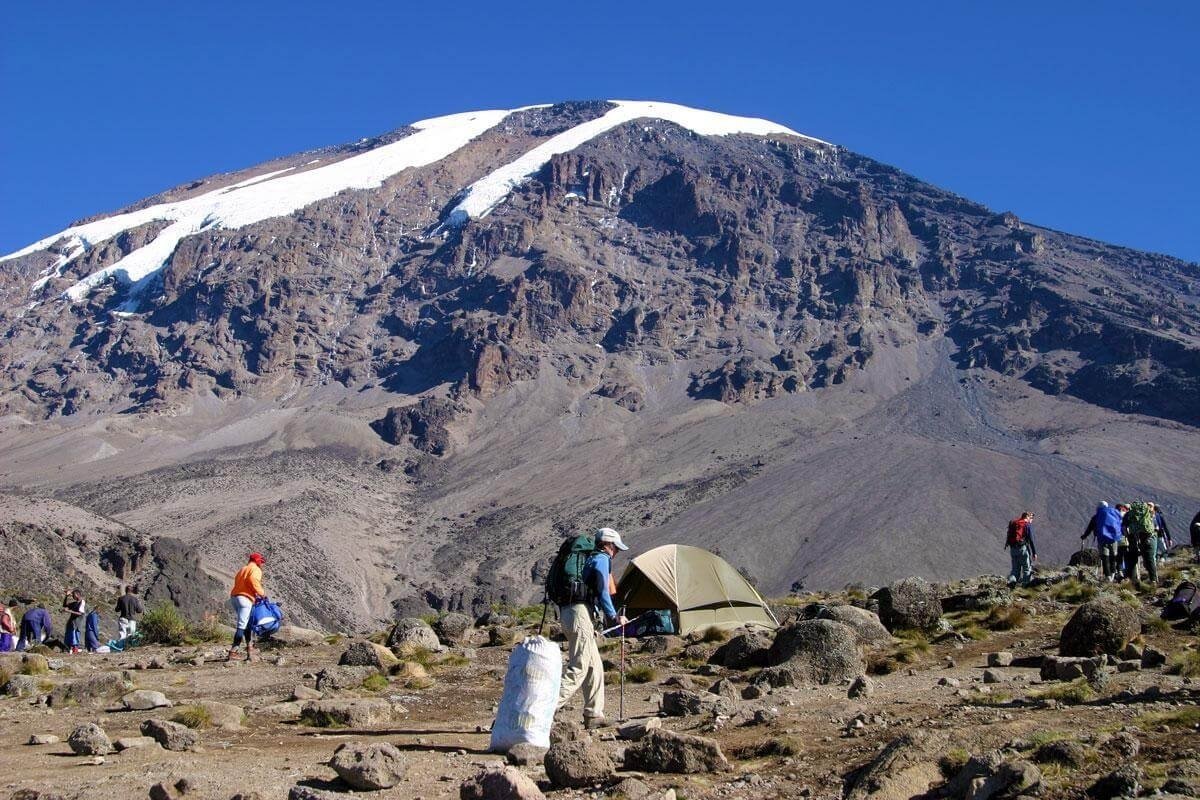
The 9 Days Kilimanjaro hike- climbing the Lemosho route is a premier choice for those seeking a balance of challenge and high success rates. This Kilimanjaro itinerary spans 9 days, with 7 days dedicated to active trekking, allowing for better physiological adaptation than shorter alternatives. Beginning on the western side of the mountain, the trail passes through remote forest zones before merging with other tracks. The path covers approximately 70 kilometers, navigating five distinct climate zones ranging from tropical rainforest to the arctic summit. By spending more time at moderate altitudes, the itinerary significantly lowers the risks associated with rapid ascent. Participants will experience a gradual progression, sleeping in tents managed by a support crew that handles all logistics. This route is favored for its scenic variety and the intentional pacing that prepares hikers for the final push to the 5,895-meter summit of Uhuru Peak.
Tour highlights for 9 Days Kilimanjaro hike- climbing the Lemosho route
Tropical rainforest trail trekking
Shira Plateau scenic views
Lava Tower acclimation climb
Barranco Wall rock scramble
High altitude desert landscapes
Uhuru Peak summit achievement
Glacial ice field sightings
Diverse mountain climate zones
Professional local guide support
Night summit ascent attempt
Morning crater rim sunrise
Private camp meal service
Daily health check monitoring
Portable toilet tent access
Expert porter team assistance
Official summit certificate award
Day by day 9 Days Kilimanjaro hike- climbing the Lemosho route
Day 1: Londorossi Gate to Mti Mkubwa Camp
The journey starts with a drive from Moshi to the Londorossi Gate at 2,100 meters. After completing park registration formalities, the trek begins through the rainforest zone. You will walk for approximately 3 to 4 hours, covering 6 kilometers. The trail is gentle, winding through dense trees and ferns. You arrive at Mti Mkubwa Camp, situated at 2,750 meters. This first day involves a modest elevation gain of 650 meters, which is essential for initial adaptation. The support crew will have your tents ready upon arrival. Temperatures at this altitude typically hover around 10°C. You will have dinner in the dining tent and prepare for the transition out of the forest the following morning. This segment is straightforward, allowing you to settle into the rhythm of the mountain.
Day 2: Mti Mkubwa Camp to Shira 1 Camp
Today, you leave the rainforest and enter the heath and moorland zone. The trek covers 8 kilometers and lasts about 5 to 6 hours. You ascend from 2,750 meters to 3,500 meters, gaining 750 meters in altitude. The landscape opens up, revealing expansive views of the Shira Plateau. As you walk, the vegetation changes from tall trees to smaller shrubs and hardy grasses. Reaching Shira 1 Camp at 3,500 meters provides a wide vista of the mountain's western face. You will notice the air becoming thinner, requiring a steady, slow pace. The temperature at this elevation often drops to 5°C or lower by evening. Proper hydration of 3 to 4 liters of water is vital today to support your body as it begins to adjust to the 3,500-meter mark.
Day 3: Shira 1 Camp to Shira 2 Camp
The trek across the Shira Plateau is relatively flat, covering 7 kilometers in 4 to 5 hours. You move from 3,500 meters to 3,850 meters. This 350-meter gain is gradual, which is excellent for acclimatization. You will pass through volcanic rock formations and sparse vegetation that characterize the plateau. Shira 2 Camp serves as a junction for several routes and offers a clear view of the Western Breach and Kibo peak. By arriving at 3,850 meters, you are testing your response to the altitude. The environment here is cold and exposed, with night temperatures likely falling near 0°C. Maintaining a consistent, slow speed remains the priority. The afternoon is reserved for rest and short walks around the camp to help your body adapt to the increased elevation.
Day 4: Shira 2 Camp to Barranco Camp
Today is a critical day for acclimatization. You ascend to the Lava Tower at 4,600 meters, which is a significant altitude gain of 750 meters from the morning start. You then descend to Barranco Camp at 3,950 meters. This "climb high, sleep low" strategy is highly effective for reducing altitude-related symptoms. The total distance covered is 10 kilometers over 6 to 7 hours. You will spend time at 4,600 meters to allow your body to experience the pressure change, followed by a descent that aids recovery. The terrain shifts into the alpine desert, characterized by rocky slopes and minimal plant life. Sleeping at 3,950 meters is a proven way to improve your overall summit success. You will wake up refreshed for the next day, having successfully navigated one of the toughest profile shifts of the trip.
Day 5: Barranco Camp to Karanga Camp
The morning begins with the famous Barranco Wall, a 250-meter rock scramble that is easier than it appears. Once at the top, you follow the trail along the southern circuit, crossing several valleys and ridges. You cover 5 kilometers in about 4 hours. You descend slightly before climbing back up to reach Karanga Camp at 3,995 meters. This constant change in elevation is a standard part of the acclimatization process. By arriving at 3,995 meters, you are preparing your system for the higher camps to come. The terrain consists of loose scree and rocky paths. The support crew will serve a warm lunch upon your arrival. You will spend the afternoon resting at nearly 4,000 meters, ensuring your heart rate and oxygen levels remain stable before the final push toward the base of the summit.
Day 6: Karanga Camp to Barafu Camp
This is a shorter trekking day, covering 4 kilometers in 3 to 4 hours. You climb from 3,995 meters to 4,675 meters at Barafu Camp. This is the final base before the summit attempt. The trail is steep, consisting of compacted volcanic ash and stone. Because you are heading toward the arctic zone, the temperature drops rapidly, often reaching -5°C or lower. You will reach camp by early afternoon, leaving plenty of time to organize your gear for the night. Your duffel bags will be repacked, and you will finalize your layers for the cold. You must sleep as much as possible, as you will be awakened shortly before midnight. Hydration and caloric intake are the most important factors for your success tonight at 4,675 meters.
Day 7: Barafu Camp to Uhuru Peak and Mweka Camp
This is the most demanding day, covering 17 kilometers over 12 to 15 hours. You start at 11:30 PM, climbing 1,220 meters to reach Uhuru Peak at 5,895 meters. The ascent is extremely steep, following switchbacks up to Stella Point at 5,756 meters. From there, it is a 1-hour walk along the crater rim to the summit. After taking measurements of your success at the top, you descend 2,800 meters back to Mweka Camp at 3,100 meters. The descent is hard on the knees and requires focus. You will navigate through the arctic, alpine desert, and moorland zones. By the time you reach Mweka Camp at 3,100 meters, you will have completed the most intense physical portion of the journey. This day is a test of stamina and mental endurance.
Day 8: Mweka Camp to Mweka Gate
The final morning involves a 10-kilometer descent from 3,100 meters to 1,600 meters at the Mweka Gate. The walk takes 3 to 4 hours and passes back through the lush rainforest zone. The path is often muddy and slippery. As you descend, the air becomes warmer and thicker with oxygen. Upon reaching the gate, you will sign the park register and receive your official summit certificate. This marks the end of the 9 Days Kilimanjaro hike- climbing the Lemosho route. You will meet your driver for the transfer back to your hotel in Moshi. A hot shower and a proper bed await you. You have successfully covered approximately 70 kilometers and ascended over 3,700 meters, completing one of the most respected climbing itineraries on Mount Kilimanjaro.
1. Where does the Lemosho Route start?
The Lemosho Route begins on the western flank of Mount Kilimanjaro, a location that offers a quieter, more secluded start than other major trails. The journey officially commences at the Londorossi Gate, situated at an altitude of approximately 2,200 meters. This gate serves as the entry point where you complete the necessary park registration formalities and meet your mountain crew.
However, the trek does not strictly begin on foot at the gate. Because the route to the initial trailhead is long, most trekkers utilize 4x4 off-road vehicles to transit from the gate further up the mountain slopes. This drive takes you through scenic, dense rainforests and eventually deposits you at the Lemosho trailhead, typically located at an elevation of roughly 3,500 meters or at a lower starting point depending on road conditions. By beginning on the western side, the Lemosho Route avoids the heavy foot traffic found on more commercial paths. This remote starting point allows hikers to slowly integrate into the mountain environment, surrounded by fewer people and more pristine wilderness. Starting at this elevation provides an immediate transition into the higher altitudes, setting a serious but manageable tone for the 9-day journey ahead as you head toward the Shira Plateau.
2. Why choose a 9-day itinerary?
Choosing a 9-day itinerary for your climb is arguably the most important decision you will make regarding your safety and success. The primary physiological hurdle on Kilimanjaro is the rapid decrease in oxygen as you gain altitude. A 9-day schedule is specifically engineered to optimize the "climb high, sleep low" principle. This approach allows your body to synthesize more red blood cells and adapt to the reduced barometric pressure at a natural, sustainable pace.
Shortening the trip to 6 or 7 days forces the body to cope with massive pressure changes within an insufficient timeframe, which significantly elevates the probability of developing acute mountain sickness (AMS). Conversely, the 9-day Lemosho itinerary provides those critical extra days at moderate elevations. This is not just about comfort; it is about biology. By spending more time in the moorland and alpine desert zones before attempting the final ascent, you allow your cardiovascular system to stabilize. This extended duration drastically lowers the risk of severe symptoms such as nausea, dizziness, or debilitating headaches. Furthermore, a 9-day trip is less physically exhausting, ensuring you arrive at the base of the summit with more energy reserves. For anyone prioritizing their health and a high statistical probability of reaching Uhuru Peak, the 9-day route is the gold standard of mountain planning.
3. What is the total distance covered?
The Lemosho Route is one of the longer trails on the mountain, which is precisely why it is so effective for acclimatization. In total, you will traverse approximately 65 to 70 kilometers (40 to 43 miles) from the point you start hiking to the moment you reach the final gate at the end of the trip. While 70 kilometers might sound modest compared to long-distance trails elsewhere, the context of high-altitude mountain trekking makes this distance significant.
You are navigating through five distinct climate zones, moving from lush, humid tropical rainforests through expansive, rocky moorlands, then into the stark, dry alpine desert, and finally into the freezing arctic conditions near the crater. Each kilometer requires varying levels of physical exertion depending on the gradient and the terrain. Some days may cover only 5 or 6 kilometers but involve steep, rocky scrambles that take several hours to complete. Other days involve flatter traverses across plateaus that allow for longer distances. Because you are constantly fighting gravity and thinning air, your pace will intentionally be slow. This total distance is spread across 7 days of active movement, ensuring that you are not pushing your body beyond its capacity. By the time you complete this 70-kilometer circuit, you will have experienced nearly every ecosystem the mountain has to offer, turning the trek into a comprehensive cross-section of African ecology.
4. Will I be required to do any technical climbing?
A common concern for prospective Kilimanjaro trekkers is whether they need specialized skills, ropes, or climbing gear. The answer is a clear no; the Lemosho Route is a non-technical trek, meaning it involves hiking and walking rather than vertical rock climbing. You do not need to bring harnesses, crampons, or carabiners, and you will not be required to possess any mountaineering experience or formal training before you arrive in Tanzania.
However, the trek is certainly not a walk in the park. While it remains a hike, it includes sections that require "scrambling." The most famous of these is the Barranco Wall. This section involves navigating a steep, rocky path that requires you to use both your hands and your feet for stability. While it feels intimidating when viewed from a distance, the path is well-worn and easily managed by anyone with average mobility. Your guides will be right there to assist you and provide instructions on where to place your hands and feet. The trail itself consists of varied surfaces, ranging from well-maintained dirt paths in the forest to loose volcanic scree on the upper slopes. The primary challenge is not the technicality of the terrain, but rather your physical endurance and your ability to keep moving steadily on steep, uneven ground. You are essentially walking up a mountain, not scaling a cliff, making it accessible to any determined individual in good health.
5. What is the summit success rate for this route?
The Lemosho Route, particularly when structured as a 9-day itinerary, is widely regarded as one of the most successful paths to the summit of Mount Kilimanjaro. While official park statistics can fluctuate, the 9-day Lemosho trek consistently reports summit success rates exceeding 90%. This high percentage is not a coincidence; it is a direct result of the route’s design and the extra time afforded to the climber.
Summit success on Kilimanjaro is almost entirely dependent on acclimatization. On shorter, 5- or 6-day routes, many climbers fail to reach the top because they succumb to altitude sickness or become too exhausted to complete the final ascent. The 9-day Lemosho itinerary flips this dynamic by providing the necessary time for the body to catch up with the altitude. By the time you reach the higher camps, your internal systems have already adjusted to the thinner air, allowing you to maintain better oxygen saturation levels. This physical stability means you are less likely to suffer from the debilitating effects of high altitude that plague those on faster tracks. The higher success rate is essentially a testament to the fact that when you respect the mountain and give your body the time it needs to adapt, your chances of reaching Uhuru Peak become significantly more favorable. For those who want to minimize the risk of having to turn back, this route provides the highest level of assurance.
6. What is the accommodation like on the mountain?
Accommodation on the Lemosho Route is exclusively tent-based, offering an authentic "expedition" experience. You will sleep in professional-grade, four-season mountain tents designed to handle the intense conditions of the Kilimanjaro environment, including high winds and sub-zero temperatures. These are not small, cramped tents; they are sturdy, high-altitude shelters that provide a reliable barrier against the elements.
The logistical support is a highlight of the experience. Every day, your team of porters will hike ahead of you to select the best site and set up your entire camp. By the time you arrive, your sleeping tent will be fully assembled, and your sleeping bag will be laid out. You will also have access to a communal mess tent—a larger structure that serves as your dining room and social hub. This tent is where you will share meals, receive briefings from your guides, and escape the evening cold. There are no permanent lodges or hotels on this route; everything is mobile. This creates a unique atmosphere where you feel deeply connected to the mountain. Living in a tent allows you to wake up to the sunrise over the African plains and fall asleep under a massive canopy of stars. While it requires adjusting to a simpler way of living for 9 days, the professional management by your support crew ensures that your sleeping environment remains clean, organized, and as comfortable as possible given the remote mountain setting.
7. Do I need to carry all my own gear?
You are not expected to carry the weight of your entire life on your back during your 9-day trek. In fact, doing so would be counterproductive to your success, as it would drain your energy and increase your risk of altitude-related exhaustion. The Lemosho Route is fully supported by a dedicated team of professional porters whose primary job is to manage the logistics of transport.
During the trek, you are only responsible for your personal daypack. This small backpack—usually around 20 to 30 liters in volume—should contain only the essential items you need for that specific day on the trail. This includes your daily water supply, a rain jacket, an extra thermal layer for temperature drops, your snacks, sunscreen, and your camera. By keeping this pack light, you maintain your center of gravity and keep your movement fluid, which is essential on steep or uneven paths.
All your heavy equipment—including your sleeping bag, your main duffel bag with all your clothes, toiletries, and personal items—is carried by the porters. They are incredibly strong and skilled at navigating the mountain trails, often moving faster than the climbers to ensure that your gear is already waiting for you at the next campsite. This division of labor allows you to focus 100% of your energy on the ascent. You are essentially a guest on the mountain, and the weight burden is handled by the local experts. This support system is critical to the high success rate of the Lemosho Route, as it allows your body to dedicate its resources to moving uphill and adapting to the altitude.
8. Are meals provided?
Yes, nutrition is a cornerstone of the Kilimanjaro trekking experience, and your 9-day journey includes a full catering service. You will not need to carry your own food, and you will certainly not be eating dehydrated rations. Your mountain crew includes a professional, highly skilled cook who manages the kitchen tent. Every day, you will be served fresh, hearty, and nutritionally balanced meals specifically designed to provide the fuel necessary for high-altitude endurance.
Breakfasts typically consist of items like hot porridge, eggs, toast, and pancakes, which provide the complex carbohydrates needed for a day of trekking. Lunches are often light but energizing, perhaps a mix of sandwiches, soup, or fresh fruit. Dinners are substantial, often featuring pasta, rice, stew, and vegetables. These meals are vital for your recovery. Beyond the food, the mountain team also ensures you have constant access to purified drinking water. The cooks collect water from local sources and treat it using boiling or filtration methods to ensure it is safe for consumption. This is a critical service, as you need to drink 4 to 5 liters of water daily to stay hydrated. The dining tent is usually the warmest place in camp, providing a comfortable space to enjoy these meals while chatting with your group. Being well-fed and well-hydrated is one of the most effective ways to combat the physical stress of the climb, and your cook’s efforts are essential to your overall performance and happiness on the mountain.
9. How cold does it get at the top?
The temperature on Mount Kilimanjaro is a dynamic, shifting force that changes dramatically as you ascend through the various climate zones. By the time you reach the higher camps and make your final push to the summit, you are entering an arctic environment where the mercury can plummet significantly. During the midnight summit attempt, temperatures typically range from $-7^{\circ}C$ to $-29^{\circ}C$ ($20^{\circ}F$ to $-20^{\circ}F$).
It is vital to understand that this is the ambient temperature. When you factor in the wind chill at 5,895 meters, the "feels like" temperature can be even colder. This is why layering your clothing is not just a recommendation—it is a survival necessity. You will be using the "three-layer system": a moisture-wicking base layer, an insulating mid-layer (like fleece or down), and a windproof/waterproof outer shell. Your extremity protection is equally important; you will need high-quality thermal gloves, a warm hat that covers your ears, and heavy-duty trekking boots designed for sub-zero conditions. The cold is most intense during the hours of darkness before sunrise, which is exactly when you are making your final ascent. While the physical exertion of climbing generates internal heat, the sheer intensity of the arctic environment means you must be prepared for extreme cold. Proper gear is the only thing standing between you and a very uncomfortable night, so investing in high-quality, cold-weather apparel is non-negotiable for a successful and safe summit.
10. Do I need to take altitude sickness medication?
Taking medication for altitude sickness is a personal decision that should be made in consultation with your doctor before you even leave home. The most commonly used medication is Acetazolamide, sold under the brand name Diamox. It works by accelerating the body's natural acclimatization process, specifically by helping you breathe more deeply and efficiently. Many climbers find that it helps mitigate mild symptoms like headaches, dizziness, or nausea, making the ascent more comfortable.
However, Diamox is not a magic shield. It does not guarantee immunity from altitude sickness, and it certainly does not replace the need for slow, steady pacing. Some climbers prefer to avoid medication, opting instead to monitor their symptoms closely and rely on the slow, 9-day ascent profile to naturally adapt. Others swear by it as a preventative measure. It is worth noting that while you can purchase this medication in pharmacies in Moshi or Arusha, you should always consult with your own physician about your medical history, potential side effects, and correct dosage. Never start a medication regimen on the mountain without prior professional guidance. If you decide to bring Diamox, view it as a backup or a helpful tool, but do not rely on it to override the physical warning signs your body gives you. The most effective way to stay healthy at high altitude remains the same: hike "pole pole," drink plenty of water, and listen to the advice of your guides.
11. How much water should I drink per day?
Hydration is the single most important factor for success on Mount Kilimanjaro. As you climb, your body loses fluid through respiration in the thin, dry air much faster than it does at sea level. If you become dehydrated, your blood volume decreases, which impairs the delivery of oxygen to your tissues—exactly what you want to avoid at high altitude. This is why you are strongly advised to drink and carry around 4 to 5 liters of purified water every single day of the trek.
This may sound like a large volume, but it is achievable if you make it a constant habit. You should aim to drink a liter before you even start trekking in the morning, another liter throughout the morning, a liter during lunch, and the rest throughout the afternoon and evening. Your guides will constantly monitor your intake and may ask how much you have had. Drinking this much water helps your body manage the chemical changes occurring due to the altitude and significantly reduces the risk of headaches and general fatigue. Using an insulated water bladder (like a CamelBak) with a hose is highly recommended, as it allows you to take small, frequent sips without stopping to pull out a bottle. In the coldest, highest altitudes, remember to keep your hose inside your jacket, or the water will freeze inside the tube. Consistent hydration is your most effective, natural defense against altitude sickness and the most important responsibility you have as a trekker.
12. How do I go to the bathroom on the trail?
Navigating basic human needs in the wilderness is a common concern for hikers, but on the Lemosho Route, the systems in place are designed to be as convenient and hygienic as possible. At the designated campsites, the National Park provides basic wooden outhouses. These are functional but can be crowded and may not meet the cleanliness standards some travelers are accustomed to.
To improve this, many reputable tour operators offer a private, portable chemical toilet tent as part of their service package. This is an exclusive facility for your group, which is set up in a private location near your camp. It is regularly serviced by your support crew to ensure it remains clean and sanitized throughout your 9-day journey. Having this amenity is a massive benefit, especially at night when you might otherwise have to walk across a cold, dark campsite to a public facility.
When you are actually hiking on the trail between camps, facilities are, naturally, nonexistent. In these situations, you will use what is often called "bush bathrooms." You simply step a reasonable distance off the trail, behind a rock or a bush, to maintain your privacy. Your guides are very experienced in this and will respect your need for space. It is essential to follow "Leave No Trace" principles—ensure you pack out any used paper in a small waste bag. These systems are simple, and while they require a bit of an adjustment for the first day or two, they become a routine part of your life on the mountain.
13. What pace should I maintain while climbing?
The most important word you will learn on Mount Kilimanjaro is "pole pole" (pronounced poh-leh poh-leh). It is a Swahili phrase that literally means "slowly, slowly." It is not just a suggestion; it is the fundamental rule of high-altitude trekking. If you take anything away from your pre-trip preparation, it should be the commitment to keep your pace incredibly slow, regardless of how much energy you feel you have.
Many new hikers make the mistake of trying to walk at their "normal" pace or even rushing to get to the next camp to rest. This is exactly what leads to exhaustion and, more importantly, altitude sickness. By walking slowly, you allow your body to match its oxygen consumption to the amount of oxygen available in the thinning air. If you go too fast, your body goes into oxygen debt, and you will quickly feel the symptoms of altitude stress. You should be able to hold a conversation while you are walking; if you are panting too hard to talk, you are moving too fast. Your guides will set the pace for you, and it will likely feel frustratingly slow at first, especially when you feel physically strong on the lower slopes. Trust them. They are experts at gauging the group's health and setting a speed that will get everyone to the summit. Your goal is to conserve your energy for the very end. On this mountain, the slowest, steadiest walker is almost always the one who successfully reaches the top.
14. What is summit night like?
Summit night is the most challenging, exhausting, and rewarding experience of the entire expedition. The event begins long before sunrise—typically around 11:00 PM or midnight. You will be awakened in the dark, cold night, forced to quickly dress in all your thermal layers, and prepare to start the final, steep ascent. The goal is to reach Stella Point on the crater rim just in time to see the sunrise over the African horizon.
The climb from Barafu Camp to the summit is grueling. It involves hours of steady movement up a steep, switchbacking path over loose volcanic scree—a terrain that often makes you feel like you are taking two steps forward and one step back. You will be walking in the dark, guided only by the beam of your headlamp and the rhythm of your boots on the dust. The cold is intense, and the oxygen is at its thinnest. It is normal to feel dizzy, sleepy, or just incredibly tired during these hours. Your guides will be right next to you, offering encouragement, checking your health, and keeping you on the right path. As the first light of dawn finally breaks, you will see the glaciers of the crater rim, which is a massive psychological boost. Reaching Stella Point is a major milestone, but the final hour to Uhuru Peak—the true summit—is a test of sheer willpower. It is a slow, steady slog, but the feeling of standing at 5,895 meters as the sun warms the world below you is a memory that stays with you forever.
15. What are the tipping guidelines for the mountain crew?
Tipping is an deeply ingrained part of the culture on Mount Kilimanjaro and is widely considered the standard way to acknowledge the extraordinary effort put in by your support crew. The people who make your summit possible—the guides, the assistant guides, the camp cooks, and the porters—work under incredibly difficult conditions, often carrying heavy loads for long distances at high altitudes to ensure your comfort and safety.
The tipping process is typically handled collectively by your group. At the end of the 9-day trek, it is customary to have a final "tipping ceremony" where you distribute the gratuity to the entire crew. You should budget between $250 and $350+ per climber for the total tip amount. This may seem like a high number, but keep in mind that this amount is split among a large team; on a typical expedition, you may have 10 to 15 support staff for a group of 3 or 4 trekkers.
It is best to bring your tips in US dollars, specifically in newer, clean bills, as local banks in Tanzania often reject older or torn notes. Many tour operators will provide you with a suggested breakdown of how the tip should be split between the guides, cooks, and porters to ensure fairness. It is common to tip the head guide a higher percentage, with the rest divided among the support staff. This gesture is not just about the money; it is a vital part of the local economy and a genuine expression of gratitude for the team that looked after you for over a week. Being generous here is highly appreciated and reflects well on the climbing community.
Booking 9 Days Kilimanjaro hike- climbing the Lemosho route with us Roads of Adventure safaris
Booking your 9-day Lemosho Route hike with Roads of Adventure Safaris is an excellent choice. This route offers a stunning, gradual, and low-traffic approach to the summit, providing the best possible acclimatization and a very high success rate
