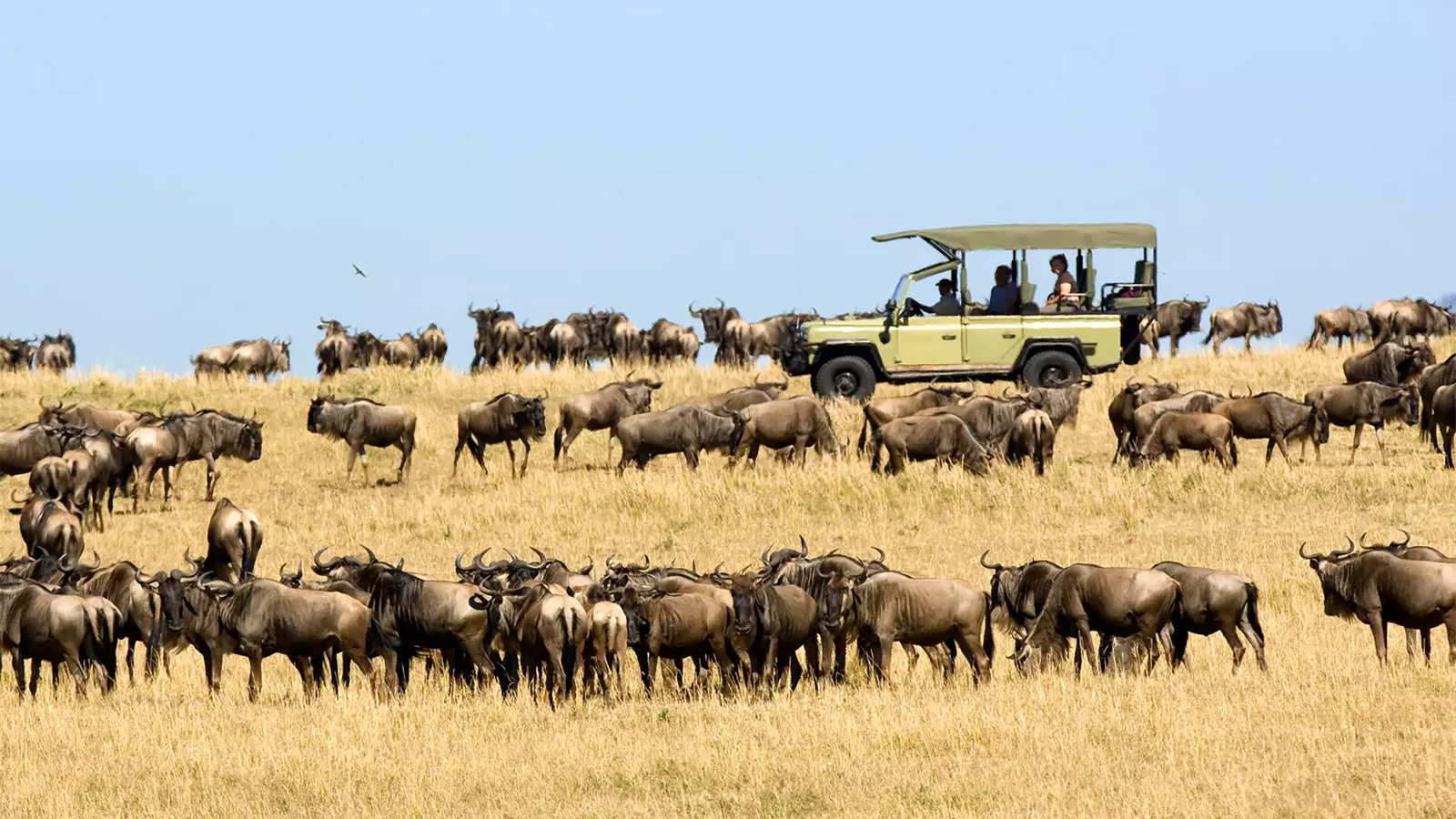
This 9 Days Combined Kenya Tanzania wildlife safari adventure experience unifies East Africa’s most celebrated natural habitats. Travelers journey across sweeping savannahs, dense acacia woodlands, and volcanic calderas to observe massive herds of migrating animals and the Big Five, creating an unmatched, immersive 9-Day Combined Kenya Tanzania wildlife safari adventure experience.
Tour highlights for 9 Days Combined Kenya Tanzania wildlife safari adventure
- Day 1: Arrival in Nairobi and Transfer to Maasai Mara
- Day 2: Full Day Exploration of Maasai Mara National Reserve
- Day 3: Maasai Mara to Serengeti via Isebania Border
- Day 4: Central Serengeti Plains Tracking
- Day 5: Central to Northern or Western Serengeti Tracking
- Day 6: Serengeti to Ngorongoro Conservation Area
- Day 7: Ngorongoro Crater Tour to Lake Manyara
- Day 8: Lake Manyara National Park to Tarangire
- Day 9: Tarangire National Park to Arusha Departure
Day 1: Nairobi to Amboseli National Park
Your 9 Days Combined Kenya Tanzania wildlife safari adventure experience kicks off with an early morning departure from Nairobi, driving south into Amboseli National Park. As you enter the park, the towering, snow-capped peak of Mount Kilimanjaro dominates the horizon, providing a majestic backdrop to the dusty plains. You spend your afternoon traversing the reserve, tracking large herds of free-ranging elephants. The marshes here attract hippos, buffaloes, and numerous waterbirds, giving you an excellent first look at East Africa’s rich biodiversity. As the sun sets, casting golden hues across the landscape, you settle into your lodge for dinner and rest.
Day 2: Amboseli National Park
Today is dedicated fully to exploring the ecosystems of Amboseli National Park. You rise before dawn to catch the morning light hitting the mountain before clouds cover the peak. Morning game drives offer prime opportunities to observe predators like lions and cheetahs moving through the acacia woodlands to hunt. You spend time near the observation hill, viewing the sprawling swamps where massive elephant families gather to bathe and feed. Your expert guide provides deep insight into the complex social structures of these gentle giants. You return to your camp for an evening under the stars.
Day 3: Amboseli to Tarangire National Park
You cross the international border, leaving Kenya behind to continue the 9 Days Combined Kenya Tanzania wildlife safari adventure experience in Tanzania. Driving towards Tarangire National Park, you pass through traditional Tanzanian towns and vast rural landscapes. Tarangire is renowned for its ancient baobab trees and large elephant herds that dig for underground water in the dry riverbeds. During your afternoon game drive, you scan the branches for tree-climbing pythons and observe varied antelope species, including the delicate gerenuk. The park's diverse terrain makes it a haven for diverse birdlife, with over five hundred species recorded here.
Day 4: Tarangire to Ngorongoro Conservation Area
Your morning starts with a final, quick game drive through Tarangire, looking out for predators before they seek shade from the midday heat. Afterward, you pack up and drive towards the Ngorongoro Conservation Area. The route takes you through the verdant highlands, eventually arriving at the crater rim, which offers sweeping views of the massive volcanic caldera below. You spend the evening at a lodge perched on the rim, enjoying the cool mountain air and preparing for the next day's descent into the crater floor.
Day 5: Ngorongoro Crater to Serengeti National Park
You descend into the Ngorongoro Crater early in the morning, navigating the steep forested slopes down to the open, grassy floor. This enclosed caldera supports a dense, permanent population of wildlife. You spend hours driving across the diverse habitats of the crater, searching for rhinos, lions, hyenas, and large concentrations of grazers. After a picnic lunch by the hippo pool, you ascend the crater walls and drive northwest into the endless plains of the Serengeti. The transition reveals a dramatic shift in scenery, marking a key milestone in your 9 Days Combined Kenya Tanzania wildlife safari adventure experience.
Day 6: Serengeti National Park
Today involves a full day of deep exploration within the vast Serengeti National Park. You explore central and transitional areas, moving alongside the massive granite rock outcrops known as kopjes. These rock formations serve as favorite resting spots for lions and leopards watching the plains. Depending on the season of your 9 Days Combined Kenya Tanzania wildlife safari adventure experience, you may intersect with the Great Wildebeest Migration, witnessing millions of grazers moving across the savannah. Your driver carefully navigates the tracks to put you in optimal positions for wildlife photography without disturbing the animals.
Day 7: Serengeti to Masai Mara National Reserve
You leave the Serengeti and travel north towards the Kenya border, processing your exit and crossing into the Masai Mara National Reserve. The drive itself serves as a scenic journey through the rolling, golden grasslands typical of the Mara. Upon entering the reserve, you begin an afternoon game drive in search of the region’s resident wildlife, including large prides of lions and solitary leopards. The Mara is celebrated for its high density of predators and diverse herbivores, providing continuous action across the open plains as you continue the 9 Days Combined Kenya Tanzania wildlife safari adventure experience.
Day 8: Masai Mara National Reserve
A full day in the Masai Mara allows for extensive wildlife viewing and cultural engagement. You have the chance to leave your lodge early to observe predators actively hunting before the heat of the day. You make your way to the Mara River, famous for the dramatic river crossings where large herds of wildebeest and zebras navigate strong currents and waiting crocodiles. In the afternoon, you visit a local Maasai village. Here, community members welcome you with traditional songs, offering insight into their pastoralist way of life and traditions.
Day 9: Masai Mara to Nairobi
On the final day of your 9 Days Combined Kenya Tanzania wildlife safari adventure experience, you enjoy an early morning game drive, capturing the soft light breaking over the Mara plains. You then start the journey back to Nairobi, driving through the Great Rift Valley escarpment, which provides scenic viewpoints of the geological fault lines. You arrive in Nairobi in the late afternoon, where you can reflect on your extensive travels. Your driver-guide drops you off at your hotel or the airport, concluding the 9 Days Combined Kenya Tanzania wildlife safari adventure experience.
1. What parks are included in a 9 Days Combined Kenya Tanzania wildlife safari adventure experience?
A standard 9-day cross-border safari is carefully paced to maximize game-viewing while minimizing travel exhaustion. To cover two massive countries in just over a week, itineraries focus heavily on the most iconic, high-density wildlife areas in East Africa's famous Northern Circuit and Southern Kenya ecosystem.
Typically, your adventure kicks off in Kenya with a visit to Amboseli National Park, celebrated for its massive elephant herds against the stark backdrop of Mount Kilimanjaro. From there, you cross over or fly to the crown jewel of Kenyan wildlife, the Masai Mara National Reserve, which serves as the northern extension of the Serengeti ecosystem.
Crossing the border into Tanzania, the itinerary seamlessly flows into the endless plains of the world-famous Serengeti National Park. You will spend multiple days exploring its distinct sectors, depending on the season, tracking resident predators and migratory herds.
Following the Serengeti, the journey moves to the dramatic Ngorongoro Conservation Area, where you will descend into the volcanic crater floor for a dense, highly localized wildlife experience. Finally, many 9-day routes conclude with a game drive through Tarangire National Park, famous for its prehistoric-looking baobab trees and sprawling elephant families, before heading to Arusha for your departure. This specific combination ensures you experience a diverse range of landscapes, from dusty lake beds and volcanic craters to open savannas.
2. Is it possible to see the Big Five during a 9 Days Combined Kenya Tanzania wildlife safari adventure experience?
Yes, you have an exceptionally high chance of spotting all members of the historic "Big Five"—lions, leopards, elephants, Cape buffaloes, and rhinoceroses—during this specific 9-day itinerary. Because you are combining the top wildlife sanctuaries of both Kenya and Tanzania, you are effectively traversing the most predator-rich and biologically diverse ecosystems on the planet.
- Elephants and Buffaloes: These are practically guaranteed. You will encounter massive elephant herds roaming beneath Mount Kilimanjaro in Amboseli and hundreds of buffaloes grazing across the savannas of the Masai Mara and Serengeti.
- Lions: Both the Masai Mara and the Serengeti are world-renowned for their dense lion prides. You will easily spot them lounging under acacia trees or stalking prey in the golden grass.
- Leopards: These elusive, solitary cats are notoriously difficult to spot because they hide in trees. However, your expert guides know their favorite haunts along the Seronera River valley in the central Serengeti and the dense riverine woodlands of the Masai Mara.
- Rhinoceroses: The rhino is the most challenging member to tick off the list due to severe poaching risks. However, the Ngorongoro Crater acts as a natural, protected sanctuary harboring a healthy resident population of endangered black rhinos. Because the crater floor is flat and open, spotting them here is much easier than anywhere else in East Africa.
By utilizing a combined cross-border route, you are essentially doubling your odds and exploring environments perfectly suited to each specific species.
3. When is the best time to book a 9 Days Combined Kenya Tanzania wildlife safari adventure experience?
Choosing when to book your 9-day safari depends entirely on what type of wildlife spectacle you prioritize. The region experiences distinct weather patterns that heavily dictate animal movement and visibility.
The peak dry season, spanning from July to October, is universally considered the prime window for game viewing. During these months, the vegetation thins out dramatically, and water sources dry up. This forces animals to congregate in massive numbers around predictable rivers and waterholes, making them much easier to locate. This period is also the only time to witness the high-stakes river crossings of the Great Migration.
Conversely, the shorter dry window from January to March offers an entirely different, deeply rewarding experience. This is the calving season in the southern Serengeti and Ngorongoro regions. Over a few weeks, hundreds of thousands of wildebeest calves are born. This sudden abundance of vulnerable young sparks intense, fast-paced predator action, as lions, cheetahs, and hyenas seize the opportunity.
If you prefer to avoid crowds, the "green season" of November to December or April to May offers lush, emerald landscapes, incredible migratory bird-watching, and lower accommodation rates, though afternoon rain showers are common.
4. Will I see the Great Wildebeest Migration on a 9 Days Combined Kenya Tanzania wildlife safari adventure experience?
You can absolutely see the Great Wildebeest Migration on a 9-day combined safari, but your travel dates will entirely dictate where you must look for it. The migration is a continuous, year-round cyclical journey driven by the search for green pastures and fresh water, meaning the herds do not stay in one place.
If you book your trip between July and October, the massive herds—totaling over 1.5 million wildebeests, zebras, and gazelles—are typically concentrated in Kenya's Masai Mara. This is the dramatic period when the animals risk their lives crossing the Mara River, dodging giant Nile crocodiles and waiting predators.
If you choose to travel between December and April, the focus shifts entirely to Tanzania. The migration moves down into the southern plains of the Serengeti and the Ndutu region near Ngorongoro. Here, the animals feed on the highly nutritious, mineral-rich grass to give birth to their young.
During the transitional months of May, June, and November, the herds are on the move through the Serengeti's Western Corridor and Northern reaches. Because a 9-day itinerary covers both the Masai Mara and the Serengeti, an experienced tour operator will adjust your daily game drives to target the specific zone where the herds are moving during your chosen month.
5. How do I travel between Kenya and Tanzania during the trip?
Logistics are a crucial part of a 9-day combined safari, as you have to navigate an international border while trying to maximize your actual tracking time in the bush. There are two primary ways operators handle travel between Kenya and Tanzania: overland border crossings or regional bush flights.
The overland option typically utilizes the Namanga border post, located between Nairobi/Amboseli in Kenya and Arusha/Tarangire in Tanzania. If your itinerary moves from Amboseli to the Tanzanian parks, you will drive to Namanga, step out to clear customs and immigration, and then swap vehicles. Kenyan safari vehicles generally do not operate commercially inside Tanzania, and vice versa. While driving gives you a great sense of local geography and culture, it can take several hours and feel tiring.
The highly recommended, time-saving alternative is taking a short regional flight. Operators often book "bush-to-bush" flights that connect regional airstrips. For example, you can fly from the Masai Mara directly to Migori airstrip near the border, take a short road transfer across the Isebania border to Tarime airstrip on the Tanzanian side, and fly straight into the Serengeti. Alternatively, you can take a commercial flight from Nairobi’s Wilson Airport (WIL) directly to Kilimanjaro International Airport (JRO). Flying eliminates a full day of driving, giving you more time on actual game drives.
6. What type of vehicle is used for a 9 Days Combined Kenya Tanzania wildlife safari adventure experience?
The standard vehicle used for a high-quality combined safari is a customized 4x4 Safari Land Cruiser. These robust vehicles are specifically engineered to withstand the punishing, unpaved washboard roads and muddy tracks characteristic of the Serengeti, Ngorongoro Crater, and Masai Mara.
A standard 4x4 Land Cruiser features heavy-duty suspension, four-wheel drive capability to navigate rugged terrain, and built-in long-range radio systems that allow your guide to communicate with other drivers about rare wildlife sightings. Most importantly, they feature a pop-up roof. When you arrive at a wildlife sighting, the roof raises up, allowing you to stand safely within the vehicle and enjoy unobstructed, 360-degree panoramic views for photography.
In Kenya, some budget-conscious operators still use customized safari minivans (microbuses), which also feature pop-up roofs. While minivans are perfectly fine for smooth tarmac roads and the flatter terrain of the Masai Mara, they are generally not used for the Tanzanian leg of the journey. Tanzania’s park regulations and rocky, steep terrains—such as the descent road into the Ngorongoro Crater—practically demand the clearance and power of a 4x4 Land Cruiser. Regardless of the vehicle type, reliable operators cap occupancy at six passengers to ensure every traveler gets a guaranteed window seat.
7. Can I customize the destinations during a 9 Days Combined Kenya Tanzania wildlife safari adventure experience?
Yes, flexibility is a hallmark of modern private safaris. While operators market fixed 9-day itineraries as a baseline, these can be easily tailored to match your specific pacing, budget, and personal interests.
If you prefer a slower, more immersive experience, you can customize the route by swapping out parks. For instance, if you don't want to spend time driving to Amboseli, you can choose to skip it entirely and allocate those extra days to the central or northern Serengeti to focus deeply on big cat tracking. You can also customize your arrival and departure points, starting in Nairobi, Kenya, and ending on the tropical beaches of Zanzibar, Tanzania, for a post-safari relaxation period.
Beyond changing the destinations, customization extends to add-on experiences. You can ask your operator to book a sunrise hot air balloon safari over the Masai Mara or Serengeti, which concludes with a champagne breakfast in the wild. You can also incorporate night game drives (available in private conservancies adjacent to the main parks), walking safaris led by armed rangers, or specialized photographic vehicles equipped with lower camera mounts. Let your operator know your goals early so they can secure the necessary park permits and lodge bookings.
8. What kind of accommodation is available?
The accommodation landscape in East Africa is incredibly diverse, ensuring that travelers of all financial profiles can experience the wild comfortably. Accommodations are broadly categorized into three distinct tiers:
- Luxury Tented Camps and Lodges: This tier completely redefines "camping." These are permanent or semi-permanent canvas pavilions built on elevated wooden platforms, featuring polished wood floors, plush king-sized beds, 24/7 solar electricity, and en-suite bathrooms with hot running water. High-end luxury lodges often include private plunge pools, gourmet dining, and butler service, with structures positioned seamlessly along wildlife corridors or riverbanks.
- Mid-Range Comfort Lodges: This is the most popular choice for a 9-day safari. These are solid-structure hotels or eco-lodges that offer comfortable, clean rooms, private bathrooms, swimming pools, and buffet-style dining. They provide an excellent balance of comfort and immersion without the premium price tag of ultra-luxury brands.
- Budget Camping: For adventurous travelers on a tight budget, this involves staying in small, public campsites inside or just outside the park boundaries. You sleep on mats in dome tents, and meals are prepared over an open fire by a dedicated safari cook traveling with you. Bathrooms and showers are shared communal facilities.
When booking, you can even mix and match tiers—choosing mid-range comfort for most of the trip, while splurging on a luxury camp for your nights in the Serengeti.
9. Are meals included in the package?
Yes, almost all 9-day combined safari packages operate on a full-board basis. This means your booking covers three substantial meals per day starting from your first lunch on the road to your final lunch on day nine.
Breakfasts and dinners are typically served at your lodge or tented camp. Breakfasts range from continental spreads to full hot stations featuring eggs made to order, fresh tropical fruits, pastries, and world-class Kenyan or Tanzanian coffee. Dinners are usually multi-course affairs or themed buffets combining continental cuisine with traditional East African dishes like ugali (maize meal), grilled meats (nyama choma), and coconut-infused stews.
Because you will be spending maximum time out in the bush tracking wildlife, returning to the lodge for lunch is often highly impractical. Therefore, your lodge will provide custom boxed lunches (picnic boxes) every morning. Your guide will drive you to a designated, secure picnic site—often under a giant acacia tree or overlooking a river—where you can stretch your legs and eat. These boxes usually contain a mix of roasted chicken, sandwiches, boiled eggs, fresh fruit, juice boxes, and snacks. Pure drinking water is always provided in abundance inside your safari vehicle throughout the day.
10. What do I need to pack for a 9 Days Combined Kenya Tanzania wildlife safari adventure experience?
Packing for a safari requires balancing strict airline weight limits for small regional planes (often capped at 15 kg/33 lbs in soft-sided bags) with the drastic temperature fluctuations of the East African bush.
Item Category
What to Pack
Why It Matters
Clothing
Lightweight, breathable clothes in neutral tones (khaki, tan, olive green).
Bright colors scare wildlife; blue and black attract biting tsetse flies.
Layers
A fleece jacket, windbreaker, scarf, and warm beanie.
Early morning game drives in open vehicles are freezing, even if midday is hot.
Footwear
Comfortable sneakers or sturdy trail-walking shoes.
Heavy hiking boots aren't needed unless doing walking safaris, but flip-flops won't cut it.
Sun Protection
Wide-brimmed hat, polarized sunglasses, and high-SPF biodegradable sunscreen.
The equatorial sun is incredibly strong, especially at higher elevations like Ngorongoro.
Gear
High-quality binoculars (8x42 is ideal) and a camera with a telephoto zoom lens (minimum 200mm-300mm).
Wildlife is often at a distance; binoculars are your most important tool.
11. Do I need a visa for both Kenya and Tanzania?
Yes, you must secure travel authorization for both countries individually. A crucial regulatory update to keep in mind is that the traditional East Africa Tourist Visa (EATV) does not cover Tanzania. The EATV is a joint initiative strictly between Kenya, Uganda, and Rwanda. If you cross into Tanzania, that regional visa becomes void. Furthermore, traditional "Visa on Arrival" systems have been heavily phased out across the region in favor of digital pre-clearance.
For Kenya, traditional tourist visas have been replaced entirely by an Electronic Travel Authorization (eTA) system. Every foreign traveler, including infants, must apply online via the official Kenyan government portal (etakenya.go.ke) at least 3 to 7 days before departure. This document gives you permission to enter the country digitally.
For Tanzania, you must apply for a separate Tanzanian eVisa via their official immigration portal (visa.immigration.go.tz). The cost ranges from $50 to $100 depending on your nationality (U.S. citizens pay $100 for a multi-entry visa by default).
Always ensure your physical passport has at least six months of validity left from your date of departure and contains at least two completely blank pages for customs stamps at the border crossings.
12. What vaccinations or health precautions should I take?
A combined safari requires proactive medical planning well before your flight departs. Your first and most critical step is scheduling an appointment with a specialized travel clinic or your doctor at least 4 to 6 weeks in advance.
The most rigid legal requirement you will encounter is the Yellow Fever vaccination. While Kenya and Tanzania have low risk in their main safari areas, Tanzania strictly enforces a rule requiring proof of vaccination (the physical Yellow Card) if you are arriving from a country endemic to Yellow Fever—and this includes crossing the land border from Kenya. Without this card, you could be denied entry or forced to receive the vaccine at a border post.
Additionally, both the Masai Mara and Serengeti are situated in high-risk malaria zones. You should talk to your doctor about prescription anti-malarial prophylactics (such as Malarone or Doxycycline).
Beyond medications, practice basic bush hygiene: apply insect repellent containing DEET daily, wear long sleeves and pants at dusk to prevent mosquito bites, and strictly stick to bottled or filtered water throughout your 9-day journey to avoid stomach bugs.
13. What is the standard tipping etiquette for a safari guide?
Tipping is a deeply ingrained cultural custom within the East African safari industry. While it remains entirely voluntary and should always reflect the quality of service you receive, tips form a vital component of the livelihood for the hospitality staff who work around the clock in remote locations.
The most critical person on your trip is your driver-guide. They act as your tracker, mechanic, navigator, and host for nine days. The standard industry baseline is to tip your guide roughly $10 to $15 USD per person, per day. If you are traveling as a private couple, this equates to around $20 to $30 USD per day combined, presented to the guide in a sealed envelope at the very end of their leg of the trip.
For the accommodation staff, most safari lodges and tented camps feature a communal "Staff Tip Box" located at the front reception desk. Tipping into this box ensures that the hidden heroes—the cooks, housekeepers, maintenance crew, and security guards—receive a fair share. A good guideline is to contribute $5 to $10 USD per room, per day to this box. It is best to bring crisp, uncreased, post-2013 US Dollar bills, as local banks often reject older or damaged foreign currency notes.
14. Are there any cultural experiences included?
A premier 9-day safari is designed to be more than just a wildlife-spotting exercise; it is an introduction to the rich human tapestry of East Africa. Most combined itineraries actively incorporate a cultural visit to a traditional Maasai or Samburu village (boma), as these pastoralist communities have coexisted alongside wild animals for centuries.
During a typical village visit, elders and community members welcome you with vibrant traditional dances and rhythmic call-and-response singing. You will be invited inside their home structures, known as inkajijik (made of mud, sticks, and thatch), to learn about their traditional lifestyle, social structures, and cattle-herding heritage.
While these visits provide wonderful photographic opportunities and a chance to buy handmade beadwork directly from the women's cooperative, they can sometimes feel commercialized due to high tourist volumes. If you want a deeper, more authentic cultural exchange, talk to your operator about booking a visit to the Hadza or Datoga communities near Lake Eyasi if your geography permits, or arrange a guided walk through local market towns on the periphery of the conservation areas to see daily rural life up close.
15. Is a 9 Days Combined Kenya Tanzania wildlife safari adventure experience family-friendly?
Yes, a combined safari can be an unforgettable family experience, but it is best suited for older children, typically ages 8 and up. A 9-day multi-country safari demands long hours of travel, emotional maturity, and physical stamina.
The primary challenge for young children is the sheer amount of time spent sitting inside a vehicle. Game drives often last between 4 to 8 hours, navigating bumpy, unpaved roads commonly referred to as the "African massage." Children must also understand the absolute necessity of staying quiet and remaining inside the vehicle when close to dangerous predators like lions or elephants.
Furthermore, many luxury tented camps are completely unfenced, meaning wildlife can freely wander through the camp property at night. Because of this, a large number of boutique lodges enforce a strict minimum age requirement (often capping it at 12 years old) for safety reasons.
If you are traveling with younger children, customize your itinerary by booking a private vehicle so you can return to the lodge early without impacting other travelers, pick family-oriented lodges that feature swimming pools and kids' clubs, and focus on fewer locations to minimize heavy cross-border transit days.
Booking 9 Days Combined Kenya Tanzania wildlife safari with us Roads of Adventure safaris
To book your 9 Days Combined Kenya & Tanzania Wildlife Safari directly with Roads of Adventure Safaris, you can initiate your reservation through their official communication channels. Because the agency is headquartered in Uganda, the standard practice for securing international safari bookings is via email or direct mobile communication
