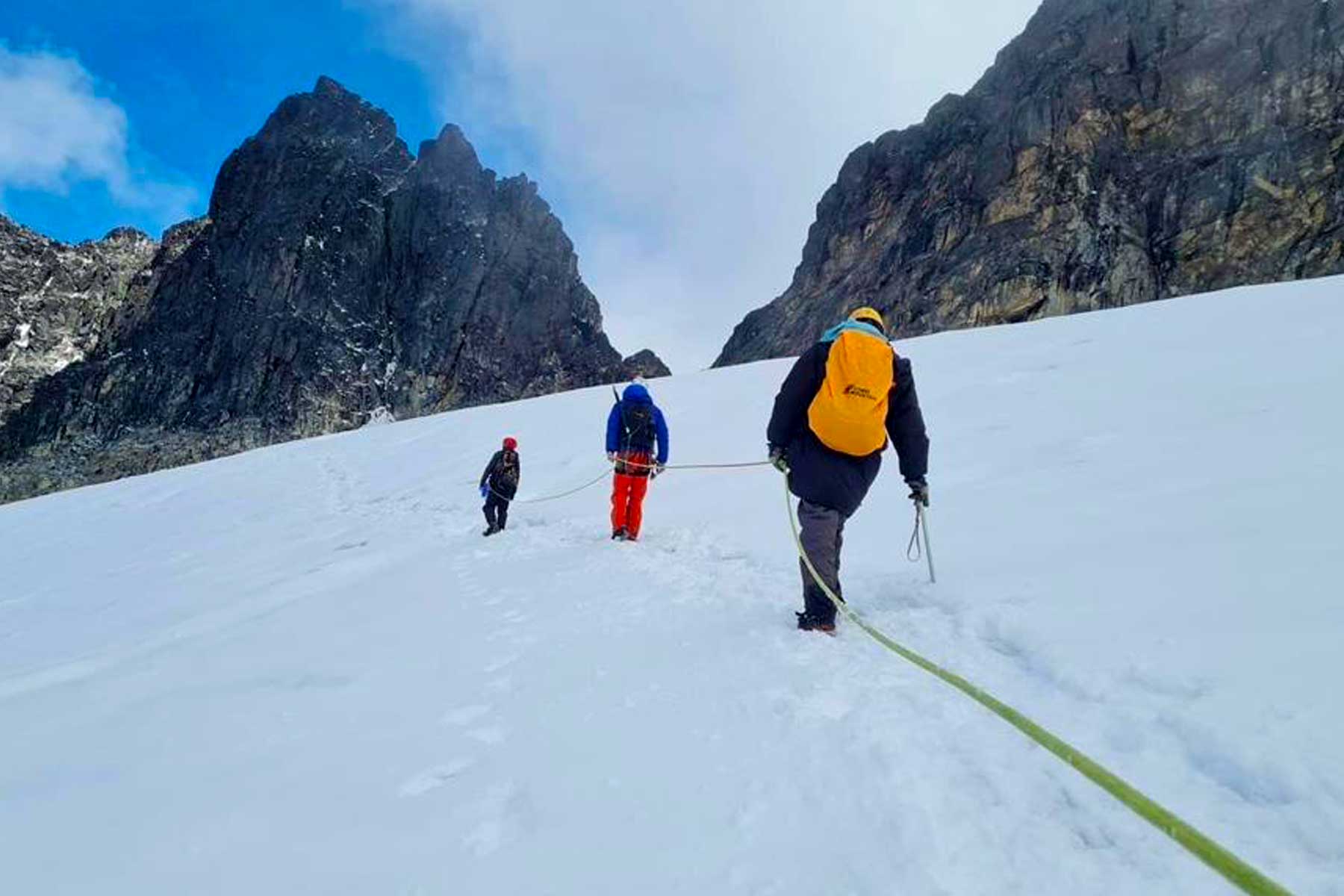
The 6-day Weismann’s Peak (4,620 m) trek in the Rwenzori Mountains offers an extraordinary alpine adventure without requiring the technical ice-climbing equipment needed for Margherita Peak. Starting from the Nyakalengija park gate at 1,648 meters near Kasese, this route scales the rugged slopes of Mount Luigi di Savoia. Operated by Roads of Adventure Safaris, the journey leads you through five distinct ecological bands—from dense tropical rainforests and bamboo thickets to high-altitude moorland filled with 4-meter giant lobelias and crystal-clear glacial lakes. Over six days, you will tackle around 40 kilometers of challenging terrain, gaining nearly 3,000 meters in elevation while supported by expert local Bakonzo guides, mountain cooks, and porters. It is a spectacular, fast-paced choice for fit hikers seeking a scenic Rwenzori summit experience.
Day 1: Nyakalengija (1,648 m) to Nyabitaba Camp (2,651 m)
Your expedition begins at the Uganda Wildlife Authority ranger station in Nyakalengija around 8:30 AM, where you will meet your Roads of Adventure Safaris guide, cook, and porter crew. Starting at an elevation of 1,648 meters, the 10-kilometer trail opens with a gentle warm-up past local farmland before entering the dense Afro-montane forest of the Mubuku River valley. As you hike for 5 to 6 hours, gaining 1,003 meters in elevation, keep an eye out for black-and-white colobus monkeys, blue monkeys, and colorful Rwenzori turacos in the canopy. The real physical test comes during the final two hours as the path climbs steeply up a narrow, root-filled forest ridge, bringing you to Nyabitaba Camp at 2,651 meters by mid-afternoon to unpack, enjoy warm tea, and rest as night falls.
Day 2: Nyabitaba Camp (2,651 m) to Guy Yeoman Camp (3,505 m)
Setting off early after a warm breakfast, you will drop down through the forest canopy to cross the suspension footbridge over the rushing Mubuku River at the Kurt Shafer bridge. From the riverbank, the trail ascends sharply over 854 meters of elevation gain across a 5-kilometer stretch that takes roughly 3 to 4 hours of hiking. You will climb through a dense bamboo belt into the surreal Heather-Rapanea zone, where 10-meter giant heather trees are draped in thick hanging moss and lichens. Slipping into your waterproof rubber Wellington boots is essential here to navigate the boggy, slick terrain and moss-covered boulders before arriving at Guy Yeoman Camp at 3,505 meters, where you can relax and allow your body to adapt to the cooler, thinner air.
Day 3: Guy Yeoman Camp (3,505 m) to Kitandara Lakes Camp (4,023 m)
Day three pushes directly into the high-alpine moorland zone for an 8-kilometer trek taking 6 to 7 hours of steady movement. Leaving Guy Yeoman Camp, you will ascend 518 meters along the upper Mubuku Valley, navigating a mix of wooden boardwalks and muddy tussock bogs framed by towering 4-meter giant lobelias and everlasting flowers. The trail passes dramatic granite cliffs and cascading waterfalls, requiring careful balance on wet stone steps and wooden ladders as you approach Freshfield Pass. By late afternoon, you will reach Kitandara Lakes Camp, perched at 4,023 meters right beside two pristine alpine lakes, where evening temperatures regularly plunge down to around  (
( ), making your warm down jacket and thermal base layers absolute necessities.
Day 4: Summit Day: Kitandara Lakes Camp to Weismann’s Peak (4,620 m) and Return
Wake up at 5:30 AM for a hot breakfast and gear check before embarking on your 6 to 8-hour round-trip summit push up Mount Luigi di Savoia with your Roads of Adventure Safaris guide. The trail covers steep, rugged, and exposed alpine terrain, requiring you to climb 597 meters over loose scree, cold boulders, and tussock gaps. Reaching the summit of Weismann’s Peak at 4,620 meters (15,157 feet) rewards you with breathtaking 360-degree views across Mount Stanley’s glaciers, Mount Speke, and Mount Baker. After celebrating and capturing photographs at the top, you will carefully retrace your steps down the 597-meter descent back to Kitandara Lakes Camp at 4,023 meters for hot soup, a hearty dinner, and a well-earned night of rest.
Day 5: Kitandara Lakes Camp (4,023 m) to Guy Yeoman Camp (3,505 m)
After taking in a crisp alpine sunrise over the Kitandara Lakes, you will begin your 5 to 6-hour descent back down the mountain toward Guy Yeoman Camp. Retracing your steps through the upper Mubuku Valley involves dropping 518 meters in elevation over steep rock steps and muddy bog sections, making adjustable trekking poles essential to reduce impact on your knees and ankles. As you descend below 3,800 meters, the chilly alpine air gradually gives way to warmer temperatures, and the landscape transitions back into green, moss-draped giant heather forests. You will arrive back at Guy Yeoman Camp (3,505 m) by early afternoon, leaving plenty of time to dry out damp gear, relax, and share stories with your support crew.
Day 6: Guy Yeoman Camp (3,505 m) to Nyakalengija Park Gate (1,648 m)
The final day is a long, continuous 13-kilometer descent lasting 7 to 8 hours back to the national park gates. You will trek down through bamboo thickets, cross the suspension bridge over the Mubuku River, and navigate the forested ridge past Nyabitaba Camp, dropping a total of 1,857 meters in elevation. As you re-enter the lush rainforest canopy, the air becomes noticeably warmer and more humid. You will reach the Nyakalengija trailhead around 3:00 PM to sign out with the UWA park rangers and collect your official climb completion certificate, where your Roads of Adventure Safaris transfer vehicle will be waiting to drive you back to Kasese, Fort Portal, or Kampala.
What makes Weismann’s Peak a great alternative to Margherita?
Weismann’s Peak stands at 4,620 meters on Mount Luigi di Savoia, offering a true high-altitude Rwenzori summit experience without the technical ice-climbing requirements of Margherita Peak (5,109 m). While Margherita demands crampons, ice axes, ropes, and glacier traversal, Weismann’s Peak is accessible to fit trekkers who want an alpine challenge without specialized mountaineering skills. Over six days, you still experience the incredible ecological diversity of the Rwenzori range, moving through dense montane forests, bamboo thickets, giant heather zones, and high-alpine moorlands framed by 4-meter giant lobelias. The summit provides unobstructed 360-degree views across Mount Stanley’s glaciers, Mount Speke, and Mount Baker, giving you a rewarded feeling of standing high on Africa’s third-tallest mountain range. Choosing this route through Roads of Adventure Safaris allows for a safer, faster-paced expedition that minimizes time spent at extreme elevations while still delivering dramatic scenery, serene glacial lakes like Kitandara, and a challenging physical climb that tests your cardiovascular endurance. It is an ideal option for experienced hikers seeking raw, untouched equatorial mountain beauty.
How difficult is the 6-day trek to Weismann’s Peak?
The 6-day Weismann’s Peak climb is physically demanding and rated as strenuous, requiring strong legs, mental determination, and solid cardiovascular fitness. Over six days, you cover roughly 40 kilometers with nearly 3,000 meters of cumulative elevation gain and loss. The terrain is famously challenging: you will navigate steep, root-filled forest ridges, slippery wooden ladders, and long stretches of deep, shoe-snatching mud in the bog zones. High-altitude walking above 4,000 meters thins the air, making every step feel heavier and increasing the risk of altitude fatigue. Daily hikes range from 4 to 8 hours, culminating in a summit day that requires climbing 597 meters over loose rock, cold boulders, and tussocks before descending back down. Training months in advance with weighted step-ups, long hill hikes, and leg-strengthening exercises like squats and lunges is essential. While technical rock or ice climbing isn't required, maintaining balance on wet, uneven surfaces for hours tests your joint stability. Supported by Roads of Adventure Safaris guides and porters, fit hikers who pace themselves properly will find the challenge deeply rewarding.
What kind of footwear is needed for this Rwenzori trek?
Footwear can make or break your Rwenzori expedition due to the range's famously wet and saturated mid-altitude terrain. Veteran mountain guides universally recommend bringing two distinct types of footwear: knee-high rubber Wellington boots (gum boots) and sturdy, waterproof leather hiking boots. The bog zones between 3,000 and 3,800 meters—such as those surrounding Guy Yeoman Camp—are essentially giant soaked sponges where deep mud quickly overwhelms standard GORE-TEX hiking boots. Wearing rubber Wellington boots fitted with custom arch-support insoles keeps your feet completely dry through deep mud and standing water. Once you ascend into the drier, rockier high-alpine zones above 4,000 meters around Kitandara Lakes and Weismann’s Peak, you will switch to your rigid hiking boots for ankle support and traction on cold boulders and scree. Pair both with durable, waterproof gaiters to keep debris out, and bring 5 to 6 pairs of thick, moisture-wicking merino wool socks. Keeping your feet dry and blister-free during long days on the trail is the single most critical factor for enjoying your time on the mountain.
What gear does Roads of Adventure Safaris provide trekkers?
Roads of Adventure Safaris takes care of complex expedition logistics so you can focus entirely on the trek. We provide all essential camp infrastructure, including sturdy, weatherproof high-altitude tents, insulated sleeping mats, and communal mess equipment for hot daily meals prepared by our mountain cooks. Our service includes a full, dedicated support team comprising licensed lead guides, armed Uganda Wildlife Authority (UWA) rangers, professional cooks, and local Bakonzo porters who carry your heavy gear (up to 15 kg per trekker) in waterproof duffle bags. We also manage all administrative arrangements, such as pre-securing UWA national park entry permits, daily trekking fees, and emergency mountain rescue logistics. If you lack specialized personal gear—like sub-zero sleeping bags rated down to  , trekking poles, rain shells, or rubber gum boots—we arrange rentals directly in Kampala or at the trailhead base camp in Nyakalengija. By supplying well-maintained equipment and organizing fair wages, gear, and warm clothing for our local porters, we guarantee a smooth, comfortable, and ethically operated mountain experience.
When is the best time to climb Weismann’s Peak?
The best time to climb Weismann’s Peak is during the two primary dry seasons: June through August and December through February. Situated right on the equator, the Rwenzoris do not have traditional winter or summer, but rather wet and dry climate cycles. Attempting the climb during dry months drastically improves trail conditions by lowering water levels in the boggy mid-altitude zones and reducing the risk of heavy downpours that turn streams into impassable torrents. During dry windows, morning skies are generally crisp and clear, providing spectacular, unobstructed views of Mount Stanley’s glaciers and surrounding crater lakes. Daytime temperatures at lower forest altitudes hover around  to
to  , though night temperatures at high camps like Kitandara (4,023 m) still plunge to near freezing (). Even in the dry season, the Rwenzoris are tropical cloud forests, meaning an occasional afternoon rain shower can happen. Booking with Roads of Adventure Safaris during these drier windows gives you the highest chance of summit success, clearer photographs, and a much more comfortable journey.
How do trekkers handle altitude sickness during the climb?
Managing altitude sickness (Acute Mountain Sickness) requires a disciplined approach to pacing, hydration, and communication. As you pass 3,000 meters, atmospheric pressure drops and oxygen molecules become sparser, which can cause symptoms like mild headaches, fatigue, or nausea. The golden rule enforced by Roads of Adventure Safaris guides is "Pole, Pole"—Swahili for slowly, slowly. Maintaining a slow, steady walking pace keeps your heart rate manageable and gives your body time to adjust. Trekkers should drink 4 to 5 liters of purified water daily to combat rapid dehydration caused by cool, dry mountain air. Eating high-carbohydrate meals prepared by your mountain cook provides the energy your body needs to acclimatize. Our lead guides monitor pulse oximeter readings daily to check blood oxygen saturation ( ) and heart rate at camp. If you experience symptoms, inform your guide immediately so they can adjust the group's pace or take action. Carrying prescription Acetazolamide (Diamox) after consulting your doctor can also help speed up natural acclimatization on the trail.
What food is served by cooks on the mountain?
Nutrition is vital during a 6-day trek, as daily physical exertion in cold weather burns between 3,500 and 5,000 calories. The professional mountain cooks provided by Roads of Adventure Safaris prepare three hot, calorie-dense meals daily using fresh ingredients transported by our porter crew. Breakfast typically features warm porridge, eggs, sausages, toast, pancakes, hot tea, and coffee to kickstart your morning energy. On the trail, you will enjoy packed lunches or hot mid-day soups, while dinners at high camps consist of hearty portions of carbohydrate-rich foods like pasta, rice, potatoes, fresh vegetables, beef, chicken, or fish stew. Fresh drinking water is collected from clean mountain streams, boiled thoroughly, and treated before filling your hydration bladders each morning. We cater to dietary requirements—including vegetarian, vegan, gluten-free, or halal—when notified during booking. Additionally, trekkers should pack personal high-energy snacks like electrolyte powders, dark chocolate, nuts, dried fruits, and energy gels to keep their blood sugar stable during long ascents between camp meals.
How are porters managed and treated during the expedition?
Porters are the backbones of any Rwenzori expedition, carrying essential food supplies, cooking fuel, tents, and personal duffle bags up steep terrain. Roads of Adventure Safaris adheres to strict ethical standards regarding porter welfare and fair compensation. Under Uganda Wildlife Authority rules, each porter's load is strictly capped at a maximum of 15 kg to prevent physical strain and injury. We ensure all porters receive fair daily wages, nutritious meals, warm sleeping accommodations at high-altitude huts, and proper cold-weather gear—including waterproof coats, gloves, and boots—suitable for sub-zero night temperatures. Most of our support crew comes from the local Bakonzo community around Kasese and Nyakalengija, meaning your trek directly supports local families and the regional economy. Treating our mountain crew with dignity and fair working conditions creates a warm, supportive atmosphere on the trail. Trekkers are encouraged to pool tips at the end of the climb ($150 to $250 total per hiker) as a direct gesture of gratitude for the team's relentless hard work.
What safety measures are in place for emergency evacuations?
Safety is the top priority for Roads of Adventure Safaris on every high-altitude expedition. Our lead guides are certified in wilderness first aid and experienced in recognizing early signs of severe altitude sickness, hypothermia, and physical exhaustion. Every climbing group is accompanied by an armed Uganda Wildlife Authority (UWA) ranger to ensure safety against wildlife and maintain park protocols. Guides carry comprehensive first-aid kits, pulse oximeters, and emergency communication devices to stay in touch with our base headquarters in Kasese and Kampala. In the event of acute illness or injury, the primary emergency procedure is an immediate, assisted descent to lower elevations with the help of our porter crew and guides. UWA operates designated emergency evacuation protocols along the Central Circuit, utilizing stretcher teams to transport injured hikers down to trailhead roadheads quickly. From the base camp, our 4x4 safari vehicles provide immediate ground transfer to medical facilities in Kasese or specialized hospitals in Kampala, giving you complete peace of mind throughout your trek.
How do I finalize my booking with Roads of Adventure?
Booking your 6-day Weismann’s Peak expedition with Roads of Adventure Safaris is simple and secure. Start by visiting our official website portal or reaching out to our Kampala reservation desk directly via phone at +256 773 796644 or through email. Our safari consultants will help you select your preferred dates, customize pre-and-post trek accommodations in Kasese or Fort Portal, and arrange seamless private 4x4 transfers from Entebbe International Airport or Kampala. To lock in your dates, a deposit is required to secure your mandatory UWA national park permits and reserve your dedicated guide and porter crew well in advance, especially during peak dry seasons (June–August and December–February). Once confirmed, we issue digital trip vouchers, detailed packing checklists, and pre-departure medical advice. Having all official permits and logistics pre-arranged guarantees an easy, stress-free arrival at the Nyakalengija park gate, letting you focus on taking on the legendary Rwenzori Mountains.
Booking 6 Days wisemann peak Rwenzori hike with us Roads of Adventure safaris
To book your 6-day Weismann’s Peak (4,620 m) expedition, get in touch with Roads of Adventure Safaris. Conveniently located along the Kampala-Entebbe Road, our office is easy to reach right from Kampala for in-person planning or gear consultations. This 6-day itinerary is a thrilling way to explore the legendary "Mountains of the Moon," following the scenic Kilembe Trail up the slopes of Mount Luigi di Savoia. Guided by expert local Bakonzo crews, you will traverse pristine rainforests, bamboo zones, and surreal Afro-alpine landscapes before reaching the summit for breathtaking 360-degree views across the entire Rwenzori range.
