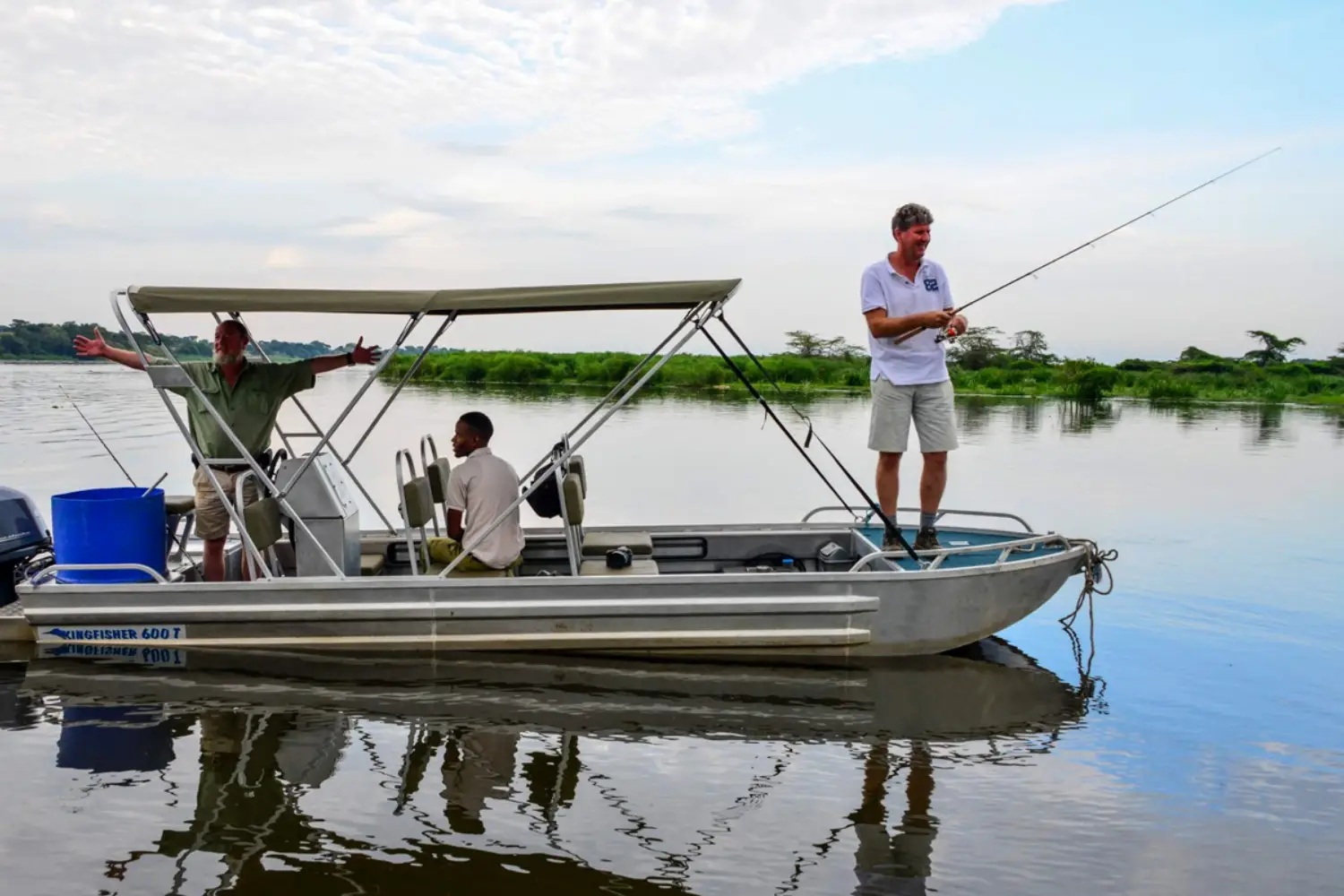
A top Uganda fishing safari usually centers on Lake Victoria and the Victoria Nile in Murchison Falls National Park. Target the massive Nile Perch, catfish, and tigerfish. A successful Uganda safari blends world-class angling with traditional game drives, gorilla trekking, and lush tropical scenery
1. 3-Day Murchison Falls Sport Fishing Tour
This 3 Day Murchison falls sot fishing tour is designed for anglers short on time, this route targets large Nile perch along the Victoria Nile. You travel directly north to Murchison Falls National Park to fish for trophy perch from the riverbanks and motorized boats stationed near the base of the cascade. Alongside river casting, this route includes classic savannah game drives across the Buligi tracks to observe elephants, Rothschild giraffes, and lions.
Daily Itinerary
Day 1: Kampala to Murchison Falls National Park (approx. 305 km, 5–6 hours)
Depart Kampala early via the Kampala–Gulu highway, driving through Masindi town. Enter through the southern Kichumbanyobo Gate, traversing the Budongo Forest reserve. Arrive at the northern banks of the Victoria Nile in the afternoon for an initial bank-casting session targeting catfish and smaller Nile perch near the Paraa crossing point.
Day 2: Full-Day Sport Fishing on the Victoria Nile
Board a motorized boat equipped with heavy-duty trolling tackle and live bait rigs. Spend the morning trolling and casting near the churning waters at the base of Murchison Falls, where oxygenated waters attract large perch. In the afternoon, shift downstream to calmer pools near the Devil’s Cauldron to target giant species using plug lures and live tilapia bait.
Day 3: Morning Game Drive & Return to Kampala (approx. 305 km, 5–6 hours)
Set out on an early morning game drive along the Buligi circuit to spot savannah wildlife, including buffalos, waterbucks, and Jackson's hartebeests. After late morning breakfast, exit the park via the Luwero triangle highway and drive back to Kampala, arriving by late afternoon.
2. 5-Day Fishing & Wildlife Safari Adventure
This 5-Day Fishing & Wildlife Safari Adventure itinerary combines rhino conservation at Ziwa Sanctuary with deep-water Nile perch fishing in Murchison Falls National Park. Moving from the central savannahs into the Albertine Rift, you gain two dedicated full days on the river paired with structured land-based game tracking. It suits travelers seeking a mix of species, including Nile perch, semutundu catfish, and big game.
Daily Itinerary
Day 1: Kampala to Ziwa Rhino Sanctuary to Murchison Falls (approx. 330 km total, 6 hours driving)
Drive north from Kampala to Nakasongola. Stop at Ziwa Rhino Sanctuary for a 2-hour guided foot trek to observe southern white rhinoceroses. Continue north through Masindi to enter Murchison Falls National Park, arriving at your lodge overlooking the river by late afternoon.
Day 2: River Bank & Downstream Boat Fishing
Begin early with bank casting along the rocky outcrops near the south riverbank. Mid-morning, board a targeted fishing boat to explore downstream eddy currents toward the Albert Nile outlet, setting deep-running crankbaits and live bait for large Nile perch and vundu catfish.
Day 3: Morning Savannah Game Drive & Afternoon Falls Boat Fishing
Explore the northern delta circuit on a morning safari drive to track lions, leopards, and hyenas. In the afternoon, launch a boat cruise heading upstream to the base of Murchison Falls, casting heavy lures into turbulent waters where large perch hunt in the current.
Day 4: Full-Day Nile Perch & Catfish Expedition
Spend a full day on the water exploring specialized fishing spots, including the Nyamusika Cliffs and the Fajao gorge. Alternate between live-bait drift fishing and spinning with heavy spoon lures, taking break periods on board while monitoring depth sounders for large fish schools.
Day 5: Top of the Falls Viewpoint & Return to Kampala (approx. 305 km, 5–6 hours)
Visit the Top of Murchison Falls viewpoint to observe the 43-meter drop where the Nile squeezes through a 7-meter gorge. Begin the return journey south via Masindi, reaching Kampala in the evening.
7-Day Luxury Uganda Fishing Safari
A multi-waterway expedition covering Lake Victoria's deep waters and the fast-flowing currents of the Victoria Nile. This route utilizes private transfers to connect Bulago Island with Murchison Falls. You target heavy Nile perch on open lake waters before transitioning to river habitats where tigerfish and massive catfish feed along fast currents.
Daily Itinerary
Day 1: Arrival in Entebbe & Speedboat Transfer to Bulago Island (approx. 45 min boat ride)
Land at Entebbe International Airport. Board a boat from Waterfront Club jetty across Lake Victoria to Bulago Island. Check into your island resort and prepare tackle gear with your angling guide for the lake conditions ahead.
Day 2: Full-Day Trolling on Lake Victoria
Board a sport fishing boat outfitted with GPS and downriggers. Spend the day trolling deep waters around the Ngamba and Ssese island channels, targeting open-water Nile perch using large Rapala lures and down-rigger setups.
Day 3: Bulago Island to Entebbe to Murchison Falls National Park (approx. 350 km, 6–7 hours driving)
Take a morning boat transfer back to Entebbe mainland. Meet your driver-guide and travel north via the Kampala–Gulu highway to Murchison Falls National Park, checking into your safari lodge along the Nile.
Day 4: Upper Nile River Fishing & Base of the Falls
Head onto the Victoria Nile in a private boat, casting along overgrown papyrus banks for tigerfish and tilapiine species. In the afternoon, position near the swirling pools below the falls to drift live bait for Nile perch.
Day 5: Dedicated Catfish & Perch Angling at Fajao Gorge
Focus your effort on the deep underwater rocky drop-offs of Fajao Gorge. Use heavy bottom-rigged tackle baited with fish fillets to target giant semutundu catfish, switching to casting heavy spoons for perch during peak afternoon water flows.
Day 6: Northern Bank Game Drive & Sunset River Cruise
Take a morning game drive across the pakuba air-strip circuit inside the park to observe herds of Jackson’s hartebeest, elephants, and giraffes. Return to the river for a relaxed late-afternoon fishing session along calm backwater.
Day 7: Drive to Entebbe via Masindi (approx. 350 km, 6–7 hours)
Depart Murchison Falls after breakfast, traveling south through Masindi town. Stop for lunch en route before continuing directly to Entebbe International Airport for your evening international flight home.
4. 9-Day Nile Perch & Big Game Safari
An extensive fishing voyage extending from Lake Victoria north through Murchison Falls into the quiet, rarely fished waters near Arra Fishing Village along the Albert Nile. Designed for dedicated anglers, this plan covers varied aquatic environments, maximizing time on the water while incorporating big game viewings in Murchison's savannah core.
Daily Itinerary
Day 1: Entebbe Arrival & Local Lake Victoria Fishing
Arrive in Entebbe, meet your guide, and check into your hotel. Take an afternoon 3-hour warm-up boat session around the nearby bays of Lake Victoria to test tackle setups and troll for shallow-water perch.
Day 2: Entebbe to Murchison Falls National Park (approx. 350 km, 6–7 hours)
Drive north via the Luwero highway. Cross the Karuma bridge and enter Murchison Falls National Park via the northern Tangi Gate, arriving at your lodge in time for an evening orientation.
Day 3: Base of Murchison Falls Fishing Expedition
Spend the full day on a dedicated fishing craft near the base of the falls. Alternate between trolling large wooden plugs along rock faces and casting weighted lures directly into the foam line created by the river's rush.
Day 4: Delta Region Fishing & Birding Cruise
Navigate downstream toward the Victoria Nile Delta where the river enters Lake Albert. Fish the slow-moving papyrus channels for Nile perch and electric catfish, keeping watch for shoebill storks along the marsh edges.
Day 5: Morning Game Drive & Afternoon Bank Angling
Conduct a morning wildlife drive along the Queen's track to spot predators and plains game. Spend the afternoon bank fishing at selected safe access points along the south riverbank near Paraa.
Day 6: Murchison Falls to Arra Fishing Village, Adjumani (approx. 160 km, 3–4 hours)
Drive further north out of the park through Pakwach, heading toward Adjumani district. Arrive at Arra Fishing Village along the wide stretch of the Albert Nile, an area known for minimal fishing pressure and native fishing practices.
Day 7: Full-Day Albert Nile Fishing at Arra
Hire local river boats to explore the deep bends of the Albert Nile near Arra. Cast along reeds and deep channels for large perch, African pike, and tigerfish using live bait and lures.
Day 8: Arra Village to Kampala (approx. 430 km, 7–8 hours)
Begin the long journey south along the Gulu–Kampala tarmac highway. Traverse the central plains of Uganda, arriving in Kampala by late afternoon for your hotel check-in.
Day 9: Kampala City Transfer to Entebbe Airport (approx. 45 km, 1–2 hours)
Enjoy a leisurely breakfast, purchase local crafts in Kampala if time allows, and take a vehicle transfer along the Entebbe Expressway to the airport for your outbound flight.
5. 12-Day Fishing, Gorillas, & Wildlife Safari
Uganda’s complete circuit connecting river fishing, savannah wildlife, and mountain gorilla tracking. The journey moves from Murchison Falls south along the Albertine Rift Escarpment to Queen Elizabeth National Park's Kazinga Channel, ending in the high-altitude rainforests of Bwindi Impenetrable National Park.
Daily Itinerary
Day 1: Entebbe to Murchison Falls National Park (approx. 350 km, 6–7 hours)
Depart Entebbe early in a 4x4 safari vehicle. Travel north through Kampala and Masindi, entering Murchison Falls via the southern gate to reach your riverbank lodge before dusk.
Day 2: Full-Day Sport Fishing Below Murchison Falls
Spend the day on the Victoria Nile. Troll heavy lures through the rapids below the falls to hook Nile perch and catfish while observing hippos and crocodiles along the bank.
Day 3: Game Drive & Top of the Falls Visit
Embark on an early game drive across the northern savannah tracks. In the afternoon, visit the top of the falls to view the river forcing its way through the narrow rock gap.
Day 4: Murchison Falls to Fort Portal (approx. 360 km, 7–8 hours)
Drive south along the Albertine Rift Valley Road, passing tea plantations and crater lake fields near Hoima and Fort Portal, positioning near the Rwenzori Mountain foothills.
Day 5: Fort Portal to Queen Elizabeth National Park (approx. 120 km, 2–3 hours)
Drive south to Queen Elizabeth National Park. Take an afternoon boat safari along the Kazinga Channel, a natural 32 km waterway connecting Lake Edward and Lake George, home to large hippo pods and waterbirds.
Day 6: Kazinga Channel & Lake Edward Angling Experience
Join local park guides for an authorized sport fishing excursion along designated sections of the Kazinga Channel and Lake Edward edges, targeting tilapia and catfish species using light gear setups.
Day 7: Game Drive in Kasenyi & Transfer to Ishasha (approx. 100 km, 2–3 hours)
Explore the Kasenyi plains on a morning game drive to search for lions tracking Uganda kob. Drive south to the Ishasha sector of the park, famous for its tree-climbing lions resting in fig trees.
Day 8: Ishasha to Bwindi Impenetrable National Park (approx. 130 km, 4–5 hours)
Take a morning drive through Ishasha to spot tree-climbing lions. Continue into the terraced highlands of Kigezi, entering Bwindi Impenetrable National Park (Buhoma or Ruhija sector).
Day 9: Mountain Gorilla Trekking in Bwindi Forest
Report to the park headquarters at 7:30 AM for a ranger briefing. Hike into the dense montane rainforest to trek a habituated mountain gorilla family, spending one hour observing them before returning to the lodge.
Day 10: Batwa Cultural Trail & Nature Walk
Take a guided forest trail walk along the river paths to view endemic Albertine Rift birds and primates. In the afternoon, visit a local Batwa community project to learn about indigenous rainforest survival traditions.
Day 11: Bwindi to Lake Mburo National Park (approx. 270 km, 5–6 hours)
Drive east through the hills of Kabale and Mbarara to Lake Mburo National Park. Arrive in time for a late afternoon game drive to view zebras, impalas, topis, and elands around the lake basin.
Day 12: Lake Mburo Boat Session & Return to Entebbe (approx. 240 km, 4–5 hours)
Take an early morning fishing and boat cruise on Lake Mburo to target local tilapia species. Conclude the safari with a drive back to Entebbe, crossing the Equator line at Kayabwe for photos before arriving at the airport.
Here are the 12 technical and operational questions regarding sport fishing and safari planning in Uganda, converted into clear, natural prose with all tables and diagrams removed.
What specific fishing tackle and gear setup are required for targeting trophy Nile Perch at Murchison Falls?
Targeting Nile Perch (Lates niloticus) in the strong flows below Murchison Falls requires heavy-duty conventional or spinning gear to withstand both the fish's weight and the river's force. Anglers generally rely on heavy 7 to 8-foot boat rods rated for 30–80 lb line, paired with high-capacity reels (size 6000–10000) that feature smooth, robust drag systems capable of exerting 15–20 kg of stopping power.
Braided main line between 60 and 80 lb test is the standard choice, joined to a heavy monofilament or fluorocarbon shock leader of 100 to 150 lb test. This thick leader protects against line abrasion from submerged granite rocks and the perch's raspy mouth. For trolling, deep-running crankbaits (such as 16–19 cm Halco Laser Pros or Rapala Magnum Super Deep Runners) work best. To avoid hardware failure under heavy stress, replace standard factory treble hooks with heavy-gauge single hooks (size 7/0 to 9/0) and heavy-duty split rings.
How do seasonal hydrological changes and rainfall patterns affect fishing success on the Victoria Nile?
Water clarity, temperature, and oxygen levels directly influence Nile Perch feeding activity along the Victoria Nile. During the primary dry seasons (December to February and June to August), river discharge levels stabilize and water clarity improves noticeably. Higher visibility allows predatory perch to hunt artificial lures by sight along eddy seams and drop-offs.
During peak rainy seasons (March to May and September to November), heavy upstream runoff brings silt and river debris into the Victoria Nile. Silt-laden, murky water reduces lure visibility, forcing anglers to rely on scent-based methods, such as fishing with live tilapia or Clarias catfish along calmer river edges. High flood waters also speed up the current, making deep holding pools turbulent and harder to fish effectively.
What permits and legal regulations govern sport fishing within Murchison Falls National Park?
Sport fishing in Murchison Falls National Park is regulated by the Uganda Wildlife Authority (UWA) to prevent overfishing. Anglers must obtain a specialized UWA Sport Fishing Permit, which is separate from standard park entry fees. A single-day fishing permit costs USD $50 per person, while a four-day permit costs USD $150.
UWA mandates a strict catch-and-release policy for large breeding Nile Perch (typically any fish over 1 meter in length). Only smaller fish caught outside critical breeding zones may be kept for meals, and only with explicit ranger permission. Independent bank fishing without an authorized guide or ranger escort is prohibited due to risks from Nile crocodiles and hippos. Motorized fishing boats operating within 500 meters of the base of the falls also require specialized clearance and an experienced local captain.
What safety precautions are mandatory when fishing from boats near the base of Murchison Falls?
Navigating a boat near the base of Murchison Falls involves managing water turbulence, sudden hydraulic surges, and nearby dangerous wildlife. Safety protocols require boats to maintain a safe distance from the primary surge basin (Fajao Gorge) to avoid being drawn into whirlpools or turned over by surges.
Commercial fishing craft must run twin-engine setups to ensure backup propulsion if one motor fails. Anglers and crew must wear type-III ISO-approved life jackets at all times on the water. Operators keep a continuous watch for territorial hippos and Nile crocodiles along the rocky shores. Boats anchor only in secondary eddies using heavy-duty, quick-release anchor lines that can be cut or dropped immediately if hippos approach the vessel.
What primary fish species can anglers target in Uganda besides the Nile Perch?
While Nile Perch draw the most attention, Uganda’s freshwaters support several other popular sport fish species. Semutundu catfish (Bagrus docmak) inhabit deep river pools and rocky drop-offs, often growing between 5 and 30 kg. Tigerfish (Hydrocynus forskahlii) thrive in fast-flowing, oxygen-rich rapids, usually weighing between 1 and 4 kg.
Vundu catfish (Heterobranchus longifilis) occupy slow-moving, muddy river bottoms and can reach weights from 10 to 50 kg. Finally, Ngege tilapia (Oreochromis esculentus) inhabit shallow, vegetated lake margins and generally weigh between 0.5 and 2 kg. Tigerfish are usually targeted in fast currents using light spinning gear with silver spoons or poppers, while catfish species are targeted using heavy bottom-rigged gear baited with cut or live bait in deep river holes.
What are the primary logistical differences between fishing Lake Victoria and fishing the Victoria Nile?
Fishing Lake Victoria involves open-water trolling, whereas fishing the Victoria Nile relies on river drift and precise spot-casting. On Lake Victoria, operations use larger twin-engine cabin cruisers equipped with fish finders, GPS plotters, and downriggers. Anglers travel longer distances across open water, trolling large lures deep near underwater drop-offs around the Ssese Islands or Bulago Island, where wind-driven waves can create rough swells.
In contrast, Victoria Nile operations use smaller, highly maneuverable 18-to-20-foot aluminum or fiberglass flat-bottom boats. Fishing stays localized around river bends, eddy lines, and deep rock structures. Techniques center on precise lure casting or controlled drifting with live bait into specific pocket waters along strong river currents.
How do you properly pack and protect sensitive camera and fishing gear against African environmental conditions?
Transporting camera equipment and fishing tackle across Uganda exposes gear to fine red dust, high humidity, and sudden tropical downpours. Store cameras, lenses, and electronics in IP67-rated hard cases fitted with rubber gaskets and silica gel packets. Roll-top waterproof dry bags work best for holding everyday gear during boat trips.
For tackle, keep lures, terminal gear, and tools inside clear utility boxes within water-resistant soft bags. Wipe down all metal components with fresh water and rust-inhibiting spray after each trip to prevent corrosion from humidity. To protect fishing rods, pack multi-piece travel rods or store two-piece rods inside rigid, lockable PVC tubes during road transport over bumpy, corrugated dirt roads.
What medical preparations and health precautions are required before travelling to Ugandan fishing locations?
Uganda's tropical climate requires specific health precautions before travel. A yellow fever vaccination is required for entry into the country, and travelers must present an official International Certificate of Vaccination upon arrival. The risk of malaria is present across all major fishing regions, including Murchison Falls and Lake Victoria, so visitors should consult a travel clinic to get antimalarial medication, such as Atovaquone-Proguanil (Malarone) or Doxycycline.
Because Schistosoma parasites (which cause schistosomiasis or bilharzia) live in quiet freshwater shorelines, avoid wading barefoot along slow-moving lake edges or marshy banks. Use insect repellents containing 30–50% DEET, and wear permethrin-treated long pants and long-sleeved shirts around sunrise and sunset when mosquitoes are most active.
What drive times and road conditions should travelers expect between Entebbe, Masindi, and Murchison Falls?
Travel across Uganda combines smooth paved highways with unpaved, corrugated park roads. The drive from Entebbe International Airport to Kampala via the Entebbe Expressway covers about 45 km and takes roughly 45 to 60 minutes. Heading north from Kampala to Masindi town covers approximately 220 km along a paved highway, taking between 3.5 and 4 hours depending on traffic.
The final leg from Masindi into Murchison Falls National Park via the Kichumbanyobo Gate covers around 85 km to the Paraa river crossing, shifting to unpaved dirt roads. This stretch requires a 4x4 vehicle with good ground clearance and takes 2 to 2.5 hours. During heavy rains, these unpaved sections become slick and rutted, which can noticeably increase travel time.
How do anglers obtain live bait in remote regions like Murchison Falls or the Albert Nile?
Sourcing good live bait is essential for targeting large Nile Perch and deep-water catfish in river habitats. Anglers and local fishing guides catch bait species early in the morning before heading out for their main fishing sessions.
They use light spinning gear with small hooks baited with bread, worms, or small spinners to catch tilapia species along shallow, calm papyrus edges. Cast nets are also thrown in sandy shallows to collect shoals of small Alestes or small tigerfish. Once caught, the baitfish go straight into aerated onboard live-wells or submerged mesh buckets towed alongside the boat to keep them active and healthy until rigged onto circle hooks.
What are the optimal times of day to target large Nile Perch, and how does diurnal activity shift?
Nile Perch follow clear daily feeding patterns shaped by light levels, water temperature, and prey movement. The most productive feeding windows occur during low-light hours: early morning (06:00 to 09:00) and late afternoon into dusk (15:00 to 19:00). During these hours, perch move toward shallow water edges and eddy seams to ambush baitfish, making medium-depth lures or surface plugs effective.
During midday (11:00 to 15:00), strong sunlight drives perch into deep underwater channels, shaded overhangs, and bottom rock depressions. Fishing during these hot hours requires trolling deep-running hard lures or dropping live bait directly into deep structure (8 to 15 meters) where the fish rest in cooler, oxygenated water.
What ethical handling procedures ensure high survival rates for released Nile Perch?
Because Nile Perch tire quickly during long fights in warm water, careful handling is needed to keep them healthy upon release. Use heavy tackle to land fish quickly rather than fighting them to total exhaustion. Land the fish using a large, knotless rubberized net or smooth lip-gripping tools; landing gaffs should never be used on fish intended for release.
Keep the fish submerged in the water as much as possible while removing barbless or crushed-barb hooks. If lifting the fish for a quick photo, support its weight horizontally with one hand under the head and the other holding the belly—never hang large fish vertically by the jaw, as this damages their spine and internal organs. Before release, hold the fish facing upstream into the current, supporting its tail until it regains energy and swims off on its own.
Booking Uganda fishing safari with us Roads of Adventure safaris
Booking a Uganda fishing safari with Roads of Adventure Safaris can be initiated directly by emailing info@roadsofadventuresafaris.com or calling their office at +256 701041637. As a verified local operator based on the Kampala–Entebbe Road, they customize multi-day angling itineraries across Uganda's top sport fishing destinations
