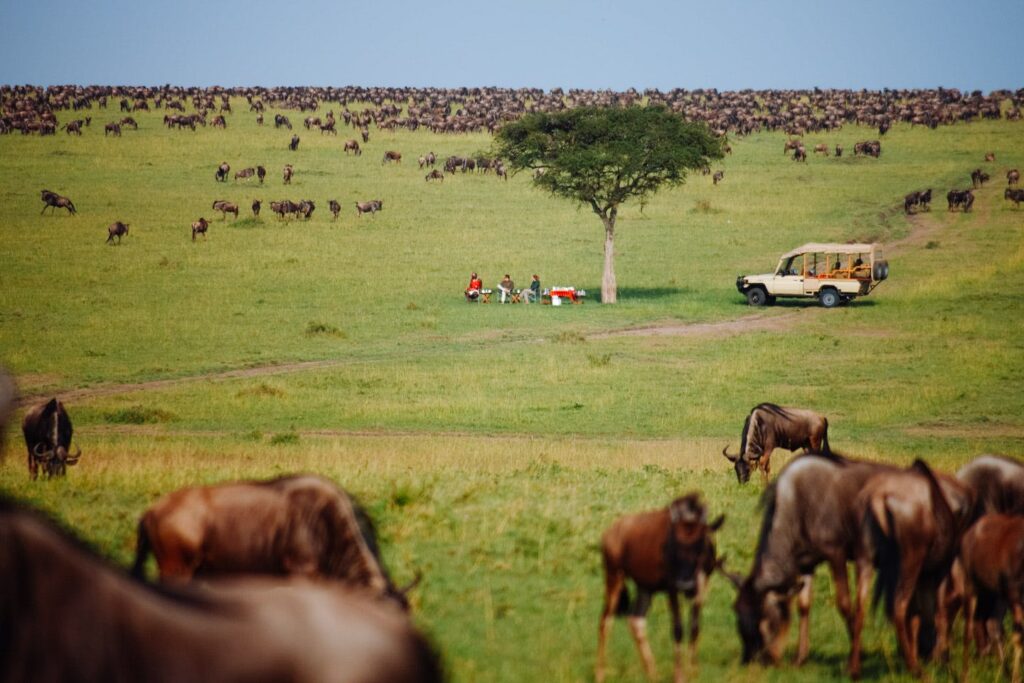
A 5-day Masai Mara itinerary offers the perfect balance to explore Kenya's premier wildlife reserve. Five days allow you to combine standard vehicle game drives, a relaxing, slow-paced or action-packed experience, and unique bucket-list adventures
5-days-masai-mara-safari-lake-nakuru-and-hells-gate-national-park-kenya-tour
5-days-best-of-kenya-wildlife-safari-to-masai-mara-lake-nakuru-and-amboseli-national-park
5-day-best-luxury-kenya-safari-to-amboseli-lake-nakuru-and-maasai-mara-safari-tour
5 Days Classic Great Migration Focus
This 5-day safari is the ultimate condensed expedition, meticulously crafted to place you in the heart of the Masai Mara during the peak of the Great Migration. Designed for wildlife enthusiasts and photographers, this "Migration Focus" itinerary prioritizes proximity to the Mara River and the most active predator corridors. You will move beyond the standard tourist loop, spending your days in the field with expert guides who monitor the movement of the mega-herds in real-time. Whether you are witnessing the visceral, high-stakes drama of a river crossing or capturing the quiet tension of a lion pride on the prowl, every hour is optimized for discovery. By balancing long-form exploration with the comfort of high-quality base camps, this journey captures the raw, unrelenting intensity of the African savannah, providing an immersive, life-changing encounter with one of nature’s greatest spectacles in a timeframe that respects your busy schedule.
Daily Itinerary
Day 1: Nairobi to the Mara
Your journey begins with a departure from Nairobi, either via a scenic five-hour drive through the Great Rift Valley or a short, breathtaking bush flight. Upon arrival at your camp near the reserve, you will settle in and enjoy a hearty lunch before embarking on your first afternoon game drive. This initial foray into the Mara introduces you to the vast, rolling plains and the immediate density of wildlife—zebras, antelopes, and giraffes—that define this ecosystem. As the sun begins to set, your guide will brief you on the latest migration intelligence, ensuring your strategy for the following days is aligned with the current location of the massive wildebeest herds.
Day 2: Tracking the Mega-Herds
Today is dedicated to a full-day exploration of the Mara’s riverine corridors. With picnic lunches packed, you will venture deep into the reserve to track the wildebeest and zebra herds. Your focus is on the Mara River, where the tension is palpable as thousands of animals congregate on the banks. Your expert guide will navigate through the terrain to position you near the most promising crossing points. You will spend the day observing the herd dynamics, waiting for that singular, adrenaline-fueled moment when a brave individual leads the plunge into the crocodile-infested waters. It is a day of intense observation, requiring patience and keen eyes.
Day 3: River Crossing and Predator Action
This is your primary day for deep-field photography and observation. Returning to the river systems, you will position your vehicle to capture the chaos of the migration from the best possible angles. The Mara River is not only a crossing point but a magnet for predators; expect to see lions, hyenas, and leopards lurking in the riverine forests, waiting for opportunistic moments to strike. Because the herds are unpredictable, you may spend hours watching the build-up—thousands of wildebeest nervously milling about—before the dramatic surge happens. Use this time to capture the sheer scale of the herds and the intimate details of the struggle.
Day 4: Immersion and Relaxation
After the high intensity of the previous days, Day 4 offers a more flexible pace. You might start with an early morning game drive to catch predators returning from their nightly hunts, followed by a mid-day return to your lodge to relax, review your photos, and recharge. In the afternoon, you may choose to visit a local Maasai village for a cultural exchange, learning about the traditions of the people who have coexisted with these herds for centuries. Alternatively, opt for an evening game drive to see the savannah transition into night, revealing the nocturnal life of the Mara’s elusive hunters.
Day 5: Final Morning and Departure
On your final morning, you will head out at dawn for one last game drive, taking advantage of the early-morning golden light. This is an excellent opportunity to find the wildlife you may have missed, such as a solitary leopard or a cheetah pair surveying the plains. After a final bush breakfast, you will begin your return journey to Nairobi. As you drive back through the Rift Valley, you’ll have time to reflect on the immense scale of the migration and the unforgettable sights of the last few days, arriving in the city by the afternoon to connect with your outbound flight
5 Days Ultimate Wildlife & Cultural Experience
This 5-day itinerary offers a sophisticated blend of adrenaline-fueled wildlife tracking and meaningful cultural discovery in the heart of Kenya’s Masai Mara. Designed for the discerning traveler who values time and depth, this "Ultimate Wildlife & Cultural Experience" skips the long drives, whisking you directly into the world’s premier predator territory via scenic bush flight. Over five days, you will trade the city’s bustle for the raw majesty of the savanna, spending your mornings on the trail of the "Big Five" and your afternoons gaining intimate insights into the Maasai people's ancient pastoralist traditions. From the thrill of spotting a leopard in the riverine thickets to the silent, golden-hued perspective of a dawn balloon safari, every moment is curated for impact. This is a journey that pushes you to connect—not just with the wild, untamed spirit of the plains, but with the rich human history that defines this iconic landscape.
Daily Itinerary
Day 1: Arrival and Ascent to the Mara Your journey begins at Jomo Kenyatta International Airport, where you will be met and assisted with your connection to the Wilson Airport. From here, take a breathtaking bush flight over the Great Rift Valley, watching the landscape shift from volcanic escarpments to the sprawling, golden horizon of the Masai Mara. Upon landing at the bush airstrip, you will be welcomed by your private guide and taken on a short, gentle game drive en route to your luxury tented camp. The arrival is seamless, allowing you to settle into your room and enjoy a sundowner on the deck while listening to the distant, rhythmic sounds of the savanna. It is an immediate, immersive transition into the wild, setting a serene and exciting tone for your five-day expedition.
Day 2: The Search for the Big Five Rise before the sun for an early morning game drive, when the Mara is most active and the light is softest. Your goal is to track the "Big Five"—lion, leopard, elephant, buffalo, and the elusive black rhino. Your experienced guide will use their expert tracking skills to navigate the plains, reading the subtle signs of the bush to locate pride members or foraging elephants. The morning offers the best chance to see predators returning from their nightly hunts. After a picnic breakfast in the heart of the bush, continue your search through the diverse riverine habitats. The intensity of spotting these majestic creatures in their natural home provides a powerful, firsthand understanding of the Mara's status as the apex of African wildlife.
Day 3: Savannah Exploration Today is dedicated to exploring the deeper, more remote corridors of the reserve. With a full-day game drive, you have the flexibility to venture far from the camp, covering diverse ecosystems—from open, grass-carpeted plains to dramatic granite kopjes and lush river banks. This depth of exploration allows you to move at the speed of the wildlife, lingering as long as you wish to observe a lion pride interacting or to watch a herd of elephants bathing. A gourmet bush lunch, prepared in the field, keeps you energized in the wild. This day is about the thrill of the "unseen"—the anticipation of what might round the next bend—providing a classic, uninterrupted safari experience that highlights the immense scale of the Mara.
Day 4: Balloon Safari and Maasai Culture Experience the pinnacle of safari luxury with an early morning hot-air balloon flight. Drifting silently above the savanna as the sun rises, you will witness the Mara’s vastness from a bird’s-eye perspective, spotting herds moving across the plains in complete stillness. Upon landing, enjoy a celebratory champagne breakfast in the bush. In the late afternoon, your focus shifts to culture with a visit to a local Maasai village. This isn't a mere observation; it is an authentic opportunity to engage with the elders, learn about their pastoralist heritage, and witness the traditional adumu jumping dance. Connecting with the community provides a profound human dimension to your trip, illustrating the enduring bond between the Maasai and the wildlife they have protected for centuries.
Day 5: Leisure and Departure On your final morning, enjoy a leisurely, slow-paced breakfast on your camp’s deck, taking in the sights and sounds of the savanna one last time. There is no rush; the pace is designed to ensure you leave feeling truly refreshed. You will head to the local airstrip for your return bush flight to Nairobi, offering one final aerial look at the stunning landscape you have just explored. Upon arrival in Nairobi, you will be transferred to Jomo Kenyatta International Airport for your international flight home. You depart carrying not just images of the Big Five, but a deep, lasting connection to both the rugged intensity of the Mara’s wilderness and the enduring spirit of its people.
5 Days Rift Valley Lakes & Mara Combo
This 5-day expedition is a masterclass in ecological diversity, expertly blending the serene birdlife of the Great Rift Valley’s alkaline and freshwater lakes with the raw, predator-rich spectacle of the Masai Mara. Designed for travelers who appreciate both the minute details of ornithology and the grand scale of the African savanna, this route offers a perfectly balanced tempo. You begin by exploring the vibrant shores of Lake Nakuru—a sanctuary for rhinos and a true "ornithological paradise"—before heading south to the legendary plains of the Mara for world-class game viewing. The journey concludes with a tranquil, immersive boat safari on Lake Naivasha and a unique walking tour on Crescent Island, where you can move among wildlife on foot. It is an ideal itinerary for those seeking to maximize variety, scenery, and wildlife encounters in a compact, highly efficient timeframe.
Daily Itinerary
Day 1: Arrival and Lake Nakuru
Arrive in Nairobi and depart for Lake Nakuru National Park, a roughly three-hour drive that takes you down into the floor of the Great Rift Valley. En route, stop at the Rift Valley viewpoint for panoramic vistas of the escarpments. Upon reaching the park, you’ll immediately begin an afternoon game drive. Lake Nakuru is famous for its massive concentrations of flamingos and pelicans, but it is also a premier rhino sanctuary where you can reliably spot both black and white rhinos. The acacia woodlands surrounding the lake are home to leopard, buffalo, and waterbuck, offering a rich introduction to Kenyan wildlife in a lush, visually striking setting.
Day 2: Nakuru to the Masai Mara
Start with an early morning birding session along the lakeshore, where you can spot diverse species such as the African fish eagle and various kingfishers. After a hearty breakfast, depart for the Masai Mara, driving through the dramatic landscape of the Rift Valley. As you reach the Mara, the terrain opens into the iconic, rolling golden plains. Enjoy an afternoon game drive upon arrival, keeping your eyes peeled for the "Big Five" and the Mara’s famous big cat populations. You’ll settle into your camp as the sun sets, listening to the chorus of the savanna, knowing you are perfectly positioned for a full day of exploration tomorrow.
Day 3: Full-Day in Masai Mara
Today is dedicated entirely to the Masai Mara National Reserve. With a full day at your disposal, you can venture deep into the plains, far from the entrance gates. This is the heart of predator country—your best chance to track lions, cheetahs, and leopards as they patrol their territories. Your guide will focus on the riverine corridors, home to hippos and crocodiles, and the open grasslands where massive herds of wildebeest, zebras, and gazelles graze. Whether you witness a hunt or simply enjoy the quiet majesty of a giraffe silhouette against the horizon, this day provides the quintessential safari experience that makes the Mara world-renowned.
Day 4: To Lake Naivasha
Enjoy a final morning game drive in the Mara, catching the wildlife during the cool, active hours of the dawn. After breakfast, begin your drive toward Lake Naivasha, a freshwater gem in the Rift Valley. Upon arrival in the afternoon, embark on a boat safari. This is an entirely different perspective on wildlife; you’ll glide past pods of hippos submerged in the shallows and spot African fish eagles plunging for their catch. The lake is also a sanctuary for hundreds of bird species, making it a dream destination for photographers. Spend the late afternoon relaxing by the lakeside, enjoying the temperate climate and the peaceful atmosphere of this highland retreat.
Day 5: Crescent Island and Return
On your final day, take a short boat ride to Crescent Island Game Park. This private sanctuary is unique because it is car-free; you’ll enjoy a guided walking tour, moving safely on foot among giraffes, zebras, wildebeests, and gazelles. Being this close to the animals without the barrier of a vehicle is a profoundly intimate experience and the perfect, quiet finale to your trip. After exploring the island, return to the shore for lunch before starting the drive back to Nairobi. You’ll arrive in the city by the late afternoon, concluding a diverse and rewarding journey through Kenya’s most beautiful landscapes.
5 Days Fly-In & Luxury Indulgence
This 5-day "Fly-In & Luxury Indulgence" itinerary is designed for the traveler who seeks the perfect balance of raw wilderness and refined comfort. By utilizing light aircraft to bypass long overland transfers, you maximize your time in the heart of the Masai Mara, where you will stay in top-tier luxury camps characterized by gourmet dining, bespoke service, and stunning vistas. The pace is intentionally slow and rhythmic, allowing you to immerse yourself fully in the sounds of the savannah from your private deck. From the quiet adrenaline of a guided bush walk to the timeless ritual of a sundowner overlooking the plains, this journey is crafted for deep relaxation and sophisticated exploration. It is an invitation to experience the wild without sacrificing the comforts of home, ensuring you leave feeling both exhilarated by the Mara’s majesty and completely rejuvenated.
Daily Itinerary
Day 1: Arrival in Luxury Your safari begins with a scenic bush flight from Nairobi’s Wilson Airport, soaring over the Great Rift Valley before touching down in the Masai Mara. Upon arrival, you will be whisked away to your luxury tented camp—a sanctuary where "under canvas" living meets 5-star elegance. Spend your afternoon at leisure; lounge on your private veranda as you watch the river flow past or catch sight of wildlife grazing in the distance. As the day cools, enjoy a gourmet afternoon tea before settling in for a multi-course dinner under the stars. The rhythmic, wild chorus of the Mara will be your soundtrack as you drift off to sleep in your plush, en-suite tent.
Day 2: Morning Exploration Rise with the sun for an early morning game drive, the most active time for the Mara’s predators. Accompanied by your expert private guide, you will track lions, leopards, or cheetahs as they patrol the golden plains. These drives are unhurried and personalized to your interests, allowing you to linger for as long as you wish at significant sightings. Return to camp mid-morning to a leisurely, chef-prepared brunch. The rest of the day is yours to enjoy the camp’s amenities—perhaps a relaxing massage at the spa, a dip in the pool, or simply quiet reflection in the camp’s library, surrounded by the sights and sounds of the bush.
Day 3: Nature on Foot Today, you exchange the vehicle for a more intimate encounter: a guided bush walk. Led by a professional guide and an expert Maasai warrior, you will step out into the landscape to observe the "small wonders" often missed from a car—the intricate tracks of wildlife, medicinal plants, and the fascinating world of insects. This immersive, sensory experience connects you deeply to the rhythm of the savannah. After a morning spent on foot, enjoy an afternoon game drive to spot the larger inhabitants of the plains. As you return to camp, the campfire will be waiting, providing the perfect setting to recount the day's discoveries with fellow travelers or in total, peaceful solitude.
Day 4: Bush Dining and Maasai Traditions Today celebrates the spirit of the safari. Your morning is free for a final, relaxed game drive or a specialized photography session. In the late afternoon, embark on an exclusive sundowner experience, where your guides will set up a private bar and campfire at a scenic viewpoint on a ridge. As the sun sinks toward the horizon, casting the sky in brilliant hues of violet and gold, you will be joined by local Maasai for a cultural exchange, hearing stories of their heritage and their enduring connection to the land. This is followed by a private, candlelit bush dinner—a gourmet experience served under the vast, clear canopy of the African night.
Day 5: Final Morning and Departure Savor your last sunrise in the Mara with a final, short game drive, capturing the early morning light on the golden grass. Return to camp for a decadent final breakfast on the dining deck, overlooking the river. There is no rush as you prepare for your departure, allowing you to truly soak in the tranquility of your surroundings one last time. A short transfer takes you to the airstrip for your flight back to Nairobi, concluding your luxury expedition. You return to the city refreshed, with the indelible memory of the Mara’s quiet elegance and the warmth of the Kenyan hospitality remaining with you long after you land.
5 Days Private Group & Budget Saver Safari
This "Private Group & Budget Saver" itinerary is designed to deliver the quintessential Masai Mara experience while maximizing your value through smart logistical choices. By focusing on budget-friendly, high-quality tented camps—often located just outside the reserve gates—and traveling as a private group to split fixed costs, you gain the freedom of a customized schedule without the premium price tag. This approach prioritizes your time in the field, utilizing efficient road transfers and local expertise to find the best wildlife viewing spots. Whether you are a group of friends or a family looking for an accessible adventure, this plan proves that an unforgettable safari is defined by your connection to the landscape, not the luxury of your lodge. It is a practical, honest, and thrilling way to witness the majesty of the African savannah.
Daily Itinerary
Day 1: Into the Wild
Your adventure begins in Nairobi, where you’ll meet your driver-guide and set off in a sturdy 4x4 safari vehicle. The drive to the Masai Mara is an experience in itself, offering sweeping views of the Great Rift Valley’s dramatic escarpments. Arriving by late afternoon, you’ll head straight to your budget-friendly camp just outside the reserve gates. These camps offer a fantastic, authentic "bush" feel with comfortable en-suite tents and communal dining areas. After settling in, you’ll head out for a sunset game drive, your first chance to spot the iconic wildlife of the Mara. As the light fades, return to camp for a hearty, home-cooked meal and the chance to share stories around the evening bonfire.
Day 2: Full-Day Immersion
Today is dedicated entirely to wildlife tracking. With a packed lunch in tow, you have the flexibility to explore deep into the reserve, far from the entrance gates. By having your own private vehicle, you and your group can decide where to linger—whether it’s watching a pride of lions resting in the shade or observing a herd of elephants near the river. This full-day format is the most efficient way to maximize your sightings and minimizes the need to return to camp mid-day. Your guide will navigate the plains, sharing their deep knowledge of animal behavior to ensure you see as much as possible throughout the day.
Day 3: Culture and Wildlife
Start with a refreshing morning game drive to catch the wildlife during the cool, golden hours when they are most active. In the afternoon, you have the option for a community encounter; visiting a local Maasai village is a moving experience that offers insight into traditional life and directly supports local families. Alternatively, use this time to relax at your camp, review your photographs, and enjoy the tranquil atmosphere of the African bush. This middle day provides a perfect, balanced pace, allowing for deeper engagement with the environment and the people who call this region home, without the pressure of a rigorous, non-stop schedule.
Day 4: Flexibility and Adventure
This day is yours to customize based on your interests. You can opt for another full-day game drive to revisit your favorite spots or seek out elusive species like the leopard or cheetah. If you are based near the Naivasha area or choose to incorporate a different landscape, this is the perfect time for an optional side trip to Hell’s Gate National Park, known for its dramatic cliffs and geothermal activity. It’s an excellent day to slow down or gear up, ensuring the itinerary remains as exciting or as relaxed as your group prefers. The focus remains on flexibility and getting the absolute most value out of your remaining time in the region.
Day 5: Homeward Bound
On your final morning, enjoy a crisp dawn game drive, keeping your eyes peeled for any final wildlife encounters before your departure. It’s a great opportunity to capture those last-minute, unforgettable photos of the landscape in the soft, early light. After a leisurely breakfast at camp, you will begin the drive back to Nairobi. The journey back is a time to reflect on the incredible wildlife and memories you've shared. You will be dropped off in Nairobi by the late afternoon, concluding your budget-saver safari with the satisfaction of a full, authentic, and professionally guided African adventure.
1. What is the typical 5-day itinerary flow?
A well-structured 5-day Masai Mara itinerary is designed to balance deep wildlife immersion with enough breathing room to avoid "safari burnout." Day 1 focuses on your arrival and transition; whether you take the 5-hour overland drive from Nairobi or a 45-minute bush flight, the afternoon is dedicated to your first game drive, allowing you to settle into the rhythm of the bush as the sun begins to set. Day 2 is your first full day of exploration, typically split into dawn and dusk drives when predator activity is at its peak. By Day 3, your itinerary should be flexible; if visiting during the migration season (July–October), this is when you dedicate time to the Mara River to track the mega-herds. If outside the migration season, this is the perfect day to explore private community conservancies for a more exclusive wildlife experience. Day 4 introduces a touch of luxury and culture; a hot-air balloon safari at dawn provides a breathtaking bird’s-eye perspective of the plains, followed by a champagne bush breakfast. Your afternoon is reserved for a visit to a Maasai cultural village, where you gain authentic insights into the indigenous traditions of the local pastoralists. Finally, Day 5 serves as a final, shorter morning game drive to catch any species you haven't yet spotted before beginning your return transfer to Nairobi. This flow ensures you see the diverse faces of the Mara—from the high-octane river crossings to the tranquil cultural moments—without feeling rushed.
2. Which is better: overland driving or flying from Nairobi?
Choosing between driving and flying depends on your priorities regarding time, budget, and appetite for adventure. Overland driving in a 4x4 safari vehicle is the more economical choice and offers a unique perspective on Kenya's geography. The drive from Nairobi to the Mara takes approximately 5 to 6 hours. While the road can be dusty and bumpy once you leave the main highway, it provides a fascinating look at the changing landscapes of the Great Rift Valley, including spectacular viewpoints and rural villages that you simply don't see from the air. It is a slow, steady immersion into the scale of the country. Flying, conversely, is the "time-saver" option. A flight from Wilson Airport in Nairobi to one of the Mara’s bush airstrips takes only about 45 minutes. This minimizes transit fatigue and maximizes your time in the reserve—often allowing you to get an extra game drive in on your arrival day. While it is significantly more expensive, it eliminates the long, arduous road travel. For a 5-day trip, where time is limited, many travelers opt to fly one way and drive the other to enjoy the benefits of both—speed upon arrival and scenic engagement on the return. Ultimately, flying is about convenience and luxury, while driving is about budget and geographical context.
3. Is 5 days the perfect duration for a Masai Mara safari?
Five days is widely considered the "sweet spot" for a Masai Mara safari. While a 3-day trip is possible, it can feel like a breathless rush; by the time you settle into the lodge and get your bearings, it is often time to pack up and leave. A 5-day duration allows you to move beyond the "checklist" approach and actually engage with the ecosystem. It provides the flexibility to track lions or leopards over multiple sessions, meaning if you miss a sighting on your first day, you have the breathing room to find it later. Furthermore, 5 days allows you to cover different sectors of the reserve—from the dense riverine forests to the wide-open grasslands—ensuring you see a variety of animal behaviors. You also have the time to incorporate non-driving activities, such as a hot-air balloon safari, a bush walk, or a deep-dive cultural visit to a Maasai village, without feeling like you are constantly behind schedule. It effectively mitigates "vehicle fatigue"—the physical toll of spending long hours on bumpy tracks—because you can balance active days with more relaxed afternoons at the lodge. In short, 5 days offers the best return on investment for your time, providing a deep, satisfying safari experience that leaves you feeling fully immersed rather than just passing through.
4. When is the best time to witness the Great Migration?
The Great Wildebeest Migration is a dynamic, year-round phenomenon, but the most dramatic, "bucket-list" viewing takes place between July and October. During this period, over 1.5 million wildebeest, accompanied by hundreds of thousands of zebras and gazelles, migrate into the Masai Mara from the Serengeti in search of fresh green grass. The absolute pinnacle of this spectacle is the Mara River crossing, where the herds must navigate deep, rushing waters while dodging large Nile crocodiles. Witnessing a crossing is an intense, visceral experience—a combination of sheer animal panic, predatory opportunity, and breathtaking, raw nature. Because the herds are constantly on the move, there is no single "correct" date; sightings are contingent on the rains and the resulting grass growth. However, planning your trip for late August or early September consistently offers the highest probability of catching the herds in the northern sector of the Mara. It is important to note that because this is the peak season, the reserve will be busy with other travelers and vehicles. If you prioritize river crossings, you must book your lodges and camps many months in advance, as the most accessible spots near the river sell out quickly. If you want to see the migration without the peak-season crowds, some travelers look at the tail-end of October, though the risk of the herds having already begun their return journey to the Serengeti is higher.
5. Which animals am I guaranteed to see in 5 days?
While "guaranteed" is a bold word in the wild, the Masai Mara is one of the most reliable wildlife locations on the planet, and a 5-day stay gives you an exceptionally high probability of seeing the core species. You are virtually certain to encounter elephants, buffalos, and lions. These animals are widespread across the reserve, and your guide will be tracking their movements daily. Leopards are also frequently spotted, though they are more solitary and elusive, often found resting in the branches of acacia trees or near riverbeds. Cheetahs are also common in the open grasslands, particularly in the mornings. Black rhinos are the most challenging to spot; they are elusive and their numbers are lower, but they do inhabit the reserve, and dedicated tracking by expert guides can often yield a sighting. Beyond the big game, you are guaranteed to see immense herds of wildebeest, zebras, and gazelles, as well as common plains game like topi, eland, and impala. You will also have endless opportunities to photograph giraffe, hippo, and an incredible diversity of birdlife. In 5 days, it is highly likely that you will see the entire "Big Five" checklist, provided you have a skilled guide and spend sufficient time in the field. The Mara's vast, open landscape is fundamentally designed for wildlife visibility, making it a high-success destination for every visitor.
6. Is it worth paying extra to visit private conservancies?
Investing in a visit to a private conservancy bordering the main Masai Mara National Reserve is, for many, the secret to a superior safari experience. While the National Reserve offers vast, iconic landscapes, it is subject to strict rules: you must stay on the roads, you cannot drive after dark, and you are often surrounded by many other vehicles at a sighting. Conservancies like Mara North, Naboisho, or Olare Motorogi operate on a completely different model. Because they are privately managed by local landowners, they offer a level of exclusivity that is impossible to find in the main reserve. In these areas, you are permitted to engage in night game drives, which reveal the fascinating world of the Mara’s nocturnal predators; you can participate in off-road driving, allowing you to get closer to a sighting; and you can enjoy guided walking safaris, which provide an intimate, ground-level perspective of the bush. Most importantly, the number of vehicles allowed into these conservancies is strictly limited, meaning your wildlife encounters remain private and quiet. You are not fighting for a viewing position with twenty other vans. For a 5-day trip, staying in a conservancy transforms your safari from a "sightseeing tour" into a true, immersive wildlife experience. Yes, it comes at a premium price, but the trade-off is higher-quality sightings and a far more peaceful, exclusive connection to the wilderness.
7. How much time should I spend at the Mara River?
If your primary goal is to witness the dramatic Great Migration, you should dedicate at least one full day to the northern sector of the reserve, specifically focused on the Mara River. The river is not a place you visit for a quick stop; it requires patience. The wildebeest herds are highly unpredictable—they may congregate on the riverbank for hours, driven by a nervous instinct, only to retreat from the water at the last second. This is known as "loafing," and it is part of the suspense. You need to be on-site from early morning to late afternoon to maximize your chances of seeing a crossing. It is common for a group to wait for 4 to 6 hours before the first wildebeest decides to lead the charge into the water. By dedicating a full day, you give yourself the best possible window to witness not only the crossing itself but also the interactions with the crocodiles and the aftermath on the opposite bank. If you are not there during the migration (July to October), the river remains a critical site for seeing hippos and massive Nile crocodiles, as well as high concentrations of elephants and water-loving birds. However, during the migration season, the northern river corridor becomes the "center of the world." Spend your full day there, bring a packed lunch, and trust your guide's advice on which specific crossing point ("kope") is most active that day.
8. Are hot-air balloon safaris worth the extra cost?
A hot-air balloon safari is one of the most expensive "add-ons" in the safari industry—typically costing between $450 and $500 per person—but for most travelers, it is an unforgettable, "once-in-a-lifetime" experience. The value lies in the unique perspective it offers. From the ground, you are a spectator; from the air, you are an observer of the landscape’s true scale. Drifting silently above the savanna as the sun rises, you can see herds of wildebeest or zebras moving in long, unending lines across the plains—a view you cannot replicate from a vehicle. You can often spot predators that are otherwise hidden in the tall grass. Furthermore, the experience doesn't end when you land; it concludes with a gourmet, champagne-style bush breakfast set up in the wild, which is a luxurious and festive ritual. If your budget permits, it is absolutely worth the investment. It transforms your perception of the Mara, turning a "game drive" into a moment of pure, aerial magic. However, it is a significant cost. If you are choosing between a longer safari (adding an extra day to your trip) or a balloon flight, you may need to decide what matters more: more time on the ground for varied tracking or one hour of spectacular, bird’s-eye perspective.
9. What can I expect on a Maasai village cultural tour?
A cultural tour of a Maasai village is a fascinating look into a community that has lived in harmony with the Mara’s wildlife for centuries. These visits are not "staged"; they are real, community-run initiatives that provide you with an authentic look at the manyatta (homestead) lifestyle. Upon arrival, you are typically welcomed with a traditional song and dance. You will have the chance to witness the famous adumu, or "jumping dance," where warriors display their agility and strength. You will then be invited into the family homes—small, earthen structures—to learn how they are constructed and how the community is organized. Your guide will often explain the intricacies of their pastoralist lifestyle, their reliance on cattle, and their traditional medicinal knowledge of the surrounding plants. It is also standard for the villagers to present their handmade beadwork and crafts for sale; purchasing these items is a direct way to support the village's economy, schools, and clinics. While some travelers may find the commercial aspect a bit direct, it is vital to remember that these communities operate under immense economic pressure. By engaging respectfully and asking questions, you turn the visit into a meaningful dialogue, leaving with a deeper appreciation for the Maasai people's resilience and their role as the primary guardians of the Mara ecosystem.
10. Do I have to leave the park for a walking safari?
Yes, walking safaris are strictly prohibited within the main Masai Mara National Reserve to ensure the safety of both tourists and the wildlife. Because the main reserve is a high-density area filled with large predators—lions, leopards, and hyenas—walking on foot carries significant risk. However, you can absolutely enjoy a walking safari if you stay in one of the private conservancies surrounding the reserve (such as Mara North, Naboisho, or Olare Motorogi). In these private lands, walking safaris are not only legal but are considered one of the best ways to experience the bush. They are always led by a professional guide and an armed ranger or an experienced Maasai warrior. These walks focus on the "small stuff"—identifying tracks, learning about insect life, understanding bird calls, and studying the medicinal properties of plants. It is a sensory-rich experience that forces you to slow down and notice the details you would zoom past in a vehicle. It is entirely different from the adrenaline of a game drive; it is meditative and educational. If a walking safari is a priority for your 5-day trip, be sure to book your accommodation specifically within one of these conservancies rather than in the main reserve.
11. How much does a 5-day Masai Mara tour package cost?
The cost of a 5-day Masai Mara tour is highly variable and depends entirely on your choice of accommodation and transport. A budget/mid-range group tour—where you travel in a shared vehicle and stay in permanent, comfortable tented camps just outside the park gates—typically starts around $1,200 to $1,500 per person. These packages are designed for value and cover all the essentials: transport, park fees, accommodation, and food. A mid-range private safari, which offers a private 4x4 vehicle and higher-quality lodges within or bordering the reserve, usually falls in the $2,000 to $2,500 per person range. At the top end, an ultra-luxury safari, featuring fly-in transfers, stays at world-class boutique camps in private conservancies, and gourmet, all-inclusive dining, can easily exceed $4,000 per person. When comparing prices, always check what is included: are the park fees (which are quite high, around $80–$100 per day) included in the quote? Does the price cover all your transport, or are there hidden extras like "flying supplements"? Paying more often buys you two things: exclusivity (fewer vehicles at a sighting) and location (being inside the reserve or a conservancy saves hours of driving). For a 5-day trip, investing a bit more to stay in a better location is usually the best way to ensure a high-value experience.
12. What does a standard 5-day package include?
A standard 5-day Masai Mara package is designed to be "all-inclusive" to spare you the stress of logistics. Almost all reputable operators include: 4x4 safari transport (either a custom Land Cruiser or a safari minivan with a pop-up roof), the services of a professional, English-speaking driver-guide who acts as your tracker, and full-board accommodation (breakfast, lunch, and dinner). You will also find that your package includes bottled water during game drives, as staying hydrated in the heat is critical. Importantly, the package will include all park entrance fees, which are substantial; these are the levies paid to the reserve to maintain the land and anti-poaching units. Some packages also include airport transfers from Nairobi. It is very important, however, to check what is excluded. Items not typically covered include international flights, visa fees, personal travel insurance, tips for your guide (which are standard and expected at the end of the trip), and optional extras like the hot-air balloon safari or specialized cultural tours. Before confirming your booking, ask for a clear, itemized list of what the operator is covering. A good operator will provide this upfront, ensuring that you don't encounter any surprise costs once you are deep in the bush.
13. Are park fees included in my tour?
In the vast majority of cases, yes, park fees are included in your tour quote. These fees are a significant part of the cost—the Masai Mara National Reserve currently charges a high daily entry fee (approximately $80 to $100 per adult, per 24 hours). Because these fees are mandatory and non-negotiable, reputable tour operators always bundle them into the total package price to avoid the logistical headache of you having to pay them at the reserve gate. However, you must verify this with your operator during the booking process. Ask them directly: "Is the package price all-inclusive of all government park conservation fees for the full duration of my stay?" A transparent operator will confirm this in writing. If they do not include them, they might be using a "low-ball" quote to make their package look cheaper than it actually is. By asking, you protect yourself from an unpleasant surprise when you arrive at the gate and are asked to pay hundreds of dollars in fees you hadn't budgeted for. Always treat the park fees as an essential part of your safari "investment"—they are what keep the parks protected and the wildlife safe.
14. Where is the best place to stay for 5 days?
The "best" place to stay depends on your goal: accessibility vs. exclusivity. For maximum accessibility—being right where the action is—choose a permanent tented camp or a lodge inside the reserve. Examples like Keekorok Lodge or Mara Serena offer prime locations. The advantage here is that you wake up already in the heart of the Mara, meaning you spend zero time driving to the park gate in the morning. This is vital if you are there for the migration, as you want to be out on the plains the second the gate opens. If your goal is exclusivity and higher-quality wildlife encounters, the best places are the high-end boutique camps located within the private conservancies (like Mara North, Naboisho, or Olare Motorogi). These camps are smaller, more intimate, and offer far more flexibility because you are not tied to the reserve's road-only rules. You can enjoy walking safaris and night drives here. For a 5-day trip, many travelers choose to split their time: 3 days in a private conservancy for a quiet, luxury experience, and 2 days in a camp inside the reserve for easy access to the main river crossing points. This combination gives you the best of both worlds, ensuring your 5-day stay is both comfortable and deeply rewarding.
15. Is a 5-day Masai Mara safari safe for families with young children?
Yes, a Masai Mara safari can be a fantastic family experience, but it requires careful planning. Kenya is generally safe, and safari lodges are well-accustomed to hosting families. Many top-tier lodges are fenced or have 24-hour security presence, ensuring that you can sleep soundly at night. However, there are some practical considerations. First, check the minimum age policy of the specific lodge or camp you are interested in; many high-end camps do not accept children under 6 or 12, partly for safety reasons and partly to preserve the quiet, intimate atmosphere for other guests. Second, the Masai Mara is a malaria zone, so you must consult your pediatrician regarding child-appropriate anti-malarial medication and ensure their routine vaccinations are up to date. Third, consider the "vehicle fatigue" factor: long game drives can be boring for young children who don't have the patience to track lions for four hours. Look for lodges that offer "Kids' Clubs" or specialized family programs. These programs keep children engaged with activities like guided nature walks (near the lodge), animal tracking lessons, or cultural craft workshops. If you choose family-friendly accommodation and pace your game drives, it will be a memory your children cherish for a lifetime.
16. What should I pack for a 5-day safari?
Packing for a 5-day safari is about balancing utility with the unique climate of the Mara. Start with your clothing: neutral colors like khaki, tan, olive, or beige are essential. They don't attract insects, don't show the red African dust, and help you blend into the savanna. Avoid bright whites or dark blues and blacks, which are magnets for tsetse flies. Since the Mara is at a high altitude, the mornings and evenings can be surprisingly chilly, even if the days are hot. Pack in layers; a warm fleece, a light jacket, or a windbreaker is a must for your early dawn game drives. For your gear, a high-quality pair of binoculars (8x42 is ideal) will be your most valuable tool for spotting wildlife across the vast plains. Don't forget a wide-brimmed hat, polarized sunglasses, and high-SPF sunscreen. For photography, a camera with a decent zoom lens is great, but don't over-pack—keep your gear light. Since internal bush flights have strict weight limits (usually 15kg in soft-sided bags), pack in a soft-sided duffel bag, not a hard-shell suitcase. Finally, bring a small personal medical kit with basics like insect repellent, antiseptic, and rehydration salts. Packing light and smart will make your 5-day journey much more comfortable and enjoyable.
Booking 5 Days Masai mara safari with us Roads of Adventure safaris
Book your 5-Day Masai Mara safari with Roads of Adventure Safaris by contacting their Kampala-based team via email at info@roadsofadventuresafaris.com or by phone/WhatsApp at +256 701 041637. They specialize in fully-customized East African itineraries, taking care of all logistics, including 4x4 ground transport, park permits, and accommodations
