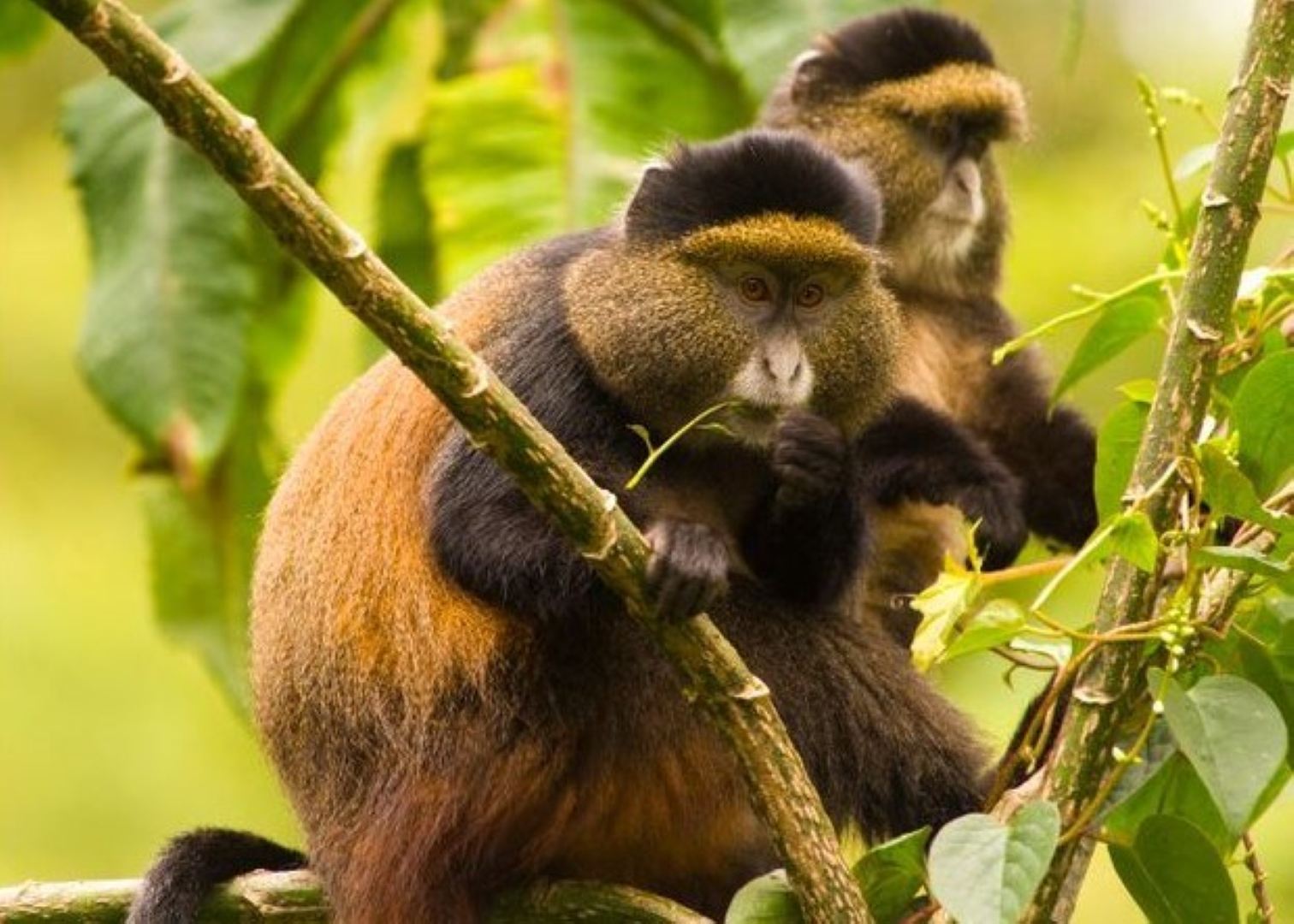
A 3-day itinerary across the border is a compact and thrilling way to combine a Uganda gorilla trek in Bwindi Impenetrable National Park with golden monkey tracking in Rwanda's Volcanoes National Park. It features dense rainforest hikes, close encounters with the great apes, and beautiful Virunga views.
Tour highlights for 3 Days gorilla trekking in Uganda and Golden monkey
Mountain gorilla encounter
Playful golden monkeys
Misty rain forests
Scenic volcanic drives
Expert ranger guides
Cross-border cultural journey
Active bamboo hikes
Endangered species tracking
Dy by day 3 Days gorilla trekking in Uganda and Golden monkey
Day 1: Arrival & Cross-Border Transfer
Your inter-country primate expedition kicks off as you arrive at Kigali International Airport (KGL) or get collected from your hotel in Rwanda's vibrant capital. Navigating this fly-Kigali, trek-Uganda route is a highly efficient industry favorite, dramatically slashing total road travel time.
You will board a private 4×4 safari vehicle for a scenic, roughly 3-hour overland journey heading north. The smooth roads quickly give way to rolling hills, offering sweeping, panoramic views of the spectacular Virunga landscape.
Kigali (KGL) ---> [3-Hour Drive] ---> Border Crossing ---> Southern Bwindi (Uganda)
You will transition through the Cyanika or Katuna immigration checkpoints, crossing seamlessly from Rwanda into Uganda's rugged southwestern corner. From there, you will navigate the mountain tracks leading straight into the Rushaga or Ruhija sectors of Bwindi Impenetrable National Park. You will check into your mountain lodge, arrange your heavy gaiters, check your waterproof gear, and fall asleep to the deep sounds of the dense rain forest.
Day 2: Gorilla Trekking in Bwindi (Uganda)
The morning begins at 7:30 AM with a mandatory, comprehensive briefing at the Uganda Wildlife Authority (UWA) park headquarters. Rangers will review crucial safety protocols, explain gorilla family structures, and assign you to a specific, habituated mountain gorilla group based on your physical fitness level.
Permit Insight: A single 2026 Uganda gorilla trekking permit costs $800 USD for foreign non-residents. This investment fully covers your park entry, expert ranger guides, and vital community conservation levies.
Accompanied by armed trackers, you will plunge directly into the thick, misty, tangled undergrowth of the primeval forest. The hike can last anywhere from 2 to 6 hours, navigating slippery ridges and muddy ravines as trackers trace fresh nests and broken bamboo stems.
Upon locating the family, you are granted exactly one magical hour to stand just meters away, observing the colossal silverback, playful juveniles, and nurturing mothers in their ancient home.
Day 3: Golden Monkey Tracking & Departure
An early 7:00 AM departure takes you back across the border into Rwanda, driving directly to the Volcanoes National Park headquarters in Kinigi. Following a brief orientation regarding primate etiquette, you will step onto the volcanic slopes to track the striking, endangered golden monkeys (Cercopithecus kandti), a species entirely endemic to the high-altitude Albertine Rift.
Permit Insight: A standard golden monkey tracking permit in Rwanda is highly accessible, costing $100 USD per person per trek.
The hike through the sun-dappled bamboo forests is physically gentle compared to the previous day's dense jungle terrain. You will spend one unforgettable hour surrounded by a hyperactive troop of up to 100 monkeys as they skillfully scramble, chatter, and leap across the bamboo canopy.
Afterward, you will descend to the lodge for a warm lunch before executing the 3-hour return transfer to Kigali International Airport for your evening flight out.
1. Why is flying into Kigali superior to flying into Entebbe for this specific 3-day dual-country primate itinerary?
When executing a condensed 3 Days gorilla trekking in Uganda and Golden monkey tracking in Rwanda volcanoes itinerary, time management is your absolute highest operational priority. Flying directly into Kigali International Airport (KGL) in Rwanda is logistically superior to landing at Entebbe International Airport (EBB) in Uganda due to the dramatic difference in overland driving times.
From Entebbe, traveling to the southern mountain gorilla sectors of Bwindi Impenetrable National Park (such as Rushaga or Ruhija) requires a exhausting, 8-to-10-hour drive spanning over 450 kilometers across winding Ugandan highways. On a short 3-day timeline, this single transit day would consume nearly half the entire safari window, leaving clients depleted before their trek even begins.
Conversely, Kigali acts as a brilliant, high-speed gateway for southwestern Uganda. The drive from Kigali north to the Ugandan border posts of Cyanika or Katuna takes just 3 hours on exceptionally smooth, paved roads. After crossing the border checkpoint, reaching Bwindi’s southern gates takes only an additional 1 to 1.5 hours.
By leveraging this geographic shortcut, a fly-Kigali, trek-Uganda blueprint compresses the initial transit phase into a manageable 4.5-hour afternoon journey. This allows clients to land in the morning, cross the border smoothly, and check into their Bwindi lodge in time for a relaxed dinner. Furthermore, it places the vehicle in perfect proximity to Volcanoes National Park for the golden monkey tracking session on Day 3. This geographic layout maximizes actual field tracking time, controls driver fatigue, reduces fuel costs, and protects the physical energy of the travelers, transforming a frantic cross-border sprint into a seamlessly organized, high-end primate expedition.
2. What are the current permit costs and booking protocols for both primate experiences on this route?
A successful 3 Days gorilla trekking in Uganda and Golden monkey tracking in Rwanda volcanoes safari requires the immediate, upfront security of two distinct primate permits managed by separate national wildlife authorities. For the mountain gorilla trek in Uganda, the permit is issued exclusively by the Uganda Wildlife Authority (UWA). The current 2026/2027 statutory tariff for foreign non-residents stands at $800 USD per person per trek. This fee covers park entry for the specific trekking sector, armed park rangers, community conservation levies, and exactly one hour of face-to-face time with a habituated gorilla family.
For the golden monkey tracking session on Day 3, the permit is managed by the Rwanda Development Board (RDB). The tariff for foreign non-residents is set at an accessible $100 USD per person per trek. This permit grants access to the high-altitude bamboo zones of Volcanoes National Park, professional guiding services, and one hour with a habituated troop.
Because both activities operate under strict daily caps to protect the primates from ecological stress, real-time availability can vanish months in advance. For mountain gorillas, UWA issues only eight permits per habituated group per day. While golden monkey permits are slightly more flexible with larger group sizes, spontaneous or last-minute travelers cannot afford to show up at the park gates expecting walk-in entry. Your team must secure these digital vouchers simultaneously via the respective UWA and RDB portals, or completely rely on an authorized local operator who can verify live availability logs, lock down the permits via immediate wire transfer, and ensure the specific Bwindi gorilla sector matches your logistical border transit points.
3. How does the East Africa Tourist Visa streamline the cross-border logistics of this tour?
Executing an inter-country loop spanning Rwanda and Uganda within a tight 72-hour window requires total efficiency at immigration checkpoints. Spontaneous travelers often make the costly mistake of purchasing separate single-entry visas for both nations. This error causes unnecessary paperwork delays at physical border posts and costs a total of $100 USD ($50 USD for Rwanda and $50 USD for Uganda). The definitive legal solution for this route is the East Africa Tourist Visa (EATV).
The EATV is a joint consular initiative that allows multi-country travel between Rwanda, Uganda, and Kenya under a single, unified document. It costs $100 USD and is valid for 90 days. Crucially, the visa allows for multiple entries across the internal borders of these three participating nations, meaning clients can cross from Rwanda into Uganda on Day 1, and cross back into Rwanda on Day 3 without their visa automatically expiring.
Land in Kigali (Apply for EATV) ---> Enter Uganda (Day 1) ---> Return to Rwanda (Day 3)
Logistically, the EATV must be applied for through the immigration portal of the first country the traveler enters. On this fly-Kigali itinerary, clients must apply via the Rwanda Directorate General of Immigration and Emigration (Irembo portal) before departure. Once approved electronically, the physical visa sticker is placed in the traveler's passport upon landing at Kigali International Airport. At the Cyanika or Katuna land borders, immigration officers simply scan the pre-existing barcode, cutting processing times down to minutes. This ensures the vehicle bypasses lengthy border queues and stays perfectly on track for the afternoon arrival.
4. What are the key environmental and physical differences between trekking in Bwindi and Volcanoes National Park?
While both components of the 3 Days gorilla trekking in Uganda and Golden monkey tracking in Rwanda volcanoes loop involve tracking endangered primates in montane ecosystems, the physical environments demand different preparation. Bwindi Impenetrable National Park lives up to its name; it is an ancient, mid-to-high-altitude primeval rainforest characterized by incredibly steep ridges, deep mud ravines, and thick, tangled canopy webs.
Trekking here happens off-trail, requiring clients to forge paths through dense undergrowth behind rangers wielding machetes. The elevation spans from 1,160 to 2,607 meters, and the undergrowth is thick with stinging nettles and wild vines, making it a highly demanding physical challenge.
In contrast, Volcanoes National Park presents a completely different volcanic landscape. Tracking golden monkeys occurs on the lower slopes of the Virunga Volcanoes, primarily within the high-altitude bamboo zones ranging between 2,200 and 3,000 meters. The terrain features distinct, well-maintained paths that cut cleanly through the bamboo forests. The canopy is significantly more open, allowing beautiful pockets of sunlight to illuminate the volcanic floor.
While the altitude in Rwanda is technically higher—which can cause brief shortness of breath for unacclimatized travelers—the grade of the incline is gentler and the footing is much more stable than the slippery clay slopes of Bwindi. Understanding these differences allows guides to prep clients correctly: Bwindi requires aggressive, deep-lugged hiking boots and full torso protection, while Volcanoes National Park demands a steady walking pace to adapt to the thin volcanic air, along with rapid camera shutter adjustments to capture fast motion in the bamboo branches.
5. How should a 3-day itinerary be hourly structured to maximize tracking success?
A highly optimized 3-day dual-country primate itinerary leaves zero margin for logistical or transport delays. The structural layout must balance long border transit drives with mandatory early morning park briefings.
Day 1: Kigali Arrival & Bwindi Drive ---> Day 2: Gorilla Trek & Rest ---> Day 3: Golden Monkeys & Flight Out
The 3-Day Tactical Masterplan
- Day 1: The Cross-Border Launch. Land at Kigali International Airport no later than 11:00 AM. Clear immigration, secure your East Africa Tourist Visa sticker, and meet your 4×4 safari driver. Depart Kigali by 12:30 PM, driving 3 hours north toward the Cyanika border. Clear cross-border customs by 4:00 PM, enter Uganda, and navigate the scenic mountain tracks to check into your lodge in the southern Rushaga sector of Bwindi by 5:30 PM for gear orientation and dinner.
- Day 2: The Mighty Mountain Gorilla Trek. Wake at 6:00 AM for an early breakfast. Arrive at the UWA Rushaga headquarters by 7:30 AM for the mandatory safety briefing and gorilla family assignments. Plunge into the rainforest at 8:30 AM. Trekking can last between 2 to 6 hours. Enjoy your exclusive, face-to-face hour with the gorillas, returning to the park boundary by 3:00 PM to collect your tracking certificate. Spend the evening resting at the lodge.
- Day 3: Golden Monkeys & Departure. Depart Bwindi at an early 5:30 AM, crossing back through the Cyanika border into Rwanda to reach the Volcanoes National Park headquarters in Kinigi by 7:00 AM. Complete the golden monkey briefing and track the playful primates from 8:30 AM to 11:30 AM. Return to the vehicle, enjoy an early lunch, and drive 3 hours back to Kigali, arriving by 4:00 PM for evening outbound international departures.
6. What specific gear modifications are mandatory for forest primate tracking?
Packing for a 3 Days gorilla trekking in Uganda and Golden monkey tracking in Rwanda volcanoes safari requires a specialized focus on technical apparel designed to withstand dense jungle environments. Standard holiday activewear or lightweight running shoes will quickly fail on the rugged terrain of Bwindi and the volcanic slopes of Kinigi.
The Primate Tracking Gear Checklist
- Footwear: Heavy, waterproof hiking boots with deep rubber lugs and excellent ankle support are mandatory. These must be thoroughly broken in before arrival to prevent severe blistering on steep inclines.
- Gaiters & Socks: Thick, high-performance hiking socks paired with canvas gaiters are essential. Clients must tuck their trousers directly into their socks or gaiters to create an impenetrable barrier against ground-dwelling safari ants and damp mud.
- Torso Protection: Long-sleeved shirts and heavy-duty safari trousers made from quick-dry, synthetic ripstop fabrics are required. Avoid shorts or short sleeves, as Bwindi is full of stinging nettles (Urtica) and sharp thorns that easily pierce bare skin.
- Hand Wear: Thick leather gardening gloves are an incredible insider asset. During steep descents, trackers must frequently grab onto raw branches, wild vines, and muddy roots for stability; gloves protect the hands from thorns and cuts.
- Weather Protection: A high-end, lightweight waterproof rain jacket with taped seams is critical, as downpours can occur at any hour in equatorial cloud forests. Finally, pack a wide-brimmed hat, high-SPF insect repellent containing DEET, and a rugged, waterproof dry bag to shield your camera equipment from intense moisture and canopy dripping.
7. How do health regulations and the "7-meter rule" protect endangered primates?
Because mountain gorillas and golden monkeys share a profound genetic lineage with human beings, they are exceptionally vulnerable to human respiratory pathogens. A common cold, influenza strain, or respiratory infection carried by an international traveler can easily devastate an entire wild primate family. Managing health compliance on a 3 Days gorilla trekking in Uganda and Golden monkey tracking in Rwanda volcanoes circuit is strictly enforced by both UWA and RDB rangers.
First, if a client displays any visible symptoms of communicable illness—such as active coughing, heavy sneezing, or a running fever—during the early morning park briefing, rangers hold the absolute legal authority to cancel their tracking status on the spot to safeguard the animals.
Second, during the encounter, a mandatory 7-meter (23 feet) safety distance must be strictly maintained at all times. While habituated gorillas or curious golden monkeys may occasionally break this rule by approaching stationary tourists, clients are legally forbidden from moving closer to the animals. Furthermore, the use of camera flash photography is strictly prohibited; the sudden, intense burst of light can easily startle the silverback or panic a monkey troop, triggering defensive, aggressive charging behaviors. Clients must also wear medical face masks in certain sectors while in the immediate presence of the gorillas. Understanding these rules ensures that your team manages guest behavior perfectly, prioritizing international conservation ethics over aggressive photography tactics.
8. What camera settings are ideal for photographing fast primates in low-light canopies?
Primate photography across Bwindi and Volcanoes National Park presents two entirely different technical lighting challenges. Inside Bwindi's dense rainforest, you are dealing with a dark, heavily shaded understory broken by harsh pockets of overexposed sunlight filtering through the canopy. Conversely, tracking golden monkeys in Rwanda places you in a brighter environment, but the subjects move with extreme speed through swaying bamboo branches.
For the mountain gorilla encounter, focus on managing your ISO and aperture. Gorillas possess deep black fur that absorbs light completely, making it easy to end up with underexposed shots lacking detail. You should shoot in RAW format to maximize dynamic range extraction later. Set your aperture as wide as your lens allows (ideally f/2.8 or f/4) to let in maximum light, and don't be afraid to push your ISO up to 1600 or 3200 to maintain a crisp image. Use spot metering focused directly on the gorilla's eyes to ensure the face is perfectly exposed.
For the golden monkey session in Volcanoes National Park, shutter speed is your most critical variable. These primates are hyperactive, jumping, scrambling, and feeding at high speeds. To freeze their frantic leaps across the bamboo canopy without motion blur, you must maintain a minimum shutter speed of 1/500s to 1/1000s. Use a continuous high-speed shooting mode (burst mode) paired with continuous tracking autofocus (AI Servo on Canon or Continuous AF on Nikon) locked onto the animal's torso or head. This technical precision prevents blurry shots, ensuring clients capture high-end, gallery-quality primate memories.
9. How do you select the correct Bwindi sector to match your cross-border transit?
Bwindi Impenetrable National Park is divided into four distinct, administratively isolated trekking sectors: Rushaga, Ruhija, Buhoma, and Nkuringo. Each sector possesses its own standalone park headquarters, ranger stations, habituated gorilla families, and localized accommodation loops. When planning a last-minute 3 Days gorilla trekking in Uganda and Golden monkey tracking in Rwanda volcanoes loop via Kigali, choosing the correct sector is a critical logistical decision.
For a Kigali-rooted itinerary, you should strictly book permits within the southern sectors of Rushaga or Nkuringo. These two sectors are geographically positioned perfectly for cross-border transit via the Cyanika border post. Driving from Kigali to the Rushaga gate takes roughly 4 to 4.5 hours of smooth travel.
If you mistakenly purchase gorilla permits for the northern sector of Buhoma, your itinerary will suffer severe delays. Reaching Buhoma from Kigali requires a grueling 6-to-7-hour drive over steep mountain ridges or forces you to loop through the Katuna border, completely disrupting the compact 3-day timeline and making it impossible to return to Rwanda in time for the early morning golden monkey briefing on Day 3. Your booking agents must explicitly verify that the gorilla permit printout states "Rushaga" or "Nkuringo" before locking down your lodging reservations, ensuring your overnight stay sits within minutes of the correct UWA morning briefing archway.
10. Why is the employment of a local porter a vital conservation and logistical asset?
When entering the morning briefing grounds for a 3 Days gorilla trekking in Uganda and Golden monkey tracking in Rwanda volcanoes safari, clients are introduced to local community porters available for hire. Spontaneous travelers who consider themselves highly fit often decline this service, viewing it as an unnecessary luxury. This is an operational mistake; hiring a porter is actually a vital contribution to community-led wildlife conservation.
Porters are recruited directly from the rural villages bordering Bwindi and Volcanoes National Park. Many were formerly involved in subsistence poaching or illegal timber harvesting inside the forest boundaries due to a lack of economic alternatives. By paying the standard porter hire fee of $20 USD per trek, clients provide direct, meaningful income to a local family. This sustainable financial model transforms community members into active guardians of the wilderness, linking the survival of the endangered mountain gorillas directly to local economic well-being.
Logistically, a porter is an incredible asset on the trail. They carry your heavy daypack containing your camera gear, lunches, and water supplies, freeing your body to focus entirely on balance and foot placement along the slippery clay slopes. On steep inclines or muddy drop-offs, a porter walks right beside you, providing a steady hand to pull you up or stabilize your steps. This service dramatically increases trekking safety, reduces physical exhaustion, and ensures that clients arrive at the primate sightings energized and ready to enjoy their exclusive hour.
11. What currency protocols and cash reserves apply to this cross-border loop?
Managing your cash reserves for an abrupt, dual-country 3 Days gorilla trekking in Uganda and Golden monkey tracking in Rwanda volcanoes expedition requires precise preparation. While upscale safari lodges easily accept major international credit cards like Visa and Mastercard for bar bills or souvenir purchases, the ground-level safari economy runs entirely on physical cash. You will be operating across three distinct currencies: US Dollars (USD), Ugandan Shillings (UGX), and Rwandan Francs (RWF).
For US Dollars, you must strictly carry bills printed after the year 2013. Local banking systems and park cashiers across both Rwanda and Uganda will flatly reject older US currency due to historical counterfeiting protections. Additionally, ensure your notes are crisp, completely untorn, unstamped, and free from any ink markings.
You will need cash reserves for several critical field expenses that cannot be settled via digital cards: hiring porters ($20 USD per porter per park), tipping your expert ranger-guides and trackers ($15 to $20 USD per client per activity), and purchasing official park tracking certificates or handmade local wood carvings. While tipping can be comfortably completed in US Dollars, having a small amount of local currency (around $20 USD equivalent in Rwandan Francs and Ugandan Shillings) is highly convenient for purchasing local snacks, bottled water, or tipping the border facility attendants along the highway transit routes.
12. How do you manage the acute altitude changes between Kigali, Bwindi, and Kinigi?
Managing altitude changes on a 3 Days gorilla trekking in Uganda and Golden monkey tracking in Rwanda volcanoes tour is a key factor in client comfort and physical endurance. The entire circuit unfolds across high-altitude mountain terrain, and spontaneous travelers arriving rapidly from sea-level environments will feel the immediate physiological impact of thin equatorial air.
Kigali sits at a moderate elevation of roughly 1,560 meters. As your vehicle climbs north toward the Ugandan border, the altitude rises steadily. The southern sectors of Bwindi sit between 2,000 and 2,400 meters, while the golden monkey trails on the volcanic slopes of Volcanoes National Park climb even higher, topping out between 2,500 and 3,000 meters.
Kigali Airport (1,560m) ---> Bwindi Forest (2,200m) ---> Volcanoes Slopes (2,800m)
At these heights, the atmospheric pressure is lower, meaning every breath delivers less oxygen to the bloodstream. To prevent acute mountain sickness (AMS) or early physical exhaustion during the treks, guides must advise clients to follow basic acclimatization protocols. Drink double the standard daily volume of water to counteract dehydration from high-altitude respiration. Maintain a slow, deliberate pacing on the trail—locally referred to by African guides as "Polé Polé" (slowly, slowly). Avoid heavy alcoholic beverages on the first two nights, and ensure clients inform their ranger-guide immediately if they experience persistent headaches, dizziness, or chest tightness, allowing the tracking team to adjust the group's ascent speed accordingly.
13. What are the legal age restrictions and tracking rules for children on this safari?
When planning a last-minute family 3 Days gorilla trekking in Uganda and Golden monkey tracking in Rwanda volcanoes journey, you must strictly audit the ages of all participating travelers. Both the Uganda Wildlife Authority and the Rwanda Development Board enforce rigid, non-negotiable minimum age limitations to protect both the safety of the guests and the health of the endangered primates.
For mountain gorilla trekking in Uganda's Bwindi Forest, the statutory minimum age limit is 15 years. Children under this age are legally prohibited from purchasing permits or stepping onto the tracking trails. This rule is strictly enforced because younger children may not possess the physical endurance required for marathon multi-hour forest climbs, and their immune systems are statistically more likely to carry common childhood illnesses that could devastate the gorillas. Furthermore, a sudden panic cry or rapid movement from a child could be misinterpreted by a dominant silverback as a threat, potentially triggering an aggressive defensive charge.
For golden monkey tracking in Rwanda's Volcanoes National Park, the standard minimum age restriction is 15 years, though park wardens may occasionally exercise minor flexibility if a teenager shows exceptional physical fitness and behavioral maturity. Before locking down expensive non-refundable permits and flight confirmations, your booking team must visually inspect the passport bio-data pages of all guests to ensure compliance with these conservation laws, preventing devastating border-gate exclusions for family groups.
14. How do seasonal rainfall cycles change the tracking difficulty on this route?
The geographic region encompassing southwestern Uganda and northern Rwanda experiences an equatorial climate with two distinct rainy loops and two dry windows. Understanding these seasonal shifts is crucial for managing client expectations regarding tracking difficulty on a 3 Days gorilla trekking in Uganda and Golden monkey tracking in Rwanda volcanoes safari.
Safari Season
Months
Trail Conditions
Tracking Dynamics
Peak Dry Season
June to August / Dec to Feb
Firm ground, minimal canopy drip, manageable mud.
Primates often climb higher up the ridges, requiring longer physical hikes to locate them.
Wet / Green Season
March to May / Sept to Nov
Extremely slippery clay, deep mud ravines, high humidity.
Gorillas and monkeys stay on lower slopes to feed on fresh bamboo shoots, resulting in shorter treks.
Traveling during the rainy green season offers distinct advantages for a quick 3-day loop: the landscapes are stunningly clear for photography, and the primates are often found much faster. However, the physical demand of the hike rises significantly as trails turn into slick mud paths. Clients must use walking sticks (provided free at the briefing stations) and lean heavily on their porters for balance. Regardless of which month you book, remember that these are high-altitude tropical cloud forests; localized downpours can happen at any hour, making high-quality waterproof gear an absolute necessity year-round.
15. Why are the tracking habits and behaviors of golden monkeys entirely unique?
While mountain gorillas capture global headlines, tracking the endangered golden monkeys (Cercopithecus kandti) in Volcanoes National Park offers an entirely different, incredibly rewarding wildlife dynamic. Golden monkeys are a specialized subspecies of the blue monkey, characterized by their brilliant, rich golden-orange fur coats that contrast beautifully against the dark green stalks of the Virunga bamboo zones.
Unlike mountain gorillas, who spend a significant portion of their day resting quietly on the forest floor, digesting food, and interacting in slow, deliberate social groups, golden monkeys are hyperactive arboreal primates. They live in massive, complex social troops that can number up to 80 or 100 individuals. They spend their days in constant, frantic motion—leaping effortlessly across the flexible bamboo canopies, chattering loudly to communicate, and quickly stripping bamboo leaves and shoots to feed.
For the traveler, this behavior creates an incredibly lively and entertaining viewing hour. The monkeys are highly curious and completely habituated to human presence, often leaping right over the heads of stationary tourists or foraging on the ground just meters away. This active environment requires a fast-paced approach to photography; you will be constantly panning your camera upward into the swaying branches, capturing quick glimpses of social play, grooming sessions, and dramatic aerial leaps. This makes the golden monkey track a perfect, energetic finale that contrasts beautifully with the deep, quiet emotional impact of the previous day's gorilla encounter.
16. How do local operators successfully coordinate a last-minute cross-border evacuation?
Operating a high-speed, cross-border 3 Days gorilla trekking in Uganda and Golden monkey tracking in Rwanda volcanoes loop means your team must maintain a robust emergency medical evacuation protocol. The remote mountainous terrains of Bwindi and Kinigi sit far from advanced tertiary trauma centers, and the physical stress of high-altitude tracking can occasionally trigger unforeseen medical issues or severe physical injuries like ankle fractures on slippery slopes.
A professional local operator secures peace of mind by embedding mandatory medical evacuation insurance into the tour package, typically utilizing regional air ambulance services like the AMREF Flying Doctors. If a client suffers an emergency in the field, park rangers and porters will deploy a specialized "stretcher team" to safely carry the patient out of the dense forest canopy to the nearest vehicle access point.
From there, your operator's ground logistics team handles the cross-border coordination. Because crossing international land borders with an injured patient can cause severe delays at standard customs counters, local operators maintain direct emergency protocols with border authorities at Cyanika. This ensures an expedited clearance for the ambulance vehicle. The patient is transferred rapidly across the border to a stabilized helipad in Rwanda, where a medical helicopter can land and airlift them directly to a world-class international hospital in Kigali within an hour. Having this emergency network operating quietly in the background turns a spontaneous, adventurous itinerary into a safe, elite travel experience.
Booking 3 Days gorilla trekking in Uganda and Golden monkey tracking with us Roads of Adventure safaris
To book a 3-day gorilla and golden monkey trekking safari with Roads of Adventure Safaris, you will need to target Mgahinga Gorilla National Park in southwestern Uganda, which is the only park in the country where both primates can be tracked in one location
