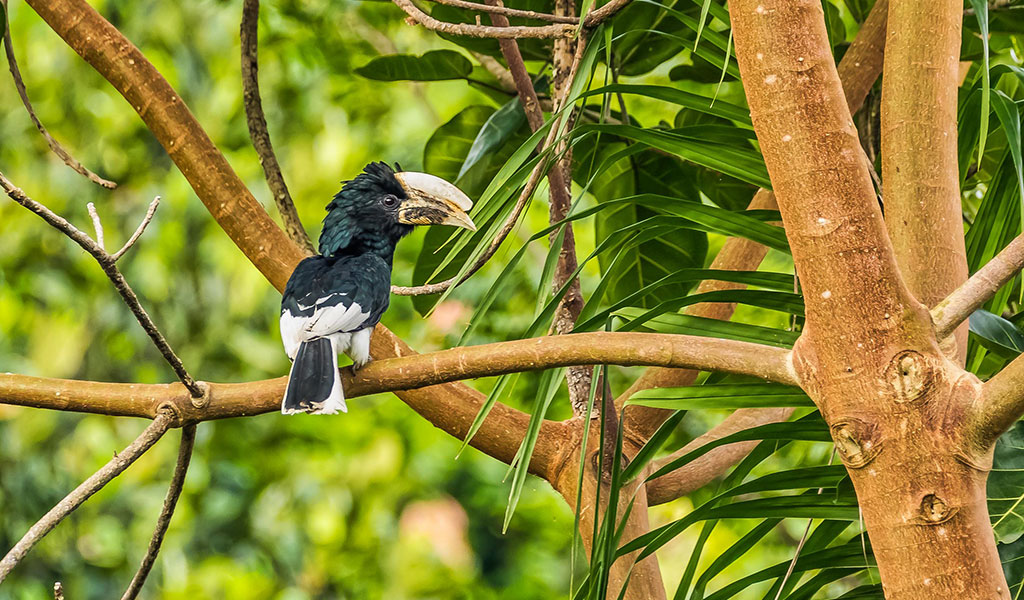
3 Days birdwatching safari in semuliki national park offers an unparalleled immersion into one of Africa's most biologically diverse equatorial habitats. Situated in the remote Albertine Rift Valley, Semuliki represents the easternmost extension of the vast Congo Basin rainforest. This unique geographic positioning makes it a premier haven for birding enthusiasts seeking Central African species rarely found anywhere else in East Africa. Home to over 440 distinct bird species, the park boasts remarkable highlights, including the iconic Shoebill Stork, the elusive Nkulengu Rail, and spectacular Hornbills. Over three intensive days, you will traverse lush swamp networks, dense lowland forests, and geothermal landscapes guided by expert local spotters. Whether tracking rare canopy dwellers, listening to beautiful unique songs, or scanning misty wetlands, this focused itinerary delivers exceptional sightings, high-density lifers, and an unforgettable wilderness adventure tailored specifically for dedicated ornithologists exploring Uganda’s spectacular Albertine Rift ecosystem today. This provides an absolutely phenomenal opportunity to expand your global life list significantly.
Tour highlights for 3 Days birdwatching safari in Semuliki national park
441 avian species
Spot rare piculet
Track shoebill stork
Central African biome
Boiling hot springs
Noisy hornbill canopy
Expert bird guiding
Lush lowland rainforest
Scenic boat cruise
Stunning rift landscapes
Day by day 3 Days birdwatching safari in Semuliki national park
Day 1: Journey to Semuliki & Night Game Drive
Your adventure begins with an early morning departure from Kampala, driving west through verdant tea plantations and scenic Ugandan landscapes. After a relaxing hot lunch in the beautiful tourism city of Fort Portal, you will descend the winding roads into the breathtaking Albertine Rift Valley, arriving at your lodge near the edge of the rainforest. Following a brief orientation and check-in, the birding commences immediately along the park's scenic fringes, where you can spot initial species like the Great Blue Turaco. As dusk settles, you will embark on an exciting night game drive across the open savannah plains. This nocturnal excursion targets highly sought-after nightjars, specifically the Standard-winged and Pennant-winged varieties, alongside owls and nocturnal mammals. You will return to your comfortable lodge for a delicious dinner, resting up ahead of a full day of intensive deep-forest exploration tomorrow morning. This first day lays a solid foundation.
Day 2: Deep Forest Birding along Kirumia Trail
Today is dedicated to exploring the iconic Kirumia Trail, a premier deep-forest birding track that cuts directly through the heart of the lowland rainforest. Armed with packed lunches, you will spend hours under the dense canopy tracking rare West African migrants and specialists. Your expert guide will help you isolate calls of the elusive Nkulengu Rail, Black Dwarf Hornbill, Yellow-throated Nicator, and Red-billed Dwarf Hornbill. The trail offers excellent chances to view the Congo Serpent Eagle and various stunning sunbirds. In the afternoon, the route shifts toward the famous Sempaya Hot Springs. Here, the unique geothermal steam vents create an distinct microclimate attracting specialized species, including the vibrant Blue-breasted Kingfisher and various honeyguides. After an exhausting but highly rewarding eight-hour trek witnessing incredible avian biodiversity, you will head back to the lodge to unwind, share highlights, and review your growing wilderness bird checklist together with fellow birders.
Day 3: Morning Wetland Scan & Return to Kampala
The final morning kicks off with a dawn birding walk around the wetlands and forest galleries near the spectacular Lake Albert swamp network. This early session is your prime opportunity to spot the prehistoric Shoebill Stork wading silently through the papyrus vegetation. You will also scan the upper tree canopies for Ross's Turacos, Piping Hornbills, and Maxwell's Black Weavers feeding in the early light. Returning to the lodge for a hearty breakfast, you will pack your gear and complete check-out procedures. Bidding farewell to Semuliki, you will ascend the rift valley walls, enjoying one last look at the pristine forest canopy. A lunch stop in Fort Portal provides a perfect break before the afternoon drive back to Kampala. You will arrive in the city by late evening, concluding your remarkable equatorial birding experience safely with fantastic memories, great photos, and an enhanced personal species record book.
What should I expect regarding the total number of bird species available?
Choosing Semuliki National Park for a three-day birdwatching safari introduces you to one of Africa’s most biologically diverse and rewarding avian habitats. You should expect an astonishing checklist of over 441 recorded bird species crammed into a relatively compact 220 square kilometers of lowland tropical rainforest. This remarkable density represents roughly 40% of Uganda’s total bird species and an incredible 60% of its forest-dependent birds, making it an absolute mecca for serious twitchers. The park serves as the easternmost extension of the vast itinerary-rich Ituri Forest block from the Democratic Republic of Congo, meaning you will encounter a unique cross-section of species that simply cannot be found anywhere else in East Africa.
The sheer volume of birds means your three days will be intensely packed with sightings from the moment the sun breaks over the Rwenzori canopy. You can expect to encounter an array of raptors, vibrant kingfishers, secretive weavers, and magnificent sunbirds. The forest structure allows for distinct layers of birdlife, from ground-dwelling flufftails scratching through the leaf litter to busy mixed-species feeding flocks moving rapidly through the mid-canopy.
While the numbers are staggering, you should also expect to work for your sightings. This is a true, pristine jungle environment, not an open savanna safari where wildlife stands out against the horizon. The dense foliage, towering ironwood trees, and tangled lianas mean that many of these species are masters of camouflage. You will need patience, sharp eyes, and a willingness to scan the shadows. However, the reward of seeing the numbers on your checklist steadily climb hour by hour makes the intense focus incredibly satisfying and underscores why Semuliki is considered Uganda’s premier forest birding destination.
What should I expect when tracking unique birds on the Kirumia Trail?
The Kirumia Trail is legendary among international birdwatchers as the ultimate path for spotting deep-forest specialists, and you should expect it to be the highlight of your physical tracking efforts. This narrow, unpaved trail slices directly through the heart of the ancient, undisturbed forest, running roughly 13 kilometers down to the spectacular Semliki River. Walking this trail means immersing yourself in a dense, primeval wilderness where the canopy shuts out most direct sunlight, creating an ethereal, green-hued environment perfect for quiet stalking. You should expect to spend a full day on this trail, moving at a very slow, deliberate pace to intercept shy undergrowth dwellers and high-canopy residents alike.
Your primary targets on the Kirumia Trail include some of Africa's most sought-after avian treasures. You should expect a strong chance of ticking off the tiny African Piculet, an incredibly elusive forest woodpecker that nests in dead branches. The trail is also a hotspot for the striking, bright-red Crested Malimbe, the Red-bellied Malimbe, and the Maxwell's Black Weaver. Ground-level tracking frequently yields views of the beautiful Fire-crested Alethe and various illadopsises moving through the undergrowth.
Beyond the birds, you should expect the trail to provide a rich multi-sensory wilderness experience. The forest floor is crisscrossed by columns of marching driver ants and covered in exotic fungi, while the mid-canopy is alive with primates. As you scan the branches for birds, you can expect regular company from troops of black-and-white colobus monkeys, red-tailed monkeys, and grey-cheeked mangabeys. The trail requires a good baseline of stamina, as you will be on your feet for six to eight hours, constantly craning your neck upward, but the quality of specialized forest lifers makes every step worth the physical effort.
What should I expect during a boat cruise on nearby Lake Albert?
A dramatic shift in scenery awaits you on the aquatic portion of your safari, where you should expect a completely different cast of ornithological characters along the southern shores of Lake Albert and the lower stretches of the Semliki River. Boarding a small, motorized watercraft, you will leave the enclosed jungle walls behind and emerge into vast, sun-drenched wetlands dominated by towering papyrus reeds, floating water lilies, and dynamic channels. The main objective of this boat cruise is to explore the dense marshes where the landscape feels entirely wild and untouched, providing an exceptional vantage point for water-associated species that are impossible to view from the forest floor.
The absolute pinnacle of this boat excursion is the opportunity to track the legendary Shoebill Stork. You should expect to navigate quietly into the remote papyrus fringes where this prehistoric-looking, giant bird stands completely motionless for hours, waiting to ambush lungfish. Spotting a Shoebill in its natural habitat is an emotional, bucket-list experience for any wildlife enthusiast. The boat allows you to get remarkably close without disturbing its hunting routine, giving you a front-row seat to its massive, clog-shaped bill and intense, yellow-eyed gaze.
In addition to the Shoebill, you should expect the wetlands to be teeming with incredible bird life. You will scan the reeds for the elusive Papyrus Gonolek, with its vibrant yellow crown and crimson breast, alongside the Blue-headed Coucal and White-winged Warbler. Overhead, spectacular African Fish Eagles scream from dead snags, while colonies of colorful kingfishers—including the Pied, Malachite, and Giant Kingfishers—hover and dive into the calm waters. The contrast between the dark forest trails and the wide-open, breeze-cooled lake ensures that your three-day itinerary feels incredibly diverse and complete.
What should I expect concerning the unique Guinea-Congo biome species?
The primary reason serious international birders travel all the way to Semuliki is to target its unique Guinea-Congo biome species, and you should expect to see birds here that are completely unavailable across the rest of East Africa. Geographically, Semuliki represents the lonely eastern fingernail of the massive Central African rainforest block. Because of this unique biogeographical positioning, the park acts as an ecological island, hosting over forty specialized West and Central African bird species whose ranges terminate strictly at the base of the Albertine Rift valley.
When stepping onto the forest paths, you should expect to search for highly prized biome-restricted specials that make this park so famous. Among the top targets are the spectacular Long-tailed Hawk, the Lyre-tailed Honeyguide (known for its amazing, mechanical echoing flight displays over the canopy), and the Congo Serpent Eagle. You can also expect to encounter a stunning variety of colorful, insect-eating forest birds, such as the Rufous-sided Broadbill, the Black Dwarf Hornbill, and the exquisite Blue-headed Crested Flycatcher.
Spotting these biome-specific birds requires a shift in your birding technique. Because these species evolved in the massive, unbroken forests of Central Africa, they are highly sensitive to microhabitats and are often canopy-dwellers or deep-thicket specialists. You should expect your guiding team to rely heavily on auditory clues, listening out for the specific, localized calls of these West African migrants before deploying powerful green laser pointers to help you lock your binoculars onto the correct branch. Ticking off even a fraction of these forty-plus Central African specialists will elevate your safari from a standard wildlife viewing trip into a world-class ornithological triumph.
What should I expect while exploring the Sempaya Hot Springs trail?
The trail leading to the famous Sempaya Hot Springs offers a brilliant fusion of dramatic geological wonders and highly productive edge-of-forest birdwatching. You should expect a easy-to-navigate, short loop trail that winds through a unique swamp-forest ecosystem before opening up into a stark, steaming geothermal clearing. Here, the earth bubbles and spits, with the "male" spring (Bitende) and the spectacular "female" spring (Nyasimbi) shooting scalding water up to two meters into the air, filling the forest clearing with a dense, sulfurous mist and white mineral deposits.
From a birding perspective, you should expect this trail to be exceptionally lively due to the "edge effect." The natural break in the dense forest canopy created by the hot springs and the surrounding wetlands allows sunlight to penetrate down to the lower levels, attracting an abundance of insects, fruits, and seeds. This makes it an ideal feeding ground for a massive concentration of birds. You should keep a sharp lookout for the stunning Crested Malimbe and the Red-chested Sunbird flitting through the hibiscus bushes, while the surrounding palms are frequently visited by the strange, fruit-eating Palm-nut Vulture.
Furthermore, you should expect to see unique behavioral adaptations along this trail. Many bird species, along with olive baboons and black-and-white colobus monkeys, frequent the hot springs area to lick minerals from the rocks or forage for warmth during the cool early mornings. The trail is flat and well-maintained with wooden boardwalks over the marshiest sections, making it a relaxing, highly accessible three-hour excursion that perfectly balances volcanic exploration with high-yield, comfortable birding right next to your park entry point.
What should I expect regarding the diversity of hornbills in Semuliki?
Semuliki National Park is affectionately known by African birders as the "Hornbill Capital of East Africa," and you should expect these loud, charismatic, and visually spectacular birds to dominate both the sights and sounds of your three-day safari. Because of the abundance of ancient, hollowed-out ironwood and fig trees, which provide perfect nesting cavities, combined with a year-round supply of wild fruits, Semuliki supports an unparalleled diversity of hornbill species. You should expect to see and hear them constantly as they fly heavily over the canopy, their wings making a distinct, rhythmic whooshing sound through the air.
During your forest walks along the Kirumia and Sempaya trails, you should expect to target several highly specialized Central African hornbills that cannot be easily found elsewhere. The undisputed king of these is the magnificent White-crested Hornbill, famous for its striking, bushy white crown and long, elegant tail feathers. You can also expect to encounter the Black Dwarf Hornbill, the Red-billed Dwarf Hornbill, and the massive, raucous Piping Hornbill. The larger, prehistoric-looking Black-and-white-casqued Hornbill and the vocal Trumpeter Hornbill are also common fixtures, often seen gathering in large, noisy social groups around fruiting fig trees.
Watching these birds offers a fascinating window into complex avian behaviors. You should expect to observe their unique breeding strategies, where the male meticulously seals the female inside a tree cavity using mud and fruit pulp, leaving only a tiny slit through which he feeds her and the chicks for months. Their loud, haunting, braying calls echo through the ancient jungle, serving as a constant acoustic backdrop to your tracking. For photographers, capturing a clear shot of a primitive casque silhouetted against the emerald forest canopy is one of the ultimate achievements of this safari.
What should I expect from my local site birding guide?
In a dense, complex lowland rainforest like Semuliki, a premier local site birding guide is your most valuable asset, and you should expect an exceptional level of expertise, dedication, and local knowledge from them. These guides are certified professionals who have spent years studying the exact square mileage of this specific forest. Because jungle birding relies heavily on split-second detections, you should expect your guide to possess almost superhuman auditory skills, capable of identifying subtle, distant chips, whistles, and trills down to the exact species level amidst a chaotic wall of jungle noise.
You should expect your guide to operate with a highly strategic approach to maximizing your checklist. Rather than just walking blindly, they map out the forest based on territory, knowing exactly which thicket a specific pair of Nkulengu Rails calls from, or which dead snag is favored by a rare African Piculet. They are masters of vocal mimicry and call-back techniques, utilizing professional audio equipment or their own whistling to gently coax secretive, skulking undergrowth birds out into small clearings so you can get a clean, unobstructed view through your binoculars.
Furthermore, you should expect your guide to be incredibly patient and deeply attuned to your specific pacing and target list. Whether you are a casual hobbyist wanting to see colorful sunbirds or a hardcore lister hunting for obscure greenbuls, they adapt the itinerary to match your desires. They will handle the heavy lifting of spotting, tracking, and setting up high-magnification spotting scopes, allowing you to relax and focus entirely on the thrill of the visual discovery. Their passion for conservation and deep pride in Semuliki’s unique biodiversity adds immense educational and human value to the experience.
What should I expect regarding the daily terrain and walking conditions?
The physical landscape of Semuliki National Park is markedly different from the mountainous tracking found in nearby gorilla or chimpanzee parks, and you should expect a terrain that is largely flat but structurally demanding in other ways. The park sits on the floor of the Albertine Rift Valley, averaging an altitude of just 670 to 760 meters above sea level. This low altitude means you will not have to contend with steep, exhausting mountain ridges or thin air; instead, the physical challenge comes from the classic, dense layout of a pristine, low-lying equatorial rainforest.
You should fully expect the forest floor to be consistently damp, soft, and muddy, even during the designated dry seasons. The dense overhead canopy traps moisture efficiently, preventing the ground from ever drying out completely. The trails, particularly the untamed Kirumia Trail, are often tangled with exposed, slippery tree roots, decaying logs, and patchworks of standing water or seasonal swamps. You can expect to navigate around muddy wallows and occasional shallow stream crossings, making high-quality, broken-in waterproof hiking boots with excellent ankle support and deep grip absolutely non-negotiable.
Additionally, the undergrowth can be incredibly thick and defensive. You should expect to occasionally duck under low-hanging lianas, push past thorny vines, and brush against dense vegetation. To stay safe and comfortable, you should expect to wear lightweight, long-sleeved safari shirts and tough canvas trousers to protect your skin from scratches. Wearing long, breathable gaiters over your boots is highly recommended to seal out mud, water, and crawling insects, ensuring you can focus entirely on the canopy without worrying about your footing.
What should I expect concerning the daily structure of the itinerary?
A three-day birdwatching safari in Semuliki is highly structured to align with peak avian activity periods, meaning you should expect early mornings, long midday rests, and focused late-afternoon sessions. Birds are most active, vocal, and visible during the cool, golden hours just after dawn and just before dusk. Therefore, you should expect your day to begin with an early wake-up call around 5:30 AM, followed by a quick breakfast and coffee at your lodge before reaching the park gates precisely as they open at 6:30 AM to catch the glorious morning chorus.
The morning session typically involves a deep-forest walk lasting four to five hours, focusing on high-energy feeding flocks and canopy specialists along the main trails. By 11:30 AM, as the tropical sun moves overhead, the temperature rises rapidly, causing the forest to go quiet as birds retreat into the deep, cool shade. You should expect to mirror this behavior by returning to your lodge for a long, relaxed midday break. This time is perfect for enjoying a hot lunch, backing up your wildlife photos, downloading bird call audios, and resting your legs during the heat of the day.
Around 3:30 PM, as the air begins to cool down, you will embark on your second daily session. This afternoon excursion often features a different birding environment, such as a boat cruise on Lake Albert, an exploration of the open Sempaya Hot Springs loop, or a slow drive along the park boundaries to scan the forest fringes. You will return to camp just after sunset to update your master trip checklist over dinner, recounting the day’s lifers before an early bedtime to prepare for another rewarding sunrise.
What should I expect when looking for Albertine Rift endemics?
While Semuliki is primarily famous for its lowland Guinea-Congo biome species, its unique geographical positioning at the western base of the majestic Rwenzori Mountains means you should also expect to cross paths with several highly localized Albertine Rift endemics. The Albertine Rift is one of Africa’s most critical conservation zones, hosting a high concentration of unique species that evolved in isolation along this dramatic mountain fracture. Because Semuliki sits right in the trough of this rift valley, certain localized endemic species descend into the park's riverine fringes and low valleys to forage.
When searching for these highly prized endemics, you should expect to target distinct microhabitats within the park. Your guiding team will lead you along specific riverbanks and dense swamp edges to look for the stunning Rwenzori Turaco, with its spectacular explosion of crimson, green, and blue feathers, or the secretive Regal Sunbird. Other high-priority Albertine targets that occasionally move through the lower Semuliki forest include the handsome Archer's Robin-Chat, the Strange Weaver, and the Stripe-breasted Tit.
Tracking these endemics requires a sharp eye for detail, as they often behave differently than the widespread lowland species, frequently hiding in thick, tangled bamboo breaks or dense riverine thickets. You should expect to spend significant time scanning specific vertical layers of the forest, waiting for a single diagnostic field mark—like a unique chest bar or a flash of color under the wing—to definitively confirm the species. Safari listers should view these Albertine Rift endemics as rare, high-value bonuses that add immense prestige and variety to an already stellar Semuliki checklist.
What should I expect regarding weather and rain during the safari?
Semuliki National Park features a classic equatorial rainforest climate, meaning you should expect hot, highly humid conditions with weather that is inherently dynamic and unpredictable. Because the park sits directly in the rain shadow of the towering Rwenzori Mountains and borders the massive Ituri moisture block, it receives heavy rainfall throughout the year, totaling up to 1,250 mm annually. Even if you book your safari during the designated "dry seasons" (such as January-February or June-July), you should fully expect to experience sudden, powerful tropical downpours.
The humidity routinely hovers between 75% and 90%, which makes the average daytime temperatures of 27°C to 30°C feel significantly warmer and more intense than standard safari environments. When a rainstorm hits, it happens with very little warning; the sky darkens rapidly, and the heavens open up into a torrential sheet of water. Rather than dampening your spirits, you should expect to embrace this as a natural part of the jungle experience—rain often cleans the air and triggers massive bursts of bird activity and vocalizations immediately after it passes.
To safeguard your comfort and expensive electronics, you must come meticulously prepared for wet weather. You should expect to carry a lightweight, highly breathable waterproof jacket and a heavy-duty rain poncho in your daypack at all times. More importantly, you must protect your gear using specialized waterproof dry bags for your camera bodies, spare lenses, and binoculars, supplemented by a waterproof backpack cover. Knowing that your high-end equipment is safely sealed against the elements allows you to stand confidently under the jungle canopy, waiting out the storm to catch the spectacular post-rain feeding frenzy.
What should I expect for photography opportunities inside the dense jungle?
Photographing birds inside a lowland tropical rainforest is widely considered one of the most challenging disciplines in wildlife photography, and you should expect to push your technical skills and gear to their absolute limits in Semuliki. The primary obstacle you will face is light management. The dense, multi-layered forest canopy blocks out up to 90% of direct sunlight, creating a dark, high-contrast environment characterized by deep shadows punctuated by harsh, blinding shafts of light breaking through the leaves.
Furthermore, the birds themselves are incredibly fast, small, and often obscured by a chaotic matrix of twigs, leaves, and vines. You should expect to shoot at very high ISO settings (routinely ranging from ISO 1600 to 6400 or higher) to maintain a fast enough shutter speed to freeze the motion of a flitting flycatcher or a vibrating sunbird in the dim understory. This means having a modern camera body with excellent low-light sensor performance and noise-reduction capability is a massive advantage. Long, fast telephoto lenses with a wide maximum aperture (such as a 300mm f/2.8, 400mm f/4, or a flexible 100-500mm zoom) are essential for pulling clean details out of the distant canopy.
You should also expect to master manual focusing techniques, as camera autofocus systems often get confused by the dense layers of branches surrounding a bird. Instead of expecting clean, studio-like portraits, you should aim to capture atmospheric environmental shots that tell the story of the jungle. When you do successfully lock focus through a gap in the leaves, capturing the vibrant iridescence of a sunbird or the detailed casque of a hornbill glowing in a rare shaft of forest light, the resulting photograph is an incredibly rewarding badge of technical honor.
What should I expect regarding annoying insects along the riverine trails?
A pristine, high-humidity riverine rainforest is an incredibly fertile breeding ground for invertebrates, and you should fully expect to encounter a wide variety of annoying insects along the Semuliki trails. Because the park borders the Semliki River and features numerous seasonal swamps, mosquitoes, biting midges (no-see-ums), and tsetse flies are a natural and active part of the ecosystem. While they play a vital role in the food chain by supporting the park's massive bird population, they can quickly become a major distraction if you are unprepared.
To manage this insect presence effectively, you should expect to implement a comprehensive personal protection strategy. First, your choice of clothing is your primary armor. You should expect to wear lightweight, tightly woven, long-sleeved safari shirts and full-length trousers, avoiding dark blue or black colors, which are known to actively attract tsetse flies. Tucking your trousers directly into your hiking socks or utilizing snug gaiters will prevent crawling insects, including safari ants and ticks, from making their way up your legs as you stand still to spot birds.
Second, chemical protection is essential. You should expect to apply a high-quality, long-lasting insect repellent containing a high concentration of DEET or Picaridin to all exposed skin, reapplying it regularly as you sweat throughout the day. Treating your specialized safari clothing with permethrin spray before arriving in Uganda provides an extra layer of defense. By proactively establishing these simple barriers, you can minimize annoying bites and ensure that your focus remains safely locked onto the canopy rather than swatting at bugs.
What should I expect to hear during quiet moments in camp?
The acoustic experience of a Semuliki safari does not terminate when you exit the park gates; rather, you should expect the night to bring an entirely new, deeply immersive acoustic symphony as the jungle's nocturnal residents come alive. Lowland rainforests are incredibly vocal environments, and because sound travels exceptionally well through the cool, still night air, sitting on the veranda of your eco-lodge or resting in your tent provides a front-row seat to an complex wall of wilderness sound that text simply cannot capture.
As darkness falls, you should expect the ambient soundscape to be dominated by a dense, rhythmic background chorus of millions of whistling cicadas, crickets, and croaking reed frogs along the riverbanks. Puncturing this steady hum are the dramatic, distinct calls of nocturnal birds. You can expect to hear the haunting, mournful whistles of the African Wood Owl, the rhythmic hooting of the Verreaux’s Eagle-Owl, and the highly sought-after, metallic calling of the elusive Nkulengu Rail, which often calls in spectacular, synchronized male-female duets that echo deep through the valley.
The true showstopper of the Semuliki night, however, is the astonishing call of the tree hyrax. You should fully expect to be startled by their escalating, blood-curdling nocturnal shrieks, which start as a series of low clicks and build into an intense, screaming crescendo that sounds completely prehistoric. Interspersed with the distant, deep hooting of chimpanzees settled in their nests and the rustling of forest elephants moving through the tall elephant grass, the nightly soundscape ensures that your birding safari feels like a profound, 24-hour immersion into one of Africa's most primitive and alive natural sanctuaries.
What should I expect about food and accommodation during this tour?
Despite its remote geographical location tucked away on the western side of the massive Rwenzori shield, you should expect a remarkably comfortable, warm, and hospitable hospitality experience during your three-day safari. The accommodation options servicing Semuliki National Park range from rustic, intimate National Park campsites and budget bandas to beautifully designed mid-range and luxury safari eco-lodges, such as the renowned Semliki Safari Lodge. These properties are engineered to blend seamlessly into the surrounding wilderness, featuring elevated canvas tents under thatched roofs, private wooden verandas with panoramic valley views, and en-suite bathrooms complete with hot running water.
You should expect the food on this safari to be a major highlight, focusing on fresh, wholesome, and highly satisfying multi-course meals designed to keep your energy levels topped up for long forest treks. Breakfasts are typically served early to accommodate birders, featuring fresh tropical fruits (pineapple, passionfruit, and sweet bananas), fresh eggs cooked to order, local Ugandan sausages, toast, and rich, organic Ugandan coffee or tea. Lunches and dinners are elegant affairs, often blending continental cuisine with local flair—think perfectly grilled tilapia fish sourced fresh from Lake Albert, savory chicken stews, fresh garden vegetables, and traditional starches like matooke or roasted potatoes.
After a long, humid day of intense tracking in the jungle, you should expect the lodge's central lounge and bar area to become a welcoming social hub. Here, you can relax in comfortable safari chairs, enjoy a cold local Nile Special beer or a refreshing gin and tonic, and swap stories with fellow travelers. The combination of attentive local service, comfortable bedding, and excellent dining ensures that your mind and body are thoroughly refreshed and ready for the trail each morning.
Booking 3 Days birdwatching safari in Semuliki national park with us Roads of Adventure safaris
Booking a 3-day birding safari to Semuliki National Park with Roads of Adventure Safaris gives you access to over 440 recorded species, including the elusive Lyre-tailed Honeyguide and White-crested Hornbill. The trip features a scenic transfer from Kampala, guided hikes along the Kirumia and Sempaya trails, and hot spring visits.
