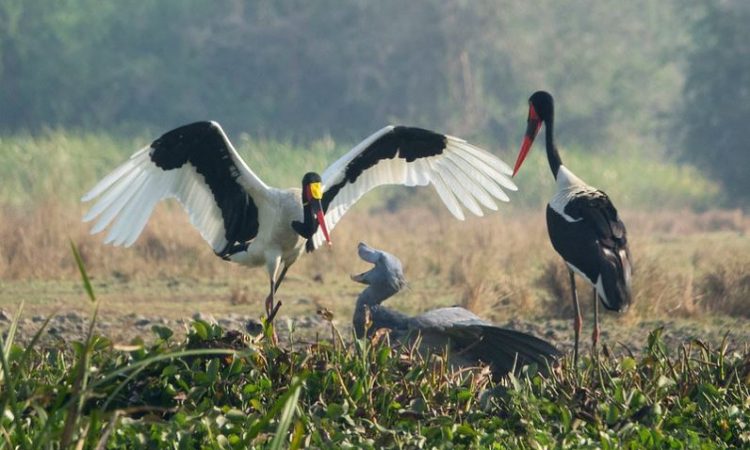
This 3 Days Bird watching safari in Murchison falls park offers an immersive experience in Uganda’s largest conservation area, boasting over 450 bird species and the roaring Nile River. Ideal for bird enthusiasts, this journey, often beginning with a visit to Ziwa Rhino Sanctuary, takes you through diverse habitats—savannah grasslands, woodlands, and riverine forests. Key sightings include the rare Shoebill Stork, Blue-throated Roller, and Carmine Bee-eater. The itinerary features a thrilling boat cruise to the base of the falls, a visit to the Nile-Lake Albert Delta, and game drives in the Paraa region to spot wildlife like giraffes and lions. This 3 Days Bird watching safari in Murchison falls park guarantees a rich, memorable experience with top-tier wildlife encounters and exceptional birding in a compressed, efficient timeframe, tailored for travelers looking for a quick, impactful getaway in northwestern Uganda's untamed landscapes.
Tour highlights for 3 Days Bird watching safari in Murchison falls park
Spot rare Shoebill storks
Explore Budongo forest species
Cruise Nile Delta wetlands
See Murchison Falls base
Watch nesting bee-eaters colonize
Track savanna bird varieties
View prehistoric ground hornbills
Observe giant Nile crocodiles
Photograph majestic wild giraffes
Enjoy expert guided tracking
Day 1: Arrival, Rhino Tracking & Transfer to Murchison Falls
Your 3 Days Bird watching safari in Murchison falls park begins with a pick-up in Kampala/Entebbe by an expert driver-guide. We head north to the Murchison Falls National Park, stopping at the Ziwa Rhino Sanctuary to track endangered rhinoceros on foot. This provides a unique, intimate wildlife encounter before reaching the park. After lunch, we proceed to the park, often making a scenic stop at the top of the falls to witness the Nile River plunge 43 meters through a narrow 7-meter gorge, creating a stunning backdrop and a "thunderous" sound. The evening includes a check-in at your lodge in Paraa and a short evening birding stroll if time permits. Dinner is served with panoramic views of the Nile, setting the stage for an action-packed 3 Days Bird watching safari in Murchison falls park.
Day 2: Morning Birding Game Drive & Afternoon Boat Cruise
Early morning starts with a game drive along the Buligi savanna tracks, a prime spot for viewing both savannah and acacia bird species like the Abyssinian ground hornbills. This is the best time for spotting lions, elephants, and leopards, while also encountering birds such as the rare Shoebill Stork. After a break, you will embark on a 3-hour boat cruise to the bottom of the falls, offering incredible opportunities to view water-loving birds like kingfishers, African fish eagles, and Carmine bee-eaters. The shores are teeming with hippos and crocodiles, while the boat brings you closer to the breathtaking falls, making this afternoon one of the highlights of the 3 Days Bird watching safari in Murchison falls park. The day wraps up with dinner at the lodge, overlooking the river.
Day 3: Delta Boat Cruise & Return Journey to Kampala
On the final day of your 3 Days Bird watching safari in Murchison falls park, you'll take an early morning boat trip to the Nile-Lake Albert Delta to look for the rare shoebill stork. The calm waters here are perfect for finding birds that are difficult to spot in the main channel, including the African Open-billed Stork. Following this, a final game drive through the park brings you back towards the entrance as you leave the stunning biodiversity of Murchison Falls behind. After lunch at a stopover, you will proceed to Kampala or Entebbe, ending your 3 Days Bird watching safari in Murchison falls park with a drop-off at your hotel or the airport. This concluding day ensures you've seen the maximum variety of birds and animals during your short stay
1. What are the best birding spots in Murchison Falls National Park?
The park's diverse ecosystems offer distinct birding "hotspots." The Nile Delta is the crown jewel, specifically the area where the Victoria Nile flows into Lake Albert; the papyrus-lined banks here are essential for spotting the Shoebill. On the Northern Bank, the Buligi Game Tracks provide vast savannah landscapes where you can find ground-dwelling birds like the Abyssinian Ground Hornbill and Denham's Bustard.
For forest specialists, Budongo Forest is incomparable. Within Budongo, the Kaniyo Pabidi section is famous for its ease of access to forest birds like the Puvel's Illadopsis. However, the legendary "Royal Mile"—a stretch of road with a high, open canopy—is the most celebrated birding trail in the region, offering sightings of rare kingfishers and flycatchers. Finally, the Nyamusika Cliffs along the river are the primary nesting sites for vibrant colonies of Red-throated Bee-eaters.
2. When is the best time for a 3-day birding safari in Murchison Falls?
While birding is a year-round activity in Uganda, the Dry Seasons (December to February and June to September) are generally considered optimal. During these months, the vegetation is thinner, making it significantly easier to spot small or shy birds in the thickets. Additionally, low water levels in the Nile Delta can concentrate water birds in smaller areas, increasing sighting frequency.
The period from November to April is particularly special because it marks the arrival of Palearctic Migrants from Europe and Northern Africa. This window provides the highest possible species count, as you can see both resident Ugandan birds and seasonal visitors. Conversely, the rainy seasons (April to May and October to November) offer lush, green backgrounds for photography and higher vocal activity, though slippery roads can make the 3-day logistics more challenging.
3. Which specialized birds can I see in Murchison Falls National Park?
Murchison Falls is home to several "must-see" specialties that are difficult to find elsewhere in East Africa. The Shoebill Stork is the primary target, but the park is also a stronghold for the Red-throated Bee-eater, which nests in the riverine cliffs. In the savannah, you will encounter the prehistoric-looking Abyssinian Ground Hornbill and the elegant Denham’s Bustard.
Other key specialties include:
- Silverbird: A beautiful, pale-grey flycatcher often seen on the acacia-dotted plains.
- Black-billed Wood-Dove: Common in the woodlands but a lovely tick for any list.
- African Skimmer: Often found in large flocks on sandbanks during the boat cruise.
- Heuglin’s Spurfowl: A regional endemic frequently spotted during early morning game drives.
- Giant Kingfisher: The largest of its kind, often seen perched over the Victoria Nile.
4. What is the most famous bird in Murchison Falls National Park?
The Shoebill Stork (Balaeniceps rex) is undoubtedly the most famous and sought-after bird in the park. Often described as "prehistoric" or "statue-like," this massive, blue-grey bird stands up to 5 feet tall and possesses a unique, shoe-shaped bill with a sharp hook at the end for catching lungfish.
Its fame stems from its rarity and its specialized habitat. It is a solitary hunter that stands motionless in the papyrus swamps for hours, making a sighting feel like a significant achievement. In Murchison, the Shoebill is a resident species, meaning it stays in the park year-round, primarily in the Victoria Nile Delta. While it can be seen at the Mabamba Swamp near Entebbe, Murchison offers the unique experience of viewing this rare bird against the backdrop of one of Africa’s most powerful rivers and diverse wildlife.
5. Can I see the "Big Five" and birds on the same 3-day trip?
Absolutely. Murchison Falls is one of the few places where you can seamlessly combine high-intensity big game viewing with elite birdwatching. To see the full "Big Five," you must include a stop at the Ziwa Rhino Sanctuary on the drive from Kampala, as rhinos are not found within the park itself. Once inside Murchison, Elephants, Buffaloes, and Lions are frequently seen on the northern savannah tracks. Leopards are more elusive but often spotted in the leopard-friendly thickets of the Buligi circuit.
Because the birds share the same habitats, your morning game drive serves two purposes: you might spot a pride of lions while simultaneously ticking off an Abyssinian Ground Hornbill or a Martial Eagle perched in a nearby acacia. The afternoon boat cruise provides a similar dual experience, allowing you to see massive herds of buffalo and hippos alongside colonies of kingfishers and herons.
6. Do I need a special guide for birding in Murchison Falls?
While general safari guides are excellent at spotting mammals, hiring a specialized birding guide is highly recommended for a dedicated birding trip. Birding in a 450+ species environment requires a professional who can identify birds by call (aural identification) and knows the specific micro-habitats of shy species like the Pel’s Fishing Owl or the White-crested Turaco.
You can hire guides through the Uganda Wildlife Authority (UWA) at the Paraa headquarters or through specialized birding tour operators. These experts carry high-quality spotting scopes and field guides, and they understand the "ethics" of birding, such as keeping a respectful distance from nesting sites. Having a guide who knows the seasonal movements of the Shoebill or the specific fruiting trees in Budongo Forest will dramatically increase your success rate over three days.
7. What is included in a 3-day birding itinerary for Murchison Falls?
A well-structured 3-day birding itinerary maximizes time in different habitats:
- Day 1: Depart Kampala early. Most itineraries include a stop at Ziwa Rhino Sanctuary (for White Rhinos and bush-land birds). Arrive at the park and visit the Top of the Falls to see Rock Pratincoles and the sheer power of the Nile.
- Day 2: A Morning Game Drive on the Northern Bank for savannah species and Big Game. In the afternoon, take a Private Boat Cruise to the Delta (specifically for the Shoebill) rather than the standard "bottom of the falls" cruise, as the Delta trip is longer and more focused on water birds.
- Day 3: An early morning visit to Budongo Forest (Kaniyo Pabidi or the Royal Mile) for forest specialists like the Chocolate-backed Kingfisher. After the forest walk, begin the return journey to Kampala/Entebbe.
8. What is the role of the Nile boat trip for bird watching?
The boat trip is a central pillar of any Murchison safari. There are two main types: the standard cruise to the Bottom of the Falls and the Delta Cruise. For birders, the Delta Cruise (downstream toward Lake Albert) is essential. The slow-moving water and extensive papyrus reeds create an ideal environment for aquatic species.
On this trip, the boat acts as a floating blind, allowing you to get remarkably close to birds that would otherwise fly away if approached on foot. You can expect to see African Skimmers skimming the water's surface, Goliath Herons (the world's largest heron), Malachite Kingfishers, and Pied Kingfishers. The boat also provides the best vantage point for the Shoebill, as many of its favorite hunting grounds are inaccessible by land.
9. Is Budongo Forest part of the 3-day birding safari?
Yes, Budongo Forest is usually included on the first or third day of a 3-day trip due to its location. It sits on the southern fringe of the Murchison Falls conservation area. It is a critical addition because it offers a "forest checklist" that is entirely different from the savannah and wetland species found in the rest of the park.
Budongo is the largest mahogany forest in East Africa and is home to over 360 bird species. Even a brief 2–3 hour walk at Kaniyo Pabidi can yield sightings of the Puvel’s Illadopsis, which is found nowhere else in East Africa. For more dedicated birders, extending the trip or arriving early to visit the Royal Mile is a priority. This forest component ensures your 3-day trip covers the full spectrum of Uganda’s avian diversity: savannah, wetland, and tropical rainforest.
10. What are the park entrance fees for Murchison Falls (2026)?
As of 2026, the Uganda Wildlife Authority (UWA) maintains a standard fee structure for Murchison Falls National Park. For Foreign Non-Residents, the entrance fee is $45 USD per person per 24-hour period. Foreign Residents (with a valid work permit) typically pay $35 USD, while East African Citizens pay 25,000 UGX.
It is important to note that these fees are strictly for park entry. Additional costs apply for activities such as:
- Boat Cruises: Approximately $30–$40 USD per person.
- Vehicle Entrance: Roughly 40,000 UGX for a Ugandan-registered tour vehicle.
- Guided Birding/Game Drives: UWA ranger fees are usually around $20–$25 per group.
- Top of the Falls Visit: Usually included in the entry, but some special walks may have a small separate fee ($10–$15).
11. Can I do birding in Murchison Falls during the rainy season?
Yes, and many professional birders actually prefer it. The rainy seasons (March–May and October–November) coincide with the breeding season for many species, meaning birds are in their brightest breeding plumage and are more vocal as they defend territories and attract mates. This makes them easier to locate by ear.
However, there are logistical trade-offs. Murchison's black cotton soil can become extremely slippery and "sticky" after heavy rain, making some game tracks impassable even for 4x4 vehicles. Visibility can also be temporarily reduced during downpours. If you plan to bird in the rainy season, ensure you have a high-clearance 4WD vehicle and allow for a bit of flexibility in your daily schedule to wait out short afternoon thunderstorms.
12. Are there any restrictions on bird photography in the park?
Uganda Wildlife Authority has strict regulations to protect the ecosystem. The most important rule is no off-road driving. You must stay on designated tracks, even if a rare bird is spotted 50 meters away in the grass. This prevents habitat destruction and soil compaction.
Additionally, the use of drones is strictly prohibited without a special (and expensive) permit from both UWA and the Civil Defense. For those using call playback (using recordings to lure birds out), this should be done sparingly and only by an experienced guide, as overusing it can stress the birds and disrupt their natural behavior. Flash photography is generally allowed for birds, but you should avoid using it excessively on nesting pairs or sensitive species like the Shoebill.
13. What clothes should I pack for birding in Murchison Falls?
Murchison Falls can be quite hot and humid, so lightweight, breathable fabrics are essential. However, because you will be in savannah and forest environments, protection is key:
- Neutral Colors: Wear khaki, green, or tan. Avoid bright colors like red or yellow, which can spook birds, and avoid blue/black, which attracts Tsetse flies.
- Long-sleeved shirts and trousers: These provide a barrier against biting insects and the sun.
- Sturdy hiking boots: Necessary for the Budongo Forest trails and the hike to the Top of the Falls.
- Wide-brimmed hat and polarized sunglasses: Essential for the boat cruise to reduce glare on the water.
- Light rain jacket: Even in the dry season, tropical showers can occur.
14. What are the accommodation options inside the park?
The park offers a wide range of lodging tailored to different budgets, mostly concentrated around the Paraa area where the ferry crossing used to be (now replaced by a bridge).
- Luxury: Lodges like Paraa Safari Lodge, Chobe Safari Lodge, and Nile Safari Lodge offer high-end amenities, swimming pools, and stunning views of the river.
- Mid-Range: Murchison River Lodge and Pakuba Safari Lodge (located on the northern bank) offer excellent value and are often situated right in the heart of birding territory.
- Budget/Camping: Red Chilli Rest Camp and the UWA-managed campsites provide affordable "bandas" and tent pitches.
Staying inside the park (or right on the boundary) is crucial for birders because it allows you to start your game drives at dawn (6:30 AM), which is the peak time for bird activity.
15. How do I get to Murchison Falls National Park for my safari?
Murchison Falls is approximately 300 km (186 miles) north of Kampala. The drive typically takes 5 to 6 hours, depending on traffic and road conditions. Most travelers use the Southern Route via Masindi, entering through the Kichumbanyobo Gate. This route takes you through the heart of Budongo Forest, allowing for "roadside birding" before you even reach the lodge.
Alternatively, the Northern Route via Karuma Bridge enters through the Tangi or Wankwar Gates. This is often faster for those staying at lodges on the northern bank. For those with a shorter timeframe, scheduled or chartered domestic flights are available from Entebbe International Airport to the Pakuba, Chobe, or Bugungu airstrips, reducing the travel time to just 60 minutes.
Booking 3 Days bird watching safari with us Roads of Adventure safaris
Book a 3-day bird watching safari with Roads of Adventure Safaris to explore Uganda's biodiversity, typically featuring hotspots like Queen Elizabeth National Park or Murchison Falls. Packages include 4x4 transport, guides, meals, and specialized birding tours. Contact them at +256 345 67890 or info@roadsofadventure.com to customize your trip.
