Uganda is an unmatched avian paradise, holding over half of Africa’s bird diversity within its borders. This meticulous 28 Days perfect Bird watching safari in Uganda and photography takes you across a vast tapestry of distinct ecosystems. From the vast, prehistoric papyrus swamps of Lake Victoria to the dense, mist-shrouded montane canopies of the Albertine Rift, every destination has been selected to optimize your species checklist and visual composition. Tailored specifically for keen birders and wildlife photographers, this expedition focuses on highly sought-after regional specialists, rare endemics, and iconic megafauna. You will navigate these pristine terrains alongside elite local guides who know every call, behavior, and hidden perch. With specialized 4x4 safari vehicles featuring custom pop-up roofs, you are guaranteed clear sightlines and maximum stability for heavy telephoto lenses. Prepare for an immersive, month-long journey that captures the true raw essence and breathtaking biodiversity of Africa’s premier birding destination.
28 Days perfect Bird watching safari in Uganda and photography
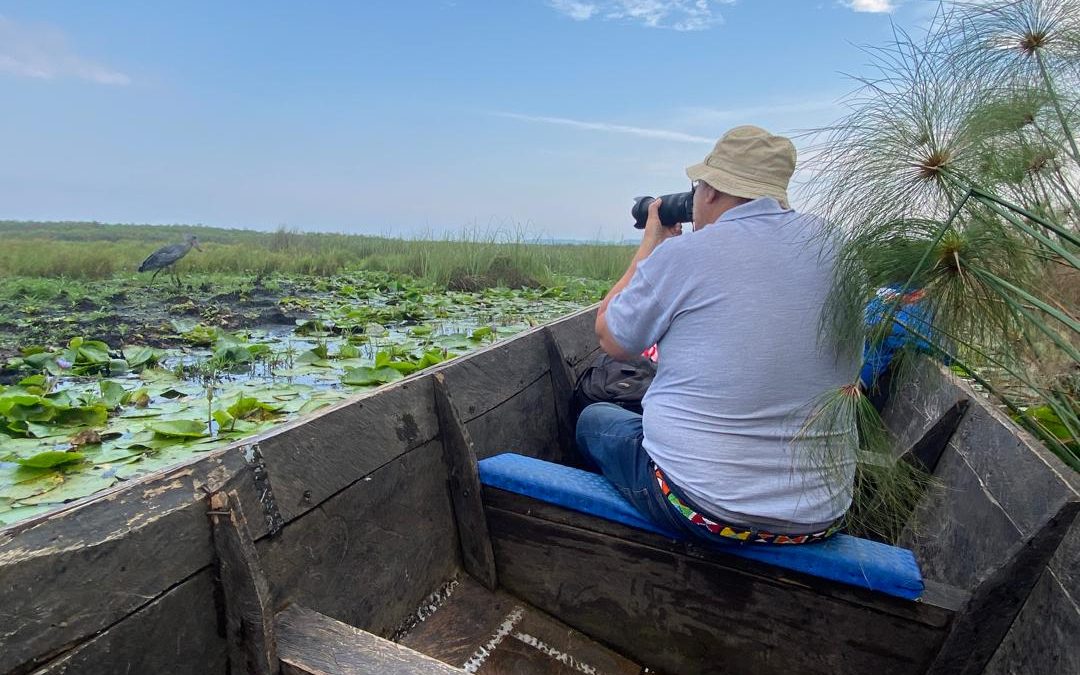
Mabamba Shoebill Stork
Mabira canopy birding
Elgon highland endemics
Pian Upe grassland
Kidepo remote wilderness
Narus valley raptors
Murchison Nile delta
Savannah big game
Budongo Royal Mile
Semuliki Congo species
Kibale primate tracking
Green-breasted Pitta encounter
Chimpanzee forest walk
Kazinga channel cruise
Ishasha climbing lions
Bwindi mountain gorillas
Albertine Rift endemics
Mubwindi Green Broadbill
Mburo acacia woodlands
Secretive African Finfoot
Equator photo stop
Entebbe botanical gardens
Stunning avian photography
Dy by day 28 Days perfect Bird watching safari in Uganda and photography
Day 1: Arrival at Entebbe International Airport
Your extraordinary 28 Days perfect Bird watching safari in Uganda and photography begins with your arrival at Entebbe. A professional representative will welcome you and arrange a smooth transfer to your boutique lodge. Depending on your landing time, we can enjoy a relaxing walk around the grounds or the lakeshore. Your guide will provide a detailed briefing on the incredible ecosystems, weather patterns, and specific photographic targets awaiting you over the next four weeks. Keep your camera gear easily accessible, as the lodge gardens often host colorful residents like the Eastern Grey Plantain-eater and Northern Masked Weaver. Get plenty of rest tonight ahead of your first major field day.
- Target Species: Black-headed Gonolek, Double-toothed Barbet, Meyer's Parrot.
- Photography Focus: Soft afternoon garden light, capturing vibrant plumage against dark green foliage.
Day 2: Birding Mabamba Wetland and Transfer to Mabira Forest
An early morning drive brings us to the famous Mabamba Wetland on the shores of Lake Victoria. We step into traditional motorized wooden canoes to explore the narrow papyrus channels. Our main objective is the majestic, prehistoric Shoebill Stork. Photographers will appreciate the low water-level angle, which offers clean, unobstructed reflections of this incredible bird. After tracking down the Shoebill and various unique water birds, we pack up and drive eastward toward the ancient, towering canopies of Mabira Forest.
- Target Species: Shoebill, Lesser Jacana, Papyrus Gonolek, Blue-breasted Kingfisher.
- Photography Focus: Action shots of water birds taking flight, dealing with early morning lake mist and subtle backlighting.
Day 3: Full Day Immersive Birding in Mabira Forest
We dedicate today to exploring the dark, dense understory and high canopies of Mabira Forest. This massive tropical rainforest provides excellent opportunities for macro photography and challenging low-light forest birding. Walking along the well-maintained interior trails, our sharp-eyed site guide will point out secretive canopy dwellers and beautifully colored fruit-eaters. We will move slowly, allowing photographers plenty of time to set up stable tripod shots in the deeper, shaded sections of the forest.
- Target Species: Nahan's Francolin, Purple-throated Cuckoo-shrike, Jameson's Wattle-eye, Tit Hylia.
- Photography Focus: Managing high-ISO settings in deep forest shade, focusing through dense branches and leaves.
Day 4: Drive via Jinja to the Foothills of Mount Elgon
We depart early, stopping briefly at Jinja to cross the iconic River Nile. Along the riverbanks, we can spot various cormorants, darters, and kingfishers. We then continue our journey toward the eastern border, watching the landscape shift into the dramatic volcanic slopes of Mount Elgon National Park. We will stop at scenic overlooks to photograph the wide plains below before settling into our comfortable lodge near the spectacular Sipi Falls.
- Target Species: Rock Pratincole, Giant Kingfisher, Great Blue Turaco.
- Photography Focus: Landscape compositions incorporating rushing water and mountain ridges, capturing birds in motion against waterfalls.
Day 5: High-Altitude Forest Birding on Mount Elgon
Today we explore the unique montane forests and bamboo zones of Mount Elgon. The high altitude introduces a completely different mix of bird species, many of which are restricted to these specific volcanic highlands. We will hike along the park's scenic trails, keeping a close watch on flowering shrubs that attract brilliant, iridescent sunbirds. The crisp, clear mountain air provides excellent contrast for sharp, highly detailed avian portraits.
- Target Species: Jackson's Francolin, Hartlaub's Turaco, Tacazze Sunbird, Olive-breasted Greenbul.
- Photography Focus: Capturing shimmering, metallic feather details on sunbirds in bright, high-altitude sunlight.
Day 6: Travel into the Dry Savannah of Pian Upe Wildlife Reserve
We head north into the rugged, remote plains of the Karamoja region, arriving at the vast Pian Upe Wildlife Reserve. This pristine, less-traveled grassland is surrounded by dramatic volcanic mountains. The wide-open country gives photographers panoramic vistas and beautiful, unobstructed golden-hour light. We will spend the afternoon searching for unique Somali-Masai biome specialists that thrive in this dry, rocky scrub.
- Target Species: Fox's Weaver (Uganda's only endemic), Karamoja Apalis, Jackson's Hornbill.
- Photography Focus: Wide-angle wildlife shots, using the warm evening sun to highlight birds perched on acacia thorns.
Day 7: Full Day Wildlife and Bird Photography in Pian Upe
We spend a full day exploring the sweeping savannah tracks of Pian Upe by open safari vehicle. This expansive reserve is excellent for tracking large ground-dwelling birds, raptors, and unique mammals like cheetahs and patas monkeys. Photographers can easily use long lenses here, as the lack of dense trees makes it simple to track birds in flight across the vast, open blue skies.
- Target Species: Abyssinian Ground Hornbill, Clapperton's Spurfowl, Secretary Bird, Ostriches.
- Photography Focus: High-speed flight photography, tracking large raptors soaring against a mountain backdrop.
Day 8: Journey North Across Karamoja to Mount Moroto
Our safari takes us deeper into the arid heart of Karamoja as we drive toward Mount Moroto. This rugged peak rises dramatically out of the surrounding dry plains. We will bird along the seasonal riverbeds and rocky foothills, looking for dry-country specialists. The local culture here is fascinating, and the unique landscape offers beautiful, minimalist backgrounds for our wildlife photography.
- Target Species: Stone Partridge, White-bellied Go-away-bird, Black-breasted Barbet.
- Photography Focus: Isolating subjects against clean, neutral-toned desert rocks and dry earth.
Day 9: Expedition into the Remote Kidepo Valley National Park
We drive further north to Kidepo Valley National Park, one of Africa’s most isolated and visually stunning wilderness areas. Flanked by the rugged Morungole Mountains, Kidepo features massive sweeping valleys and golden savannahs. The afternoon game drive focuses on the Narus Valley, where permanent water sources attract large numbers of birds and big game, including massive herds of Cape buffalo.
- Target Species: Rose-ringed Parakeet, Clapperton's Spurfowl, Kori Bustard.
- Photography Focus: Environmental portraits showing birds interacting alongside large African mammals in golden light.
Day 10: Exploring the Wild Narus and Kidepo Valleys
We set out for a full day of exploration across Kidepo's distinct valley systems. The Narus Valley offers rich acacia woodlands, while the Kidepo Valley features dry borassus palm groves near the South Sudan border. This variety of habitats provides an incredible checklist of raptors and dry-country specialists. We will use our vehicle's pop-up roof to get stable, elevated angles for the perfect shot.
- Target Species: Pygmy Falcon, Dark Chanting Goshawk, Fox Kestrel, Yellow-billed Hornbill.
- Photography Focus: Bird-of-prey portraits, capturing sharp details of raptors perched high on dead tree branches.
Day 11: Travel West to Gulu Town
We say goodbye to the beautiful wilderness of Kidepo and begin our journey westward across the northern plains of Uganda. This travel day takes us through local villages and changing landscapes, with casual birding stops along agricultural fields and small wetlands. We will reach Gulu town by late afternoon, allowing plenty of time to download your photos, recharge batteries, and clean your camera gear after the dusty Karamoja tracks.
- Target Species: Crested Francolin, Helmeted Guineafowl, Long-crested Eagle.
- Photography Focus: Casual roadside photography, documenting rural landscapes and versatile birds adapting to open spaces.
Day 12: Drive to Murchison Falls National Park (Northern Sector)
We head south from Gulu to enter the historic Murchison Falls National Park. We spend the afternoon exploring the northern savannahs, where rolling hills and borassus palms create a classic African landscape. This area is teeming with wildlife, giving us fantastic opportunities to photograph birds perched on large mammals or hunting insects stirred up by our vehicle.
- Target Species: Abyssinian Roller, Denham's Bustard, Black-billed Barbet, Northern Carmine Bee-eater.
- Photography Focus: Capturing the bright, contrasting colors of rollers and bee-eaters against the pale-dry grasses.
Day 13: Delta Boat Cruise and Northern Savannah Game Drive
We board a morning boat cruise down the River Nile toward the Lake Albert Delta. This calm wetland area is another prime location for spotting the Shoebill and a huge variety of water birds. The boat provides a very stable platform for photography. In the afternoon, we head back out onto the savannah tracks to search for large ground birds and active predators.
- Target Species: Saddle-billed Stork, Goliath Heron, African Skimmer, Pel's Fishing Owl.
- Photography Focus: Low-angle water photography, capturing reflections and action shots of birds feeding along the shoreline.
Day 14: Morning Nile Boat Cruise and Drive to Masindi Town
We take a morning boat trip upstream to the base of Murchison Falls, where the entire Nile squeezes through a narrow 7-meter gorge. We will scan the rocky cliffs for specialized water birds that thrive in the heavy mist. Afterward, we visit the top of the falls for dramatic landscape photos, then exit the park and drive to Masindi town, the gateway to the famous Budongo Forest.
- Target Species: Rock Pratincole, Bat Hawk, White-crested Turaco.
- Photography Focus: Long-exposure water photography, capturing birds perched on wet rocks amidst powerful river currents.
Day 15: Birding the Famous Royal Mile in Budongo Forest
We head out before dawn to experience the Royal Mile in Budongo Forest, widely considered one of the finest forest birding tracks in Africa. This wide, flat avenue cut through a spectacular mahogany canopy provides excellent visibility. The tall trees allow more light into the mid-story, making it a fantastic location for photographing elusive forest kingfishers, flycatchers, and unusual skulkers.
- Target Species: Chocolate-backed Kingfisher, African Dwarf Kingfisher, Nahan's Partridge, Chestnut-capped Flycatcher.
- Photography Focus: Tracking fast-moving birds through the mid-canopy, using fill-flash subtly to bring out true plumage colors.
Day 16: Birding Busingiro Section and Transfer to Fort Portal
Today we explore the Busingiro section of Budongo Forest, searching for any tricky species we might have missed yesterday. After a productive morning walk, we embark on a scenic drive south through local tea plantations and along the Albertine Rift escarpment. We will enjoy beautiful views of Lake Albert before arriving in the pleasant town of Fort Portal, nestled under the Rwenzori Mountains.
- Target Species: Puvel's Illadopsis, Rufous-sided Broadbill, Fire-crested Alethe.
- Photography Focus: Low-angle forest floor shots, focusing on shy birds moving through leaf litter.
Day 17: Lowland Forest Exploration in Semuliki National Park
We descend into the hot, steamy lowlands of Semuliki National Park. This unique forest represents the easternmost edge of the vast Congo Basin rainforest, bringing many Central African bird species into East Africa. Walking along the Kirumia Trail, we enter a wild ecosystem filled with unusual hornbills and specialized forest skulkers found nowhere else in the country.
- Target Species: White-crested Hornbill, Red-billed Dwarf Hornbill, African Piculet, Swamp Palm Bulbul.
- Photography Focus: Adapting to high humidity, capturing clear details of birds hidden in dense, tangled undergrowth.
Day 18: Transfer to Kibale Forest and Bigodi Wetland Walk
A short drive brings us to Kibale Forest National Park, a world-famous primate paradise that also boasts an incredible bird checklist. In the afternoon, we visit the community-run Bigodi Wetland Sanctuary. A boardwalk trail leads us through the papyrus and swamp forest, offering fantastic, close-up photography of turacos, barbets, and various monkeys feeding in the fruiting trees.
- Target Species: Great Blue Turaco, Papyrus Gonolek, White-winged Warbler, Hairy-breasted Barbet.
- Photography Focus: Medium-range portraits of birds feeding on wild figs, working with the soft, diffused light of the swamp canopy.
Day 19: Tracking the Green-breasted Pitta and Chimpanzee Walk
Today features one of the ultimate highlights of our 28 Days perfect Bird watching safari in Uganda and photography. We head into the forest floor before sunrise, listening intently for the distinctive display call of the rare Green-breasted Pitta. Finding and photographing this master of camouflage on the dark forest floor is an unforgettable experience. In the afternoon, we switch focus to track a troop of wild chimpanzees moving through the forest.
- Target Species: Green-breasted Pitta, Joyful Greenbul, African Grey Parrot.
- Photography Focus: Extreme low-light photography, tracking fast ground-dwelling birds, and capturing dynamic chimpanzee behavior in the trees.
Day 20: Drive south to Queen Elizabeth National Park
We leave the rainforest behind and drive south, crossing the equator as we enter Queen Elizabeth National Park. The landscape opens up into sweeping savannah plains, volcanic crater lakes, and extensive wetlands. Our afternoon game drive explores the Kasenyi plains, a fantastic area for open-country birds, large raptors, and classic African wildlife like lions and elephants.
- Target Species: Martial Eagle, Temminck's Courser, Flappet Lark, Rupell's Griffon Vulture.
- Photography Focus: Capturing birds of prey in flight against the dramatic, backdrop of the Rwenzori Mountains.
Day 21: Kasenyi Game Drive and Kazinga Channel Boat Cruise
We start with an early morning drive through Kasenyi to capture the park's wildlife in the soft morning light. In the afternoon, we board a boat cruise along the Kazinga Channel, a natural waterway connecting Lake Edward and Lake George. This cruise is an absolute dream for photographers, allowing you to drift safely within meters of elephants, hippos, and thousands of nesting water birds.
- Target Species: African Skimmer, Pink-backed Pelican, Pied Kingfisher, Yellow-billed Stork.
- Photography Focus: Fast shutter speeds to freeze fish-hunting action, capturing birds interacting closely with large mammals along the water's edge.
Day 22: Birding through Ishasha Sector to Bwindi (Buhoma)
We travel south through the remote Ishasha sector of the park, famous for its unique tree-climbing lions. We will keep a sharp look out for these big cats resting in the large fig trees, while also watching for savannah birds. Afterward, the road winds upward into the misty, ancient rainforests of Bwindi Impenetrable National Park, arriving at the lower-altitude Buhoma sector.
- Target Species: Ross's Turaco, Broad-billed Roller, Caspian Plover, Black-bee-eater.
- Photography Focus: Spotting and composing subjects hidden high in branches, balancing exposure between bright skies and deep tree shade.
Day 23: Forest Photography along the Buhoma Waterfall Trail
We spend the day hiking the lush waterfall trails inside Bwindi's pristine forest canopy. Buhoma is home to an incredible variety of Albertine Rift endemics and colorful forest specialties. Walking slowly along the clear rivers and mossy banks, we can take advantage of the shade to capture highly detailed macro images and beautiful compositions of forest birds near rushing water.
- Target Species: Black Bee-eater, African Broadbill, Short-tailed Warbler, Blue-headed Sunbird.
- Photography Focus: Long-exposure shots of forest streams with birds as focal points, using flash carefully to illuminate dark plumage.
Day 24: Birding "The Neck" and Transfer to Ruhija Sector
We drive to the higher-altitude Ruhija sector of Bwindi, stopping to bird a famous riverine forest stretch known as "The Neck." This narrow forest corridor offers great visibility over the water, making it a favorite spot for colorful kingfishers and unusual flycatchers. As we climb higher into Ruhija, the air turns cool and misty, introducing an entirely new group of high-altitude Albertine Rift endemics.
- Target Species: Cassin's Flycatcher, Black-faced Rufous Warbler, Mountain Wagtail, Regal Sunbird.
- Photography Focus: Capturing birds in changing mountain weather, using mist and soft fog to add a beautiful atmosphere to your images.
Day 25: Deep Hike to Mubwindi Swamp for the African Green Broadbill
Today is a major highlight for serious birders. We hike deep down through the high-altitude cloud forest to the remote Mubwindi Swamp. Our main target is the rare and beautiful African Green Broadbill, a tiny bird that builds its nest over the forest trails. The hike is challenging, but the reward of photographing this special endemic in its mossy habitat is well worth the effort.
- Target Species: African Green Broadbill, Grauer's Rush Warbler, Archer's Robin-Chat, Stripe-breasted Tit.
- Photography Focus: Isolating small green birds against vibrant green moss and bamboo leaves using a shallow depth of field.
Day 26: Travel to Lake Mburo National Park
We descend from the Bwindi highlands and drive east through rolling hills and local farmlands toward Lake Mburo National Park. This small acacia-woodland park features a beautiful network of lakes and wetlands. It is the only place on our route where we can find certain southern-savannah species, and it offers great opportunities to photograph zebras, impalas, and waterbirds.
- Target Species: Red-faced Barbet, Tabora Cisticola, Coqui Francolin, Mosque Swallow.
- Photography Focus: Golden-hour photography across the acacia woodlands, using the warm light to highlight subtle feather textures.
Day 27: Morning Boat Cruise on Lake Mburo and Drive to Entebbe
We take a peaceful morning boat trip on Lake Mburo, scanning the quiet, tree-lined shores for the secretive African Finfoot and various kingfishers. After the cruise, we begin our drive back to Entebbe, stopping for lunch and a fun photo opportunity at the Equator crossing. We arrive at our lakeside hotel in Entebbe by late afternoon.
- Target Species: African Finfoot, White-backed Night Heron, Rufous-bellied Heron, Giant Kingfisher.
- Photography Focus: Tracking fast, low-swimming water birds from a moving boat, managing tricky reflections on the water's surface.
Day 28: Entebbe Botanical Gardens Birding and Departure
On the final day of our 28 Days perfect Bird watching safari in Uganda and photography, we explore the historic Entebbe Botanical Gardens on the edge of Lake Victoria. These beautiful, mature grounds feature towering trees and open lawns, offering a relaxing location for close-up bird photography. After a final lunch and a trip review with your guide, you will transfer to the airport for your evening flight home.
- Target Species: Great Blue Turaco, Ross's Turaco, Orange Weaver, Verreaux's Eagle-Owl.
- Photography Focus: Enjoying the bright, open garden light to capture clean, high-contrast portraits of Uganda's most colorful residents.
G
What are the absolute best times of year to undertake this 28-day itinerary for optimal birding and photography conditions?
Timing your 28 Days perfect Bird watching safari in Uganda and photography is all about balancing weather patterns, breeding cycles, and palearctic migrant arrivals. Uganda experiences two distinct dry seasons: from June to September and from December to February. Choosing between these windows depends heavily on your specific goals for species count versus photographic conditions.
The period from June to September is widely considered the prime window for resident forest species. During these drier months, trail access in dense rainforests like Bwindi Impenetrable Forest and Kibale Forest is significantly easier. Lower rainfall means less mud, fewer slippery steep climbs, and less risk of sudden downpours disrupting delicate camera setups. Additionally, many resident forest birds are highly active, feeding on fruiting trees, which makes them easier to track and photograph.
However, if your priority is maximizing your total checklist, the months of November to April introduce a massive influx of palearctic and intra-African migratory birds. During this time, wetlands like the Mabamba Swamp and the Kazinga Channel fill with thousands of migratory waders, terns, and raptors. The landscape is also incredibly lush and green, providing beautiful, vibrant backgrounds for your photos.
The main trade-off occurs during the heavy rainy seasons of April, May, and October. While these months bring challenging muddy roads and dense cloud cover that reduces light in the forest canopy, they also trigger peak breeding plumage and magnificent courtship displays for many species, such as weavers and widowbirds. Ultimately, the mid-to-late dry seasons remain the safest choice for photographers who need stable, predictable lighting conditions and smooth overland travel across Uganda’s varied terrain.
2. What specific camera bodies, telephoto lenses, and support systems do you recommend for an expedition of this length and variety?
An intensive 28-day trip across changing environments—ranging from deep, dark rainforest floors to wide, sun-drenched desert plains—requires a versatile and reliable gear setup. For your camera system, carrying two separate camera bodies is highly recommended. The dry savannah tracks of Kidepo and Pian Upe are incredibly dusty. Swapping lenses in an open 4x4 safari vehicle exposes your sensor to fine grit, which can leave annoying dust spots on your images. Having one body permanently attached to a super-telephoto lens and the second body ready with a wider zoom lens keeps your sensor safe.
For your primary lens, a focal range of $400\text{mm}$ to $600\text{mm}$ is standard for bird photography. Super-telephoto zoom lenses, such as a 150-600mm or a 200-600mm, offer incredible flexibility when framing fast-moving birds from a safari vehicle or a boat. However, inside the dense rainforests of Bwindi and Budongo, the thick canopy blocks out a significant amount of natural sunlight. To maintain fast shutter speeds without pushing your ISO to noisy extremes, fast prime lenses like a 300mm f/2.8 or a 400mm f/4 are incredibly valuable.
+------------------+----------------------------------+------------------------------------+
| Ecosystem | Key Challenge | Recommended Lens & Settings |
+------------------+----------------------------------+------------------------------------+
| Dense Rainforest | Low light, tangled branches | 300mm f/2.8 or 70-200mm f/2.8 |
| (Bwindi, Kibale) | | Wide aperture, high ISO (3200+) |
+------------------+----------------------------------+------------------------------------+
| Open Savannah | Extreme distances, heat haze | 200-600mm or 150-600mm zoom |
| (Kidepo, Murch.) | | Narrower aperture, fast shutter |
+------------------+----------------------------------+------------------------------------+
| Wetlands & Lakes | Boat movement, active flight | 100-400mm or 200-600mm with IS |
| (Mabamba, Mburo) | | Continuous AF, active stabilization|
+------------------+----------------------------------+------------------------------------+
Support systems are equally important. Heavy tripods are useful in open areas, but they can be clumsy on tight forest trails or inside vehicles. Instead, bring a sturdy monopod with a tilt head for forest hikes, and carry a compact beanbag. Resting your heavy lens on a beanbag placed on the vehicle's pop-up roof provides excellent stability for sharp, long-distance shots.
3. How do we manage electrical charging, data backup, and gear maintenance across remote wilderness locations like Kidepo and Pian Upe?
Keeping your equipment powered, backed up, and clean is a daily priority on a month-long safari. While major towns like Entebbe, Masindi, and Fort Portal have reliable grid power, remote bush lodges in Kidepo Valley and Pian Upe often rely entirely on solar power or generators. These systems are usually turned off late at night, making a structured charging routine essential.
Pro Charging Tip: Always travel with a multi-socket surge protector and a universal adapter. Whenever your vehicle is running or the lodge generator is active, plug in a multi-charger to refresh your camera batteries, phone, and laptop simultaneously.
Our specialized 4x4 safari vehicles are equipped with internal inverters and USB ports, allowing you to charge your backup batteries safely while driving between locations. Make it a habit to carry at least three to four high-capacity spare batteries in your daypack, as cold mountain air in locations like Mount Elgon and Ruhija can drain battery life much faster than expected.
Data redundancy is your insurance policy against a failed memory card. Given the thousands of high-resolution images you will capture, bring an ample supply of fast, weather-sealed memory cards. Every evening, transfer your files to a laptop and back them up onto two separate, rugged external hard drives. Keep one drive in your main luggage and the other in your hand luggage. Finally, bring a comprehensive cleaning kit. Use a hand-operated rubber air blower and a soft brush to remove dust after dry savannah game drives, and pack plenty of microfiber cloths and specialized cleaning solution to clear condensation after humid morning rainforest walks.
4. What are the physical demands, trail conditions, and hiking realities when searching for rare endemics in Bwindi and Kibale?
The physical difficulty of this safari varies significantly depending on the terrain. Open savannah game drives and boat cruises require very little physical effort, but searching for iconic forest endemics requires a reasonable level of physical fitness and agility. Rainforest trails are rarely flat, paved, or predictable.
In the higher-altitude Ruhija sector of Bwindi, searching for the rare African Green Broadbill requires a long hike down into the steep, rugged Mubwindi Swamp. This trail sits at an elevation of over 2,300 meters above sea level, where the thinner mountain air makes uphill climbing much more tiring. The trails can be wet, slippery, and crossed by exposed tree roots. You will need to move slowly and carefully while carrying your camera gear to ensure safety for both yourself and your lenses.
__ Deep Rainforest Canopy (Low Light / High Humidity)
/ \
High-Altitude Ridge / \ Slippery, Muddy Slopes (Roots & Vines)
+------------------------+ \
| Ruhija Sector (2300m+) | \ Mubwindi Swamp Floor (Target: Green Broadbill)
+------------------------+ \___________________________________________
[Requires: Sturdy Boots, Monopod, Rain Cover]
In Kibale Forest, tracking the Green-breasted Pitta involves walking into the forest understory before dawn. You will step off the main paths, navigating through thick vines, low branches, and uneven forest floor litter in dim morning light. To stay comfortable and focused on the birds, wearing sturdy, broken-in waterproof hiking boots with deep traction is essential. Lightweight, breathable long-sleeved shirts and long trousers protect against stinging nettles and scratches. It is also a good idea to tuck your trousers into high socks to keep crawling insects out. Hiring a local porter at the park headquarters is a fantastic option; they can carry your heavy camera bag, leaving you free to focus entirely on spotting and photographing your avian targets.
5. How are the safari vehicles configured to accommodate large camera lenses, tripods, and multiple photographers?
Logistical comfort is a vital component of a successful extended photo safari. This comprehensive 28-day itinerary relies on customized 4x4 safari Land Cruisers specifically engineered for wildlife viewing and photography. These vehicles feature robust four-wheel-drive systems, heavy-duty suspension to smooth out rough dirt roads, and large windows that give you clear views of the landscape.
The standout feature for photographers is the extended pop-up roof. When elevated, the roof provides a stable, 360-degree viewing platform, allowing you to stand up comfortably and track birds flying across the open sky or perched high in acacia trees. The edges of the roof open hatches are lined with soft padding, creating a perfect support base for resting heavy telephoto lenses on beanbags to eliminate camera shake.
Inside the vehicle, seating configuration is handled carefully to ensure everyone has ample space. For a dedicated photography safari, we strictly limit group sizes so that every photographer is guaranteed a window seat. This allows you to keep your camera body, extra lenses, and cleaning kits safely arranged right next to you on the seat for quick access. The open floor space provides plenty of room to store larger camera bags away from the elements. Additionally, vehicles are outfitted with multi-point power inverters, making it easy to charge batteries and keep your equipment running during long transfers between parks.
What are the real target lists for Albertine Rift endemics and Congo Basin specialists on this specific route?
Uganda’s unique geographical position makes it a meeting point for several distinct African ecosystems. This 28-day itinerary crosses multiple biological zones, giving you the chance to photograph birds that are incredibly difficult to find anywhere else on the continent. The two most sought-after groups on this journey are the Albertine Rift Endemics and the unique Central African Congo Basin specialists.
The Albertine Rift is a dramatic montane valley running along western Uganda, home to over two dozen endemic birds. As we climb into the cool cloud forests of Bwindi Impenetrable National Park, our main targets include the elusive African Green Broadbill, the beautifully colored Regal Sunbird, and the striking Rwenzori Turaco. We will also search for secretive understory species like the Archer's Robin-Chat and the Mountain Masked Warbler, which require patience and precise focusing to isolate against dark, mossy backdrops.
Further north, Semuliki National Park protects a lowland forest that represents the eastern edge of the vast Congo Basin rainforest. This introduces a completely different variety of birds. Here, we enter an ecosystem filled with massive hornbills, such as the White-crested Hornbill and Black-casqued Wattled Hornbill. We will also look for rare nocturnal birds like the Nkulengu Rail, alongside beautiful, colorful species like the Blue-billed Malimbe. Photographing these distinct specialists requires an experienced guide who can recognize their calls and understands their specific habits within the forest canopy.
How does the itinerary ensure an ethical approach to sensitive activities like tracking the Green-breasted Pitta or photographing nesting Shoebills?
Ethical wildlife viewing is a core responsibility when operating an extended safari through delicate ecosystems. High-end bird photography should never come at the expense of an animal's well-being or the preservation of its habitat. This itinerary works alongside the strict regulations set by the Uganda Wildlife Authority (UWA) and local community conservation groups to ensure that our presence supports wildlife protection.
When searching for the iconic Shoebill Stork in the Mabamba Wetland, we use local community-managed wooden canoes. The guides navigate slowly and quietly through the papyrus channels, maintaining a respectful distance from the birds. This approach ensures the Shoebills are not stressed, allowing photographers to capture natural behaviors like hunting or preening without disturbing the bird. During the nesting season, approaching known nests too closely is strictly avoided, preventing parents from abandoning their eggs or exposing chicks to predators.
The Green-breasted Pitta in Kibale Forest requires an equally careful approach. Because this small bird is highly sought after and can be difficult to find on the dark forest floor, we work exclusively with official park rangers. We avoid using continuous playback calls, which can cause unnecessary stress and disrupt the bird's natural territory control. Flash photography is strictly regulated or prohibited inside the national parks to avoid startling forest wildlife. Instead, we rely on high-ISO modern camera sensors, wide-aperture lenses, and natural, diffused forest light to capture stunning, authentic images responsibly.
What are the costs, booking timelines, and logistics involved for the optional Gorilla and Chimpanzee tracking permits?
While this safari is designed primarily around birding and photography, many travelers choose to enhance their journey with iconic primate encounters. Uganda is one of the best places in the world to see mountain gorillas and chimpanzees up close. However, because permit availability is strictly limited to protect the primates, these experiences require careful planning and advanced booking.
A standard mountain gorilla trekking permit in Bwindi Impenetrable National Park costs $800 USD for foreign non-residents. This permit grants you an unforgettable one-hour encounter with a habituated gorilla family. For photographers looking for a deeper experience, the Gorilla Habituation Experience in the southern sectors of Bwindi costs $1,500 USD. This option allows you to spend up to four hours with a wild group alongside researchers, giving you more time to observe behavior and adjust to the low-light forest conditions.
Chimpanzee trekking permits for the rich forests of Kibale National Park cost $250 USD for a standard one-hour encounter, while a Chimpanzee Habituation permit is $300 USD. Because demand for these permits is incredibly high—especially during the peak dry seasons—it is highly recommended to secure your permits four to six months in advance. We handle all the logistics, booking, and processing through the Uganda Wildlife Authority, ensuring your permits are locked in and perfectly integrated into your 28-day itinerary.
What standard of accommodation, dining options, and health precautions can we expect across this diverse itinerary?
An intensive 28-day expedition requires a high standard of comfort to ensure you stay rested, healthy, and focused on your photography throughout the month. The accommodations chosen for this route are a curated mix of comfortable mid-range safari lodges, eco-lodges, and permanent tented camps that blend seamlessly into the surrounding wilderness.
Most lodges feature private en-suite bathrooms, comfortable beds with protective mosquito netting, and private verandas that often double as excellent bird-watching spots. Dining options at the lodges typically include three-course dinners and hearty breakfasts, featuring a mix of fresh international cuisine and flavorful local dishes. Lunches are often provided as customized picnic boxes carried in the vehicle, allowing us to maximize our time out in the field without needing to return to camp during prime daylight hours.
From a health perspective, traveling across Uganda requires a few essential preparations. A valid Yellow Fever vaccination certificate is a mandatory requirement for entry at Entebbe International Airport. Because several of the parks we visit sit at lower elevations where malaria is present, taking a recommended preventative malaria medication is highly advisable. We always recommend drinking bottled or filtered water, which is provided in unlimited supply inside our safari vehicles. Carrying a basic personal first-aid kit containing bug spray, sun cream, and rehydration salts will keep you comfortable across the country’s diverse climates.
How do local site guides interact with our main safari guide to ensure we find highly secretive target birds?
The success of a specialized, long-duration birding safari relies heavily on the expertise of your guiding team. Throughout this 28-day journey, you will travel with a senior Ugandan safari guide who possesses an extensive knowledge of avian identification, bird calls, and optimal photographic composition. This main guide acts as your consistent host, managing vehicle logistics and matching your daily pace.
However, when entering complex national parks like Bwindi, Semuliki, or Kibale, we enhance this expertise by partnering with specialized local site guides. These site guides live and work directly within the immediate community or park boundaries. They walk the forest paths almost every day, giving them an intimate, up-to-the-minute understanding of exactly where secretive birds are nesting, feeding, or establishing territories.
The Guiding Partnership: Your main safari guide manages the overall daily plan, targets, and vehicle positioning, while the local site guide provides precise, real-time tracking on foot within the forest understory.
This collaboration is incredibly valuable when tracking master-of-camouflage species like the Green-breasted Pitta or the African Green Broadbill. The local site guide can often identify individual territorial perches or recognize specific alarm calls made by other forest wildlife that point directly to a target bird's location. This team approach saves time and significantly reduces foot traffic through sensitive habitats, ensuring a highly successful, educational, and respectful experience for both the photographer and the wilderness.
Booking 28 Days perfect Bird watching safari in Uganda and photography with us Roads of Adventure safaris
Planning a 28-day bird watching and photography safari in Uganda with Roads of Adventure Safaris is the ultimate way to capture over 1,000 recorded bird species and incredible wildlife across multiple national parks
