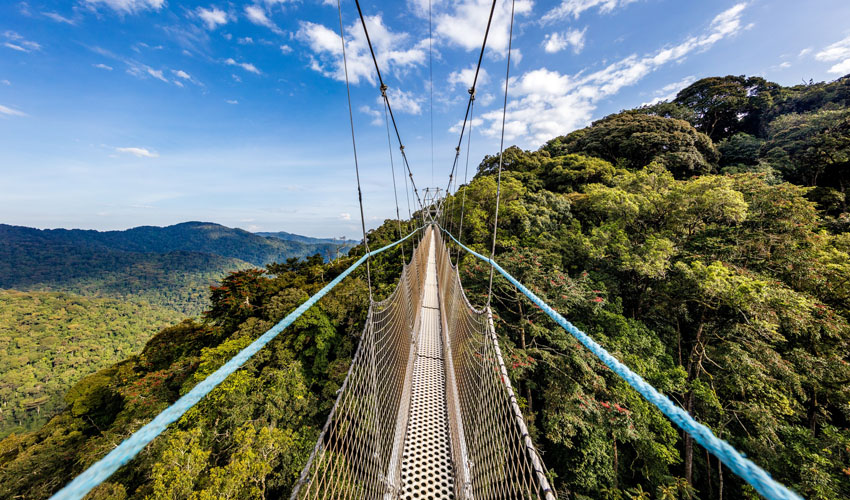
A 2–4-day Nyungwe National Park primate safari offers high-success chimpanzee trekking in Rwanda's ancient rainforest, canopy walks, and monkey spotting. Located in southwestern Rwanda, these tours typically start in Kigali and include permits for tracking in Cyamudongo Forest, with prices ranging from ~$620 to over $1,400 per person
2-days-nyungwe-luxury-fly-in-to-trek-with-chimpanzee
2-days-nyungwe-chimpanzee-tracking-and-canopy-walk
3-days-luxury-honeymoon-chimpanzee-tracking-and-canopy-walk-in-nyungweb
3-days-budget-chimpanzee-tracking-in-nyungwe-forest-park
3-days-nyungwe-chimpanzee-tracking-and-lake-kivu-relaxation
3-days-best-rwanda-canopy-walk-and-nyungwe-chimpanzee-tracking-adventure
3-day-chimpanzee-trekking-tour-package-canopy-and-lake-kivu
4-days-nyungwe-chimpanzee-trekking-canopy-walk-and-lake-kivu-relaxation
2-Day Nyungwe Highlights (Kigali to Kigali)
Embark on a captivating two-day escape from the rhythmic pulse of Kigali to the emerald embrace of Nyungwe National Park, one of Africa’s oldest and most biologically diverse rainforests. This compact yet exhilarating itinerary offers a profound balance of Rwanda’s storied heritage and its untamed natural wonders. You will journey from the refined, traditional courts of the Nyanza King’s Palace to the soaring heights of a world-class canopy walkway, suspended high above the ancient mahogany trees. The adventure culminates in an immersive dawn trek through the misty foliage of Cyamudongo or the main forest, where the spirited vocalizations of habituated chimpanzees echo through the canopy. Perfect for the time-conscious traveler, this circuit provides a sensory-rich deep dive into the heart of the "Land of a Thousand Hills," leaving you with a lasting connection to the country’s royal past and its vibrant, wild future.
Day 1: Royal Heritage & Aerial Adventures
Your journey begins with a scenic drive south from Kigali, winding through terraced hills toward Nyanza, the historical heart of the Rwandan kingdom. Here, you will explore the King’s Palace Museum, a meticulously reconstructed beehive-shaped residence that offers a window into pre-colonial monarchy. Witness the majestic, long-horned Inyambo cattle and hear the traditional singers who serenade them. After a local lunch, continue to Nyungwe National Park for an adrenaline-fueled afternoon. You’ll navigate the Igishigishi Trail to reach the famous Canopy Walkway. Suspended 70 meters above the forest floor, this 160-meter bridge provides a breathtaking "bird’s-eye view" of the ancient treetops, where you might spot blue turacos and playful L’Hoest’s monkeys. As the mist settles over the ridges, you’ll head to your lodge for dinner, surrounded by the peaceful symphony of the rainforest.
Day 2: Primate Encounters & The Road Home
The day starts under a blanket of stars with a 5:00 AM briefing, as you prepare for the highlight of the trip: chimpanzee trekking. Whether you venture into the main forest or the smaller, lush fragment of Cyamudongo, the experience is electric. Guided by expert trackers, you will follow the echoes of "pant-hoots" through the dense undergrowth to find our closest relatives swinging through branches or grooming on the forest floor. Observing their complex social dynamics for an hour is a rare privilege. After trekking, return to the lodge for a well-earned breakfast and a chance to freshen up before beginning the drive back to Kigali. The return journey offers a final opportunity to admire Rwanda’s rolling landscapes and vibrant roadside markets, arriving in the capital by early evening with memories of a truly transformative wilderness encounter.
3-Day Nyungwe & Wildlife
This expanded three-day itinerary offers an immersive journey into Nyungwe National Park, a sprawling montane rainforest that serves as a sanctuary for 13 distinct primate species and a kaleidoscope of endemic birds. Beyond the capital’s bustle, you will delve into Rwanda’s cultural soul at the Nyanza King’s Palace before entering a world of ancient mahogany and giant ferns. This safari is designed for those who wish to go beyond the highlights, pairing the iconic canopy walk and chimpanzee trekking with a dedicated afternoon for deeper exploration. Whether you choose to track the striking Ruenzori Colobus monkeys—known for forming some of the largest arboreal troops in Africa—or hike through lush tea estates to the thundering Isumo Waterfalls, you will experience the forest’s diverse ecosystems at a deliberate, rewarding pace. It is a comprehensive encounter with the "Green Heart of Rwanda," blending high-altitude adventure with serene natural beauty.
Day 1: Cultural Landmarks & The Canopy Walk
Your adventure begins with a morning departure from Kigali, traveling southwest through a landscape of rolling hills and vibrant villages. Your first stop is the Nyanza King's Palace Museum, where you will explore a traditional royal residence and meet the sacred Inyambo cattle with their impressive, sweeping horns. After a local lunch in Huye, continue the scenic drive to Nyungwe National Park. By mid-afternoon, you will reach the Uwinka Visitor Center to begin the trek to the Canopy Walkway. Suspended 70 meters above a deep ravine, this 160-meter-long bridge offers an unparalleled vantage point of the rainforest canopy, providing chances to spot high-dwelling primates and colorful turacos. After this exhilarating "bird’s-eye" introduction to the forest, you will transfer to your lodge for a relaxing evening, falling asleep to the rhythmic sounds of the African wilderness.
Day 2: Chimpanzee Trekking & Forest Specialties
An early start is essential today, with a 5:00 AM transfer to the forest edge for an unforgettable chimpanzee trekking experience. Following expert trackers into the mist-shrouded heights of the Cyamudongo or Uwinka sectors, you will listen for the distinctive "pant-hoots" that signal the presence of these charismatic primates. Spending an hour watching them play, groom, and forage in their natural habitat is a profound wildlife encounter. In the afternoon, the choice of discovery is yours: join a guided trek to locate a "supergroup" of up to 400 Black-and-White Colobus monkeys, or take the Isumo Waterfall Trail. This hike winds through fragrant tea plantations and steep rainforest ravines, culminating at a magnificent 25-meter-high cascade where the cool mist and lush ferns create a primordial atmosphere. You’ll return to the lodge for a well-earned dinner and overnight stay.
Day 3: Morning Serenity & Return to Kigali
On your final morning, enjoy a relaxed breakfast while soaking in the panoramic views of the forest-draped ridges. Depending on your interests, you may opt for a short morning birding walk to spot some of the 310 species recorded here, including the Great Blue Turaco, or visit a nearby tea plantation to learn about the "crop-to-cup" process that defines the region’s emerald-green foothills. Mid-morning, you will begin the return journey toward Kigali. A stop in Huye provides an opportunity to visit the Ethnographic Museum, home to one of Africa’s finest archaeological and anthropological collections, offering deeper insight into Rwandan history. After a final en-route lunch, continue the drive through the scenic countryside, arriving back in the capital by late afternoon for your onward flight or hotel drop-off, concluding your comprehensive Nyungwe forest circuit.
4-Day Primate & Culture Tour
This comprehensive four-day expedition offers the most profound exploration of Nyungwe National Park, designed for nature enthusiasts who seek a deep connection with Africa’s oldest montane rainforest. By extending your stay, you move beyond the typical highlights to experience the forest’s complex layers, from the sun-drenched canopy to the misty floor. This itinerary expertly weaves together Rwanda’s royal history at the Nyanza King’s Palace with extraordinary primate encounters, including dedicated time for both chimpanzee trekking and the search for massive troops of Ruwenzori Colobus monkeys. With four days at your disposal, the pace allows for specialized excursions, such as elite birding tours to spot Albertine Rift endemics or a scenic hike to the thundering Isumo Waterfalls. It is a soulful journey through a biodiversity hotspot, offering ample time to witness the rare behaviors of 13 primate species while surrendering to the serene, ancient rhythm of the "Land of a Thousand Hills."
Day 1: Royal Traditions to Rainforest Ridges
Setting out from Kigali, your journey heads south toward the historical seat of the Rwandan monarchy. At the Nyanza King’s Palace, you will step back in time to explore the architectural brilliance of the traditional royal dome and interact with the regal Inyambo cattle, whose keepers maintain a centuries-old tradition of song and care. Following a midday break for a traditional lunch, the drive continues into the high-altitude landscapes of the Albertine Rift, where the air cools and the vegetation turns a lush, deep green. Upon entering Nyungwe National Park, you will head straight to the Uwinka Visitor Center for the iconic Canopy Walk. Walking 70 meters above the forest floor, you will enjoy a spectacular introduction to the park’s scale, spotting blue monkeys and giant hornbills as the sun begins to dip behind the emerald ridges before you settle into your lodge.
Day 2: Into the World of the Chimpanzee
The morning begins before dawn as you head into the forest for an exhilarating chimpanzee trekking adventure. At 5:00 AM, you will meet your guides and enter the dense foliage of the Cyamudongo or Uwinka sectors, following the vocal calls and rustling branches of our closest genetic relatives. Spending an hour in the presence of a habituated troop provides a rare window into their social lives, from playful juveniles to dominant alphas. After returning for a late breakfast and a period of relaxation, the afternoon is dedicated to the striking Ruwenzori Colobus monkeys. Unlike most primates, these monkeys form exceptionally large "supergroups" numbering in the hundreds. Tracking them through the forest is a visual feast, as their long, white-flowing hair contrasts sharply against the green canopy, providing incredible photographic opportunities and a unique perspective on primate social structures.
Day 3: Forest Waterfalls or Avian Wonders
Day three is designed for deep forest immersion, offering a choice between the park’s most beautiful aquatic landmark or its world-renowned birdlife. You may choose the Isumo Waterfall Trail, a rewarding trek that descends through fragrant tea estates and thick rainforest to reach a stunning 25-meter cascade. The misty basin and surrounding tree ferns create a prehistoric atmosphere perfect for reflection. Alternatively, for those with a passion for ornithology, a specialized morning birding excursion offers the chance to tick off rare endemics like the Regal Sunbird or the Great Blue Turaco among the park’s 310 recorded species. In the afternoon, you might opt for a second chimpanzee trek to a different sector for a new perspective, or simply enjoy a guided nature walk along the Umugote Trail to appreciate the park’s incredible variety of orchids and ancient hardwood trees.
Day 4: Ethnographic History & The Scenic Return
After a final breakfast overlooking the mist-filled valleys, you will bid farewell to the rainforest and begin the scenic drive back toward Kigali. The journey includes a significant stop in Huye to visit the Ethnographic Museum, gifted by Belgium in the 1980s. This world-class institution houses one of Africa’s finest collections of archaeological artifacts, traditional clothing, and historical tools, providing a final, vital layer of cultural context to your Rwandan experience. After a relaxed lunch in the city, the drive continues through the rolling "thousand hills," passing through bustling market towns and terraced farms. You will arrive in Kigali by late afternoon, perfectly timed for an evening flight departure or a drop-off at your hotel, carrying with you the profound silence of the ancient woods and the vibrant memories of Rwanda's extraordinary wildlife and heritage.
1. What is the best time for a Nyungwe primate safari?
The optimal window for a Nyungwe primate safari is during the two primary dry seasons: from June to September and again from December to February. During these months, the rainforest’s notoriously steep and rugged trails become significantly more manageable. While Nyungwe is a true rainforest and can receive rain at any time, the reduced precipitation during these periods means less mud and a lower risk of slipping on the moss-covered roots that crisscross the forest floor. From a primate-viewing perspective, the dry season often provides clearer visibility through the dense canopy, making it easier to track the fast-moving chimpanzees and the striking Ruwenzori colobus monkeys.
For ornithology enthusiasts, the dry season is equally rewarding as many bird species are more active and easier to spot against the thinning foliage. However, it is worth noting that the "wet" seasons (March to May and October to November) have their own unique charm. During the rains, many trees come into fruit, which can actually make locating chimpanzees more predictable as they congregate around known food sources rather than wandering deep into the forest interior. Additionally, the forest is at its most vibrant and emerald-green during the rains, providing a stunning backdrop for photography, provided you have high-quality waterproof gear. Ultimately, while the dry seasons offer the most comfortable trekking conditions, Nyungwe’s status as an evergreen montane forest ensures a spectacular and biodiverse experience year-round, provided travelers are prepared for the high-altitude climate and the occasional equatorial downpour.
2. Where is Nyungwe National Park located?
Nyungwe National Park is situated in the southwestern corner of Rwanda, bordering Burundi to the south and Lake Kivu and the Democratic Republic of the Congo to the west. It is part of the Albertine Rift, a region famous for its high density of endemic species and dramatic topography. From the capital city, Kigali, the park is approximately 225 kilometers away. While this distance might seem modest, the journey typically takes between five and six hours due to the winding nature of Rwanda's "thousand hills" and the necessary speed limits through mountain passes and rural trading centers. The drive itself is a scenic highlight, passing through terraced mountainsides and the historic city of Huye.
For those looking to save time or avoid a long drive, the park is also accessible via a domestic flight into Kamembe International Airport, located in the town of Cyangugu. From Kamembe, it is only about a 32-kilometer (roughly one hour) drive to the park’s western entrance. This region serves as a critical watershed for the country, feeding both the Congo and Nile River basins. Its location on the crest of the Congo-Nile Divide ensures a cool, misty climate that stands in stark contrast to the warmer savannahs of eastern Rwanda. Whether arriving by road from the capital or by air via Lake Kivu, visitors are greeted by a vast, prehistoric expanse of green that covers over 1,000 square kilometers, making it one of the largest and best-preserved montane rainforests in Central and East Africa.
3. What is the minimum age for chimpanzee trekking in Nyungwe?
To ensure the safety of both visitors and the primates, the minimum age for chimpanzee trekking in Nyungwe is 15 years. This age restriction is strictly enforced by the Rwanda Development Board (RDB) and aligns with international primate conservation standards, similar to those applied for mountain gorilla trekking. There are two primary reasons for this limit. First, chimpanzees are wild animals that can be highly unpredictable; their vocalizations are loud, and their movements through the canopy and undergrowth can be sudden and aggressive. A certain level of maturity and physical stamina is required to navigate the steep, slippery terrain and to follow the instructions of the park rangers during an encounter.
Secondly, younger children are more susceptible to common childhood illnesses, such as coughs, colds, and mumps, which can be transmitted to chimpanzees. Because chimpanzees share about 98% of human DNA, they are highly vulnerable to human respiratory infections, which can be fatal to an entire wild community. By setting the age limit at 15, park authorities reduce the biological risk to these endangered primates. For families traveling with younger children, Nyungwe still offers a wealth of activities that do not have the same strict age requirements. Younger explorers can often participate in guided nature walks on gentler trails, visit the thundering waterfalls, or enjoy the Canopy Walkway (though this also requires a degree of bravery and adult supervision), allowing the whole family to experience the beauty of the rainforest even if the deep-forest primate treks are reserved for older teens and adults.
4. How long does chimpanzee trekking last?
The duration of a chimpanzee trek in Nyungwe is highly variable, typically lasting anywhere from two to five hours. Unlike mountain gorillas, which tend to stay in a relatively localized area once they find a feeding spot, chimpanzees are highly mobile and spend much of their day swinging through the high canopy or moving swiftly along the forest floor in search of fruit, honey, or even small prey. The length of your trek depends entirely on where the habituated groups—either the Uwinka group or the Cyamudongo group—decided to nest the previous night and how far they have traveled since sunrise.
The experience begins very early in the morning, often with a 5:00 AM briefing, as trackers head out ahead of the tourists to locate the primates by their loud "pant-hoot" calls. Once the group is located and your party reaches them, the "official" viewing time begins. Per conservation regulations, you are permitted one hour of observation from the moment of contact. This hour is a whirlwind of activity; you may see them grooming, playing, bickering, or nursing their young. Because they are often high in the trees, much of this hour involves looking upward through binoculars. After the hour concludes, you begin the hike back to the trailhead. While the physical exertion can be demanding, the adrenaline of the encounter and the expert knowledge shared by the guides make the time pass quickly. It is essential to carry enough water and a packed snack, as the return hike can be just as strenuous as the trek in, depending on the steepness of the terrain.
5. What happens if I have a cold or the flu?
In the interest of conservation and the long-term survival of the species, you should not participate in a chimpanzee trek if you are suffering from a cold, flu, or any other infectious illness. This policy is a cornerstone of responsible primate tourism in Rwanda. Because chimpanzees are our closest living relatives, they lack immunity to many common human pathogens. A simple respiratory infection that a human might recover from in a week can quickly escalate into a pneumonia epidemic within a chimpanzee community, potentially devastating a habituated group that has taken years to protect and study.
If you arrive for your trek with visible symptoms—such as persistent coughing, sneezing, or a fever—the park rangers and trackers have the authority to ask you to stay behind. While this can be a massive disappointment after months of planning, it is a vital sacrifice for the protection of these endangered animals. In many cases, if you report your illness to the authorities before the trek begins, there may be provisions for rescheduling or partial refunds depending on the specific permit policies at the time, though this is never guaranteed. To avoid this situation, travelers are encouraged to practice strict hygiene in the days leading up to their safari and to consider wearing a surgical mask during the encounter if requested by the guides. Being a responsible traveler means prioritizing the health of the wildlife over the immediate desire to see them, ensuring that future generations can also enjoy the privilege of seeing Nyungwe's chimpanzees in their natural habitat.
6. Do I need a permit for chimpanzee trekking?
Yes, a permit is absolutely mandatory for chimpanzee trekking in Nyungwe National Park. These permits are controlled and issued by the Rwanda Development Board (RDB) and serve several critical functions. First, they limit the number of visitors allowed to see each chimpanzee group per day, which minimizes the stress on the primates and prevents habitat degradation. Second, the revenue generated from permit sales is directly reinvested into the park’s management, including the salaries of the rangers and trackers who protect the forest from poaching and illegal logging, as well as community developmental projects in the surrounding villages.
Due to the high demand and the strictly limited number of spots available each day, it is highly recommended to book your permit well in advance, often several months before your intended travel date. This is especially true if you plan to visit during the peak dry seasons of June to September. Permits can be secured through a registered tour operator or directly through the RDB's online portal. On the day of the trek, you must present your permit along with a valid passport or national ID at the park headquarters for verification. The cost of the permit typically includes the park entrance fees and the services of the expert guides and trackers who lead the expedition. Without this document, access to the primate viewing areas is strictly prohibited, so ensuring your paperwork is in order is the most important step in your safari preparation.
7. How many chimpanzees can be seen in Nyungwe?
Nyungwe National Park is home to an estimated population of 400 chimpanzees. While they roam freely throughout the 1,019 square kilometers of the park, there are two primary communities that have undergone the lengthy process of "habituation." Habituation is a multi-year process where researchers and rangers spend time near the chimps daily until the primates become accustomed to the presence of humans and no longer flee or act aggressively when approached.
The first habituated group is located in the main forest near Uwinka. This group is generally larger and occupies a vast territory with challenging, steep terrain. The second group is found in the Cyamudongo Forest, which is a smaller, detached fragment of the park located about an hour's drive from the main forest. While Cyamudongo is smaller, it is densely packed with biodiversity, and because the forest area is limited, the chimpanzees there are often—though not always—easier to locate. Seeing all 400 individuals is impossible, as many groups remain wild and unaccustomed to humans, but the two habituated groups offer a reliable and intimate window into their lives. Beyond the chimpanzees, Nyungwe’s status as a primate powerhouse is bolstered by the presence of 12 other species, including the endemic L’Hoest’s monkey and the owl-faced monkey, making the park a critical refuge for Central African primates and a premier destination for wildlife enthusiasts.
8. What is the Canopy Walkway?
The Canopy Walkway in Nyungwe is one of Rwanda's most iconic tourism attractions and one of the few of its kind on the African continent. It is a sophisticated suspension bridge system that hangs 70 to 90 meters above the forest floor, depending on the ravine depth below. The structure is divided into three sections, with the longest stretch reaching about 200 meters in length. This engineering marvel allows visitors to walk literally among the treetops, providing a perspective that was once reserved only for birds and high-dwelling primates.
The walk begins with a guided hike along the Igishigishi Trail, which is relatively accessible but does involve some steep inclines and declines. Once you reach the bridge, you are treated to breathtaking views of the ancient rainforest canopy, stretching out toward the mountains of the DR Congo and the shimmering waters of Lake Kivu in the distance. From this height, you can observe the intricate layers of the forest, from the giant emerging hardwoods to the colorful orchids and epiphytes clinging to the branches. It is also an exceptional spot for birdwatching, as many of Nyungwe's 310 bird species inhabit the upper stories of the forest. While the bridge is perfectly safe and built to international standards, it does sway slightly with your footsteps, providing a thrilling sense of adventure for those with a head for heights. It is a "must-do" activity that offers a sense of the forest’s immense scale and beauty that simply cannot be captured from the ground.
9. What should I pack for the hike?
Packing correctly for a Nyungwe trek is the difference between a comfortable adventure and a grueling ordeal. Because you will be navigating dense, prickly undergrowth and potentially muddy slopes, long-sleeved shirts and long trousers are essential. These protect your skin from stinging nettles, thorny branches, and biting insects. It is also common practice to tuck your trousers into your socks to prevent safari ants from crawling up your legs. A pair of sturdy, waterproof hiking boots with good ankle support and deep tread is perhaps the most important item, as the terrain is often uneven and slippery.
The weather in Nyungwe is notoriously fickle, so lightweight rain gear or a high-quality poncho should always be in your daypack, even if the sky looks clear in the morning. Layering is key, as it can be chilly during the 5:00 AM briefing but quite warm once you begin the physical exertion of the climb. Other essentials include a wide-brimmed hat, high-SPF sunscreen, and a potent insect repellent containing DEET. For the trek itself, bring a pair of binoculars to see primates and birds in the high canopy, and a camera with a good zoom lens (remembering that flash is forbidden). Finally, ensure you have a waterproof daypack to carry at least two liters of water and some energy-dense snacks, as the trek can sometimes take longer than anticipated. Many travelers also find a pair of lightweight gardening gloves useful for gripping branches and vines when navigating steep sections of the trail.
10. Can I see other primates besides chimpanzees?
Absolutely. While chimpanzees are the "star" attraction, Nyungwe is celebrated as one of the best primate-watching destinations in the world, hosting a total of 13 different species. One of the most spectacular sights is the Ruwenzori colobus monkey. In Nyungwe, these striking black-and-white primates form "supergroups" that can number over 400 individuals—one of the largest arboreal primate groupings ever recorded in Africa. Watching a sea of white-tailed monkeys move through the emerald green forest is an unforgettable experience.
In addition to the colobus, you are very likely to encounter L'Hoest's monkeys, which are often seen foraging near the roadsides or along the well-trodden trails. These handsome monkeys have a distinct white "beard" and a chestnut-colored back. Other frequently sighted species include grey-cheeked mangabeys, blue monkeys, and red-tailed monkeys. For those willing to venture out on a guided night walk, there is even the chance to see nocturnal primates like bushbabies (galagos) and pottos, whose large, reflective eyes can be spotted in the beam of a ranger's flashlight. The sheer diversity of primates means that every walk in Nyungwe is a potential wildlife encounter. Whether you are specifically tracking a group or just hiking to a waterfall, the rustle of branches overhead often signals the presence of one of these fascinating creatures, making the park a living laboratory for primate behavior.
11. Is it possible to do a 2-day safari?
Yes, a 2-day safari to Nyungwe is possible, though it is a fast-paced and physically demanding option. This "highlights" itinerary is best suited for travelers with limited time who are based in Kigali and want to experience the essence of the rainforest without a long stay. On Day One, you would typically depart Kigali very early (around 6:00 AM) to begin the six-hour drive south. Most itineraries include a stop at the King's Palace in Nyanza or the Ethnographic Museum in Huye to break up the journey and provide some cultural context. You would arrive at the park in the afternoon, just in time for the Canopy Walkway excursion, followed by dinner and an early night at your lodge.
Day Two is the "big day," starting with a 5:00 AM wakeup call for chimpanzee trekking. After the trek—which usually concludes by midday—you would return to the lodge for a quick lunch and a shower before beginning the long drive back to Kigali. While this schedule allows you to see the two most famous attractions of the park, it leaves very little time for rest or for exploring the many other trails and waterfalls the park has to offer. It also means spending about 10 to 12 hours in a vehicle over the course of 48 hours. For those who enjoy a slower pace or have a deep interest in birding and botany, a 3-day or 4-day trip is generally recommended to fully appreciate the serenity of the ancient forest and to account for the physical fatigue that comes with high-altitude trekking.
12. What are the rules for photographing chimpanzees?
Photographing chimpanzees in the wild is a dream for many, but it comes with a set of strict rules designed to protect the primates' well-being. The most important rule is that flash photography is strictly prohibited. Chimpanzees have very sensitive eyes, and the sudden, bright burst of a flash can startle, agitate, or even provoke an aggressive response from the group. It can also disrupt their natural social behaviors, causing them to move away and ending the sighting prematurely for everyone. To get the best shots in the low-light conditions of the forest floor, you should use a camera with good "low light" or high ISO capabilities and a fast lens (f/2.8 or f/4).
Additionally, visitors must maintain a minimum distance of 7 to 10 meters from the chimpanzees at all times. This distance is a safety buffer for both you and the animals. If a chimpanzee moves toward you, you are expected to step back quietly to maintain that gap. You should also keep your voice to a whisper and avoid making sudden movements or pointing your camera gear aggressively. If you need to sneeze or cough, you must turn away and cover your mouth to prevent the spread of germs. Finally, remember that your time with the chimps is limited to one hour. While it is tempting to spend the entire time behind a lens, many guides recommend taking a few minutes to simply put the camera down and observe with your own eyes. The connection you feel watching a mother chimp interact with her infant is often more powerful than any photograph.
13. What is the 4-day itinerary usually like?
A 4-day itinerary is widely considered the "gold standard" for a Nyungwe safari, as it balances the major highlights with the time needed to truly soak in the atmosphere of the Albertine Rift. Day One is dedicated to the journey from Kigali, featuring cultural stops in Nyanza or Huye and an evening arrival at the park. Day Two typically focuses on the Canopy Walkway in the morning and perhaps a visit to a local tea plantation or a birding walk in the afternoon, allowing you to acclimate to the altitude and the humid forest air.
Day Three is usually the centerpiece: an early morning chimpanzee trek. Because you have four days, you aren't rushed to leave immediately after the trek; you can spend the afternoon on a more relaxed excursion, such as tracking the Ruwenzori colobus monkeys or hiking the beautiful Isumo Waterfall Trail, which leads through tea estates to a magnificent cascade. Day Four provides a final morning for a specialized activity—such as a dedicated birding tour to find the African Green Broadbill—before the scenic drive back to Kigali. This extended timeframe also acts as a "buffer" in case of extreme weather or if the chimpanzees are particularly elusive on one of the days. By the end of four days, you will have experienced the forest’s culture, its primates, its avian life, and its stunning landscapes, leaving you with a comprehensive understanding of why Nyungwe is one of Africa’s most precious natural treasures.
14. Are there porters available?
Yes, hiring a porter is highly recommended and is one of the best ways to support the local economy directly. Porters are typically members of the communities living on the outskirts of the park, and for many, this work is a vital source of income that provides a sustainable alternative to illegal activities like poaching or wood-gathering. A porter will carry your heavy daypack, leaving you free to focus on your footing, your breathing, and your photography. This is especially helpful in Nyungwe, where the trails can be incredibly steep and the humidity can make even a light pack feel much heavier than it is.
Beyond carrying your gear, porters often act as an "extra set of hands." They are incredibly sure-footed and will offer a steadying hand or a push when you are navigating a particularly slippery slope or a muddy ravine. The cost of hiring a porter is very reasonable (usually around $10 to $15 USD plus a tip), and the value they add to your trekking experience is immense. Even if you consider yourself physically fit, having a porter allows you to conserve your energy for the observation hour with the primates. It also creates a wonderful opportunity for cultural exchange, as most porters are happy to share stories about their lives and their relationship with the forest. By hiring a porter, you are transforming your safari into a community-led conservation effort, ensuring that the people living nearest to the chimpanzees have a vested interest in their continued protection.
15. What are the dining and accommodation options?
Accommodation around Nyungwe National Park has evolved to cater to a range of budgets, though the options are more limited than in other Rwandan parks. At the high end, there are luxury lodges that offer world-class service, private villas with forest views, and gourmet dining that blends international cuisine with Rwandan ingredients. These lodges often provide an all-inclusive experience, including packed "breakfast boxes" for your 5:00 AM trek and multi-course dinners by the fireplace. For mid-range travelers, there are comfortable eco-lodges and forest camps located near the park entrances (Uwinka or Gisakura) that offer cozy rooms, hot showers, and hearty, communal-style meals perfect for refueling after a long day of hiking.
Dining in the region focuses heavily on fresh, local produce. You can expect to enjoy plenty of tropical fruits, sweet potatoes, beans, and "matooke" (steamed green bananas), alongside grilled meats or fresh fish from nearby Lake Kivu. Tea is a major highlight; the slopes surrounding the park are home to some of the world’s finest high-altitude tea plantations, and a cup of local ginger tea is the traditional way to warm up after a misty morning in the forest. Most lodges are very accustomed to catering to various dietary needs, including vegetarian and gluten-free diets, provided they are notified in advance. Regardless of where you stay, the hospitality is famously warm, and the experience of dining while listening to the distant calls of the forest creates an atmosphere of total immersion in the Rwandan wilderness.
Booking Nyungwe activities with us Roads of Adventure safaris
Book your Nyungwe Forest National Park activities with Roads of Adventure Safaris for tailored primate tracking, canopy walks, and scenic tours in Rwanda. Based in Uganda, they specialize in customized, mid-range, and luxury primate packages—including chimpanzee tracking (~$90 permit) and canopy walks (~$40)
