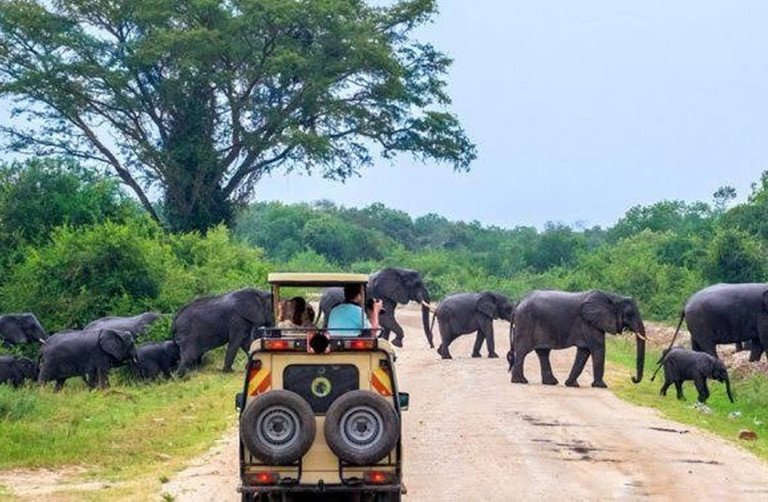
Embrace the absolute pinnacle of East African overland travel on this 19 Days 4x4 Best Jeep Road trip Uganda safari. Tailored specifically for intrepid travelers who value rugged independence and deep wilderness immersion, this comprehensive loop tackles Uganda’s dramatic topography from the seat of a robust 4x4 Land Cruiser. Your journey covers every major ecosystem in the country, from the thunderous cascades of the Nile and the remote, arid savannas of Kidepo Valley to the misty primeval jungles of Kibale and Bwindi. Along the way, the pop-up roof of your safari jeep provides uninterrupted, eye-level views of the Big Five, wild chimpanzees, and endangered mountain gorillas. This route avoids rushed domestic flights, focusing instead on the authentic, evolving beauty of rural landscapes, hidden crater lakes, and vibrant local communities. It is the definitive road trip for a true, unhurried discovery of Africa’s biodiversity.
Tour highlights for 19 Days 4x4 Best Jeep Road trip Uganda safari
Wild rhino tracking
Vast northern savannas
Remote Kidepo wilderness
Enormous buffalo herds
Authentic Karamojong manyatta
Majestic Murchison Falls
Nile delta cruise
Prehistoric shoebill search
Winding rift escarpment
Emerald tea plantations
Wild chimpanzee encounter
Bigodi monkey walk
Emerald crater lakes
Geographic equator crossing
Kazinga channel boat
Tree-climbing lion search
Mountain gorilla trek
Volcanic lake canoe
Guided bush walk
Day by day 19 Days 4x4 Best Jeep Road trip Uganda safari
Day 1: Arrival at Entebbe International Airport & Victoria Lakeside Rest
Your 19-day grand Ugandan overland expedition begins the moment your flight touches down on the shores of Lake Victoria. Your professional driver guide will meet you outside the arrival’s terminal, helping you load your luggage into the spacious 4x4 safari jeep that will serve as your reliable home for the next nineteen days. From the airport, take a short, smooth drive through the quiet, tree-lined streets of Entebbe to check into your boutique hotel. The remainder of the afternoon is dedicated entirely to resting after your long flight, resetting your internal clock, and reviewing the upcoming route map with your guide over a cold beverage. Enjoy a fresh dinner featuring local tilapia fillet or continental classics, followed by an early night to prepare your mind and body for the long road northward tomorrow morning.
Day 2: Scenic Drive North to Ziwa Rhino Sanctuary via the Luwero Triangle
An early breakfast sets the stage for a prompt 6:30 AM departure. Stepping into your jeep, you will navigate out of the metropolitan traffic and onto the smooth northern tarmac highway. The route snakes through the historic Luwero Triangle, a region characterized by vast fruit markets, roadside cassava vendors, and sprawling charcoal-burning homesteads. By mid-morning, pull off the highway into the pristine woodlands of the Ziwa Rhino Sanctuary. After a safety briefing from an expert resident ranger, leave the vehicle behind to track southern white rhinos on foot through the thick bushveld. Watching these prehistoric giants graze just meters away is a profound introduction to Uganda's conservation success. Enjoy lunch at the sanctuary restaurant before completing a short afternoon drive to your lodge near the edge of Masindi town.
Day 3: Journey to the Remote Karamoja Region & Kitgum Outpost
Today your 4x4 jeep proves its true worth as you leave the standard tourist circuits behind and push deep into the rugged, undulating landscapes of Northern Uganda. The paved highway stretches past sprawling cotton fields and traditional mud-and-thatch homesteads as you enter the expansive Acholi sub-region. The driving is smooth but requires a vigilant eye for crossing livestock and vibrant local bicycles laden with fresh produce. Stop in the bustling town of Gulu for a hearty lunch of local matooke and grilled meats, immersing yourself in the energetic atmosphere of the north's commercial hub. In the afternoon, your jeep charts a path further northeast toward Kitgum. Arrive at your comfortable accommodation by late afternoon, giving you time to stretch your legs and enjoy a refreshing sundowner before dinner.
Day 4: Traversing the Wilderness to Kidepo Valley National Park
The drive from Kitgum to Kidepo Valley National Park is arguably one of the most scenic road trips on the continent. As you ascend into the remote Karamoja highlands, the tarmac gives way to rough, corrugated dirt tracks that wind past dramatic granite inselbergs and isolated mountain peaks. Your jeep’s heavy-duty suspension easily tames the uneven terrain as you pass curious Karamojong herders draped in vibrant, checkered shúkà blankets. By midday, you will cross the park boundaries, immediately greeted by vast golden savannas framed by the majestic Morungole mountain range. Check into your safari camp for a fresh lunch and a brief rest. In the late afternoon, embark on your first rugged game drive through the Narus Valley, spotting enormous herds of cape buffalo, elephants, and elegant Rothschild giraffes.
Day 5: Full Day Game Viewing in the Wild Narus & Kidepo Valleys
Wake up to the crisp, cool air of an untouched African wilderness. Today is fully dedicated to exploring the diverse biomes of Kidepo from the elevated vantage point of your jeep's pop-up roof. The morning drive focuses on the wildlife-rich waterholes of the Narus Valley, where predators like lions, leopards, and spotted hyenas often linger in the tall grass waiting for thirsty prey. After a midday rest and lunch at your lodge to escape the midday heat, drive north toward the dry, sandy Kidepo River bed. This arid landscape is home to unique wildlife species not found elsewhere in Uganda, including the graceful lesser kudu, ostriches, and secretary birds. Return to camp as the setting sun paints the rugged mountain backdrops in deep hues of crimson and gold.
Day 6: Authentic Karamojong Cultural Encounter & Wilderness Ridge Drive
Spend your morning engaging with the fascinating human history of this remote frontier. Your jeep carries you to a traditional, fortified Karamojong village known locally as a manyatta. Here, you will enter the intricate labyrinth of thorn bushes and mud structures to meet the elders, watch energetic traditional jump-dances, and learn about their deeply ingrained cattle-keeping culture. This interactive visit offers a powerful, unaltered look at pastoral life in East Africa. Return to the park for lunch and some quiet relaxation. In the afternoon, head back into the savanna for an extended tracking drive along the isolated loop trails. Your expert guide will scan the rocky outcrops for cheetahs and lions resting on the granite kopjes before you return to your wilderness lodge for a starlit dinner.
Day 7: Southern Overland Journey to Murchison Falls National Park
Bid farewell to the isolated northern frontier as your 4x4 jeep begins a long, highly rewarding southbound transit toward the country's largest protected conservation area. The route takes you back through the rugged plains of Karamoja before connecting to the smooth highway leading down into the Albertine Rift Valley. The changing vegetation is striking, transitioning seamlessly from semi-arid shrubs to lush, tropical woodlands. Stop for a picnic lunch along the way to break up the drive. By mid-afternoon, enter the northern gates of Murchison Falls National Park. As you navigate the smooth dirt tracks toward the river, look out for curious families of patas monkeys darting across the road. Arrive at your riverside lodge in time to watch hippos emerge from the water.
Day 8: Delta Game Drive & Classic Boat Safari to the Base of the Falls
The morning begins with an early crossing of the Victoria Nile to explore the fertile game tracks of the northern Buligi circuit. This peninsula is packed with wildlife; within minutes, you can expect to see tower after tower of giraffes, large herds of Jackson's hartebeest, and massive bull elephants feeding beneath palm trees. After a successful three-hour drive, return to the lodge for lunch. At 2:00 PM, board a specialized river boat for a three-hour safari upstream toward the base of Murchison Falls. You will cruise past thousands of snorting hippos, massive Nile crocodiles basking on the banks, and colorful colonies of red-throated bee-eaters. The boat brings you safely within view of the devil's cauldron, where the Nile forces itself through a tiny seven-meter gorge.
Day 9: The Victoria Nile Delta Cruise & Top of the Falls Exploration
This morning features a tranquil boat cruise downstream toward the expansive Lake Albert Delta. This swampy wetland is a paradise for avid birdwatchers, offering one of the highest chances in East Africa to spot the rare, prehistoric shoebill stork hunting in the papyrus beds. The cruise also provides excellent opportunities to see elephants and kobs drinking along the water's edge. Return to dry land for lunch before your guide drives the jeep up the steep Rift Valley escarpment to visit the Top of the Falls. Walking along the cliff edges, you will feel the ground vibrate beneath your feet as the entire river drops forty-three meters into the gorge below. The cool mist rising from the canyon provides a refreshing end to the afternoon.
Day 10: Albertine Rift Escarpment Road Trip to Fort Portal
Today is an epic driving day as your 4x4 jeep tackles the scenic, winding roads running parallel to the Blue Mountains of the Democratic Republic of Congo. The route follows the floor of the Albertine Rift Valley, taking you past the sparkling blue waters of Lake Albert and through bustling fishing villages. Your vehicle will climb steep switchbacks up the escarpment, revealing sweeping panoramic views of the entire valley below. The landscape slowly shifts into endless, rolling green hills blanketed by neat rows of tea plantations as you approach the clean, colonial town of Fort Portal. Stop at a local cafe for lunch before driving the short remaining distance to your forest camp nestled on the boundary of Kibale Forest National Park.
Day 11: Primates of Kibale Forest & Bigodi Wetland Sanctuary Walk
The primeval rainforest of Kibale holds the highest density of primates in Africa, and today you get to meet its most famous residents. Head to the Kanyanchu visitors center for an early morning briefing before venturing under the dense jungle canopy with armed rangers. The forest echoes with bird calls and rustling leaves until a sudden outburst of screaming hoots reveals a community of wild chimpanzees. Spend an unforgettable hour watching our closest relatives groom, play, and leap through the branches above. Return to camp for a hot lunch. In the afternoon, take a short drive to the community-run Bigodi Wetland Sanctuary for a guided boardwalk tour, where you can spot rare birds like the great blue turaco and up to eight other monkey species.
Day 12: Crater Lakes Exploration & Drive to Queen Elizabeth National Park
Start your morning winding through the breathtaking Kasenda Crater Lakes region. The narrow dirt tracks trace the high ridges of ancient volcanic explosions, offering spectacular views of deep, emerald-green lakes ringed by small farms and banana groves. It is a photographer's dream that truly highlights the versatility of your 4x4 vehicle. After this scenic exploration, drive south across the equator line, pausing for a classic photo opportunity, before entering Queen Elizabeth National Park. The flat savanna is framed by the dramatic, jagged peaks of the Rwenzori Mountains in the distance. Check into your safari lodge for a fresh lunch, followed by an evening game drive across the Kasenyi plains to search for lions, leopards, and large herds of unique Uganda kobs.
Day 13: Kasenyi Lion Tracking & Kazinga Channel Boat Launch
Set out before sunrise to join a specialized research team for a lion tracking experience in the Kasenyi sector. Using radio telemetry collars, your guide can locate the resident prides hiding in the thick thickets, offering a fascinating look at predator behavior and conservation science. Return to the lodge for a late breakfast and a few hours of relaxation by the pool. At 3:00 PM, head to the Mweya peninsula to board a public launch cruise along the famous Kazinga Channel. This natural 32-kilometer waterway connects Lake Edward and Lake George, hosting an incredible concentration of hippos, cape buffaloes, and bathing elephants. The birdlife along the muddy banks is spectacular, featuring skimmers, pelicans, and majestic fish eagles.
Day 14: Wilderness Transit to the Remote Ishasha Sector
Pack your bags for a scenic journey to the remote southern sector of the park. The road to Ishasha is a rough, untamed dirt track that cuts through the heart of the Maramagambo forest and open savannas, providing a genuine wilderness driving experience. Keep a sharp eye out for elephants and olive baboons lining the roadside. Arrive at your secluded lodge along the Ishasha River in time for a fresh lunch. In the late afternoon, embark on a dedicated game drive through the iconic fig-tree savannas. Ishasha is famous for its unique population of tree-climbing lions, which spend the hot afternoons draped lazily over the low branches of sycamore fig trees to escape the ground heat and biting insects.
Day 15: Tracking Tree-Climbing Lions & Drive to Bwindi Impenetrable Forest
Spend your morning on a final, thorough search of the Ishasha circuits to locate any lions you might have missed the previous day, while enjoying the sight of elegant topi antelopes grazing in the open plains. Afterward, enjoy an early lunch before turning your jeep toward the steep, mist-covered mountains of Kigezi. The flat savannas quickly disappear, replaced by dramatic, terraced hillsides that cling to the vertical slopes. Your 4x4 jeep will navigate the winding, unpaved mountain roads with ease as you climb higher into the cool alpine air. By late afternoon, you will reach the dense, ancient boundary wall of Bwindi Impenetrable National Park, checking into your rainforest lodge to prepare for tomorrow's monumental mountain trek.
Day 16: Once-in-a-Lifetime Mountain Gorilla Trekking in Bwindi
This is the undisputed crown jewel of your African road trip. Put on your heavy hiking boots and pack a lunch before gathering at the park headquarters for a critical safety briefing. Divided into small groups of eight, you will plunge into the steep, tangled undergrowth of the ancient rainforest under the guidance of expert trackers and machete-wielding rangers. The trek can take anywhere from two to seven hours as you navigate slippery mud slopes and thick vines. However, all physical exhaustion vanishes the moment you step into a clearing and find yourself standing meters away from a family of wild mountain gorillas. Spend one quiet hour watching the silverback watch over his playing infants before returning to the lodge for celebration.
Day 17: Scenic Mountain Drive to the Volcanic Lake Mutanda
Leaving the thick forest of Bwindi behind, your jeep embarks on a highly dramatic mountain drive heading further south toward the border town of Kisoro. The road hugs the edges of deep valleys, providing panoramic views of the towering Virunga Volcanoes lined up along the horizon. Arrive by lunchtime at a beautiful resort resting right on the shores of the tranquil, freshwater Lake Mutanda. In the afternoon, step into a traditional wooden dugout canoe for a peaceful cruise across the glassy water, visiting historic islands and learning about local island folklore from your resident guide. The lake is completely free of bilharzia, hippos, and crocodiles, making it a perfectly serene place to unwind after your strenuous jungle trek.
Day 18: Journey to Lake Mburo National Park via the Igongo Cultural Center
Start your morning with a smooth drive out of the volcanic highlands, descending into the rolling pastoral valleys of Mbarara. The dirt roads give way to smooth tarmac as you cruise past vast banana plantations and herds of iconic long-horned Ankole cattle. Stop at the famous Igongo Cultural Center for a traditional lunch and a brief tour of their museum, which showcases the rich heritage of the western kingdoms. In the afternoon, complete the short remaining drive to Lake Mburo National Park, Uganda’s smallest savanna reserve. Check into your rocky ridge lodge and enjoy a late afternoon game drive. Here, your jeep will bring you face-to-face with vast herds of zebras, impalas, and elegant eland antelopes grazing under acacia trees.
Day 19: Early Morning Guided Bush Walk & Return Journey to Entebbe
Your final day begins with an intimate, on-foot guided bush walk accompanied by an armed park ranger. Walking through the savanna allows you to appreciate the smaller details of the ecosystem, from tracking animal footprints in the morning dew to standing safely just meters away from grazing zebras and bushbucks. Return to the lodge for a hearty breakfast before packing your bags into the jeep for the final leg of your road trip back to Entebbe. Stop at the Kayabwe Equator crossing for a fun water experiment and some last-minute souvenir shopping. Arrive at Entebbe International Airport by late afternoon, marking the official end of your epic nineteen-day Zimbabwean-built 4x4 overland adventure through the Pearl of Africa.
What specific model of 4x4 Land Cruiser is provided, and what custom modifications does it feature?
The backbone of this nineteen-day overland expedition is a custom-built, heavy-duty Toyota Land Cruiser, specifically from the robust Hardtop 70 Series (typically the HZJ76 or extended HZJ78 models). These vehicles are globally recognized as the gold standard for rugged African overlanding due to their mechanical simplicity and extreme durability. Unlike standard consumer sports utility vehicles, these commercial-grade fleet units feature full-time four-wheel-drive capabilities, a manual transfer case with selectable low-range gearing, and high ground clearance necessary to clear deep ruts and exposed boulders. The suspension system is completely overhauled with heavy-duty leaf springs and upgraded shock absorbers to tame corrugated washboards while carrying heavy loads.
The most critical customization for wildlife viewing is the full-length mechanical pop-up roof. This roof hatches upward on gas struts, allowing all passengers to stand simultaneously for unobstructed, 360-degree photography at eye level with savanna predators without stepping outside the vehicle's protection. Inside, the cabin is modified to replace standard bench seats with individual, ergonomic safari seats equipped with customized seatbelts and electronic charging panels. These panels feature universal AC electrical sockets and dual USB ports running off an auxiliary dual-battery system, ensuring your cameras, drones, and phones stay powered during remote bush camping. Furthermore, the vehicle carries essential recovery gear hidden in integrated side brackets, including dual spare tires, a high-lift farm jack, durable sand ladders, a heavy tow strap, and a fully stocked mechanical toolkit.
What are the typical road conditions on this loop, and how much total driving time is expected?
Uganda’s transport infrastructure has advanced significantly, yet a nineteen-day loop covering both extreme geographical corners exposes travelers to a wide spectrum of driving surfaces. Approximately 60% of this specific itinerary utilizes smooth, newly laid asphalt highways. Major arterial routes—such as the journey from Kampala to Gulu, the southern descent from Fort Portal to Queen Elizabeth National Park, and the final return leg from Mbarara to Entebbe—are fully paved, allowing for efficient cruising speeds. However, the remaining 40% of the route consists of unpaved surfaces, ranging from graded gravel park roads to rough, challenging dirt tracks that require skilled navigation.
The most demanding road sectors occur in the far north and the extreme southwest. The tracks leading into Kidepo Valley are notoriously corrugated, causing intense vibrations that require a slow, deliberate pace. In Bwindi Impenetrable Forest and the surrounding Kigezi highlands, the roads are unpaved, narrow shelf tracks cut directly into volcanic slopes. During seasonal downpours, these clay-heavy tracks quickly transform into incredibly slick, greasy surfaces where activated four-wheel-drive low range is mandatory to prevent sliding. Over the nineteen days, you will cover roughly 2,200 kilometers. Average daily driving windows fluctuate drastically; some transit days, like Day 7 or Day 10, demand five to seven hours of active travel including scenery stops, while park days involve shorter, low-speed game drives spanning two to four hours.
How do the chimpanzee tracking permits in Kibale differ logistically from gorilla tracking permits in Bwindi?
While both excursions offer profound primate encounters, they operate under distinct logistical frameworks, age caps, and field rules managed by the Uganda Wildlife Authority. Gorilla trekking permits in Bwindi Impenetrable National Park cost $800 per person for foreign non-residents. Given the massive global demand and strict limit of eight tourists per habituated gorilla family per day, these permits must be secured six to twelve months in advance. The minimum age limit is strictly enforced at fifteen years. The tracking process in Bwindi is highly physical and unscripted; it begins at 8:00 AM from one of four distant sectors (Buhoma, Ruhija, Rushaga, or Nkuringo), and rangers use machetes to clear paths through tangled vines on vertical mountain slopes until the family is found.
Chimpanzee tracking permits in Kibale Forest National Park cost $250 per person for foreign non-residents. Kibale operates on a double-session schedule daily, offering a morning excursion starting at 8:00 AM and an afternoon trek starting at 2:00 AM. Logistically, chimpanzee tracking is generally faster and less physically exhausting because the terrain in Kibale is relatively flat with well-maintained, clear walking trails. However, the animal behavior is entirely different. Gorillas are cohesive, ground-dwelling vegetarians that remain stationary during your one-hour visit. Chimpanzees are highly volatile, vocal, tree-dwelling omnivores. They move rapidly through the high canopy, meaning your group will often need to jog through the forest to keep up with their vocalizations as they hunt or patrol territory boundaries.
What are the seasonal weather variations across the regions covered in this 19-day itinerary?
Executing a comprehensive countrywide loop means navigating distinct microclimates, as Uganda’s weather is shaped by the equator, large lakes, and high-altitude mountain ranges. The country experiences two dry seasons and two wet seasons annually. The primary dry window spans from June to August, transitioning into a secondary dry phase from December to February. These months represent the peak safari window; vegetation thins out significantly, and wildlife clusters tightly around remaining permanent water holes in Kidepo, Murchison, and Queen Elizabeth, making game tracking highly productive. Dirt roads remain firm, minimizing driving delays.
Conversely, the heavy rainy seasons occur from March to May and again from September to November. Traveling during these months brings a different set of rewards and challenges. The landscapes transform into a brilliant, lush emerald green, air clarity is exceptional for landscape photography, and migratory bird species arrive in thousands along the Nile and Kazinga Channel. Furthermore, primate tracking can be highly advantageous during the rains, as chimpanzees and gorillas find abundant fruit on the lower slopes, often shortening your trekking distance. However, downpours can be sudden and torrential, temporarily wash out dirt bridges, and turn mountain roads into thick mud. Temperatures also vary by altitude; while the northern plains of Kidepo can reach hot daytime highs of 34°C (93°F), the misty mountain ridges of Bwindi regularly drop to a chilly 10°C (50°F) at night, requiring versatile layering.
What kind of lodging standards are utilized, and can a budget-friendly guest house option be maintained throughout?
Maintaining a comfortable, mid-range or budget-friendly lodging profile across this entire 19-day route is entirely feasible, but the style of accommodation shifts based on the remote nature of each location. In established tourism hubs like Fort Portal, Queen Elizabeth, and Entebbe, travelers enjoy a wide selection of community-run guest houses, eco-lodges, and cozy bed-and-breakfasts. Properties in these sectors feature private en-suite bathrooms, persistent solar electricity, charging stations, and full-service restaurants providing fresh, locally sourced international dishes.
In highly remote conservation sectors like Kidepo Valley or the Ishasha wilderness, the accommodation style transitions to permanent, heavy-duty safari tents or rustic wooden bandas built on elevated platforms. These wilderness camps focus heavily on eco-friendly sustainability. Electricity is typically driven by solar panel arrays that charge a central bank, meaning power might be turned off in the late evening, and high-powered devices like hair dryers are banned. Hot water is frequently provided via traditional "bush showers," where staff fill an insulated overhead canvas bag with heated water upon your request. Despite the simple, rustic architecture, these properties maintain excellent hospitality standards, providing clean linens, mosquito netting over beds, and wholesome, multi-course dinners served under the stars around a central campfire.
What specific medical precautions, vaccinations, and physical fitness goals are recommended?
Preparing for an extended overland road trip through equatorial Africa requires proactive health management. The single most important regulatory medical requirement is the Yellow Fever vaccination. You must present an official, valid International Certificate of Vaccination (Yellow Card) at Entebbe airport border control upon arrival; failure to produce this document will result in denied entry or mandatory on-site vaccination. Additionally, because this itinerary covers several low-altitude savanna zones and wetlands, malaria is endemic throughout the entire route. Travelers must consult a travel clinic to obtain a prescription for preventative malaria prophylactics (such as Atovaquone/Proguanil or Doxycycline) and use insect repellent containing high concentrations of DEET.
Physical fitness preparation must be tailored to the demands of the primate treks. Gorilla trekking in Bwindi is physically taxing; you must be capable of walking continuously for three to seven hours over uneven, slick terrain without modern pathways. To prepare, dedicate the weeks prior to departure to aerobic conditioning, core stability work, and practice walking on steep inclines while wearing your heavy hiking boots. It is also wise to pack a comprehensive personal first-aid kit containing broad-spectrum antibiotics, rehydration salts, anti-diarrheal medication, antihistamines, and blister moleskin. Rest assured, the vehicle always carries emergency medical supplies, and local porters are readily available at park trailheads to assist with physical balance during the hikes.
How are meals and clean drinking water managed during long driving days in remote zones?
Dietary logistics are carefully structured to prevent dehydration and gastrointestinal issues while traveling through remote interior regions. The safari jeep is equipped with a large, integrated mechanical car fridge or a heavily insulated ice chest that is restocked daily with chilled bottles of purified, UV-treated drinking water. Travelers are strictly advised to avoid drinking unboiled tap water at any point; purified bottled water is provided completely free of charge in the vehicle and at all lodges for drinking and brushing teeth.
On major transit days, meals are organized using a hybrid approach. For long drives through areas lacking established restaurants—such as the journey into Kidepo Valley—lodges provide packed safari lunchboxes. These boxes contain roasted chicken, fresh sandwiches, hard-boiled eggs, local fruits, and juice boxes, allowing for scenic picnic lunches at designated park viewpoints. When driving through regional commercial towns like Gulu, Masindi, or Mbarara, your guide will take you to vetted local restaurants to sample authentic Ugandan cuisine, such as matooke (steamed green bananas), posho, and tender beef stew. Lodges and restaurants are highly adaptable to specific dietary preferences; vegan, vegetarian, gluten-free, and lactose-free diets can easily be accommodated if communicated to the operational team prior to your arrival.
What is the process for cultural interactions, and how do we ensure visits are ethical?
A primary focus of this nineteen-day road trip is providing authentic, respectful windows into the diverse cultures of Uganda, from the nomadic pastoralists of the north to the ancient forest keepers of the southwest. To ensure these encounters remain ethical and avoid creating a transactional environment, all community visits are coordinated directly through registered community-based tourism associations. A prominent example is the visit to the Karamojong manyatta near Kidepo or the Batwa trail experience near Bwindi. These initiatives are entirely owned and operated by the communities themselves, ensuring that permit fees are channeled directly into local development funds, schooling, and clean water wells.
When entering these traditional spaces, your professional guide acts as a cultural bridge to explain local etiquette. Travelers should always ask for explicit permission before taking portraits of individuals, particularly children or village elders. Dress codes should remain modest; when visiting local communities or markets, it is respectful to wear trousers or skirts that cover the knees, and shirts that cover the shoulders. Rather than distributing cash or loose candies directly to children along the roadside—which inadvertently encourages begging and truancy—travelers wishing to make a tangible impact are guided to donate textbooks, pens, or medical supplies directly to village schoolmasters or local health clinics during scheduled stops
What are the specific safety protocols regarding wildlife encounters and vehicle security?
Safety is treated with absolute priority throughout this cross-country loop. When exploring savanna parks like Murchison Falls, Queen Elizabeth, and Kidepo, you are entering unfenced wilderness zones where wild animals hold absolute right-of-way. While viewing wildlife from the 4x4 Land Cruiser, passengers must remain inside the vehicle chassis at all times. Sitting on the roof or hanging far out of the windows is strictly prohibited. Animals are habituated to the specific shape of the safari jeep, but a human silhouette breaking that shape can trigger a defensive flight-or-fight response from large megafauna like elephants or lions.
On foot excursions—including white rhino tracking at Ziwa, chimpanzee tracking in Kibale, gorilla trekking in Bwindi, and the morning bush walk in Lake Mburo—you are accompanied by armed, highly trained park rangers from the Uganda Wildlife Authority. These rangers monitor animal body language constantly and maintain strict safety perimeters. Regarding general vehicle and property security, Uganda is widely recognized as one of the safest, most welcoming destinations for international travelers in Africa. The safari jeep features integrated central locking mechanisms, and your driver-guide stays with the vehicle at all public stops. Lodges feature 24-hour security guards, and rooms are equipped with secure lockers or lockable bags to store passports, travel documents, and valuable camera gear safely.
How do tipping customs work in Uganda, and what currency should I use for personal expenses?
Tipping is an integral, highly appreciated custom within Uganda’s tourism economy, acting as a direct way to reward exceptional service and support local families. Tips are always voluntary and should reflect the quality of care received. As a general operational benchmark, your professional safari driver-guide is typically tipped between $10 and $15 per day from the group. For tracking activities, the park rangers and guides are generally tipped $10 to $20 per group per activity. When staying at safari lodges, a central tipping box is usually located at the reception desk; contributing $5 to $10 per day into this box rewards the behind-the-scenes staff, including chefs, room stewards, and security guards.
Regarding currency mechanics, the official currency is the Ugandan Shilling (UGX). It is highly practical to exchange a small amount of foreign currency into shillings upon arrival in Entebbe to cover minor personal expenses, such as buying fresh roadside fruit, purchasing handmade crafts, or buying local beers at bars. For major transactions, United States Dollars (USD) are universally accepted across all national parks and lodges. However, a critical banking rule applies: US dollar banknotes printed prior to the year 2021 are widely rejected by local banks and forex bureaus due to past counterfeiting vulnerabilities. Ensure all your cash bills are crisp, unblemished, free of tears or ink stamps, and printed from recent series years to guarantee seamless acceptance.
Booking 19 Days 4x4 Best Jeep Road trip Uganda safari with us Roads of Adventure safaris
Booking a 19-day 4x4 Jeep safari with Roads of Adventure Safaris is an excellent way to explore Uganda. You'll experience immersive gorilla trekking in Bwindi, chimpanzee tracking in Kibale, and game drives in Kidepo Valley and Murchison Falls
