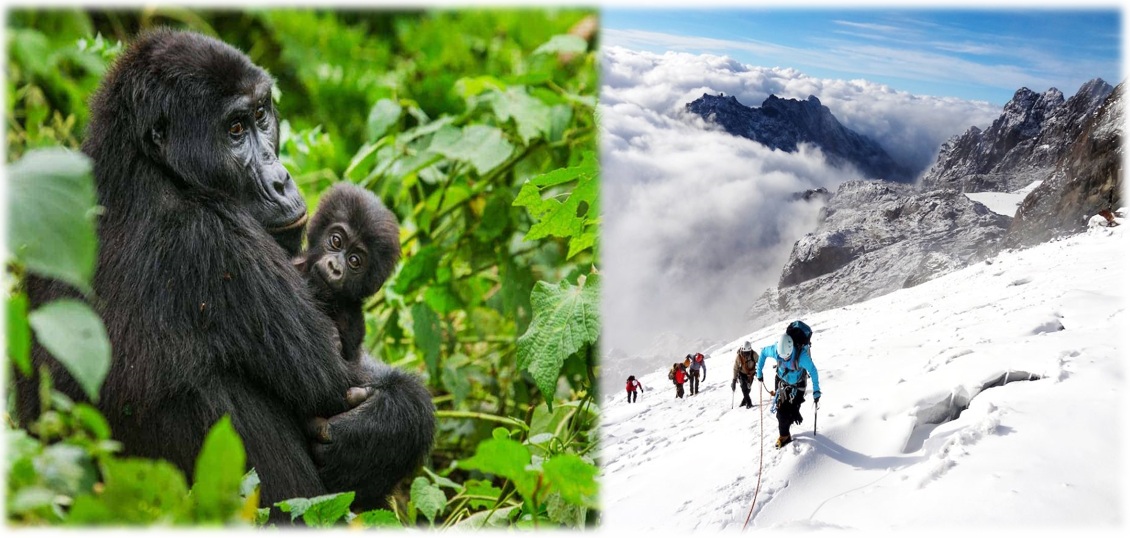
Embark on the ultimate Ugandan adventure, seamlessly combining epic high-altitude mountaineering with legendary safari wildlife. Start your journey in the lush forests of Kibale, home to wild chimpanzees, before tracking game across the savanna and cruising the Kazinga Channel in Queen Elizabeth National Park. The core of your expedition takes you high into the mist-shrouded Rwenzori Range—the legendary Rwenzori ("Mountains of the Moon")—to conquer the technical ice and rock of Margherita Peak (5,109m). Finally, wind down your epic journey in the primal jungle of Bwindi Impenetrable Forest, coming face-to-face with endangered mountain gorillas. Blending world-class trekking, rich culture, and raw African wilderness, this carefully crafted 16-day circuit offers the trip of a lifetime for true adventure seekers.
Day 1: Arrival in Entebbe
Touch down at Entebbe International Airport (EBB), beautifully set along the shores of Lake Victoria (Nnalubaale). After clearing customs and collecting your luggage, meet your local guide for a short 10 to 15-minute transfer covering roughly 6 km to your quiet hotel in Entebbe town (1,150m). Unwind from your long flight, enjoy a cold local drink, and rest up ahead of tomorrow's journey into the western wilds of Uganda.
Day 2: Entebbe to Kibale National Park
Depart Entebbe early in the morning for a scenic 310 km drive heading west toward Fort Portal, taking roughly 5 to 6 hours. You will pass through lush green countryside, vibrant trading centers, and sprawling tea estates owned by the Tooro Kingdom. Arrive at Kibale National Park (1,590m) by late afternoon, check into your rainforest lodge, and relax while soaking in the peaceful sounds of the surrounding canopy.
Day 3: Chimpanzee Tracking & Bigodi Sanctuary
Head into Kibale Forest after an early morning safety briefing at the Kanyanchu visitor centre (1,590m). Accompanied by experienced Uganda Wildlife Authority (UWA) rangers, spend 3 to 4 hours tracking habituated wild chimpanzees over 5 to 8 km of forest trails. In the afternoon, take a relaxed 4 km walk through the Bigodi Wetland Sanctuary to spot red colobus monkeys, sitatungas, and the majestic Great Blue Turaco.
Day 4: Kibale to Queen Elizabeth National Park
Enjoy a relaxed breakfast before embarking on a scenic 120 km drive south toward Queen Elizabeth National Park (910m), taking about 2.5 to 3 hours. Your route passes dramatic volcanic crater lakes before entering the famous Kasenyi Plains sector. In the late afternoon, set off on a 30 km game drive across the golden savanna to search for Ugandan kob, giant cape buffaloes, elephants, and resident lion prides.
Day 5: Kazinga Channel & Transfer to Kasese
Board a midday boat safari along the 32 km Kazinga Channel, a natural waterway connecting Lake George and Lake Edward (910m). Spend two hours floating past some of Africa's highest concentrations of hippos, along with bathing elephants, Nile crocodiles, and abundant waterbirds. Afterward, take a short 45 km drive taking just under an hour to Kasese town (1,200m) to meet your mountain support team and inspect gear for the Rwenzoris.
Day 6: Trek 1 – Nyakalengeji / Kilembe Gate to Sine Camp
Begin your expedition at the Kilembe trailhead gate (1,450m) for park clearance and porter assignments. Hike 9.5 km over 5 to 6 hours through the dense Afro-montane forest belt, climbing alongside the rushing, glacier-fed Nyamwamba River. Keep an eye out for blue monkeys and colorful Rwenzori turacos in the canopy before arriving at Sine Camp (2,596m), tucked near the roaring Enock’s Falls for a net elevation gain of +1,146m.
Day 7: Trek 2 – Sine Camp to Mutinda Camp
Ascend steeply out of the forest canopy and enter the dense bamboo belt, crossing into a magical world of giant heather trees draped in old-man's beard moss. Today's 6.1 km climb takes 4 to 5 hours up steep ridge steps to reach Mutinda Camp (3,588m), gaining +992m. If you are feeling strong in the late afternoon, tackle an optional high-altitude scramble up to the Mutinda Lookout (3,975m) for incredible panoramic views over the Kasese valley.
Day 8: Trek 3 – Mutinda Camp to Bugata Camp
Trek across alpine bogs filled with exotic giant groundsels (Senecio) and towering lobelias. Today's 6.7 km route takes 5 to 6 hours as you navigate the scenic Mutinda Valley, climbing over Namusangi Ridge (3,840m) before dropping into the Bugata Valley. You will camp near Lake Bugata (4,062m) surrounded by dramatic glacial tarns and jagged rock walls, having gained +474m for the day.
Day 9: Trek 4 – Bugata Camp to Hunwick's Camp
Climb sharply up and over the dramatic Bamwanjara Pass (4,450m), which rewards you with breathtaking views of Mount Stanley’s snow-capped peaks on clear mornings. Descend carefully down loose scree slopes past the historic Bujongolo rock shelter, crossing the deep glacial valley of Kitandara before a final climb to Hunwick’s Camp (3,974m). Today's technical 6.2 km traverse takes roughly 5 to 7 hours with a net loss of -88m.
Day 10: Trek 5 – Hunwick’s Camp to Margherita Camp
Navigate up the valley floor over steep, polished rock slabs to reach the iconic Scott Elliot Pass (4,334m). From here, continue ascending along the rugged edge of the lower Elena Glacier toward Margherita Camp (4,485m), which sits precariously on high rock ledges directly beneath the massive Stanley Icefall. Today's 4.2 km push takes 4 to 5 hours (+511m gain), allowing time to fit crampons, harnesses, and ropes for summit day.
Day 11: Trek 6 – SUMMIT DAY: Margherita Peak to Hunwick's Camp
Wake up at 2:00 AM for a starlight push across the frozen landscape. Strap on crampons and rope up to traverse the Stanley Glacier before tackling the steep, fixed-line ice wall leading to Margherita Peak (5,109m)—the roof of Uganda. After celebrating on the summit, carefully descend back past Margherita Camp to Hunwick’s Camp (3,974m), completing an intense 11.5 km round-trip over 10 to 12 grueling hours.
Day 12: Trek 7 – Hunwick’s Camp to Kihanga Camp
Begin your long descent through the lush, misty landscapes of Oliver's Pass (4,500m), following the cascading Nyamwamba River valley downwards. Enjoy the rapid return of thicker oxygen as you pass stunning moss-draped cloud forests and isolated alpine tarns. Today's 11 km trek takes roughly 6 to 7 hours, dropping a total of -1,574m in altitude to reach your final wilderness sanctuary at Kihanga Camp (2,400m).
Day 13: Trek 8 – Kihanga Camp to Kilembe Gate & Kasese
Finish your mountain descent with a 9 km hike taking about 4 hours back down through the lush lower rainforest canopy to the Kilembe base gate (1,450m). Say goodbye to your dedicated mountain guides and porters, receive your official climb completion certificate, and take a quick 15 km drive to your hotel in Kasese town (1,200m) for a long-awaited warm shower, cold meal, and comfortable bed.
Part 3: Bwindi Gorillas & Return Journey
Day 14: Kasese to Bwindi (Ishasha Sector)
Depart Kasese on a 210 km drive heading south toward Bwindi Impenetrable Forest, taking roughly 5 to 6 hours depending on road conditions. En route, make a safari game drive through the famous Ishasha sector of Queen Elizabeth National Park to look for rare tree-climbing lions lounging in large fig trees. Arrive at your lodge in Bwindi (1,500m–2,100m) in the late afternoon to prepare for gorilla trekking.
Day 15: Mountain Gorilla Trekking in Bwindi
Gather at the UWA park station early in the morning for a safety briefing and group assignment. Led by expert trackers and armed rangers, trek 3 to 10 km over 2 to 6 hours through Bwindi's dense, tangled jungle vegetation at elevations between 1,400m and 2,200m. Once located, spend one unforgettable hour quietly observing a family of wild mountain gorillas up close before returning to the lodge for a celebratory evening.
Day 16: Bwindi to Entebbe Airport
Set off from Bwindi on a 460 km return journey to Entebbe, taking about 8 to 9 hours by road. You will pause at the Equator line in Kayabwe for lunch, photos, and souvenir shopping before arriving at Entebbe International Airport (EBB) for your late-night flight home. Alternatively, you can take a 1-hour domestic scheduled flight from the nearby Kihihi or Kisoro airstrips directly to Entebbe.
How physically demanding is the Rwenzori climb compared to Kilimanjaro?
While Kilimanjaro is higher, the Rwenzori Trek is widely considered much more physically demanding and technically challenging. Kilimanjaro is essentially a very high-altitude highway walk along well-trodden trails. In contrast, the Rwenzoris demand navigating steep, muddy terrain, slippery moss-covered roots, boggy river crossings, and exposed rock scrambles. Once you push past Margherita Camp toward the summit, you are executing a genuine alpine ascent involving crampons, ice axes, fixed ropes, and glacier navigation. Additionally, the weather in the "Mountains of the Moon" is notoriously wet and unpredictable, meaning you will often be hiking in cold, damp conditions that drain your energy reserves faster. Building solid cardiovascular endurance through long hikes with a weighted backpack, leg-strengthening gym work, and mental resilience for challenging weather conditions is essential. You do not need to be an elite mountaineer, but arriving in peak physical shape will make the experience far safer and infinitely more enjoyable.
What gear do I need for Margherita Peak versus the savanna safaris?
Packing for this expedition requires preparing for two completely different environments: tropical heat and frozen alpine heights. For the safari and gorilla trekking portions, light, breathable clothes in neutral colors (khakis, tans, greens) are ideal, alongside stout hiking boots, lightweight long trousers, and high-concentration insect repellent. Once you transition to the Rwenzoris, your wardrobe must shift dramatically toward high-performance technical gear. You will need a three-layer system: moisture-wicking thermal base layers, an insulating mid-layer like fleece or down, and a fully waterproof, windproof outer shell. Mountaineering gear—including harness, crampons, ice axe, helmet, and heavy-duty insulated waterproof gloves—can be rented at the Kilembe trailhead, but bringing your own broken-in alpine boots, high-quality gaiters, and rated sleeping bag (-10°C) is strongly advised.
How do I prepare for altitude sickness during the Rwenzori ascent?
High-altitude sickness is a real risk when ascending above 3,000 meters, and Margherita Peak sits at a formidable 5,109 meters. The key to successful acclimatization on this route is the gradual profile of the Kilembe Trail, which ascends across several days with reasonable elevation jumps. To minimize risk, adopt the mountain rule of pole pole—swahili for "slowly, slowly"—keeping your heart rate down even on gentle inclines. Drink at least 4 to 5 liters of fluid daily; dehydration accelerates altitude symptoms dramatically. Many trekkers carry Diamox (acetazolamide) after consulting a travel physician. Listen closely to your body; mild headaches can often be managed with hydration and rest, but persistent nausea, severe dizziness, or confusion are red flags. Your guides carry emergency oxygen and are trained to monitor your oxygen saturation levels daily.
What can I expect during the mountain gorilla trekking experience in Bwindi?
Gorilla trekking in Bwindi Impenetrable Forest is a deeply emotional, bucket-list experience, but it requires some physical preparation. The day begins around 7:30 AM with a briefing by UWA rangers, where you are assigned to a specific habituated gorilla family based on fitness levels. The trek through the jungle can take anywhere from 45 minutes to 6 hours depending on where the family moved overnight. You will hack through dense vines, cross muddy slopes, and push through thick brush. Once the rangers spot the family, the clock starts: you get exactly one magical hour to sit quietly, observe, and photograph them from a safe distance of 7 to 10 meters. Watching silverbacks interact with playful infants in their natural habitat is utterly mesmerizing and makes every step of the challenging jungle trek worth it.
How safe is traveling through Uganda for international tourists?
Uganda is generally a very safe, warm, and welcoming destination for international travelers, with tourism serving as a major pillar of the national economy. The safari sectors like Kibale, Queen Elizabeth, and Bwindi are heavily protected by dedicated Wildlife Authority rangers and Tourism Police. In urban hubs like Entebbe and Kasese, standard common-sense travel precautions apply: avoid displaying valuable jewelry, keep personal electronics secured, and refrain from walking alone late at night in unlit areas. When trekking in national parks, always follow the safety instructions of your licensed guides and armed rangers, who understand animal behavior and terrain safety inside and out. Water safety is also simple: drink bottled or purified water throughout your trip. Ugandans are famously friendly and hospitable, so you can expect warm smiles and helpful guidance wherever you go.
What is the best time of year to undertake this 16-day itinerary?
Timing is everything for an itinerary that combines technical mountaineering with wildlife viewing. The optimal windows for this specific expedition fall during Uganda's two primary dry seasons: from December through February, and from June through September. During these dry months, trail conditions in the Rwenzoris are less boggy, mountain passes are clearer, and the glaciers offer safer traction for the summit push. Lower rainfall in Queen Elizabeth National Park draws wildlife to riverbanks and waterholes, making game viewing and the Kazinga Channel boat cruise spectacular. In Bwindi, dryer ground makes forest trails far less slippery during gorilla tracking. While it is technically possible to travel during the wetter months of April, May, October, and November, the Rwenzori trails become extremely muddy and taxing, making summit attempts significantly more difficult.
How does tipping work for porters, guides, and safari drivers in Uganda?
Tipping is customary in Uganda’s tourism industry and serves as a vital source of income for local mountain communities and park staff. For your safari driver-guide across the 16 days, budgeting $15–$20 USD per day from your group is a generous standard. During the Rwenzori expedition, tipping is arranged through a tipping pool system at the gate upon completion; budget around $15–$20 USD per day for lead mountain guides, $10–$15 per day for assistant guides and cooks, and $8–$10 per day for each porter. For gorilla and chimpanzee tracking, tipping the UWA ranger guide ($10–$15 per tracker) and hiring a local porter at the Bwindi trailhead ($20 base fee plus a $5–$10 tip) is highly recommended, as it directly supports local families.
What are the accommodations like along the trail and during safaris?
Accommodations on this trip transition smoothly between comfortable safari lodges and rugged mountain camps. During the safari phases in Entebbe, Kibale, Queen Elizabeth, and Bwindi, you will stay in mid-range to luxury eco-lodges offering private en-suite bathrooms, hot showers, plush bedding, and delicious local and international cuisine. Once you enter the Rwenzori Mountains, accommodation shifts to wooden wilderness huts and insulated mountain camps maintained along the Kilembe trail. These camps provide bunk beds or basic sleeping platforms, dry shelter from wind and rain, and eco-friendly pit latrines. Your mountain crew includes experienced camp cooks who prepare surprisingly warm, hearty, carbohydrate-rich meals—such as soups, pasta, rice, and fresh fruit—to keep your energy high throughout the high-altitude trek.
Do I need specialized visas and vaccinations before flying to Uganda?
Yes, international travelers need to complete a few administrative and health requirements before arrival. You must obtain an e-Visa online via the official Ugandan immigration portal prior to boarding your flight, as visas on arrival are no longer issued at Entebbe International Airport. A valid Yellow Fever vaccination certificate is mandatory for entry into Uganda and will be inspected at border control. Additionally, taking prescription malaria prophylaxis (such as Malarone or Doxycycline) is strongly advised for the safari portions, as Queen Elizabeth and Kibale lie in low-altitude mosquito zones. Ensure your routine vaccinations (Tetanus, Hepatitis A/B, Typhoid) are up to date, and consider purchasing comprehensive travel insurance that explicitly covers high-altitude mountaineering up to 5,500 meters and emergency medical evacuation.
Why is hiring a local porter so important in Bwindi and the Rwenzoris?
Hiring local porters is one of the most direct, impactful ways you can contribute to local community conservation while dramatically improving your own trekking experience. In the Rwenzoris, porters carry your heavy duffel bags, cooking gear, tents, and safety supplies up thousands of meters of steep terrain. In Bwindi, hiring a local porter for $20 to carry your daypack allows you to walk freely and navigate steep jungle slopes with ease. More importantly, many porters are former poachers or local youths from villages bordering the national parks; gaining direct income from tourism incentivizes local communities to protect wildlife and rainforest habitats rather than exploit them. Their infectious positivity, incredible strength, and deep knowledge of the land will quickly make them your favorite part of the expedition.
Booking Mountain Rwenzori hike and Uganda safari with us Roads of Adventure safaris
Booking with Roads of Adventure Safaris turns your dream Ugandan expedition into a effortlessly guided reality. Whether you want to conquer the snow-capped heights of Margherita Peak (5,109m) via the technical Kilembe Trail or traditional Central Circuit, or simply enjoy a multi-day low-altitude hike, we seamlessly pair your trek with thrilling wildlife safaris. From spotting tree-climbing lions along the Kazinga Channel in Queen Elizabeth National Park to tracking chimpanzees in Kibale and gorillas in Bwindi, crafting your journey is simple: just pick your favorite extensions, send us your dates and group size, and let our team handle everything from luxury or budget lodge arrangements to securing those essential park and primate permits early.
