Scheduling the intense mountain hike first, then recovering in Jinja. Secure a combined package like those offered by Roads Of Adventure Safaris to handle the 7-to-8-hour logistical transfer between Kasese and Jinja.
Mountain Rwenzori Hike Tips
Here is a detailed, practical breakdown of each tip to help you successfully navigate the unique challenges of trekking the Rwenzori Mountains.
Pace Yourself (Pole Pole)
Acclimatization in the Rwenzoris relies heavily on controlling your speed from the moment you leave the trailhead at Nyakalengija. The local Swahili phrase pole pole—meaning "slowly, slowly"—is the ultimate rule on this mountain range. As you cross the 3,000-meter mark near John Matte Hut, the air thins noticeably, decreasing oxygen availability with every step up the valley. Pushing too hard early on burns through vital energy reserves and drastically increases your risk of Acute Mountain Sickness (AMS), which can trigger severe headaches, debilitating nausea, and early evacuation.
To help your body adapt, maintain a slow, rhythmic pace where you can easily hold a conversation without gasping for breath. Hydration plays an equally critical role in preventing altitude illness. Cold mountain air and heavy exertion accelerate fluid loss through breathing, often without you feeling sweaty. You need to consciously drink between three and four liters of water every single day. Carry a insulated water bottle or a hydration bladder, and treat all water collected from mountain streams using purification tablets or boiling. Eating carbohydrate-rich meals provided by your camp crew—even when high altitude dampens your appetite—fuels your blood with the glucose needed to process oxygen efficiently. If you start noticing early symptoms of altitude sickness, inform your lead guide immediately rather than pushing through the pain.
Layer Clothing Effectively
The microclimates of the Rwenzori Mountains vary dramatically as you ascend, shifting from warm, humid rainforests at the base to sub-zero alpine environments near the summit peaks. Achieving comfort and staying safe requires a dynamic layering strategy rather than relying on one bulky jacket. Your base layer must consist of synthetic or merino wool fabrics that actively pull sweat away from your skin. Avoid cotton entirely; once cotton gets wet from sweat or rain, it stays cold and drastically increases your risk of hypothermia in freezing winds.
Above your base layer, add an insulating mid-layer such as a heavy grid fleece or a lightweight down sweater to trap body heat. Your outer shell should feature a fully waterproof, windproof membrane like Gore-Tex to block the frequent, relentless rains characteristic of the Albertine Rift. Once you reach high-altitude overnight huts like Bujuku (3,962 meters) or Kitandara (4,023 meters), temperatures drop rapidly after sunset, frequently dipping below freezing. Inside the unheated wooden huts, a sub-zero rated sleeping bag (comfort level rated to at least -10°C or 14°F) is absolutely essential for a good night's rest. Pair your sleeping bag with a high-R-value insulated sleeping pad, thermal thermal sleepwear, a warm beanie, and thick wool socks to ensure your core temperature remains stable throughout the night.
Bring High-Quality Gaiters
The Rwenzori range is internationally famous among mountaineers for its extensive, deep mud fields and spongy alpine bogs. Regions like the Bigo Bogs feature vast stretches of saturated peat moss, tussocks, and deep mud channels that can easily swallow a leg up to the knee. Standard hiking boots alone are simply not enough to keep your feet dry when navigating this terrain, as mud and cold water will inevitably spill over the tops of your footwear within the first few hours of trekking.
Investing in a pair of heavy-duty, knee-high waterproof gaiters changes everything. Quality gaiters wrap securely around your calf and fasten tightly under the arch of your boot, creating an impenetrable seal against deep liquid mud, cold water, and abrasive scrub brush. They keep your socks bone-dry, prevent small pebbles and debris from slipping inside your footwear, and add an extra thermal layer for your lower legs. Many experienced Rwenzori trekkers actually pair their gaiters with tall rubber gumboots (wellies) for the bogged lower sections between John Matte and Bujuku huts, switching back to traditional leather mountaineering boots once they reach higher, rockier terrain. Whatever footwear combination you choose, robust gaiters remain one of the most practical pieces of gear you can pack.
Weighted Pack Training
Trekking through the Rwenzoris demands exceptional leg strength, core stability, and cardiovascular endurance. The trails consist of steep, continuous ascents over slick tree roots, boulder fields, vertical mud walls, and high mountain passes. You will be on your feet for six to eight hours a day, carrying a daypack filled with water, extra layers, camera gear, and emergency supplies. Preparing your body for this specific physical load well before you arrive in Uganda is the best way to ensure an enjoyable trek.
Begin your physical conditioning at least three to four months prior to your trip. Incorporate weighted pack training into your weekly routine by loading a backpack with 15 to 20 kilograms of weight (using sandbags or water jugs) and hiking on hilly outdoor trails. This conditions your lower back, hips, and shoulders to handle sustained loads while training your stabilizer muscles for uneven terrain. Complement your outdoor hikes with targeted stair-climbing workouts—either on a gym StairMaster or a local stadium staircase. Stair training specifically mimics the endless vertical stepping required on the Rwenzori ladders and rocky ascents. Add functional lower-body exercises like weighted squats, lunges, and step-downs to build strength in your quadriceps and knees, which will protect your joints during the steep, jarring descents back down the mountain.
Headlamp & Extra Batteries
Campsites and high-altitude huts along the Rwenzori Central Circuit operate entirely off-grid without electrical outlets. Once the sun sets around 7:00 p.m., the mountain lodges and trails plunge into total darkness. A high-output, reliable headlamp is an absolute necessity for moving around the huts at night, organizing your gear, and preparing for early morning trail starts.
Its importance becomes paramount on summit day if you are tackling Margherita Peak (5,109 meters) or crossing high passes like Scott Elliot. Summit pushes begin in the dead of night—typically between 2:00 a.m. and 3:00 a.m.—to ensure you navigate the tricky glaciers and reach the peak before morning clouds and heavy mist roll in. You will be climbing steep rock slabs, fixed ropes, and icy glaciers using only the beam of your headlamp to illuminate the path ahead. Cold ambient temperatures severely drain battery life, causing standard lithium and alkaline batteries to lose charge twice as fast as normal. Always pack extra brand-new batteries in an interior pocket close to your body heat, or carry a high-capacity portable power bank to recharge USB headlamps inside your sleeping bag overnight.
Invest in Essential Quality Gear
Cutting corners on basic trekking equipment can quickly turn a dream expedition into a miserable or dangerous situation. The Rwenzori environment is brutally unforgiving on gear; constant moisture, jagged rock, and sharp vegetation will test every piece of equipment you bring. First and foremost, you need sturdy, high-cut waterproof hiking boots with deep rubber lugs for traction. Ensure your boots are thoroughly broken in months before your trip to prevent painful, trip-ending blisters on the trail.
Alongside reliable footwear, high-grade waterproof outer layers are non-negotiable. Invest in a heavy-duty waterproof jacket and matching rain pants rated for severe weather rather than flimsy plastic ponchos, which tear easily on branches. Equally vital are a pair of strong, adjustable trekking poles with rubber tips and snow baskets. The Rwenzori descents are notoriously steep and slippery, placing immense impact force on your knees and quadriceps. Trekking poles drastically reduce joint stress by distributing your weight to your upper body, helping you maintain balance on slick mud slopes, mossy rock slabs, and wet boardwalks. Don't forget durable, waterproof gloves to protect your hands when gripping cold metal ladders, cables, and muddy rocks.
Budget for Mandatory Tipping
Tipping is a fundamental and deeply appreciated aspect of mountain culture in the Rwenzoris. The success and safety of your trek rely entirely on the incredible hard work of your local support team, which includes a lead guide, assistant guides, a mountain cook, and a crew of porters. These teams haul heavy supply crates, cook hot meals in freezing conditions, navigate dangerous terrain, and ensure you make it up and down the mountain safely.
When planning your trip budget, set aside dedicated cash for tipping guidelines at the end of the expedition. The standard baseline allocation is approximately $15 per day for your lead guide, $7 per day for your cook, and $5 per day for each porter in your personal team. Because there are no ATMs or electronic payment facilities anywhere near the park gates in Nyakalengija, you must carry this tip money in physical cash. Ensure you bring clean, un-torn US Dollar bills (printed after 2013, as older bills are often rejected in East Africa) or local Ugandan Shillings (UGX). Handing your tips directly to team members during the traditional end-of-trek farewell ceremony at the park gate ensures your appreciation reaches the people who made your journey possible.
Pack Preferred High-Energy Nutrition
While the meals prepared by your campsite chefs are remarkably hearty, warm, and filling—typically featuring rice, potatoes, pasta, fresh vegetables, meat stews, and soups—they are designed around traditional, localized ingredients. High-altitude exertion burns calories at an accelerated rate, and the physical demands of six to eight hours of trekking mean you will need quick, easily accessible fuel between camp meals.
Pack a generous personal supply of your favorite high-energy trail snacks to keep in your daypack. Energy gels, chews, electrolyte replacement powders, protein bars, dried fruit, and salted nuts are ideal because they provide instant carbohydrates and essential sodium without taking up much space or weight. High altitude frequently alters your sense of taste and can cause a loss of appetite; having familiar, appetizing snacks that you genuinely enjoy eating makes it much easier to keep your energy levels high when you don't feel like eating a full meal. Electrolyte tablets added to your water bottle also help replenish vital salts lost through exertion and aid rapid hydration throughout the long mountain days.
Jinja White Water Rafting Tips
Here is a detailed guide to help you maximize your time on the Victoria Nile with these essential Jinja white water rafting tips.
Choose Your Intensity Level
Selecting the right rapid grade is the most important decision for your Nile rafting excursion. White water packages range from gentle Grade 3 family trips to full-throttle Grade 5 extreme runs. Grade 3 trips stick to lower-volume channels, gentle drops, and scenic river floats—ideal for multi-generational families, non-swimmers, or anyone seeking a relaxed day on the water.
If you hit the river immediately after completing the intense 8-day Rwenzori Mountain circuit, serious physical fatigue will already be set in. Your core, shoulders, and legs will be sore, making Grade 3 the smartest, most enjoyable choice. However, if you have plenty of physical energy left and want maximum adrenaline, Grade 5 delivers massive standing waves, deep river drops, and high-velocity flip sections through iconic rapids like Overtime and Bad Place. Be honest about your energy levels so you can enjoy the river safely without overwhelming your body.
Dress Smartly for the Water
What you wear on the river directly impacts your comfort and freedom of movement. Loose clothing, heavy cotton T-shirts, or bulky shorts absorb massive amounts of water, quickly becoming heavy, saggy, and restrictive when paddling or swimming through heavy rapids.
Opt instead for snug, quick-drying athletic gear. A long-sleeved rash guard paired with synthetic boardshorts or athletic leggings provides the ultimate outfit. The synthetic fabric wicks water instantly and dries fast during calm river floats. Furthermore, long sleeves and pants offer essential protection against the harsh equatorial sun, preventing severe sunburn from direct sun exposure and intense glare off the water surface. Secure your footwear with sturdy water shoes or sport sandals featuring heel straps; flip-flops and unstrapped slides wash away instantly in strong river currents.
Prioritize Safety Equipment & Briefings
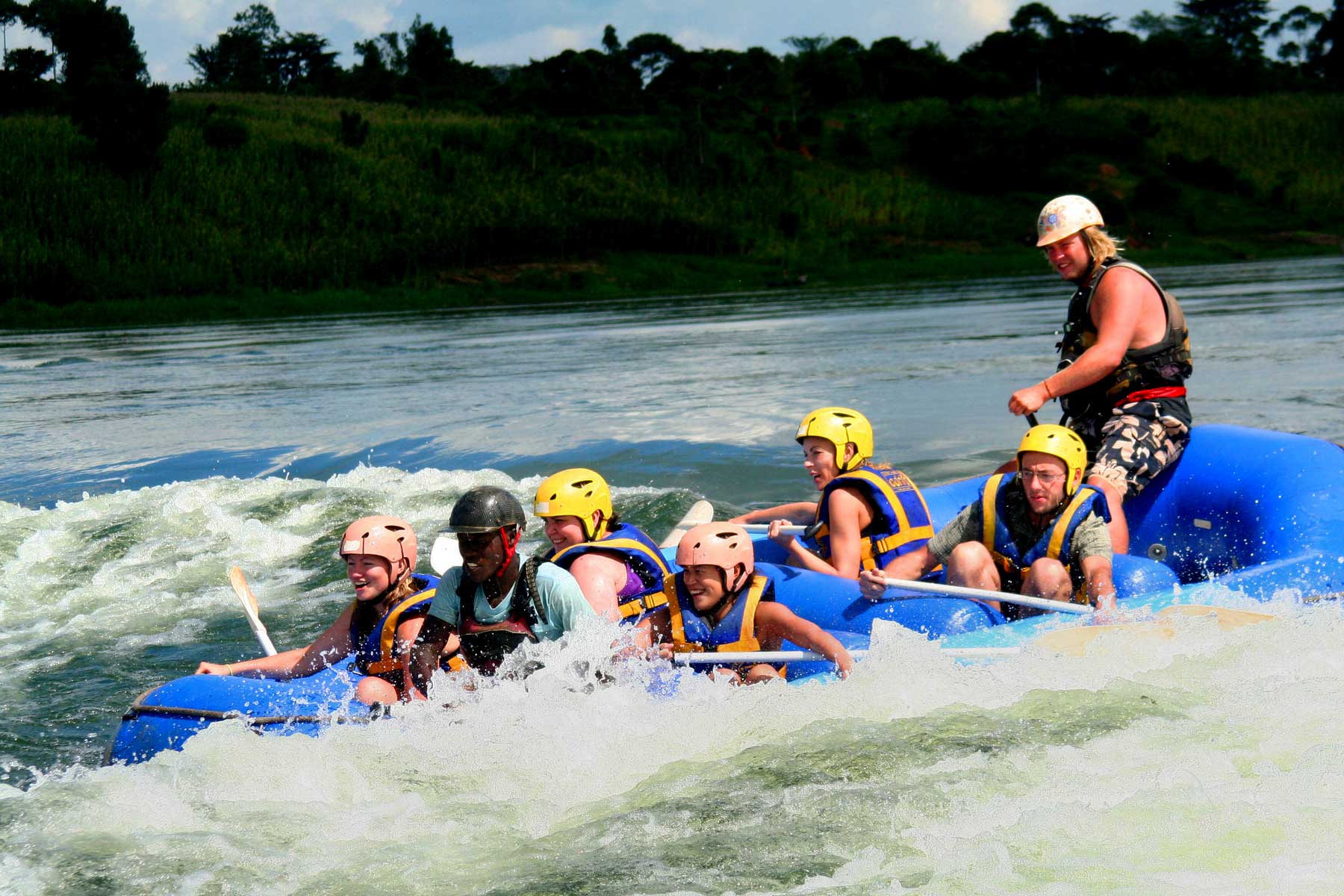
Safety on the Victoria Nile relies on strict operational standards and high-grade personal protective equipment (PPE). Before stepping into your raft, your outfitter will equip you with a high-flotation personal flotation device (PFD) and a impact-rated white water helmet. Ensure your guide adjusts every strap tightly—your PFD should fit snug against your torso so it stays in place if you pop up in turbulent water. Never unbuckle your helmet or loosen your vest while on the river.
Equally vital is the mandatory pre-river safety orientation conducted on land. Your lead guide will demonstrate essential self-rescue techniques, such as adopting the "downriver float" position (feet up, pointed downstream) if swept overboard, holding onto your paddle, and pulling teammates back into the boat. Pay close attention to instructions on how to tuck under flipped rafts and how to interact with safety kayakers. Mastering these procedures beforehand transforms unpredictable river moments into controlled, safe adventures.
Pack Smart for a Water Day
Because you will spend several hours fully submerged in river water, keep your personal carry list extremely minimal and strictly waterproof. Apply water-resistant, reef-safe sunscreen with a high SPF rating to your face, neck, and arms before putting on your helmet and life jacket, and reapply during lunch stops. The reflection of sunlight off the Nile accelerates skin damage significantly.
Consider wearing tight-fitting water goggles or polarized sports sunglasses with a floating retaining strap. The explosive spray from Grade 5 waves can blind paddle captains temporarily; keeping clear vision helps you react quickly to guide commands. Leave all non-waterproof items—phones, wallets, regular cameras, and expensive jewelry—behind in your hotel safe or in your outfitter’s secure land vehicles. Professional photo kayakers accompany most rafting crews, capturing high-resolution photos and video footage of your run so you don't risk losing your devices to the Nile.
Listen to Your Paddle Guide
Your raft guide is an expert professional who spends years learning the Nile's fluid dynamics, hidden rocks, whirlpools, and rapid entries. Once you hit open water, your guide's voice becomes your operational command center. You will be trained on basic paddle commands: "Forward Hard," "Backwards," "Get Down," and "Lean Left/Right."
Executing these commands instantly and in unison with your raft crew determines whether your boat punches cleanly through a massive wave crest or flips upside down into a washing-machine rapid. When the guide yells "Get Down," drop immediately into the bottom of the raft, hold onto the safety lines with one hand, and keep your helmet low. Trusting your guide’s navigation and executing commands without hesitation keeps the raft stable and minimizes unnecessary flips in heavy hydraulic features.
Relax in the Calm River Pools
White water rafting in Jinja is not a non-stop chaos machine; it follows a natural rhythm of intense, high-energy rapid runs punctuated by long, tranquil stretches of calm, flat water. After conquering famous, heart-pounding rapids like Overtime, Retaker, or Dead Money, the river opens up into wide, slow-moving pools.
Take full advantage of these calm intermissions to rest your arms, catch your breath, and soak in the breathtaking riverine environment. The guides will let you slide out of the raft to float lazily along the Nile in your high-flotation life jacket. Keep an eye on the lush foliage along the banks; these calm floating sections offer incredible opportunities to spot native wildlife, including fish eagles, pied kingfishers, monitor lizards, and otters resting along the shoreline.
Unwind at the Post-Rafting BBQ
A full day of paddling against Grade 4 and 5 rapids burns an enormous amount of calories. Most professional Jinja rafting outfitters wrap up the day's expedition with a celebrated riverside tradition: a hot, hearty barbecue banquet served right at the river takeout point near Kalagala Falls.
After changing into dry clothes, gather with your raft crew to feast on grilled meats, fresh local vegetables, salads, and fruits while reviewing photos and videos taken during your run. It is the perfect opportunity to relax, swap stories about wild flips or close calls, and toast your river victory with a cold Nile Special beer while watching the sun set over the Victoria Nile.
8 Days Mountain Rwenzori hike and Jinja white water rafting
8 Days Mountain Rwenzori Hike & Jinja White Water Rafting
Trade the roaring rapids of the Victoria Nile for the glacial, mist-draped peaks of the Rwenzori range on this ultimate 8-day expedition across Uganda. Designed for high-energy adventurers, this itinerary pairs world-class river rafting with a technical high-altitude mountain circuit. You begin in Jinja, navigating massive Grade 4 and Grade 5 rapids surrounded by tropical riverine forests. From there, you travel west across the country to ascend the legendary "Mountains of the Moon".
Over six days on the Central Circuit trail, you trek through distinct ecological zones—from lush montane rainforests and bamboo belts to alpine bogs and giant lobelia gardens. The journey culminates in an early-morning glacier traverse up Margherita Peak at 5,109 meters on Mount Stanley, delivering expansive views of the Albertine Rift Valley. It is a demanding, deeply rewarding back-to-back challenge that showcases two of East Africa's most iconic landscapes.
Day 1: Kampala to Jinja & Victoria Nile White Water Rafting
Your adventure starts early with a morning pick-up in Kampala for the 80-kilometer drive east along the Jinja Highway, crossing the Source of the Nile Bridge to reach Jinja. After arriving at the staging point, your professional river guides provide a safety orientation and gear fitting with helmets and high-flotation life jackets.
You then launch onto the Victoria Nile for an intense, 21-kilometer stretch of white water. You paddle through world-class Grade 4 and Grade 5 rapids—including well-known features like Overtime, Retaker, and Bad Place—punctuated by calm river pools where you can swim and watch native kingfishers and fish eagles. Safety kayakers paddle alongside throughout the run to manage any boat flips. After clearing the final rapid set near Kalagala Falls, you enjoy a hearty, post-rafting barbecue lunch by the riverbanks before settling into your riverside lodge for the evening.
Day 2: Transfer from Jinja to Kasese (Rwenzori Foothills)
After breakfast along the river, you check out and begin a long, cross-country road transfer heading west toward Kasese District—the primary gateway to Rwenzori Mountains National Park. The 450-kilometer journey takes roughly 8 to 9 hours, winding through the rolling tea plantations of Fort Portal and crossing traditional trading towns along the edge of the equator.
As you approach the western border, the high fault-block ridgelines of the Rwenzori range dominate the horizon. You arrive in Kasese town (elevation 1,290 meters) by late afternoon and check into your base lodge. Here, you meet your head mountain guide from the Rwenzori Mountaineering Services (RMS) or Uganda Wildlife Authority (UWA) for a mandatory gear check, ensuring your crampons, harness, waterproof layers, and thermal gear are ready for the climb.
Day 3: Nyakalengija to Nyabitaba Hut
You drive 15 kilometers from Kasese to the park gates in Nyakalengija at 1,615 meters. After registering with UWA rangers and meeting your team of Bakonzo porters, you step onto the Central Circuit trail. The path starts by weaving through local farmlands along the Mobuku River before crossing its tributary, the Mahoma River.
Entering the park boundary, the trail ascends steeply through dense montane forest and tall elephant grass. As you gain height along a rocky ridge, keep an eye out for black-and-white colobus monkeys, blue monkeys, and the colorful Rwenzori turaco overhead. The 10-kilometer hike takes 5 to 6 hours, gaining roughly 1,036 meters of elevation. You arrive at Nyabitaba Hut (2,651 meters) late in the afternoon, where you rest on a high forest ridge overlooking the Portal Peaks.
Day 4: Nyabitaba to John Matte Hut
Leaving Nyabitaba, you descend through the forest canopy to cross the Kurt Shafer Bridge at 2,300 meters, spanning the confluence of the Mobuku and Bujuku rivers. From the riverbed, the trail climbs steeply into a thick bamboo zone before transitioning into a surreal forest of giant heather trees draped in hanging moss.
You navigate slick, exposed tree roots and rock slabs up to the Nyamileju rock shelter, which offers clear views across the valley toward Mount Stanley and Mount Speke on clear days. The final leg crosses wet, boggy terrain where wooden boardwalks and tussocks help you navigate the mud. This 11-kilometer trek requires 6 to 7 hours of sustained effort. You arrive at John Matte Hut (3,505 meters) near the Bujuku River, where evening temperatures drop sharply.
Day 5: John Matte to Bujuku Hut
The day begins by descending from John Matte Hut to cross the Bujuku River, entering the notorious Lower and Upper Bigo Bogs. You walk across elevated wooden boardwalks built to protect the fragile alpine vegetation, surrounded by giant groundsels (Dendrosenecio adnivalis) and tall lobelias.
Clearing the bogs, the trail climbs steadily toward Lake Bujuku (3,900 meters), a quiet glacial lake set in a deep amphitheater below Mount Baker, Mount Speke, and Mount Stanley. You skirt the marshy, boulder-strewn shores of the lake to reach Bujuku Hut (3,962 meters). This 5-kilometer leg takes 5 to 6 hours due to the altitude and technical footing. Bujuku Hut serves as a critical base for acclimatization before your push into the higher alpine zones.
Day 6: Bujuku to Elena Hut
You leave Bujuku Hut and tackle a steep climb through Groundsel Gully, navigating vertical rock sections equipped with fixed metal ladders and safety cables anchored into the cliff faces. The trail continues up to Scott-Elliot Pass at 4,372 meters, offering views across the Kitandara lakes basin.
At the pass, you branch right off the main loop onto a steep, exposed trail that climbs over cold, exposed slabs of granite. This 4-kilometer leg takes 4 to 5 hours to reach Elena Hut (4,541 meters), perched directly on a cold, rocky ridge at the edge of Mount Stanley's permanent ice line. You spend the afternoon resting inside the hut, hydrating, and double-checking your summit equipment—harnesses, ice axes, helmets, ropes, and crampons—before turning in early.
Day 7: Elena Hut to Margherita Peak & Kitandara Hut
Your summit push starts in total darkness around 2:00 AM. Wearing headlamps, heavy thermal layers, and crampons, you navigate the steep granite slabs up to the Stanley Glacier. You rope up with your guide to cross the ice sheets, negotiating crevasses and scrambling up a fixed-rope section to reach the final icy crest.
Reaching Margherita Peak (5,109 meters)—the highest point in Uganda and the third-highest summit in Africa—rewards you with a sunrise view over the glaciated peaks and the Congo basin. After taking photographs, you carefully descend the glacier back to Elena Hut for a brief rest and warm meal. You then continue down past Scott-Elliot Pass to the twin Kitandara lakes, reaching Kitandara Hut (4,023 meters) for the night after a demanding 8 to 10 hours on the trail.
Day 8: Kitandara to Nyakalengija & Departure
Your final day on the mountain starts with a short, steep climb up to Freshfield Pass at 4,282 meters, taking in your last high-altitude views before beginning a long, continuous descent down the Mubuku River valley. You pass the Kabamba rock shelter and Guy Yeoman Hut (3,261 meters), descending through the giant heather and bamboo zones back down to Nyabitaba.
From Nyabitaba, you make the final push down the forest ridge to the park gates at Nyakalengija (1,615 meters). After a brief debriefing ceremony to collect your summit certificates and tip your support team, you meet your vehicle for the road transfer back to Entebbe International Airport or Kampala, concluding your Ugandan expedition.
When is the best time for Rwenzori hike and white-water rafting
The best time for this adventure is during Uganda’s two primary dry seasons: December to February and June to September. During these dry months, trail conditions on the Rwenzori Mountains are far less muddy, mountain bogs are easier to cross, and clear skies offer breathtaking views of Margherita Peak.
For white-water rafting on the Victoria Nile in Jinja, river conditions are excellent year-round. However, during the drier seasons, water levels remain warm and stable, making it ideal for navigating Grade 4 and Grade 5 rapids safely alongside professional safety teams.
Booking Rwenzori hike and white-water rafting with us Roads of Adventure safaris
Booking your expedition with Roads of Adventure Safaris ensures a seamless, fully customized East African itinerary from arrival to departure. We manage every detail, including securing official Uganda Wildlife Authority (UWA) park entry permits, mountain concession fees, and certified high-altitude guides.
Our team provides comprehensive ground transport in 4x4 safari vehicles, coordinates professional river-rafting outfitters in Jinja, and arranges experienced local Bakonzo porters for your mountain circuit. By trusting Roads of Adventure Safaris with your logistics, gear checks, and transfers, you can focus entirely on enjoying your white-water paddling and high-altitude trekking experience.
