Travel across Uganda on this 13 Days gorilla trekking, Rwenzori hike and Mabamba Uganda birding safari. This expedition blends primate tracking, high-altitude alpine mountaineering, and swamp birding. Your journey starts in the ancient, misty jungles of Bwindi Impenetrable National Park, home to wild mountain gorillas. From Bwindi, head to Queen Elizabeth National Park to view savannah wildlife along the Kasenyi plains and Kazinga Channel. Next, tackle the legendary Mountains of the Moon along the Central Circuit trail, climbing from lush montane rainforests to the glaciated summit of Margherita Peak at 5,109 meters. Conclude your journey at Mabamba Bay Wetland on Lake Victoria, searching for the prehistoric Shoebill stork by traditional canoe.
Detailed Day-by-Day Itinerary
Day 1: Arrival and Transfer to Bwindi Impenetrable National Park
Upon arrival at Entebbe International Airport, meet your private driver guide for a briefing. Begin the 460-kilometer drive southwest toward Bwindi Impenetrable National Park. Pass through rolling hills, farmland, and busy trading centers, crossing the Equator at Kayabwe for photos and experiments. Drive past the city of Mbarara and head into the Kigezi highlands, often called the Switzerland of Africa due to its terraced hillsides. Bwindi sits at elevations between 1,160 meters and 2,607 meters, harboring over 400 mountain gorillas alongside 350 bird species. Arrive late in the afternoon at your lodge near the park boundary. Check into your room, unpack gear, and enjoy dinner while listening to nocturnal forest sounds. Rest well tonight to prepare your body for tomorrow's jungle trekking challenge.
Day 2: Mountain Gorilla Trekking and Transfer to Queen Elizabeth National Park
Assemble at 7:30 AM at the Uganda Wildlife Authority ranger station for a safety briefing. Rangers divide hikers into small groups of 8 and assign habituated gorilla families, such as the Mubare, Habinyanja, or Rushegura groups. Enter the thick jungle at 8:00 AM, using walking sticks to navigate steep, muddy slopes and tangled vines. Trekking duration ranges from 2 to 6 hours depending on where the gorillas nested the previous night. Upon locating the family, spend 1 hour watching giant silverbacks, females, and playful juveniles feeding on bamboo shoots. Retrace your steps back to the park base to collect your trekking completion certificate. Immediately board your vehicle and drive 150 kilometers north to Queen Elizabeth National Park, checking into your lodge along the park boundary for dinner and overnight rest.
Day 3: Kasenyi Game Drive and Kazinga Channel Boat Cruise
Start early with coffee before embarking on a 6:30 AM game drive across the Kasenyi plains. This open savannah sits in the shadow of the Rwenzori range and serves as a major breeding ground for Uganda kob. Track pride lions, leopards, giant forest hogs, side-striped jackals, and herds of African bush elephants. Return to the lodge for lunch and relaxation. At 2:00 PM, head to the Mweya peninsula for a 2-hour boat launch along the 32-kilometer Kazinga Channel connecting Lake George and Lake Edward. Drift past dense pods of hippos, Nile crocodiles, and wallowing buffalo herds. Birdwatchers can spot over 60 waterbird species along the banks, including African skimmers, pink-backed pelicans, and yellow-billed storks, before returning to the lodge for dinner.
Day 4: Transfer to Rwenzori Foothills and Gear Preparation
After breakfast, leave Queen Elizabeth National Park and drive 85 kilometers north toward Kasese town. Continue to Nyakalengija village, located at 1,615 meters above sea level, which serves as the primary base camp for the Rwenzori Mountaineering Services. Meet your team of chief mountain guides, safety porters, and cooks who will support your high-altitude trek. Spend the afternoon sorting equipment, testing waterproof gear, fitting crampons, and weighing duffel bags to adhere to the strict 15-kilogram porter weight limit. Hire specialized rubber boots (gumboots), which are essential for walking through the lower bog zones. Receive a final briefing on trail safety, acute mountain sickness prevention, and environmental preservation inside Rwenzori Mountains National Park. Spend the night at a local lodge near the trailhead.
Day 5: Rwenzori Hike – Nyakalengija (1,615m) to Nyabitaba Hut (2,651m)
Begin your Central Circuit trek at the Nyakalengija park gate. Register with park authorities and walk past Bakonzo farmland before entering the park boundary. Follow the trail along the Mubuku River, crossing steep ridges and streams over wooden bridges. Pass through tropical rainforest trees adorned with mosses and epiphytes. Listen for the calls of the Rwenzori turaco, an endemic bird with bright red flight feathers, and spot blue monkeys and black-and-white colobus monkeys in the canopy. The trail steepens as you cross the Mahoma River before climbing a rocky ridge. Arrive at Nyabitaba Hut, perched at 2,651 meters, after completing a 10-kilometer hike over 4 to 5 hours. View Mount Speke and Portal Peaks in the distance before enjoying dinner and rest.
Day 6: Rwenzori Hike – Nyabitaba Hut to John Matte Camp (3,505m)
Depart Nyabitaba Hut early, descending through the forest to cross the Kurt Shafer Bridge, where the Mubuku and Bujuku rivers merge at 2,600 meters. Enter a thick zone of bamboo (Sinarundinaria alpina), navigating steep, slippery rock faces. Ascend through the mossy heather zone, where trees are draped in thick lichens (Usnea). Pass Nyamuleju rock shelter, an old base camp displaying views of Mount Stanley and Mount Speke during clear weather. Continue walking along the Bujuku River valley, entering a swamp filled with tussock grass and giant heather trees. Complete the 11-kilometer route over 6 to 7 hours to reach John Matte Camp at 3,505 meters. Dry your boots by the camp stoves, enjoy a hot meal, and prepare for cold night temperatures.
Day 7: Rwenzori Hike – John Matte Camp to Bujuku Hut (3,962m)
Leave John Matte Camp and drop down to cross the Bujuku River, entering the Lower Bigo Bog. Walk across boardwalks constructed over deep peat bogs, surrounded by giant lobelias (Lobelia wollastonii) and tree groundsels (Dendrosenecio). Climb out of the bog into the Upper Bigo Bog, crossing tussocks to reach Lake Bujuku. Hike along the shores of this glacial lake, observing high-altitude aquatic bird species and endemic vegetation. The trail leads up a valley to Bujuku Hut, located at 3,962 meters between Mount Baker, Mount Speke, and Mount Stanley. This 6-kilometer section takes 5 to 6 hours due to steep terrain and muddy paths. Rest early to help your body adapt to the thinner air and lower oxygen levels.
Day 8: Rwenzori Hike – Bujuku Hut to Elena Camp (4,563m)
Depart Bujuku Hut for a short but steep climb up the slopes of the valley. Traverse ground filled with loose boulders, lichens, and alpine flowers before reaching the Scott Elliot Pass junction at 4,372 meters. Turn right onto the trail leading directly toward Elena Camp, leaving behind the boggy vegetation for bare, cold granite rocks. Scramble up steep rock slabs using fixed ropes and handholds. Arrive at Elena Hut, perched at 4,563 meters on a bare rock ridge directly beneath the Elena Glacier. Cover 4 kilometers over 4 to 5 hours. Prepare your glacier climbing equipment, including harnesses, ropes, ice axes, and crampons. Sleep early inside the insulated wooden hut ahead of your summit attempt.
Day 9: Summit Margherita Peak (5,109m) and Descend to Kitandara Hut (3,979m)
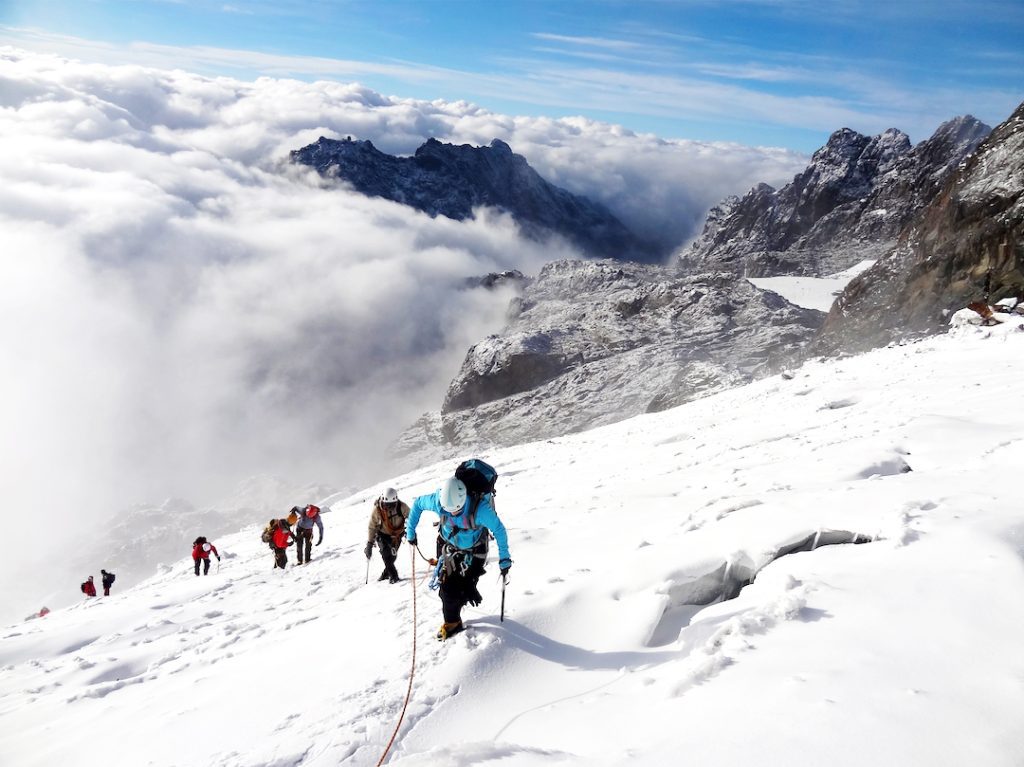
Wake at 2:00 AM for hot tea, donning thermal layers, headlamps, and climbing boots. Leave Elena Camp at 3:00 AM, scrambling up cold granite to reach the edge of the Stanley Glacier. Put on crampons and rope together with your guides. Cross the glacier plateau, climbing fixed ropes up a steep rock wall to access the Margherita Glacier. Navigate crevasses to reach the summit of Margherita Peak at 5,109 meters, the highest point in Uganda. Stand beside the summit sign before descending back to Elena Camp for a brief rest. Continue descending past Scott Elliot Pass to Kitandara Hut at 3,979 meters, set beside the Twin Kitandara Lakes. Total trekking time spans 10 to 12 hours.
Day 10: Rwenzori Hike – Kitandara Hut to Guy Yeoman Camp (3,505m)
Begin the day with a steep climb from Kitandara Hut up to Freshfield Pass, located at 4,282 meters above sea level. Cross open alpine moss fields while taking in views across the border into the Democratic Republic of the Congo. From the pass, begin a long descent along the muddy trails of the Kabamba Valley. Pass cascading waterfalls and rock shelters used by early explorers. Descend through zones of giant heather and bamboo, following the fast-flowing Mubuku River down the valley. Cover 6 kilometers over 6 to 7 hours of walking. Arrive at Guy Yeoman Camp, positioned at 3,505 meters, surrounded by cliff faces. Unwind, share summit stories with your crew, and enjoy a hot dinner.
Day 11: Descend to Nyakalengija and Transfer to Kampala
Leave Guy Yeoman Camp for the final leg of your mountain descent. Hike down steep, muddy paths along the Mubuku River, passing Kichuchu rock shelter. Re-enter the bamboo forest zone and cross wooden bridges back toward Nyabitaba Hut. Continue descending the mountain ridge down to the park entry gate at Nyakalengija (1,615m). Complete the 15-kilometer descent in 6 to 7 hours. Receive your official Rwenzori summit certificate from park officials and bid farewell to your mountain guides and porters. Board your safari vehicle and travel 330 kilometers east across Uganda, passing Fort Portal and Mityana towns. Arrive late in the evening in Kampala or Entebbe for dinner and a restful night in a comfortable hotel.
Day 12: Mabamba Swamp Birding Safari for the Shoebill
After an early breakfast, transfer 50 kilometers southwest to Mabamba Bay Wetland on the shores of Lake Victoria. This Ramsar site covers 2,424 hectares of papyrus marsh and water lily channels. Board a narrow motorized wooden canoe driven by a local birding guide. Navigate papyrus channels to locate the rare, prehistoric Shoebill stork (Balaeniceps rex) as it hunts lungfish in the shallows. Mabamba maintains high sighting success rates. Search for other wetland endemics, including the papyrus gonolek, blue swallow, swamp flycatcher, white-winged tern, and African pygmy goose. Return to the mainland for lunch before driving back to Entebbe for dinner.
Day 13: Leisure Morning and Departure
Enjoy a relaxed morning at your hotel overlooking Lake Victoria. Depending on your flight schedule, take an optional guided walk through the Entebbe Botanical Gardens, established in 1898. Walk along shaded pathways under mature rainforest trees to spot free-ranging black-and-white colobus monkeys, vervet monkeys, and avian species such as the Great Blue Turaco, Ross's Turaco, and African Casqued Hornbill. Return to your hotel room to pack your luggage, check out, and settle any outstanding bills. Meet your driver guide for the short transfer to Entebbe International Airport. Check in for your evening international flight home, concluding your 13 Days gorilla trekking, Rwenzori hike and Mabamba Uganda birding safari.
How physically demanding is mountain gorilla trekking in Bwindi?
Mountain gorilla trekking in Bwindi Impenetrable National Park requires moderate to high physical fitness. The terrain consists of steep, muddy ridges, tangled vegetation, and slippery slopes without established trails. Hikes can last anywhere from 2 to 6 hours depending on where the habituated gorilla family nested the previous night. Elevations in Bwindi range from 1,160 meters to 2,607 meters above sea level, making the air noticeably thinner as you ascend. Hikers often must push through thick underbrush and cross small streams while carrying daypacks. Hiring a local porter at the park gates provides physical balance on muddy trails while directly supporting surrounding forest communities.
What equipment is required to climb Margherita Peak on Mount Stanley?
Summitting Margherita Peak at 5,109 meters requires specialized high-altitude and glacier gear. Because the final approach involves crossing active glaciers and steep rock faces, climbers need crampons, an ice axe, a climbing harness, locking carabiners, and safety ropes. Standard alpine wear includes rigid mountaineering boots, moisture-wicking base layers, heavy fleece mid-layers, and a windproof, waterproof shell jacket. Heavy thermal gloves, wool socks, and UV-blocking sunglasses protect against freezing winds and glare. Below the snowline, knee-high rubber boots (gumboots) are indispensable for navigating the deep mud of the Bigo Bogs along the Central Circuit.
What makes Mabamba Swamp the best place to spot the Shoebill stork?
Mabamba Bay Wetland covers over 2,424 hectares of papyrus marsh and open water lily channels on Lake Victoria. This Ramsar-protected wetland hosts a healthy population of the rare Shoebill stork (Balaeniceps rex), which feeds primarily on lungfish in the shallow waters. Local community guides navigate flat-bottomed wooden canoes quietly through narrow channels, allowing birdwatchers to approach without startling the birds. Unlike dense forests, Mabamba’s open papyrus vegetation allows clear, unobstructed views when a Shoebill stands motionless waiting for prey. Morning boat trips yield high sighting success rates before the afternoon heat sets in.
How do trekkers handle altitude sickness during the 7-day Rwenzori Central Circuit?
Preventing acute mountain sickness (AMS) on the Rwenzori Central Circuit relies on gradual ascent, proper hydration, and paced walking. Starting at Nyakalengija (1,615m), the trail gains over 3,400 vertical meters over 5 days before reaching Margherita Peak (5,109m). Mountain guides maintain a slow pace to allow your body time to produce red blood cells in response to reduced oxygen levels. Trekkers drink 3 to 4 liters of water daily and sleep in insulated huts like John Matte (3,505m) and Bujuku (3,962m) to adapt gradually. Guides monitor oxygen saturation levels daily using pulse oximeters and carry supplemental oxygen tanks for emergency descents if severe symptoms appear.
What wildlife can visitors see in Queen Elizabeth National Park during this safari?
Queen Elizabeth National Park features diverse ecosystems ranging from open savannahs to wetlands and riverine forests. On early morning game drives across the Kasenyi plains, visitors track pride lions, solitary leopards, spotted hyenas, and herds of Uganda kob. African bush elephants, giant forest hogs, and cape buffaloes roam freely across the park. The 32-kilometer Kazinga Channel hosts dense concentrations of hippos and Nile crocodiles along its banks. Birdwatchers can spot over 600 avian species across the park, including Martial Eagles, African Skimmers, Pink-backed Pelicans, and Saddle-billed Storks along the water's edge.
When is the best time of year to undertake this 13-day Uganda itinerary?
The ideal windows for this combined safari fall during Uganda’s dry seasons: June through September and December through February. During these months, forest trails in Bwindi remain less muddy, making mountain gorilla trekking safer and less strenuous. On Mount Stanley, dry weather brings clearer skies, firmer snow conditions, and reduced mud levels across the Lower and Upper Bigo Bogs. Low rainfall also lowers water levels at Mabamba Swamp, concentrating lungfish and increasing Shoebill sighting opportunities. While high-altitude mountain weather can change suddenly year-round, dry months offer the most reliable trail conditions.
What permits are required for mountain gorilla trekking and Rwenzori mountaineering?
Gorilla trekking in Bwindi requires a permit issued by the Uganda Wildlife Authority (UWA). Due to high demand and strict daily caps of 8 visitors per gorilla family, securing permits several months in advance is critical. For the Rwenzori portion, trekkers pay daily UWA park entrance fees along with Central Circuit trekking packages managed by local community concessionaires like Rwenzori Mountaineering Services (RMS). These packages cover licensed mountain guides, safety porters, mountain hut accommodations, rescue protocols, and cook fees required inside the national park boundaries.
What accommodation style is used during the mountain portion versus the wildlife safari?
Accommodations shift based on the location along the itinerary. During the safari sections in Bwindi, Queen Elizabeth National Park, and Entebbe, guests stay in safari lodges ranging from comfortable mid-range chalets to luxury eco-lodges with hot showers, en-suite bathrooms, and full-service dining rooms. In contrast, accommodations inside Rwenzori Mountains National Park consist of rustic wooden mountain huts like Nyabitaba, John Matte, Bujuku, and Elena Camp. These high-altitude shelters feature communal bunk beds with foam mattresses, dry pit latrines, and shared dining areas warmed by camp stoves.
Why are porters essential for both gorilla trekking and high-altitude mountain hiking?
Porters play a central role in trail safety, heavy lifting, and local community conservation in Uganda. In Bwindi, hiring a porter frees hikers from carrying heavy daypacks, allowing them to balance on steep, slippery jungle slopes. On the Rwenzori Central Circuit, porters carry food supplies, cooking gear, and group luggage up to 15 kilograms per bag across muddy bogs and steep mountain passes. Beyond physical support, porter programs provide direct employment to Bakonzo and Batwa families living near park boundaries, turning wildlife conservation into a direct source of income for local households.
How long is the drive between major national parks on this 13-day route?
Drive times vary across Uganda’s varied terrain and road networks. The longest ground transfer takes place on Day 1, covering roughly 460 kilometers from Entebbe to Bwindi over 8 to 9 hours. Transferring from Bwindi north to Queen Elizabeth National Park takes about 4 to 5 hours (150 km), depending on road conditions through the Ishasha sector. From Queen Elizabeth to Nyakalengija at the base of the Rwenzori range takes 2 to 3 hours (85 km). The drive back from Kasese to Kampala or Entebbe on Day 11 covers 330 kilometers and takes approximately 6 to 7 hours.
Booking Rwenzori hike, gorilla and birding with us Roads of Adventure safaris
Roads of Adventure Safaris offers tailored East African expeditions, making them an excellent choice for a multi-activity expedition combining a Rwenzori mountaineering trek, mountain gorilla trekking, and specialized birdwatching.
To secure your permits, mountain guides, and park registrations for this multi-destination Uganda itinerary, you can coordinate your booking through the Roads of Adventure Safaris Contact Portal or reach out directly via WhatsApp at +256 752 453147
