Welcome to an extraordinary 12 Days / 11 Nights Uganda Wildlife safari, Primates, Birds, Culture & Rwenzori Hiking Safari expedition meticulously engineered for passionate adventurers, wildlife enthusiasts, and avid trekkers alike. This immersive safari offers an unparalleled loop through the very best of East Africa’s natural wonders, seamlessly blending classic savannah game drives, deep-forest primate encounters, high-altitude mountaineering, and rich cultural interactions. Your journey begins at the edge of Lake Victoria searching for prehistoric birds, tracks endangered rhinos on foot, and navigates the thunderous Murchison Falls. From there, you will plunge into the primate capital of Kibale Forest before testing your endurance on the iconic, mist-shrouded Rwenzori Mountains. Descending from the clouds, you will explore the teeming savannahs and channels of Queen Elizabeth National Park, search for enigmatic tree-climbing lions, and track majestic mountain gorillas within Bwindi’s prehistoric canopy. This comprehensive itinerary showcases Uganda's astonishing biodiversity, rich heritage, and breathtaking landscapes, promising an unforgettable African transformation.
Tour highlights for 12 Days / 11 Nights Uganda Wildlife safari, Primates, Birds, Culture & Rwenzori Hiking Safari
Prehistoric shoebill tracking
Foot rhino tracking
Savannah game drives
Murchison launch cruise
Powerful waterfall vistas
Albertine Rift journey
Wild chimpanzee trekking
Bigodi swamp birding
Alpine mountain climbing
Rwenzori ridge hiking
Scenic crater landscapes
Kazinga channel cruise
Climbing lion search
Mountain gorilla trekking
Indigenous Batwa encounters
Equator photo opportunity
Day by day 12 Days / 11 Nights Uganda Wildlife safari, Primates, Birds, Culture & Rwenzori Hiking Safari
Day 1: Entebbe → Mabamba Swamp → Ziwa Rhino Sanctuary → Murchison Falls
Your 12 Days / 11 Nights Uganda Wildlife safari, Primates, Birds, Culture & Rwenzori Hiking Safari adventure commences with an early morning departure to the legendary Mabamba Swamp, an extensive papyrus wetland on the shores of Lake Victoria. Boarding a traditional wooden motorized canoe, you will navigate narrow channels to track the prehistoric, highly endangered Shoebill Stork in its natural habitat, alongside numerous endemic wetland birds. Following this captivating encounter, journey northward through dynamic landscape transitions to the Ziwa Rhino Sanctuary. Here, you will experience the profound thrill of tracking the southern white rhinos on foot through safe savannah woodlands, accompanied by expert rangers. This vital conservation project offers intimate viewing and exceptional photographic opportunities of these magnificent mammals. After the trek, enjoy a relaxing lunch before proceeding through the park gates into Murchison Falls National Park, arriving at your lodge in time to unwind, enjoy a delicious dinner, and settle in for the night.
- Accommodation: Nkundwa Nile View Lodge
- Meal Plan: Full Board (F/B)
Day 2: Murchison Falls National Park – Game Drive & Nile Boat Cruise
Wake up for an early breakfast before departing for a morning game drive across the northern savannah delta. Guided by golden morning light, you will actively search for lions, massive herds of elephants, Cape buffaloes, elegant Rothschild’s giraffes, Jackson’s hartebeests, Uganda kobs, oribis, and playful warthogs. Return to the lodge for lunch and relaxation before embarking on an afternoon launch cruise along the historic River Nile, heading directly toward the base of the thunderous falls. The riverbanks host massive Nile crocodiles, pods of hippos, and diverse water birds like the goliath heron. Upon reaching the dramatic base, you can opt for additional activities or simply marvel at the world's most powerful waterfall forcing its way through a narrow gorge. Conclude your day with a scenic evening game drive back to the lodge, followed by a relaxing dinner.
- Accommodation: Nkundwa Nile View Lodge
- Meal Plan: Full Board (F/B)
Day 3: Murchison Falls → Top of the Falls → Kibale Forest National Park
Following breakfast and check-out, drive to the spectacular Top of Murchison Falls. Stand at the canyon's edge to feel the earth vibrate as the entire Nile forces its way through a seven-meter gap, casting brilliant rainbows across the mist for spectacular photos. Bid farewell to the savannah as you journey southward toward Kibale National Park, recognized globally as the Primate Capital of the World. The scenic drive navigates the dramatic landscapes of the Albertine Rift Valley, revealing rolling hills, traditional homesteads, and extensive tea plantations. Pause in the vibrant town of Fort Portal for a local lunch before continuing to the boundary of the lush tropical rainforest. Check into your beautifully situated lodge, where you can relax, listen to the vibrant forest symphony, enjoy a freshly prepared dinner, and rest ahead of tomorrow’s chimpanzee trekking.
- Accommodation: Kibale Forest Lodge
- Meal Plan: Full Board (F/B)
Day 4: Kibale Forest – Chimpanzee Tracking & Bigodi Wetland Birding
An early breakfast prepares you for an unforgettable encounter in the jungle. Gather at the park headquarters for an essential briefing before entering Kibale's dense canopy with expert trackers to locate a habituated chimpanzee community. Upon finding them, spend a magical hour watching our closest relatives feed, play, and communicate high in the trees. Return to the lodge for a warm lunch before heading out to the Bigodi Wetland Sanctuary for an afternoon guided nature walk. This community-run reserve is a haven for avian biodiversity, allowing you to search for spectacular species like the Great Blue Turaco, Papyrus Gonolek, Black Bee-eater, and rare African Grey Parrots. The walk also offers frequent sightings of multiple monkey species, including red colobus and sitatunga antelopes, concluding a vibrant day dedicated to forest conservation and primate discovery.
- Accommodation: Kibale Forest Lodge
- Meal Plan: Full Board (F/B)
Day 5: Kibale Forest → Rwenzori Mountains (Nyakalengija to Nyabitaba Camp)
Enjoy breakfast before checking out and transferring to the base of the legendary Rwenzori Mountains, famously known as the Mountains of the Moon. Arrive at the Nyakalengija park office (1,615 meters above sea level) for registration, equipment checks, and an introduction to your professional mountaineering guides and porters. Your mountain trek begins by winding through vibrant local farming communities and following the rushing Mubuku River. Cross the park boundary into a pristine zone of thick tropical rainforest and high elephant grass, climbing steadily up a steep ridge. Keep an eye out for unique forest wildlife, including the three-horned chameleon and brilliant blue monkeys. Reach Nyabitaba Camp (2,561 meters above sea level) by late afternoon, where you will enjoy a hot mountain meal, absorb the surrounding mountain vistas, and sleep soundly in the crisp alpine air.
- Accommodation: Nyabitaba Camp
- Meal Plan: Full Board (F/B)
Day 6: Rwenzori Mountains – Nyabitaba Camp to John Matte Camp
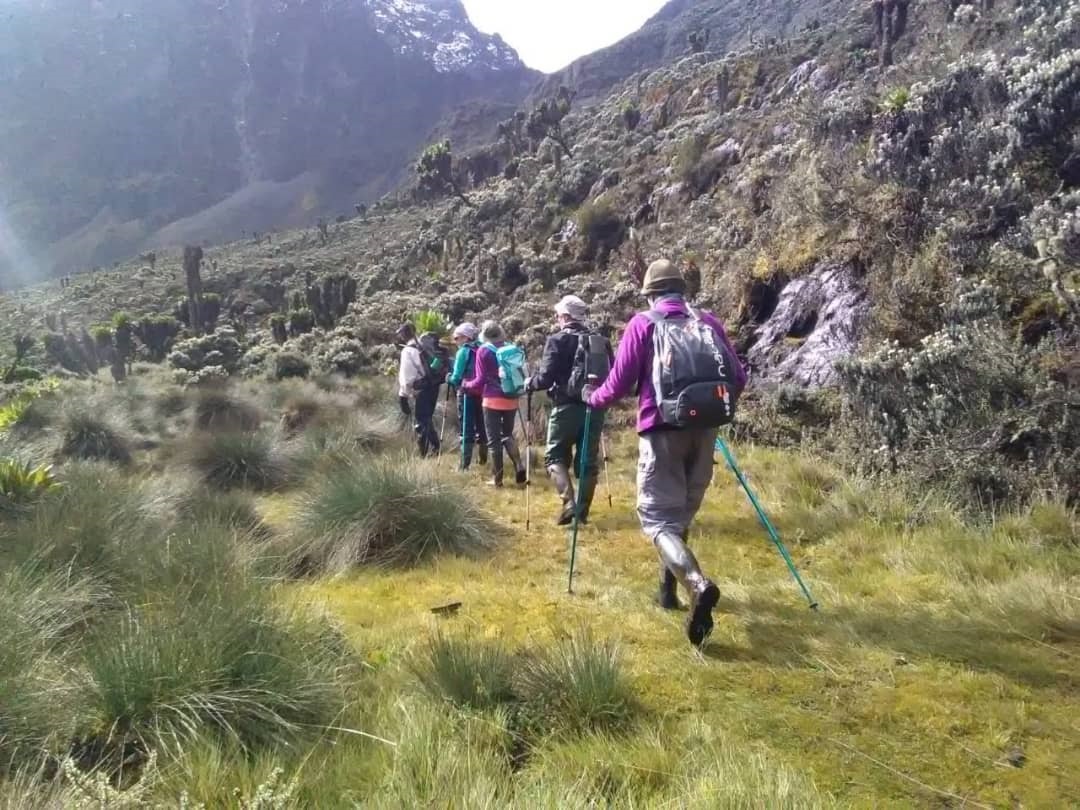
Depart Nyabitaba Camp early, descending through lush forest trails to cross the suspension bridge over the roaring Bujuku River at Kurt Shafer Bridge. From here, the route climbs steeply into a spectacular bamboo zone and over slippery, moss-covered rocks. As you ascend, the terrain opens up into the lower Bigo Bog, introducing you to the otherworldly afro-alpine vegetation, featuring giant lobelias and towering groundsels. Navigate the boardwalks across the wetlands, enjoying views of the towering peaks above. Continue climbing through the heather zone, where hanging moss creates a fairy-tale atmosphere along the trail. Arrive at John Matte Camp, situated at an elevation of 3,505 meters, in the late afternoon. Here, a hot dinner awaits, providing much-needed nourishment as you rest and adjust to the high altitude under the starry African sky.
- Accommodation: John Matte Camp
- Meal Plan: Full Board (F/B)
Day 7: Rwenzori Mountains – John Matte Camp to Bujuku Camp & Back
Today features a challenging, high-altitude trek from John Matte Camp up to Bujuku Camp, crossing into the upper Bigo Bog. Push through the marshy terrain, using jumping-stones and boardwalks surrounded by giant lobelias. The trail climbs steadily past scenic Lake Bujuku, leading directly into the breathtaking Bujuku Valley. This impressive valley is spectacularly framed by the jagged walls of Mount Baker, Mount Speke, and Mount Stanley. Reaching Bujuku Camp at 3,962 meters, enjoy a well-deserved hot lunch while admiring close-up views of glaciers clinging to the surrounding peaks. This excursion provides vital altitude acclimatization for the journey. After resting and taking stunning photographs, begin your descent back down through the changing alpine light to the familiar comforts of John Matte Camp for a warm dinner and a restful night.
- Accommodation: John Matte Camp
- Meal Plan: Full Board (F/B)
Day 8: Rwenzori Mountains → Nyakalengija → Queen Elizabeth National Park
Begin your final mountain descent from John Matte Camp, retracing your steps back past Nyabitaba Camp. The trail leads down the ridge, through the bamboo forest, and back to the Nyakalengija park gates, where you will say goodbye to your mountain crew. Celebrate completing the hike before boarding your vehicle for a scenic drive to Queen Elizabeth National Park, known as the Medley of Wonders. Enter the Kasenyi savannah sector, keeping an eye out for early wildlife sightings against the backdrop of distant crater lakes. Check into your lodge, where you can wash away the mountain dust, enjoy a relaxed dinner, and fall asleep to the sounds of the African savannah.
- Accommodation: Enshama Game Lodge
- Meal Plan: Full Board (F/B)
Day 9: Kasenyi Sector – Game Drive & Kazinga Channel Boat Cruise
Set out on an early morning game drive across the Kasenyi plains, a prime mating ground for the Uganda kob. Search for lions, elusive leopards, spotted hyenas, large herds of elephants, Cape buffaloes, and topis, all framed by historic volcanic crater lakes. Return to the lodge for breakfast and a relaxing midday break. After lunch, enjoy a classic boat safari along the famous Kazinga Channel, a natural waterway connecting Lake Edward and Lake George. This cruise offers incredible views of hippos, elephants, and crocodiles cooling off along the water's edge, alongside water birds like skimming skimmers and pelicans. Conclude your afternoon with an evening game drive through the park before returning to the lodge for dinner.
- Accommodation: Enshama Game Lodge
- Meal Plan: Full Board (F/B)
Day 10: Kasenyi Sector → Ishasha (Tree-Climbing Lions) → Bwindi (Buhoma)
Enjoy breakfast and check out of your lodge, traveling south toward the Ishasha sector of Queen Elizabeth National Park. This region is famous for its unique population of tree-climbing lions, often seen resting on the branches of large fig trees. Keep an eye out for these magnificent cats, alongside topis, buffaloes, and elephants moving through the savannah. After a relaxing lunch in the Ishasha sector, leave the savannah behind and head into the rugged Kigezi highlands. Climb into the mist-shrouded hills to reach the ancient boundaries of Bwindi Impenetrable National Park. Arrive in the Buhoma sector and check into your eco-lodge, where you can unwind, enjoy dinner, and prepare for tomorrow's gorilla trekking adventure.
- Accommodation: Ride for a Woman / Gorilla Conservation Lodge
- Meal Plan: Full Board (F/B)
Day 11: Bwindi Impenetrable Forest – Mountain Gorilla Trekking & Batwa Culture
Wake up early for breakfast and head to the park headquarters with a packed lunch for an essential pre-trek briefing. Assigned to a habituated gorilla family group, enter the ancient rainforest with expert rangers to track these gentle giants. The trek leads through dense vines and steep ridges, culminating in a magical hour spent observing a gorilla family feed, play, and rest. Return to the forest edge to meet your driver for a restful break. In the afternoon, enjoy an optional cultural visit to the indigenous Batwa pygmies. Learn about their historic forest life through traditional songs, dances, and demonstrations of ancient hunting and medicine-gathering techniques, before returning to the lodge for a celebratory dinner.
- Accommodation: Ride for a Woman / Gorilla Conservation Lodge
- Meal Plan: Full Board (F/B)
Day 12: Bwindi Impenetrable Forest → Equator Crossing → Entebbe
On your final day, enjoy breakfast before checking out of your lodge to begin the return journey to Entebbe. Travel through the rolling hills of Kigezi, passing local markets and cattle farms along the way. Pause at the Uganda Equator crossing for a delicious lunch, fun water experiments, and souvenir shopping. Continue the drive through Kampala, arriving in Entebbe by late afternoon to check into your lodge or transfer to the airport for your flight home, concluding your extraordinary 12-day Ugandan safari.
- Accommodation: Africa Gorilla Lodge / Via-Via Guest House
- Meal Plan: Full Board (F/B)
What specialized gear is required for the multi-day Rwenzori hiking segment?
The three-day trek from Nyakalengija to John Matte and Bujuku camps introduces hikers to high-altitude alpine conditions, demanding specialized preparation. Unlike standard savannah safaris, the Rwenzori Mountains—famously known as the "Mountains of the Moon"—are notorious for wet, muddy, and freezing environments. The single most critical item is a pair of high-quality, knee-high rubber boots (wellies), which are indispensable for navigating the marshy lower and upper Bigo Bogs. Standard hiking boots easily sink into the deep peat, making waterproof footwear mandatory.
Layering is equally vital as you ascend from Nyabitaba Camp (2,561m) to Bujuku Camp (3,962m). Hikers require moisture-wicking thermal base layers, an insulating fleece mid-layer, and a heavy-duty, breathable waterproof jacket and trousers to protect against relentless mountain mist and rain. For the overnight stays in wooden cabins at John Matte and Bujuku, a four-season sleeping bag rated for sub-zero temperatures is essential, alongside a warm beanie, thermal gloves, and thick wool socks.
To safely manage the steep, rocky ridges past the Kurt Shafer Bridge and the slippery boardwalks across the wetlands, sturdy trekking poles are highly recommended to maintain balance. Finally, pack a durable daypack with a waterproof cover for personal items like a headlamp, camera, and water purification tablets, while your primary gear is carried by local porters in a waterproof duffel bag. Proper gear ensures safety and comfort, allowing you to appreciate the bizarre afro-alpine vegetation and dramatic glacial peaks rather than battling the intense elements.
How does the Shoebill tracking experience at Mabamba Swamp operate?
The excursion at Mabamba Swamp on Day 1 is a meticulously managed birding adventure designed to spot the prehistoric Shoebill Stork. Located on the fringes of Lake Victoria, this extensive papyrus wetland is an internationally recognized Ramsar site. The experience begins early in the morning when the birds are most active, hunting for lungfish in the shallow channels. Visitors board traditional, stable wooden motorized canoes operated by expert local community guides who have spent years studying the swamp's complex ecosystem and the specific behaviors of its resident birds.
Once inside the thick papyrus vegetation, the guide cuts the motor, switching to a quiet wooden paddle to minimize disturbance. The canoe glides silently through narrow, winding water paths choked with water lilies. Guides communicate with other fishermen to pinpoint where the solitary, prehistoric-looking storks are standing motionless, waiting to strike at their prey. When a Shoebill is located, the canoe maintains a respectful distance to ensure the bird does not flush, offering travelers an extraordinary, up-close viewing experience that can last for an hour.
Beyond the iconic Shoebill, this boat safari provides remarkable sightings of other endemic wetland birds, including the Malachite Kingfisher, African Jacana, Papyrus Gonolek, and Long-toed Plover. The entire operation is a model for community-based ecotourism; a portion of the tracking fees directly supports local fishermen, transforming former poachers into active conservation guardians. This ensures the long-term survival of this vulnerable, prehistoric species while offering birders a spectacular start to their 12-day Ugandan journey.
What are the physical demands and altitude considerations for this specific safari?
This 12-day itinerary is exceptionally diverse, combining standard wildlife viewing with some of the most physically demanding trekking experiences in East Africa. The safari requires a high level of physical fitness, cardiovascular endurance, and leg strength. The ultimate physical challenge lies within the Rwenzori mountaineering phase, where hikers ascend from 1,615 meters to nearly 4,000 meters above sea level in just three days, conquering steep ridges, muddy bogs, and slippery, moss-covered ladders. Walking at these altitudes exposes the body to lower oxygen levels, making slow pacing ("pole pole") and proper hydration critical to preventing Acute Mountain Sickness (AMS).
Immediately following the mountain descent, the physical exertion continues in Bwindi Impenetrable National Park on Day 11. Gorilla trekking is unpredictable and demands stamina; it involves hacking through dense tropical undergrowth, crossing tangled vines, and navigating steep, muddy hillsides at elevations ranging from 1,160 to 2,600 meters. A single trek can last anywhere from two to seven hours depending on the movement of the assigned gorilla family.
Even the chimpanzee tracking in Kibale Forest on Day 4, though flatter, requires quick walking over uneven terrain to keep pace with fast-moving primate troops. To prepare for this safari, travelers should engage in regular cardiovascular training, stair climbing, and hill walking with a weighted pack for at least three months prior to arrival. Understanding these physical demands ensures that you can safely enjoy the dramatic transitions from the sweltering savannah delta to freezing alpine peaks and dense jungles.
How do the primate tracking rules differ between chimpanzees in Kibale and gorillas in Bwindi?
While both experiences offer life-changing encounters with habituated wild primates, the strict conservation protocols mirror the distinct behaviors and habitats of chimpanzees and mountain gorillas. In Kibale Forest, chimpanzee tracking on Day 4 involves dynamic movement. Chimps are highly arboreal, vocal, and fast-moving, meaning trackers spend considerable time walking rapidly through the forest floor while looking up into the high canopy. The maximum group size permitted per chimp community is typically eight people, and a minimum tracking distance of 8 meters is requested, though chimps frequently cross paths or descend quickly.
Conversely, gorilla trekking in Bwindi on Day 11 targets a strictly terrestrial and cohesive family unit led by a dominant silverback. Because gorillas share 98% of human DNA and live in vulnerable pockets, conservation rules are strictly enforced. Group sizes are capped at eight tourists per gorilla family daily, and a strict minimum viewing distance of 7 meters must be maintained at all times to prevent disease transmission. If a gorilla approaches, visitors are instructed to crouch down and avoid direct eye contact.
For both primates, standard rules apply: a absolute maximum of one hour of direct interaction is permitted once the animals are located, flash photography is strictly banned, and eating, drinking, or smoking near the primates is illegal. Crucially, if a traveler shows any signs of communicable illness, such as a cough or flu, they will be barred from entering both Kibale and Bwindi. These rules protect the health of these endangered animals while ensuring human safety.
What unique bird species can be ticked off across the different ecosystems of this itinerary?
This 12-day safari is an avian paradise, traversing an incredible array of distinct ecosystems including freshwater swamps, lowland tropical rainforests, afro-alpine zones, and open savannahs. Your birding checklist begins on Day 1 at Mabamba Swamp, where the primary target is the legendary Shoebill Stork, alongside wetland specialties like the Lesser Jacana, Blue-breasted Bee-eater, and African Marsh Harrier. Moving north into Murchison Falls, the savannah delta and riverbanks reveal the rare Red-throated Bee-eater, Abyssinian Ground Hornbill, Denham's Bustard, Goliath Heron, and the majestic African Fish Eagle.
As you plunge into the dense tropical rainforest of Kibale and the adjacent Bigodi Wetland on Day 4, the bird composition completely changes. This region is famous for the spectacular Great Blue Turaco, Black Bee-eater, Papyrus Gonolek, Narina Trogon, and the elusive African Pitta. The high-canopy forest also provides shelter to the African Grey Parrot and various greenbuls.
Ascending into the Rwenzori Mountains introduces unique Albertine Rift endemics and specialized alpine species. In the bamboo and heather zones between Nyabitaba and John Matte camps, birders can spot the Rwenzori Turaco, Handsome Francolin, Regal Sunbird, and the Strange Weaver. Finally, the Kazinga Channel in Queen Elizabeth National Park serves as an avian crossroads, teeming with thousands of migratory and resident water birds, including African Skimmers, Pink-backed Pelicans, and Yellow-billed Storks. This vast ecological diversity allows a dedicated birder to easily record over 300 distinct species during the single 12-day loop.
What is the significance of the Ishasha sector, and what are the chances of seeing tree-climbing lions?
The Ishasha sector, located in the remote southern region of Queen Elizabeth National Park, is one of the most famous wildlife corridors included in your Day 10 transit to Bwindi. This area is globally renowned for its unique population of tree-climbing lions, a fascinating behavioral phenomenon shared with only one other major population in Lake Manyara, Tanzania. Unlike typical lions that remain on the ground, Ishasha’s lions spend the heat of the day lounging on the low, sprawling branches of old sycamore fig trees and albizia trees.
Behavioral biologists suggest several reasons for this climbing habit. Primarily, it allows the lions to escape the intense ground heat and enjoy cooler breezes up in the canopy. Additionally, climbing high protects the cats from the relentless bites of tsetse flies and irritating insects that thrive in the tall savannah grass below. From their elevated perches, the lions also gain an excellent vantage point to scan the open plains for large herds of topis and Uganda kobs grazing nearby.
While seeing these tree-climbing lions is a primary highlight, encounters are never guaranteed. Success depends on weather patterns, prey movements, and tracking luck. During heavy rains, the branches become slippery, forcing the lions to remain grounded. However, your itinerary schedules an intentional game drive through this sector, maximizing your chances. Even if the lions prove elusive, Ishasha offers fantastic sightings of massive herds of buffaloes, forest elephants, and elegant topis, making it a vital and wild component of the safari.
How does this itinerary support local communities and indigenous cultures?
An essential dimension of this 12-day safari is its deep integration with sustainable community development and cultural preservation. Throughout the route, your presence directly funds grassroots economic initiatives. On Day 1, the Mabamba Swamp Shoebill experience is entirely community-managed, ensuring that local boatmen and guides profit directly from conserving the wetland rather than exploiting it. Similarly, the Day 4 nature walk in Bigodi Wetland is run by the Kibale Association for Rural and Environmental Development (KAFRED), which uses tourism revenue to build local schools, fund clean water projects, and support women's craft collectives.
Your stay in the Buhoma sector of Bwindi further emphasizes community empowerment. Choosing accommodations like "Ride for a Woman" directly provides job training, income, and educational support to local women overcoming domestic and economic hardships.
The cultural highlight occurs on Day 11 during the optional interaction with the indigenous Batwa pygmies. The Batwa were the original hunter-gatherer inhabitants of the Bwindi Impenetrable Forest before it was gazetted as a national park in 1991. Because they were displaced without land, the Batwa cultural trail provides a critical platform for them to generate income. By demonstrating their ancient forest survival skills, traditional medicine collection, fire-making techniques, and ceremonial dances, the Batwa preserve their rich heritage for younger generations while earning an honorable living. This ensures that conservation works in harmony with human dignity.
What geological and landscape transitions will a traveler experience over these 12 days?
This safari showcases an extraordinary cross-section of East African geography, taking travelers across highly dramatic terrain shaped by tectonic forces and ancient volcanic activity. The journey begins in the flat, watery basin of Lake Victoria at Entebbe and Mabamba Swamp. Driving north toward Murchison Falls, the landscape flattens into a semi-arid, sweeping woodland savannah cut in half by the Victoria Nile. At the heart of the park, you witness a massive geological bottleneck where the wide Nile forces itself through a tiny seven-meter volcanic rock cleft, plunging 43 meters into the Albertine Rift Valley floor.
From Murchison, the route drives south along the edge of the western branch of the East African Rift System. You will experience spectacular views of the Albertine Rift escarpment before ascending into the lush, rolling hills of Fort Portal and the dense, pre-glacial tropical canopy of Kibale Forest. The landscape transforms completely as you enter the Rwenzori Mountains. Here, tectonic uplift has created non-volcanic, jagged block mountains that transition rapidly through five distinct vegetation zones: from montane forest to bamboo zones, heather forests draped in old man's beard, and afro-alpine moorlands framed by massive glaciers.
Descending from the mountains, you enter the flat, volcanic rift valley floor of Queen Elizabeth National Park, peppered with stunning explosion crater lakes and smooth savannah plains. Finally, the journey climbs into the ancient, intensely terraced Kigezi Highlands, leading into the ancient, rugged volcanic ridges of Bwindi. This incredible diversity means your backdrop changes daily.
What are the key differences between tracking rhinos on foot and standard vehicle game drives?
Your safari explicitly combines both traditional vehicle-based game drives and active foot-tracking safaris, offering two completely different ways to experience African wildlife. On Day 1 at the Ziwa Rhino Sanctuary, you will disembark from your vehicle to track southern white rhinos entirely on foot. Accompanied by armed, expert rangers, this pedestrian approach heightens your senses. Walking through the bush forces you to tune into the sounds of breaking twigs, evaluate fresh footprints, and read wind directions to avoid alerting these massive mammals. Foot tracking provides an intimate look at the ecosystem, allowing you to stand just a few meters from a 2,000-kilogram rhino, creating an intense, adrenaline-fueled connection with nature.
Conversely, the game drives in Murchison Falls (Day 2) and Queen Elizabeth National Park (Day 9) utilize customized 4x4 safari vehicles with pop-up roofs. Vehicle safaris allow you to cover vast distances of savannah plains within a few hours, maximizing your chances of encountering apex predators like lions and leopards, or massive herds of migratory elephants and buffaloes.
Animals in major national parks view safari vehicles as non-threatening, single objects, allowing the car to approach closely without causing panic. The vehicle also provides a safe, elevated platform for steady wildlife photography. While vehicle drives offer comfort, speed, and safety around dangerous predators, tracking rhinos on foot breaks the physical barrier between you and the wild, making them perfectly complementary safari experiences.
Why is the Kazinga Channel boat cruise considered a prime wildlife highlight?
The afternoon boat safari along the Kazinga Channel on Day 9 is widely recognized as one of the most rewarding wildlife viewing experiences in East Africa. This natural 32-kilometer waterway connects Lake George and Lake Edward, slicing directly through the heart of Queen Elizabeth National Park. The channel acts as a permanent, reliable oasis that attracts an astonishing concentration of mammals, reptiles, and birds throughout the year, particularly during the dry seasons when inland water sources dry up.
Boarding a double-decker or launch boat allows travelers to sit back and observe wildlife from a unique water perspective. As the boat hugs the lush riverbanks, you will cruise past the highest concentration of hippos in Africa, floating in massive pods and grunting dramatically. Enormous Nile crocodiles, some reaching lengths of five meters, bask openly on the muddy shores.
The channel is also a primary bathing spot for massive herds of elephants and Cape buffaloes, who walk down to the water to drink, swim, and wallow in the mud to cool off from the midday sun. Waterbuck, kobs, and forest hogs are frequently seen along the edges. For photographers, the boat provides a remarkably stable and close-up view of wild animals behaving naturally, completely undisturbed by water traffic. Combined with the reflection of the sun and the backdrop of the Rwenzori mountains, the Kazinga Channel cruise delivers dense wildlife viewing with minimal physical effort.
What accommodation styles can a traveler expect on this 12-day journey?
This diverse itinerary features an eclectic mix of accommodations carefully chosen to match the unique environment of each destination, ranging from rustic mountain cabins to comfortable mid-range eco-lodges. In the savannah and forest parks, such as Murchison Falls (Nkundwa Nile View Lodge), Kibale Forest (Kibale Forest Lodge), and Queen Elizabeth (Enshama Game Lodge), you will experience classic safari-style lodging. These properties feature comfortable cottages or permanent safari chalets with en-suite bathrooms, hot running showers, comfortable bedding, mosquito netting, and private verandas that look out onto the Nile or thick forest boundaries.
The style changes significantly during the three-day Rwenzori hiking segment from Day 5 to Day 7. Inside the mountain park, luxury is replaced by practical, high-altitude alpine shelters. Nyabitaba and John Matte are basic wilderness camps consisting of wooden mountain huts equipped with communal bunk beds and simple mattresses. Water is collected directly from clean mountain streams, and toilets are basic pit latrines. These camps focus entirely on providing shelter, community warmth, and hot meals prepared by your mountain chef.
Once back in civilization at Bwindi (Ride for a Woman or Gorilla Conservation Lodge), you will enjoy charming eco-lodges built with local stone and timber, featuring cozy fireplaces designed to ward off the chilly jungle nights. The safari concludes in Entebbe with relaxed, vibrant guest houses like Via-Via, offering a warm atmosphere. This progression ensures you remain fully immersed in the local surroundings.
How does weather and seasonality impact the logistics of this multi-activity safari?
Operating a safari that includes savannah game drives, primate tracking, and alpine mountaineering requires careful consideration of Uganda’s equatorial climate. Uganda experiences two distinct dry seasons (June to August and December to February) and two wet seasons (March to May and September to November). This 12-day safari can technically run year-round, but each season changes the logistics of the activities.
During the dry seasons, wildlife viewing in Murchison Falls and Queen Elizabeth is optimal because vegetation is thin and animals gather reliably around permanent water sources like the Nile and Kazinga Channel. The mountain trails in the Rwenzoris and the steep slopes of Bwindi are significantly less muddy, making the physical hiking segments safer and more manageable. However, primate permits must be booked months in advance due to high peak-season demand.
Conversely, traveling during the wet seasons transforms the landscapes into a vibrant green. Birdwatching is exceptional as migratory birds arrive, and food is abundant. For primate tracking, chimpanzees and gorillas often stay on the lower slopes where fruit is plentiful, resulting in shorter walks. The logistical downside is that heavy rains can make mountain tracks slick, increase mud in the bogs, and cause occasional road delays. Your itinerary is engineered with 4x4 vehicles and experienced guides to handle these seasonal challenges, ensuring that regardless of your travel dates, the transitions between ecosystems remain seamless.
What are the permit requirements, booking lead times, and cancellation policies for primates?
The logistical backbone of this entire 12-day safari revolves around securing strict government permits for chimpanzee tracking in Kibale and mountain gorilla trekking in Bwindi. These permits are managed exclusively by the Uganda Wildlife Authority (UWA) to tightly control human impact on these endangered primates. Because demand from global travelers far exceeds the daily supply, booking lead times are critical. For peak dry months (June–August and December–February), gorilla permits must be fully secured six to twelve months in advance. Chimpanzee permits should ideally be booked four to six months ahead.
As of recent UWA regulations, a single gorilla tracking permit costs $800 USD for non-resident foreigners, while a chimpanzee permit in Kibale costs $250 USD. These fees are paid directly at the time of booking to lock in your tracking dates on Day 4 and Day 11.
It is important to understand that primate permits are highly regulated and carry strict cancellation policies. Once purchased, permits are non-refundable unless the traveler is formally disqualified from tracking by a park warden due to active illness, in which case a partial medical refund policy may apply. If a permit must be rescheduled, UWA guidelines allow for date changes under specific conditions, subject to availability and administrative fees. Your safari operator handles these complex booking requirements, ensuring all permits match your travel schedule before you arrive.
What packing essentials and health precautions are mandatory for this safari?
Given the vast range of activities—from canoeing in wetlands to alpine mountaineering and tracking mountain gorillas—packing requires careful organization. Essential clothing includes long-sleeved safari shirts and lightweight trousers to protect against stinging nettles, sharp branches, and insects during forest treks. Sturdy, broken-in hiking boots with good ankle support are mandatory for Bwindi, while knee-high rubber boots are required for the Rwenzoris. Bring a wide-brimmed sun hat, high-SPF sunscreen, and polarized sunglasses for open savannah game drives and boat cruises. A high-quality insect repellent containing DEET is indispensable for forest trails.
From a medical standpoint, several health precautions are necessary. A valid Yellow Fever vaccination certificate is a mandatory entry requirement for Uganda and will be checked upon arrival at Entebbe International Airport. Because your routing cuts through high-risk malaria zones, taking a doctor-prescribed malaria prophylactic (such as Malarone or Doxycycline) is strongly recommended.
Pack a personal first-aid kit containing rehydration salts, anti-diarrhea medication, broad-spectrum antibiotics, blister band-aids (essential for the Rwenzori hike), pain relievers, and any personal prescriptions. Since you will be ascending to nearly 4,000 meters at Bujuku Camp, consider packing Diamox after consulting your doctor to assist with altitude acclimatization. Finally, drinking tap water is strictly avoided; always consume bottled or treated water provided by your guide throughout the 12 days.
How does the final day transit operate, and what is the significance of the Equator monument stop?
Day 12 marks the conclusion of your 12-day safari, involving a scenic cross-country drive from the mountain landscapes of Bwindi back to Entebbe International Airport. This long journey takes roughly eight to nine hours, traversing the beautiful rolling hills of the Kigezi highlands, often called the "Switzerland of Africa," before flattening out into the cattle-ranching plains of Ankole and the urban landscape of central Uganda.
The primary geographical highlight of this drive is the scheduled stop at the Uganda Equator monument in Kayabwe. This spot marks the exact location where the imaginary line of the Earth's Equator divides the northern and southern hemispheres. Standing at this monument offers an excellent photo opportunity, allowing you to place one foot in the northern hemisphere and the other in the southern hemisphere simultaneously.
Local guides at the Equator perform fascinating, simple scientific demonstrations using water funnels to showcase the Coriolis effect. They demonstrate how water drains clockwise in the northern hemisphere, counter-clockwise in the southern hemisphere, and drops straight down without spinning directly on the Equator line. The site features vibrant craft markets, art galleries, and community cafes. It serves as the perfect spot to enjoy a local lunch, purchase hand-carved souvenirs, and stretch your legs before continuing the drive through Kampala to Entebbe, bringing your comprehensive Ugandan adventure to a memorable close
Booking Uganda Wildlife safari, Primates, Birds, Culture & Rwenzori Hiking Safari with us Roads of Adventure Safaris
Booking a combined wildlife, primates, birding, cultural, and Rwenzori hiking safari with Roads of Adventure Safaris offers tailored, expert-guided exploration of Uganda. Packages seamlessly bundle gorilla/chimpanzee trekking, savannah game drives, and mountaineering into a single immersive trip
