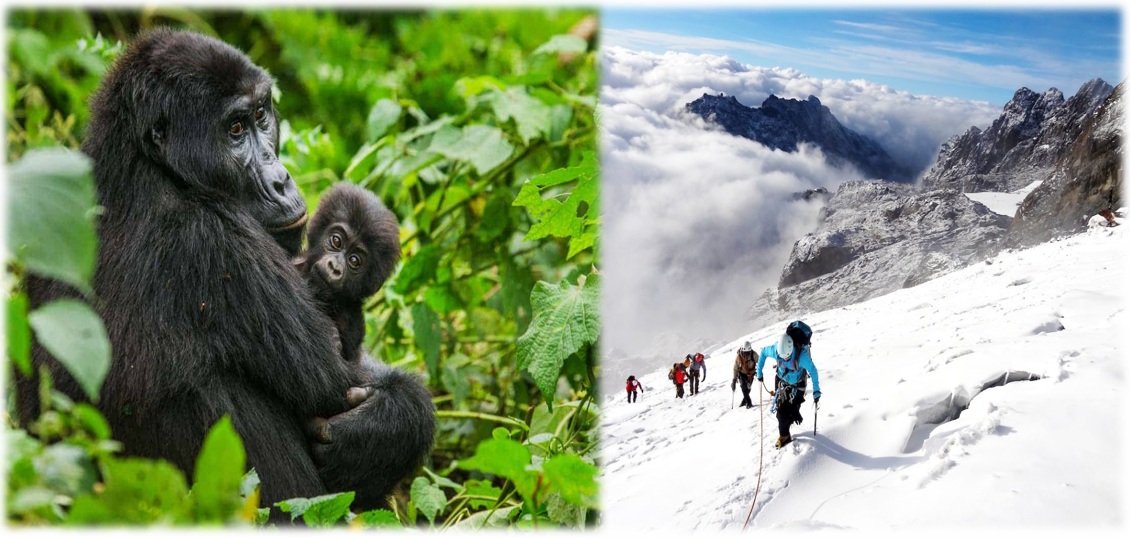
Prepare for an unforgettable 10 Days gorilla trekking safari and Mountain Rwenzori hike
expedition through Uganda’s most dramatic landscapes, combining the raw physical thrill of alpine mountain climbing with the magic of wild primate encounters. This high-octane journey takes you from the mist-shrouded, snow-capped peaks of Mount Stanley straight into the heart of classic African savannahs and ancient tropical rainforests.
You will conquer Africa’s third-highest mountain, navigate towering bamboo forests, cross glacial valleys, and gaze across the Great Rift Valley. Afterward, unwind with savannah game drives and boat cruises alongside hippos and elephants before venturing deep into Bwindi Impenetrable Forest for a once-in-a-lifetime encounter with endangered mountain gorillas. Demanding exceptional physical fitness and a passion for pure wilderness, this itinerary delivers the ultimate East African safari—offering an unbeatable blend of high-altitude trek, rich biodiversity, and raw, untouched beauty.
Day 1: Entebbe to Kasese & Rwenzori Trek Briefing
Your expedition begins early in Entebbe or Kampala with a scenic six-to-seven-hour drive heading west across Uganda's rolling countryside. As you travel through vibrant market towns like Fort Portal, the dramatic silhouette of the Rwenzori "Mountains of the Moon" begins to dominate the horizon. Upon reaching Kasese at the base of the mountains, you will check into your lodge, meet your professional mountain guides, and undergo a comprehensive safety briefing. Together, you will inspect essential gear—including crampons, harnesses, ice axes, and waterproof layers—to ensure you are fully prepared for the demanding alpine terrain ahead. Spend the rest of the evening relaxing, enjoying a nourishing dinner, and resting up before your high-altitude challenge officially kicks off early the next morning at your foothill lodge.
Day 2: Base Camp to Sine Camp (Montane Forest Zone)
After an early morning breakfast, head to the trailhead to meet your team of local guides and porters. Your trek begins through lush montane forest, climbing steadily alongside roaring mountain rivers like the Nyamwamba. Keep your eyes open for black-and-white colobus monkeys, colorful turacos, and unique bird species endemic to the Albertine Rift. The trail gradually steepens as you cover roughly nine kilometers over five to six hours, gaining altitude through thick bamboo thickets and moss-draped evergreen trees. Reach Sine Camp at approximately 2,596 meters in the late afternoon. Here, surrounded by towering trees and a chilling mountain breeze, you will settle into rustic wooden huts, enjoy a hot meal, and rest your legs for the higher elevations ahead.
Day 3: Sine Camp to Mutinda Camp (Heather & Alpine Zone)
Wake up early to crisp mountain air and continue your ascent through the giant heather zone. The vegetation shifts dramatically as trees give way to otherworldly giant lobelias, groundsels, and thick carpets of colorful sphagnum moss across high-altitude bogs. You will navigate wooden boardwalks designed to help cross muddy patches while soaking in stunning vistas of deep valleys below. The trek covers about six kilometers over four to five hours of steep climbing to reach Mutinda Camp at 3,588 meters. After arriving, you can take an optional afternoon hike up Mutinda Lookout Peak at 3,925 meters for breathtaking panoramic views and critical high-altitude acclimatization. Return to camp for dinner, warm tea, and an early sleep under a star-filled alpine sky.
Day 4: Mutinda Camp to Elena Camp (Glacial High Camp)
Today’s trek transitions into the rugged high-alpine moorland and rocky terrain. You will navigate around stunning glacial lakes framed by towering granite cliffs and hanging glaciers. As you push above 4,000 meters, the air thins noticeably and vegetation turns sparse. The trail involves climbing steep, rocky ladders and negotiating boulder fields for roughly five to seven hours. Arrive at Elena Camp, perched dramatically on a cold, exposed rocky ridge at 4,541 meters. Your guides will conduct a mandatory equipment check and review safety protocols for using ropes, crampons, and ice axes on the glacier tomorrow. Eat a high-energy dinner early and retreat to your sleeping bag for a short, cold night of rest before summit day.
Day 5: Summit Margherita Peak (5,109m) & Descend to Base
Your summit push begins in pitch darkness around 2:00 AM. Equipped with headlamps, you will traverse steep granite slabs to reach the Stanley Glacier, then strap on crampons and rope up to cross crevasses and ascend the icy slope leading to Margherita Peak—Africa’s third-highest summit at 5,109 meters. Standing atop the glacier as the sun rises over Uganda and the Democratic Republic of Congo is an unforgettable reward. After capturing summit photos, begin a careful descent back down through Elena Camp, continuing past high-alpine huts all the way down to the base camp near Kilembe. This grueling ten-to-twelve-hour day tests your endurance, but concludes with hot showers, comfortable beds, and celebratory drinks back at your foothill lodge in Kasese.
Day 6: Rwenzori Foothills to Queen Elizabeth National Park
Enjoy a well-deserved lie-in and a relaxed breakfast while handing back rented mountaineering equipment. Mid-morning, embark on a short, scenic two-hour drive south towards Queen Elizabeth National Park, Uganda’s premier savannah destination. As you descend from the cloud-wrapped mountains, the scenery changes dramatically into sweeping golden grass plains dotted with acacia trees and crater lakes. Check into your lodge overlooking the park or the Kazinga Channel in time for a warm lunch. Spend the afternoon unwinding, massaging sore muscles, and soaking in pool views while watching warthogs, waterbucks, and elephants roam near the lodge grounds. Relax with a cold drink as sunset casts deep crimson hues across the Rift Valley landscape before enjoying dinner at your safari lodge.
Day 7: Game Drive & Kazinga Channel Boat Safari
Set off on an early morning three-hour game drive across the Kasenyi Plains around 6:30 AM, when predators are most active. Guided by an expert tracker, search for lions, leopards, spotted hyenas, Ugandan kobs, and large herds of buffalos. After lunch, take a thrilling two-hour boat cruise along the Kazinga Channel, a natural 32-kilometer waterway connecting Lake George and Lake Edward. This channel boasts one of the world's highest concentrations of hippos, alongside massive Nile crocodiles and hundreds of forest and water bird species. Elephants and buffalos frequently cool off along the water’s edge, providing spectacular photo opportunities from the boat before you return to your lodge for dinner and starlit relaxation.
Day 8: Tree-Climbing Lions of Ishasha to Bwindi Forest
After breakfast, depart Queen Elizabeth National Park and drive south through the Ishasha Sector. Ishasha is famous worldwide for its unique population of tree-climbing lions, which often lounge high in the branches of giant fig trees to escape insects and catch cool breezes. Spend a couple of hours scanning the branches for these majestic big cats alongside topi antelopes and elephants. Continue your five-to-six-hour total journey winding upward into the misty, forested hills of Bwindi Impenetrable National Park, a UNESCO World Heritage site home to nearly half the world’s remaining mountain gorillas. Arrive at your lodge nestled on the rainforest rim by late afternoon, enjoy a hearty dinner, and rest up for your big gorilla trekking day tomorrow.
Day 9: Gorilla Trekking in Bwindi Impenetrable Forest
After an early breakfast, head to the park headquarters at 7:30 AM for a safety briefing and assignment to a gorilla family. Led by armed park rangers and trackers, venture into the ancient, tangled rainforest. The hike can take anywhere from two to six hours depending on where the gorilla family nested the night before, negotiating muddy slopes and dense vines. Upon locating the family, spend one magical hour observing them from a safe distance of seven meters. Watching giant silverbacks, playful juveniles, and mothers nursing babies is an extraordinarily moving experience. After your hour expires, hike back to the trailhead to collect your trekking certificate before returning to your Bwindi lodge for an evening of celebration.
Day 10: Bwindi to Entebbe & Departure
Enjoy a final breakfast listening to the morning bird song of the ancient rainforest. Begin your return journey back to Entebbe or Kampala, covering approximately 450 kilometers over eight to nine hours. You will cross the equator line at Kayabwe, stopping for memorable photo opportunities, souvenirs, and a hot lunch. Alternatively, you can opt for a short domestic flight from a nearby airstrip directly to Entebbe International Airport to save travel time. Upon arrival in Entebbe in the late afternoon or early evening, transfer directly to Entebbe International Airport for your outbound flight home, marking the end of an extraordinary ten-day Ugandan wilderness expedition.
How physically demanding is the summit climb up Margherita Peak?
Reaching Margherita Peak (5,109 meters) on Mount Stanley is a grueling, highly technical alpine challenge requiring exceptional endurance and mental grit. Unlike simple trekking peaks, the Rwenzoris demand navigating steep rock scrambles, wooden ladders, muddy high-altitude bogs, and vertical granite walls. The final summit push begins around 2:00 AM from Elena Camp (4,541 meters), forcing climbers to negotiate icy granite slabs, crevasses, and slick glaciers while tied into fixed ropes using crampons, harnesses, and ice axes. Pushing through thin air at sub-zero temperatures makes this a severe cardiorespiratory test. A high level of pre-trip physical preparation—such as heavy pack hikes, marathon training, or leg-strength conditioning—is absolute necessity to safely complete the 10-to-12-hour round trip on summit day.
What essential mountaineering gear is required for Mount Stanley’s glacier?
Conquering Mount Stanley’s glaciers requires technical mountaineering hardware alongside heavy-duty cold-weather apparel. Essential safety gear includes sharp crampons suited for soft snow and hard ice, a climbing harness, an ice axe, a protective helmet, and carabiners for roped ascents. Because the Rwenzori range is notoriously wet, multi-layering is critical: high-quality waterproof and windproof hard-shell jackets and trousers, thermal base layers, fleece mid-layers, and heavily insulated, waterproof mountaineering boots are mandatory. Furthermore, thick thermal gloves, UV-blocking glacier sunglasses, gaiters to keep mud and snow out of boots, and a reliable headlamp with spare batteries are crucial. Local outfitters in Kasese lease heavy hardware, but personal fitted apparel should be thoroughly broken in beforehand.
How does high altitude impact trekkers climbing the Rwenzori Mountains?
Climbing above 3,000 meters exposes trekkers to significantly lower atmospheric pressure and reduced oxygen levels, which can trigger Acute Mountain Sickness (AMS). Symptoms like throbbing headaches, nausea, dizziness, fatigue, and loss of appetite are common as you ascend toward Elena Camp and Margherita Peak. If left unmanaged, AMS can escalate into severe, life-threatening conditions like High Altitude Pulmonary Edema (HAPE). To mitigate these risks, the itinerary incorporates gradual altitude gain, allowing body acclimatization through lower camp nights and optional hikes like Mutinda Lookout Peak (3,925m). Staying hydrated, eating calorie-dense meals, maintaining a steady pacing rhythm, and carrying acclimatization medications like Acetazolamide (Diamox) under medical supervision are vital strategies for mountain survival.
What should you expect during a gorilla trek in Bwindi?
Gorilla trekking in Bwindi Impenetrable National Park is an immersive, unpredictable rainforest trek through dense vegetation, steep ravines, and muddy slopes. Guided by armed rangers and expert trackers, you will hack through thick vines and undergrowth to locate a habituated gorilla family. Trekking durations vary dramatically—ranging from 2 to 6 hours depending on where the primates traveled overnight. Once located, you are granted exactly one hour to quietly observe the family from a respectful seven-meter distance. Watching massive silverbacks, attentive mothers, and playful juveniles feed, groom, and interact in their natural habitat is profoundly moving. The terrain can be slick and challenging, making sturdy waterproof boots, gardening gloves, and a local porter extremely helpful.
What makes Queen Elizabeth National Park's Ishasha sector so famous?
The Ishasha Sector, located in the southern region of Queen Elizabeth National Park, is globally renowned for its rare populations of tree-climbing lions. Unlike most lions across Africa that stay firmly on the ground, Ishasha’s lions routinely climb high into the sprawling branches of ancient fig and acacia trees. Wildlife biologists believe they do this to catch cool elevated breezes, avoid irritating biting insects, and maintain a clear, panoramic view of grazing prey across the savannah plains. Visitors exploring Ishasha on game drives can spot these majestic big cats lounging lazily on thick tree limbs alongside herds of topi antelopes, Ugandan kobs, and savannah elephants, making it a unique safari stopover between the Rwenzori mountains and Bwindi.
Transitioning from the freezing, thin-air glaciers of the Rwenzori Mountains to the warm, humid, and oxygen-dense rainforests of Bwindi tests your body's physical adaptability. In just a few days, your body drops from sub-zero temperatures at 5,100 meters to muggy tropical heat, causing rapid metabolic shifts and muscle fatigue. Muscle soreness from the mountain descent—often called "delayed onset muscle soreness" (DOMS)—can make negotiating Bwindi's steep, muddy jungle ravines particularly grueling on weary knees and legs. The key to managing this rapid transition lies in taking full advantage of the intermediate safari days in Queen Elizabeth National Park, focusing on aggressive muscle recovery, proper hydration, gentle walking, balanced nutrition, and adequate sleep before tackling the gorilla trek.
What weather conditions should travelers prepare for on this expedition?
This combination itinerary spans microclimates ranging from tropical savannahs and damp rainforests to icy alpine peaks. The Rwenzoris are famous for unpredictable, wet weather, experiencing heavy rainfall, thick fog, freezing winds, and snow near the summit year-round. Bwindi Impenetrable Forest is similarly wet, characterized by high humidity, sudden tropical downpours, and slick, muddy paths even during drier months. Meanwhile, Queen Elizabeth National Park features dry, hot savannah sun with warm breezes and daytime temperatures reaching up to 28°C (82°F). Travelers must pack for extreme weather swings—ranging from lightweight, breathable summer gear for safari game drives to heavy waterproofs, thermal fleece, down jackets, and insulated gloves for the mountain summit.
What permits and paperwork are required for this Uganda safari?
Executing this multi-adventure safari requires several official permits and documents arranged well in advance. The most critical is the official gorilla trekking permit issued by the Uganda Wildlife Authority (UWA), which grants access to Bwindi's gorillas for one hour and must be secured months prior due to strict daily visitor caps. You also require Rwenzori mountaineering permits covering mountain park entrance, guide fees, porter support, and hut accommodations along the trail. Furthermore, entry into Queen Elizabeth National Park requires standard park conservation fees. International travelers must hold a valid passport (with at least six months validity), an online Yellow Fever vaccination certificate, and an approved Ugandan E-Visa or East Africa Tourist Visa before arriving in Entebbe.
Why is hiring a porter recommended for both major treks?
Hiring local porters for both the Rwenzori mountain climb and the Bwindi gorilla trek is strongly recommended for physical relief and local economic impact. On Mount Stanley, porters carry heavy duffel bags containing cold-weather gear, tents, cookware, and food supplies, allowing you to hike with only a light daypack containing water, rain gear, and personal items. In Bwindi’s dense rainforest, porters navigate slick, muddy ravines while carrying your camera equipment and daypack, providing a steadying hand over precarious terrain. Beyond reducing physical strain and injury risks, hiring porters directly supports local communities bordering the national parks, providing sustainable employment that incentivizes wildlife conservation over poaching and deforestation.
What wildlife species might you spot across these three parks?
Combining these three distinct ecosystems yields an extraordinary cross-section of East African biodiversity. In the high-altitude forests and bamboo zones of the Rwenzoris, you may spot rare Albertine Rift endemic birds, black-and-white colobus monkeys, and three-horned chameleons. Descending into Queen Elizabeth National Park's savannahs and the Kazinga Channel, you will see tree-climbing lions, leopards, African bush elephants, massive herds of buffalos, hippos, Nile crocodiles, waterbucks, and giant forest hogs. Finally, entering the ancient tropical rainforest of Bwindi brings you face-to-face with endangered mountain gorillas, L'Hoest's monkeys, chimpanzees, forest elephants, and over 350 vibrant bird species, creating a comprehensive cross-section of Uganda’s world-class natural heritage.
Booking 10 Days gorilla trekking safari and Mountain Rwenzori hike with us Roads of Adventure safaris
Booking your 10-day gorilla trekking and Rwenzori climbing safari with Roads of Adventure Safaris is smooth and straightforward. First, contact our local team in Kampala with your preferred travel dates. Because mountain gorilla permits in Bwindi Impenetrable National Park are strictly limited, we immediately check live availability with the Uganda Wildlife Authority and secure your permits alongside your Rwenzori trekking passes. Once your initial deposit is confirmed, our safari specialists tailor every detail to match your fitness level and budget—from specialized mountain gear and private 4x4 Land Cruisers to expert alpine guides—ensuring your dream peak-to-primate expedition is fully locked in and stress-free.
