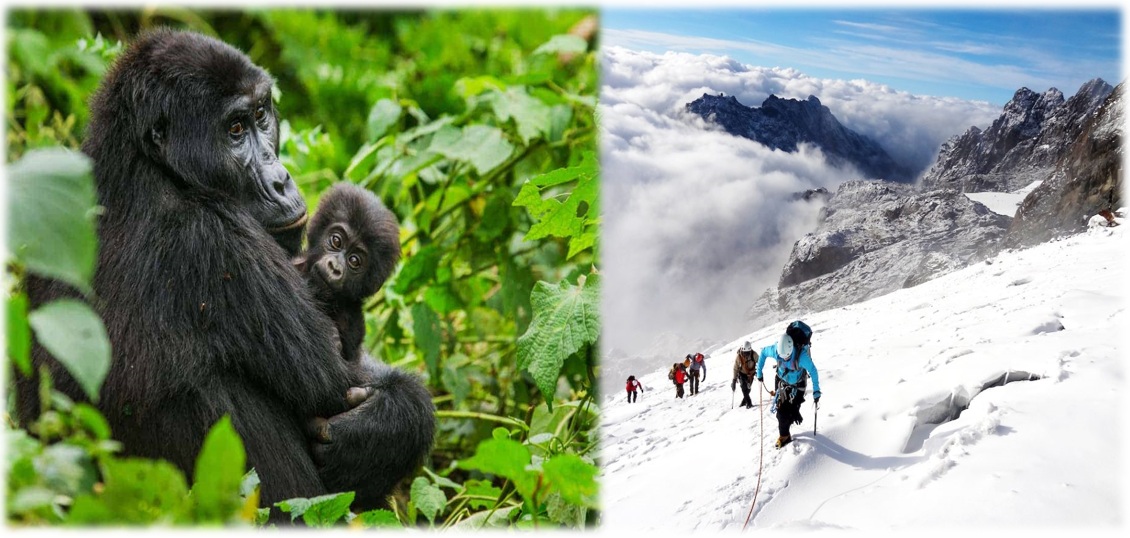
This 10-day Uganda expedition combines three of the country’s most unforgettable wilderness experiences: chimpanzee trekking in Kibale Forest, a multi-day hike in the Rwenzori Mountains (“Mountains of the Moon”), and mountain gorilla trekking in Bwindi Impenetrable National Park. You’ll start in Entebbe, transfer to Kibale, and spend time with chimpanzees while also learning how other forest animals survive in this lush ecosystem. Then you’ll move to the Rwenzori region and complete the central circuit, day by day, through forest, moorland, wetlands, and high alpine scenery. Finally, you’ll travel to Bwindi for gorilla tracking, guided by professional rangers as you search for a gorilla family. The itinerary is paced to help you enjoy both nature and comfort at the end of each day.
Day 1: Arrival & Transfer to Kibale
Arrive at Entebbe International Airport. After immigration and brief orientation, you will head toward Kibale National Park, the gateway to Kanyanchu. Depending on your schedule, transfers may include an early drive in a 4x4 vehicle or a domestic flight to the western route, followed by road transfer to the park area. By late afternoon, you will settle into a forest lodge near the Kibale boundary, close enough to start your trekking early the next day. The evening is kept relaxed so you can rest, hydrate, and prepare for a forest morning. Your guide will also go through key chimpanzee trekking guidelines, including how to stay with the group and how to behave around primates. Dinner is served at the lodge, with opportunities to share questions and plan for the next steps.
Day 2: Chimpanzee Tracking & Bigodi Wetland
In the morning, you begin chimpanzee trekking in Kibale National Park. After receiving a briefing from rangers, you follow forest tracks through dense vegetation, listening for chimpanzees before you eventually locate their feeding area. Once you meet the group, you will spend time observing them as they move, feed, and interact. The experience is guided, with rangers helping you keep safe distances and understand what you’re seeing. In the afternoon, you visit Bigodi Wetland Sanctuary for a guided walk. Bigodi is known for its primates, birds, and small wildlife, making it a good complement to the chimpanzee morning. Expect to spot species such as vervet monkeys and a variety of birds, while learning about wetland conservation. You return to your lodge for dinner and a calm overnight.
Day 3: Journey to Rwenzori Mountains
After breakfast, you depart Kibale and travel toward the Rwenzori region. Your route takes you across western Uganda to the Rwenzori Mountaineering Services (RMS) headquarters in Nyakalengijja, near Kasese (approximately 1,615 m). On arrival, you meet the RMS team for trek arrangements. If you need trekking gear, you can arrange rental items through RMS at this point, such as walking poles, extra warm layers, or rain protection. You also confirm your porters and briefing details, and review what to expect during the central circuit. Afternoon time is for rest, light movement, and preparing your daypacks with essentials like a rain jacket, gloves, a headlamp, and water treatment. This is also the moment to double-check your documents, trek clothing, and warm layers, since the Rwenzori weather changes quickly. Dinner and overnight are arranged near the RMS staging area.
Day 4: Nyakalengijja to Nyabitaba Hut
Today begins your central circuit ascent. Starting from Nyakalengijja, you hike through montane forest along the Mubuku River toward Nyabitaba Hut, at about 2,651 m. The walking time is typically around 5–6 hours, depending on the pace of the group and weather conditions. Early in the trek, the environment is cooler and greener, with thick vegetation and signs of wildlife. You may hear birds and other forest animals as you move uphill. Along the route, guides often share information about Rwenzori plant life and how ecosystems change with altitude. The climb is steady rather than rushed, so you can conserve energy and adjust to cooler air. By afternoon you reach Nyabitaba Hut, where you can rest, hydrate, and enjoy a simple meal. After dinner, your team prepares for the higher sections of the circuit ahead.
Day 5: Nyabitaba to John Matte Hut
This day continues your climb from Nyabitaba Hut (around 2,651 m) toward John Matte Hut at approximately 3,505 m. The trek usually takes about 6 hours. As you ascend, the forest gives way to moorland and giant heather zones, with wetter ground and sections that may feel muddy after rain. You cross the Bujuku River and continue up the trail, while your guide watches for route markers and provides advice on safe footing. During the hike, you can also look out for changing landscapes, including distant views toward the Portal Peaks when the sky clears. Expect a slower pace on the wetter stretches, with breaks for snacks and water. Arriving at John Matte Hut, you’ll settle in, warm up, and review the plan for the next day’s higher glacial valley approach. Dinner is served at the hut or nearby camp facilities managed by the trek team.
Day 6: John Matte to Bujuku Hut
Today’s hike takes you higher into the upper regions of the Rwenzori, from John Matte Hut (about 3,505 m) to Bujuku Hut at roughly 3,962 m. The walking time is commonly 5–6 hours. The terrain becomes more alpine as you pass through boggy sections and areas dominated by giant lobelia and groundsel plants. These landscapes are distinct from the lower forest zones and may look surreal under mist, with bright flowering patches and narrow paths. You may also notice how the air feels thinner as altitude increases. Because weather can shift quickly, you’ll likely spend time adjusting layers for warm sun or cooler wind. When you arrive at Bujuku Hut, located in a glacial valley setting, you’ll have a better view of the surrounding highland terrain. You rest well tonight, since tomorrow includes a continued push toward higher passes and lake views.
Day 7: Bujuku to Kitandara Hut
After breakfast, you continue from Bujuku Hut (around 3,962 m) toward Kitandara Hut at approximately 4,023 m. The day typically takes 4–5 hours. Your route includes the ascent to Scott Elliot Pass at about 4,372 m. As you climb, the landscape opens up, and the trail can be exposed, so warm layers and rain protection are important. On clear days, you’ll be able to see prominent peaks in the distance, including views associated with Mt. Stanley and Mt. Speke. Once you cross the pass, the trek becomes more scenic as you descend toward the Kitandara Lakes area. The lakes and surrounding terrain provide a calmer contrast to the pass crossing. Reaching Kitandara Hut, you rest and take time to recover—hydration, stretching, and a warm drink help. The evening is a good moment for photos and for discussing what to expect on the long descent that follows.
Day 8: Kitandara to Nyabitaba & Descent to Nyakalengijja
Today is a longer day with a steep, careful descent. You begin around Kitandara Lakes and hike back toward Nyabitaba Hut, then continue downhill to Nyakalengijja to meet your transport. The total walking time is often 7–8 hours, depending on conditions and pacing. Along the descent you may pass Fresh Field Pass and follow switchbacks through changing vegetation zones. When the trail is wet, take shorter steps and keep your eyes on the ground. The altitude drop is gradual, and you may feel tired due to the long hours and downhill strain. Your guide and porters help maintain a safe rhythm with rest points along the way. When you reach Nyabitaba Hut, you’ll take a brief break before continuing the descent to Nyakalengijja. In the late afternoon or evening, you meet transport back to the staging area or onward route. Dinner and overnight are arranged for recovery after the trek.
Day 9: Transfer to Bwindi Impenetrable Forest
After breakfast, you travel from the Rwenzori region to Bwindi Impenetrable National Park. This road journey generally takes about 6–7 hours depending on the sector and traffic, and it may include stops for rest and refreshments. As you move toward Bwindi, the landscape changes again—hills, villages, and increasingly forested scenery signal that you are approaching gorilla country. Once you arrive at the Bwindi area, you check in, rest, and prepare for the gorilla trekking activity scheduled for the next day. The team will guide you through important instructions for trekking, including how to move silently, maintain safe distances, and follow rangers when searching for a gorilla family. Evening is mostly about recovery: hydrating, keeping warm, and organizing daypacks with essentials like rain gear and extra water. You sleep in a lodge near the park, ready for an early start.
Day 10 :Gorilla Trekking & Departure
Begin the day early for mountain gorilla trekking in Bwindi Impenetrable National Park. After a briefing and group allocation, you enter the forest with experienced rangers who guide the search for a gorilla family. The terrain can be uneven, so the trek requires patience and steady walking as you move through dense vegetation. Once you locate the gorillas, you will have one hour with the family to observe their behavior and movements in their natural environment. This hour is guided—rangers may adjust positions to help keep everyone safe and ensure respectful viewing. After your time with the gorillas, you exit the forest and begin your transfer onward for your next plans. Depending on your itinerary, this can mean travel back to Entebbe or continuing within western Uganda. The day ends with memories of real, close wildlife encounters and the satisfaction of completing both the forest and mountain chapters of your journey.
How difficult is the chimpanzee trekking experience in Kibale?
Chimpanzee trekking in Kibale National Park is generally considered moderate in difficulty. Unlike the steep, vertical ascents of Bwindi or the high-altitude demands of the Rwenzori Mountains, Kibale features relatively flat, gently undulating terrain at an elevation between 1,100 m and 1,590 m above sea level. However, "moderate" doesn't mean a simple walk in the park. The forest floor is thick with dense underbrush, slippery tree roots, and tangled vines.
You will likely walk off-trail for 2 to 5 hours, covering distances between 5 km and 12 km depending on where the habituated chimpanzee troops nested the night before. Because primates move quickly through the canopy, your UWA (Uganda Wildlife Authority) guide may need to pick up the pace when troops move along the ground, requiring a brief jog through humid forest conditions. Humidity routinely reaches 80% to 90%, with temperatures around 27°C. Wearing sturdy, waterproof hiking boots with ankle support, long moisture-wicking trousers, and tucked-in socks (to deter safari ants), alongside carrying at least 2 liters of drinking water, will ensure you navigate the terrain comfortably.
What essential gear should you pack for Rwenzori hiking?
Trekking the Rwenzori Mountains requires gear built for rapidly changing tropical-alpine environments, where temperatures plunge from 20°C at Nyakalengijja (1,615 m) to below freezing at high camps like Kitandara (4,023 m).
- Footwear: Broken-in waterproof hiking boots with deep tread are essential. Pair them with gaiters and heavy-duty rubber rain boots (wellies), which are indispensable for wading through the deep Bigo Bogs between John Matte Hut (3,505 m) and Bujuku Hut (3,962 m).
- Clothing: Layering is vital. Pack thermal base layers, a warm fleece mid-layer, and a 100% waterproof Gore-Tex outer jacket and rain trousers to withstand sudden downpours.
- Sleeping & Carrying: A sleeping bag rated down to -10°C is required for unheated alpine huts. You'll also need a 30–40 L daypack with a rain cover, trekking poles to ease knee strain during steep descents (such as the drop from Scott Elliot Pass at 4,372 m back to Nyabitaba at 2,651 m), headlamps with extra batteries, UV sunglasses, SPF 50 sunscreen, and water purification tablets. Heavy or specialized items can also be rented directly from RMS at Nyakalengijja.
How long does it take to drive to Kibale?
The overland drive from Entebbe International Airport (or Kampala) to Kibale National Park covers approximately 310 km to 350 km, taking between 5 and 7 hours depending on traffic and road conditions. Your journey heads west along the paved Fort Portal highway via Mityana, Mubende, and Kyenjojo.
The initial stretch leaving the Entebbe–Kampala urban zone often encounters morning traffic, which can add up to an hour. Once past Mityana, the drive opens into a smooth, scenic route through tea plantations and countryside villages. A popular midpoint stop is Mubende for lunch and stretching your legs. Upon reaching Fort Portal—roughly 300 km from Entebbe—you turn south for the final 35 km paved and marram road connection leading straight to Kibale’s Kanyanchu Visitor Center.
If you prefer to avoid the long drive, domestic flights operated by AeroLink Uganda run daily from Entebbe Airport to Kasese Airstrip (a 75-minute flight), followed by a 1.5-hour 4x4 road transfer directly to your lodge near the forest.
What altitude sickness risks exist during the Rwenzori trek?
Altitude sickness, or Acute Mountain Sickness (AMS), is a genuine factor on the Central Circuit once you cross 2,500 m. The itinerary ascends steadily: Day 4 starts at Nyakalengijja (1,615 m) and reaches Nyabitaba Hut (2,651 m); Day 5 pushes to John Matte Hut (3,505 m); Day 6 reaches Bujuku Hut (3,962 m); and Day 7 summits Scott Elliot Pass at 4,372 m before dropping to Kitandara Hut (4,023 m).
At Scott Elliot Pass, effective oxygen levels drop to roughly 60% of sea-level pressure. Symptoms can include persistent headaches, mild nausea, dizziness, insomnia, and shortness of breath during exertion. To prevent AMS, guides enforce a strict pole pole (slow and steady) hiking pace and require you to drink 3 to 4 liters of water daily. Carrying Diamox (Acetazolamide) under medical advice can significantly assist acclimatization. If severe symptoms of High Altitude Pulmonary or Cerebral Edema develop, immediate descent is mandatory. RMS guides monitor your blood oxygen saturation levels and heart rate using pulse oximeters twice daily at every hut.
How many hours do you spend with Bwindi gorillas?
During a standard gorilla tracking excursion in Bwindi Impenetrable National Park, your direct viewing time with a habituated mountain gorilla family is strictly capped at exactly one hour (60 minutes). Set by the Uganda Wildlife Authority (UWA) and international conservation organizations, this limit minimizes stress on the animals and reduces the risk of human disease transmission to primates who share nearly 98% of our DNA.
However, the total duration of the excursion ranges from 2 to 8 hours. You begin at 7:30 AM with a safety briefing at one of Bwindi’s four tracking sectors (Buhoma, Ruhija, Rushaga, or Nkuringo). Advanced trackers head out at dawn to locate where the gorilla family built their nests the night before. You will then hike between 1 km and 8 km across steep, densely vegetated terrain at elevations ranging from 1,160 m to 2,607 m to reach them. Once your guide spots the family, the one-hour timer begins.
(Note: Travelers looking for extended encounters can book a Gorilla Habituation Experience in Rushaga, which grants up to 4 hours with a semi-habituated family).
What makes the Bigodi Wetland Sanctuary walk so special?
Located just 6 km outside Kibale National Park, the Bigodi Wetland Sanctuary walk is a community-managed conservation initiative run by the Kibale Association for Rural and Environmental Development (KAFRED). The 4.5 km boardwalk and dirt trail loop takes roughly 2.5 to 3 hours to explore, offering a vibrant contrast to the deep forest canopy.
What sets Bigodi apart is its rich concentration of biodiversity in a compact swamp ecosystem. It shelters over 200 bird species and is famous as the home of the striking Great Blue Turaco, which is frequently spotted flying between papyrus stands. Additionally, eight distinct primate species inhabit the sanctuary, including red colobus, black-and-white colobus, L'Hoest's monkeys, grey-cheeked mangabeys, vervets, and olive baboons.
Local community guides lead every tour, sharing deep insights into traditional medicinal plants, wetland ecology, and village life. Even better, 100% of the entry fees fund local development—financing clean water projects, building secondary schools, and supporting local women’s artisan cooperatives.
How far is the road transfer from Rwenzori to Bwindi?
The overland transfer from the Rwenzori base at Nyakalengijja (near Kasese) to Bwindi Impenetrable National Park covers between 180 km and 260 km, depending on which sector of Bwindi your lodge is located in. In a 4x4 safari vehicle, travel time generally takes 5 to 7 hours.
- Northern Bwindi (Buhoma Sector): The route covers around 180 km and takes roughly 5 to 6 hours. Traveling south along the Kasese–Ishasha road takes you past Queen Elizabeth National Park, where you might catch sight of famous tree-climbing lions resting in large fig trees.
- Southern Bwindi (Rushaga or Nkuringo Sectors): The distance stretches to 240–260 km over winding mountain roads, requiring closer to 7 hours.
Road conditions transition from smooth asphalt near Kasese to unpaved, winding marram roads as you ascend into the Kigezi Highlands (often called the "Switzerland of Africa"). The dramatic scenery of terraced hillsides, volcanic vistas, and roadside banana farms makes the time pass quickly.
What is the physical fitness level required for Bwindi?
Gorilla trekking in Bwindi Impenetrable National Park demands a moderate-to-high level of physical fitness. The park’s elevation ranges from 1,160 m to 2,607 m above sea level, meaning the air is thinner than at sea level. Unlike established park trails, tracking gorillas involves scrambling up slick 45-degree slopes, crossing muddy ravines, and stepping over tangled root systems while ranger guides clear paths with machetes.
A typical trek covers anywhere from 5 km to 12 km of hiking over a period of 2 to 7 hours. To comfortably complete the trek, you should be able to walk continuously on uneven, slippery terrain for several hours while carrying a 5 kg daypack with water, rain gear, and lunch. Strong ankles, good core balance, and cardiorespiratory endurance are essential.
If you have physical limitations or limited mobility, you can hire a sedan chair ("helicopter stretcher") service, where a team of 8 local porters safely carries you to and from the gorilla family for an additional fee of $300 to $500 USD.
How high is Scott Elliot Pass in the Rwenzori Mountains?
Scott Elliot Pass sits at an elevation of 4,372 meters (14,344 feet) above sea level. It marks the highest point reached along the standard Central Circuit route on Day 7 of your itinerary, connecting the upper Bujuku Valley (3,962 m) to the high-alpine Kitandara Lakes Valley (4,023 m).
Climbing up to the pass from Bujuku Hut involves navigating steep scree slopes, exposed rock ledges, and slippery alpine paths, taking roughly 3 to 4 hours of intense uphill effort. Temperatures at the pass frequently hover around 0°C to 5°C, accompanied by strong winds, heavy mist, or occasional snowfall.
On clear days, Scott Elliot Pass offers stunning vistas of Mount Stanley’s glaciers, Mount Speke (4,890 m), Mount Baker (4,843 m), and the twin Kitandara Lakes far below. Navigating the pass safely requires sturdy ankle-support boots, windproof thermal clothing, waterproof outer layers, and careful footwork—especially during the steep descent down the rocky scree toward Lake Kitandara.
What permit rules apply to gorilla trekking in Bwindi?
Gorilla trekking in Bwindi Impenetrable National Park is governed by strict statutory regulations managed by the Uganda Wildlife Authority (UWA) to protect both visitors and the endangered primates:
- Permit Rates: Every tracker must possess an official permit ahead of time. Rates stand at $800 USD for foreign non-residents, $700 USD for foreign residents, and 300,000 UGX for East African citizens. Permits are strictly limited to 8 visitors per gorilla family per day and must be secured months in advance.
- Age Requirement: Trekkers must be at least 15 years old.
- Health Restrictions: Anyone showing signs of infectious illnesses (such as flu, severe coughing, or diarrhea) will be turned away to protect the gorillas from human diseases.
- Trekking Etiquette: You must maintain a minimum distance of 7 meters (23 feet) from the gorillas at all times. Flash photography, eating, drinking, smoking, or making sudden movements near the troop are strictly prohibited. Masks (surgical or N95) must also be worn during the 1-hour viewing period.
Booking Mountain Rwenzori hike, and primates tracking with us Roads of Adventure safaris
Booking an ultimate safari with Roads of Adventure Safaris is a fantastic way to experience Uganda’s unmatched biodiversity. You can seamlessly combine the strenuous, high-altitude Rwenzori trekking with thrilling primate tracking experiences, like mountain gorillas in Bwindi or chimpanzees in Kibale
